Sharing API Keys with Vendors: The Risks Nobody Talks About

Handing a vendor your API key feels fast until quota vanishes, data leaks, or renewal locks you in. The risks of sharing api keys go beyond one bad actor and touch cost, security, compliance, and recovery time. This guide is for owners, SEO leads, and developers who are asked to paste keys into third party dashboards and want a safer path. You will learn what access a shared key grants, how quota abuse happens, which contract terms reduce damage, how to vet vendors in thirty minutes, which alternatives avoid raw sharing, and what to do if a key is already in vendor hands. The focus is sharing api keys, and each section gives plain checks you can run before you share. Each recommendation below uses plain steps, named roles, and checks you can verify in provider consoles and tool logs. You do not need enterprise software to follow along. A small team with one vault, one log sheet, and one calendar can run the full pattern. Work through sections in order the first time, then reuse individual sections as checklists during reviews and incidents.
Key takeaways
- Full quota use in linked project across one scoped project keeps control clear.
- Issue time boxed keys shows true cost before you scale volume.
- Store secrets in a vault with roles, rotate on schedule, and log every use.
- Test small batches first, then expand after clean results and steady logs.
- What sharing api keys actually grants
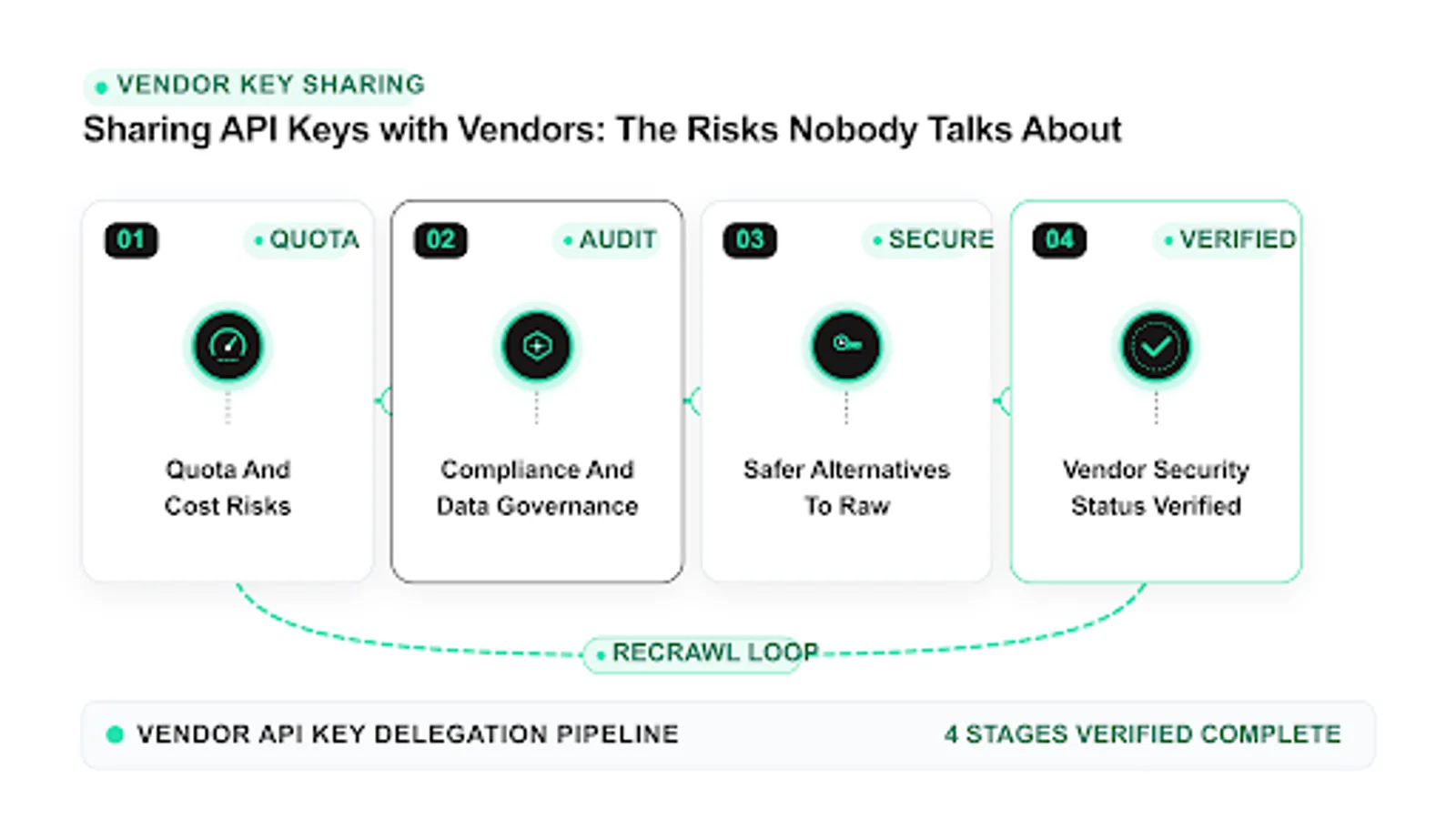
- Quota and cost risks when vendors use your keys
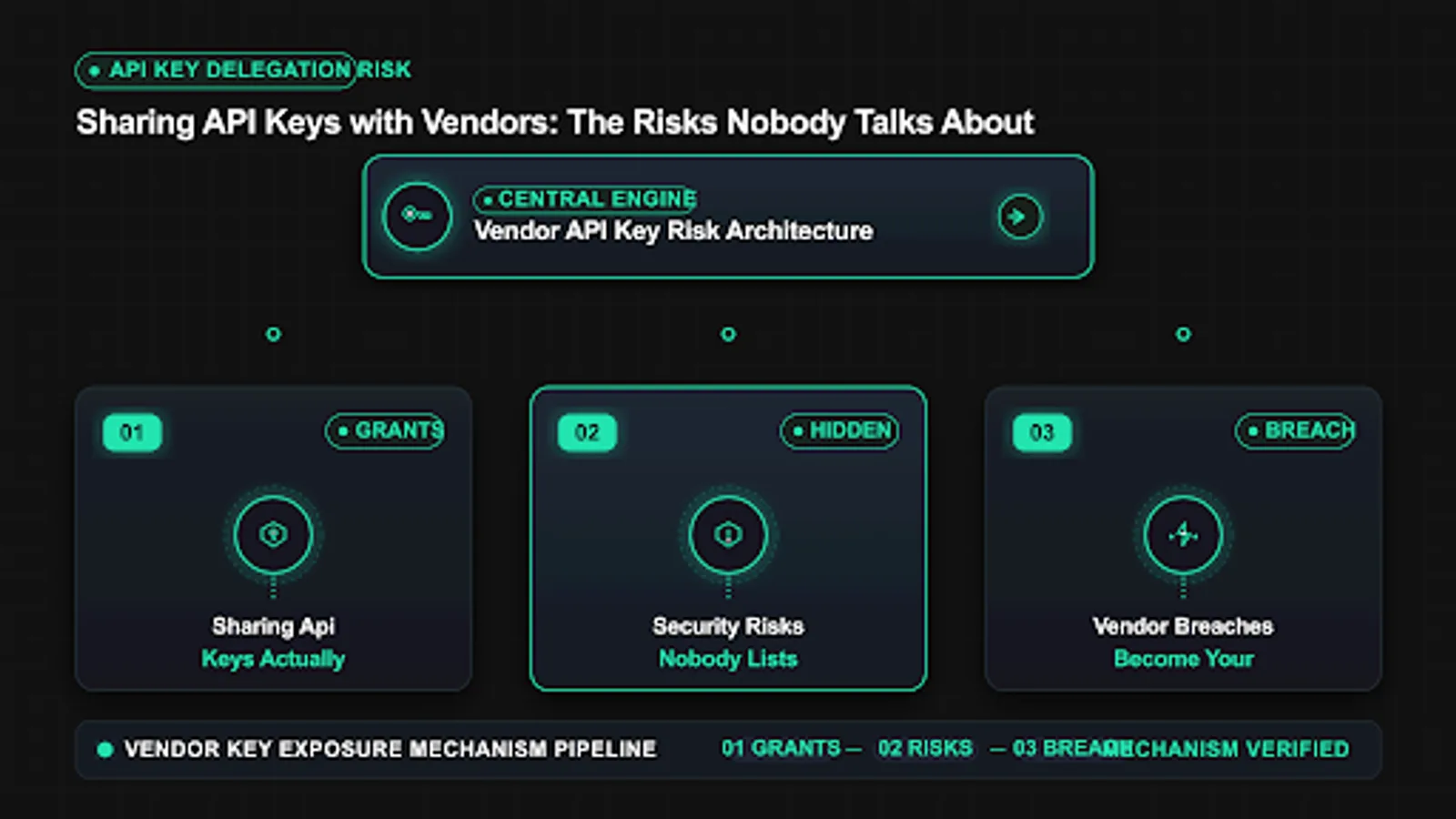
- Security risks nobody lists on pricing pages
- Compliance and data governance problems
- How vendor breaches become your breach
- Safer alternatives to raw key sharing
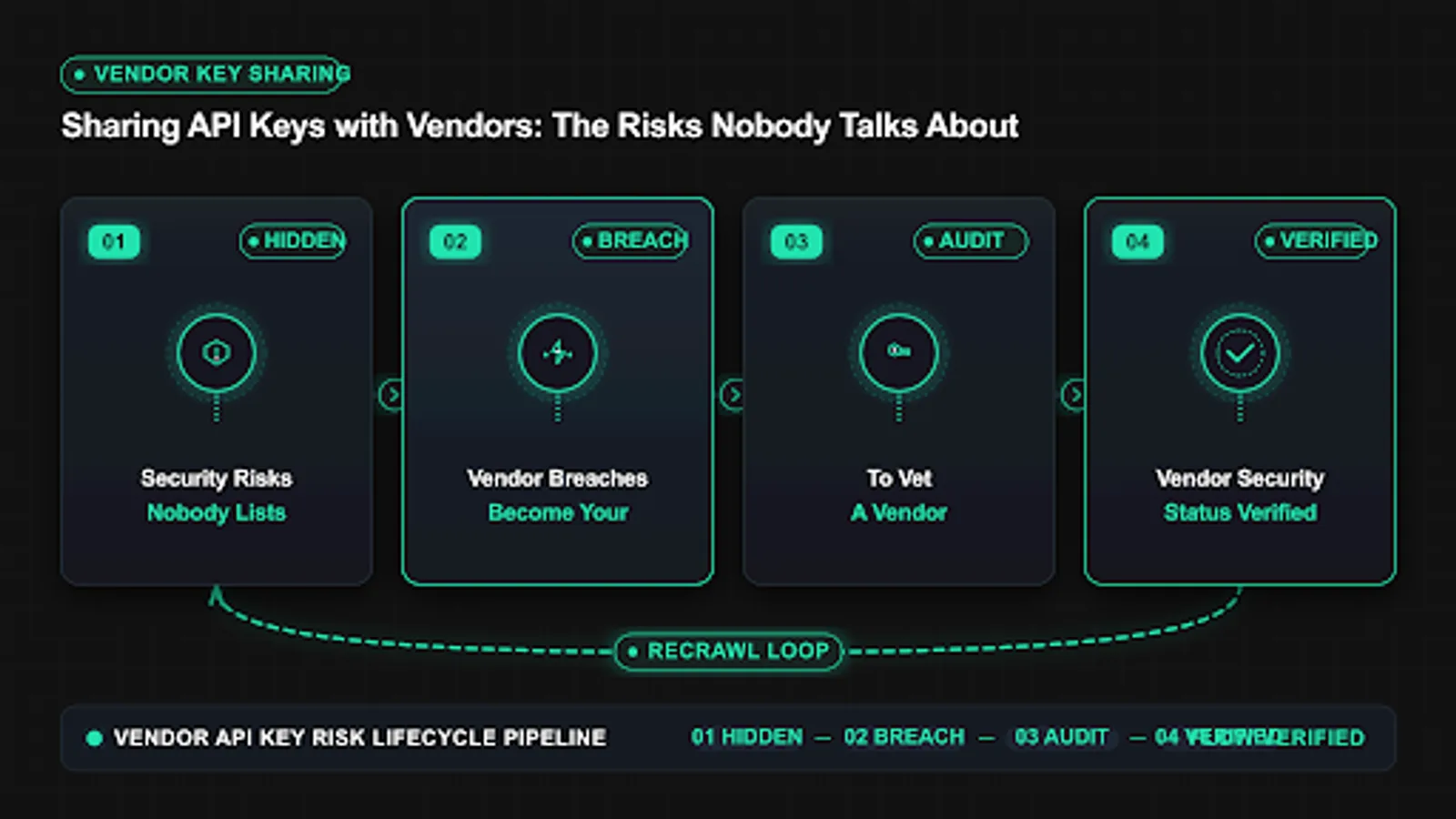
- How to vet a vendor before you share anything
- Contracts and scopes that limit damage
- If you already shared a key and need recovery
- BYOK done right versus key sharing done wrong
- Decision framework for owners
- FAQ
 <!-- IMAGE-PROMPT cover: 1200x630, DependsIt brand, deep charcoal #121212 background, vibrant mint #22E3B0 accent glow, thin node-network line art, Clash Display style bold heading space on left, General Sans clean labels, subject: Sharing API Keys with Vendors: The Risks Nobody Talks About, flat vector, high contrast, accessible, no photorealistic faces, no text smaller than 24px, no em dash in rendered text, export PNG then cwebp -q 82 to WEBP -->
What sharing api keys actually grants
What sharing a key actually grants deserves a plain definition before you act, because sharing api keys fails most often from vague ownership rather than hard technology. In this workflow you are the customer of the provider and the user of the tool, which means two dashboards matter: the provider console where quota and keys live, and the tool dashboard where jobs run. Start by naming the exact outcome you want, such as daily URL submissions under your own quota or predictable spend per project. Write that outcome in one sentence in your runbook. When everyone agrees on the outcome, later choices about scope, project separation, and logging become straightforward and easy to audit.
- Full quota use in linked project. In the context of sharing api keys, this step protects quota, clarifies ownership, and keeps logs readable for the next review.
- Submission rights where authorized. In the context of sharing api keys, this step protects quota, clarifies ownership, and keeps logs readable for the next review.
- Read of basic project metadata. In the context of sharing api keys, this step protects quota, clarifies ownership, and keeps logs readable for the next review.
- Actions logged under your identity. In the context of sharing api keys, this step protects quota, clarifies ownership, and keeps logs readable for the next review.
- Cost billed to your account. In the context of sharing api keys, this step protects quota, clarifies ownership, and keeps logs readable for the next review.
Why does what sharing a key actually grants matter for teams running sharing api keys every week? Because small errors compound at scale. A key with too broad a role can touch projects it should never see. A missing log row turns a simple 403 into a day of guessing. A test job pointed at production can burn a full day of quota before lunch. Owners feel this as delayed launches and surprise costs. Developers feel it as noisy alerts and late fixes. A clear pattern for what sharing a key actually grants removes that friction. You get faster reviews, calmer incidents, and numbers you can explain to clients without hedging.
To apply what sharing a key actually grants in your sharing api keys workflow, follow a short repeatable loop. First, inventory the current state: which keys exist, where each one is stored, which scopes each one grants, and which jobs use it. Second, narrow scope to the minimum that still completes the job, using separate projects for production and testing. Third, move secrets into a vault with role based access and inject them at runtime instead of copying files. Fourth, run a small batch of five to ten real tasks and confirm response codes, log rows, and cost. Fifth, document the result with dates and owners so the next person does not start from zero.
A common mistake with what sharing a key actually grants is treating it as a one time setup instead of a living control. Teams paste a key once, forget where copies live, and only revisit the topic after an auth failure or quota alert. The fix is a light routine: review scopes quarterly, confirm rotation dates on a shared calendar, check logs weekly at first then monthly, and test recovery steps before you need them. If you run sharing api keys across client sites, add per client notes so one incident never spreads across accounts. This steady rhythm takes less than an hour a month and prevents most urgent fixes.
Before you give vendor api key access, confirm exactly which endpoints and quota the vendor needs. Every api key risk grows when one broad key opens many projects with no expiry, so scope tightly and set a review date.
Quota and cost risks when vendors use your keys
Quota and cost risks when vendors use your keys deserves a plain definition before you act, because sharing api keys fails most often from vague ownership rather than hard technology. In this workflow you are the customer of the provider and the user of the tool, which means two dashboards matter: the provider console where quota and keys live, and the tool dashboard where jobs run. Start by naming the exact outcome you want, such as daily URL submissions under your own quota or predictable spend per project. Write that outcome in one sentence in your runbook. When everyone agrees on the outcome, later choices about scope, project separation, and logging become straightforward and easy to audit.
- Runaway loops consume daily quota. In the context of sharing api keys, this step protects quota, clarifies ownership, and keeps logs readable for the next review.
- Tests eat prod limits. In the context of sharing api keys, this step protects quota, clarifies ownership, and keeps logs readable for the next review.
- Retries amplify bad configs. In the context of sharing api keys, this step protects quota, clarifies ownership, and keeps logs readable for the next review.
- Billed usage spikes on AI keys. In the context of sharing api keys, this step protects quota, clarifies ownership, and keeps logs readable for the next review.
- No refund for misuse. In the context of sharing api keys, this step protects quota, clarifies ownership, and keeps logs readable for the next review.
Why does quota and cost risks when vendors use your keys matter for teams running sharing api keys every week? Because small errors compound at scale. A key with too broad a role can touch projects it should never see. A missing log row turns a simple 403 into a day of guessing. A test job pointed at production can burn a full day of quota before lunch. Owners feel this as delayed launches and surprise costs. Developers feel it as noisy alerts and late fixes. A clear pattern for quota and cost risks when vendors use your keys removes that friction. You get faster reviews, calmer incidents, and numbers you can explain to clients without hedging.
To apply quota and cost risks when vendors use your keys in your sharing api keys workflow, follow a short repeatable loop. First, inventory the current state: which keys exist, where each one is stored, which scopes each one grants, and which jobs use it. Second, narrow scope to the minimum that still completes the job, using separate projects for production and testing. Third, move secrets into a vault with role based access and inject them at runtime instead of copying files. Fourth, run a small batch of five to ten real tasks and confirm response codes, log rows, and cost. Fifth, document the result with dates and owners so the next person does not start from zero.
A common mistake with quota and cost risks when vendors use your keys is treating it as a one time setup instead of a living control. Teams paste a key once, forget where copies live, and only revisit the topic after an auth failure or quota alert. The fix is a light routine: review scopes quarterly, confirm rotation dates on a shared calendar, check logs weekly at first then monthly, and test recovery steps before you need them. If you run sharing api keys across client sites, add per client notes so one incident never spreads across accounts. This steady rhythm takes less than an hour a month and prevents most urgent fixes.
| Check | What good looks like for sharing api keys |
|---|---|
| Scope | Least privilege on one project, test separated from prod |
| Storage | Vault with roles and MFA, no raw files in chat |
| Logging | Key fingerprint, time in UTC, code, and cost per call |
| Recovery | Overlap window, rollback version, owner on call |
Use this table during reviews. If any row is unclear for quota and cost risks when vendors use your keys, pause and fix that row before scaling volume. Clear rows now mean fewer incidents later, and each row maps directly to a line in your runbook.
Formal vendor credential sharing should use vault to vault transfer with roles, not email or chat. Treat third party api access like temporary contractor access with least privilege, caps, and time limits.
Security risks nobody lists on pricing pages
Security risks nobody lists on pricing pages deserves a plain definition before you act, because sharing api keys fails most often from vague ownership rather than hard technology. In this workflow you are the customer of the provider and the user of the tool, which means two dashboards matter: the provider console where quota and keys live, and the tool dashboard where jobs run. Start by naming the exact outcome you want, such as daily URL submissions under your own quota or predictable spend per project. Write that outcome in one sentence in your runbook. When everyone agrees on the outcome, later choices about scope, project separation, and logging become straightforward and easy to audit.
- Keys stored in vendor database. In the context of sharing api keys, this step protects quota, clarifies ownership, and keeps logs readable for the next review.
- Broad staff access at vendor. In the context of sharing api keys, this step protects quota, clarifies ownership, and keeps logs readable for the next review.
- Logs kept beyond contract. In the context of sharing api keys, this step protects quota, clarifies ownership, and keeps logs readable for the next review.
- Keys copied to backups. In the context of sharing api keys, this step protects quota, clarifies ownership, and keeps logs readable for the next review.
- No proof of deletion. In the context of sharing api keys, this step protects quota, clarifies ownership, and keeps logs readable for the next review.
Why does security risks nobody lists on pricing pages matter for teams running sharing api keys every week? Because small errors compound at scale. A key with too broad a role can touch projects it should never see. A missing log row turns a simple 403 into a day of guessing. A test job pointed at production can burn a full day of quota before lunch. Owners feel this as delayed launches and surprise costs. Developers feel it as noisy alerts and late fixes. A clear pattern for security risks nobody lists on pricing pages removes that friction. You get faster reviews, calmer incidents, and numbers you can explain to clients without hedging.
To apply security risks nobody lists on pricing pages in your sharing api keys workflow, follow a short repeatable loop. First, inventory the current state: which keys exist, where each one is stored, which scopes each one grants, and which jobs use it. Second, narrow scope to the minimum that still completes the job, using separate projects for production and testing. Third, move secrets into a vault with role based access and inject them at runtime instead of copying files. Fourth, run a small batch of five to ten real tasks and confirm response codes, log rows, and cost. Fifth, document the result with dates and owners so the next person does not start from zero.
A common mistake with security risks nobody lists on pricing pages is treating it as a one time setup instead of a living control. Teams paste a key once, forget where copies live, and only revisit the topic after an auth failure or quota alert. The fix is a light routine: review scopes quarterly, confirm rotation dates on a shared calendar, check logs weekly at first then monthly, and test recovery steps before you need them. If you run sharing api keys across client sites, add per client notes so one incident never spreads across accounts. This steady rhythm takes less than an hour a month and prevents most urgent fixes.
 <!-- IMAGE-PROMPT diagram-01: 1600px max, DependsIt brand mint #22E3B0 on charcoal #121212, node-network line art, Clash Display style headings, General Sans clean labels, subject: Security risks nobody lists on pricing pages diagram for sharing api keys, flat vector, accessible, high contrast, no em dash -->
  <!-- IMAGE-PROMPT diagram-02: 1600px max, DependsIt brand, subject: lifecycle loop with 4 stages and return arrow about Quota and cost risks when vendors use your keys | Compliance and data governance problem, flat vector, accessible, no em dash -->
An api key exposure often starts with a pasted snippet in a ticket or a committed test file. Many vendor trust risks come from unclear storage, shared staff access, and long backups, so ask for specifics before approval.
Compliance and data governance problems
Compliance and data governance problems deserves a plain definition before you act, because sharing api keys fails most often from vague ownership rather than hard technology. In this workflow you are the customer of the provider and the user of the tool, which means two dashboards matter: the provider console where quota and keys live, and the tool dashboard where jobs run. Start by naming the exact outcome you want, such as daily URL submissions under your own quota or predictable spend per project. Write that outcome in one sentence in your runbook. When everyone agrees on the outcome, later choices about scope, project separation, and logging become straightforward and easy to audit.
- Unclear data processor role. In the context of sharing api keys, this step protects quota, clarifies ownership, and keeps logs readable for the next review.
- Missing retention limits. In the context of sharing api keys, this step protects quota, clarifies ownership, and keeps logs readable for the next review.
- Cross border storage questions. In the context of sharing api keys, this step protects quota, clarifies ownership, and keeps logs readable for the next review.
- No audit right in terms. In the context of sharing api keys, this step protects quota, clarifies ownership, and keeps logs readable for the next review.
- Client approvals blocked. In the context of sharing api keys, this step protects quota, clarifies ownership, and keeps logs readable for the next review.
Why does compliance and data governance problems matter for teams running sharing api keys every week? Because small errors compound at scale. A key with too broad a role can touch projects it should never see. A missing log row turns a simple 403 into a day of guessing. A test job pointed at production can burn a full day of quota before lunch. Owners feel this as delayed launches and surprise costs. Developers feel it as noisy alerts and late fixes. A clear pattern for compliance and data governance problems removes that friction. You get faster reviews, calmer incidents, and numbers you can explain to clients without hedging.
To apply compliance and data governance problems in your sharing api keys workflow, follow a short repeatable loop. First, inventory the current state: which keys exist, where each one is stored, which scopes each one grants, and which jobs use it. Second, narrow scope to the minimum that still completes the job, using separate projects for production and testing. Third, move secrets into a vault with role based access and inject them at runtime instead of copying files. Fourth, run a small batch of five to ten real tasks and confirm response codes, log rows, and cost. Fifth, document the result with dates and owners so the next person does not start from zero.
A common mistake with compliance and data governance problems is treating it as a one time setup instead of a living control. Teams paste a key once, forget where copies live, and only revisit the topic after an auth failure or quota alert. The fix is a light routine: review scopes quarterly, confirm rotation dates on a shared calendar, check logs weekly at first then monthly, and test recovery steps before you need them. If you run sharing api keys across client sites, add per client notes so one incident never spreads across accounts. This steady rhythm takes less than an hour a month and prevents most urgent fixes.
How vendor breaches become your breach
How vendor breaches become your breach deserves a plain definition before you act, because sharing api keys fails most often from vague ownership rather than hard technology. In this workflow you are the customer of the provider and the user of the tool, which means two dashboards matter: the provider console where quota and keys live, and the tool dashboard where jobs run. Start by naming the exact outcome you want, such as daily URL submissions under your own quota or predictable spend per project. Write that outcome in one sentence in your runbook. When everyone agrees on the outcome, later choices about scope, project separation, and logging become straightforward and easy to audit.
- Vendor repo leak exposes you. In the context of sharing api keys, this step protects quota, clarifies ownership, and keeps logs readable for the next review.
- Phished vendor staff risks you. In the context of sharing api keys, this step protects quota, clarifies ownership, and keeps logs readable for the next review.
- Shared infra spreads impact. In the context of sharing api keys, this step protects quota, clarifies ownership, and keeps logs readable for the next review.
- Delayed notice slows revocation. In the context of sharing api keys, this step protects quota, clarifies ownership, and keeps logs readable for the next review.
- You pay for cleanup time. In the context of sharing api keys, this step protects quota, clarifies ownership, and keeps logs readable for the next review.
Why does how vendor breaches become your breach matter for teams running sharing api keys every week? Because small errors compound at scale. A key with too broad a role can touch projects it should never see. A missing log row turns a simple 403 into a day of guessing. A test job pointed at production can burn a full day of quota before lunch. Owners feel this as delayed launches and surprise costs. Developers feel it as noisy alerts and late fixes. A clear pattern for how vendor breaches become your breach removes that friction. You get faster reviews, calmer incidents, and numbers you can explain to clients without hedging.
To apply how vendor breaches become your breach in your sharing api keys workflow, follow a short repeatable loop. First, inventory the current state: which keys exist, where each one is stored, which scopes each one grants, and which jobs use it. Second, narrow scope to the minimum that still completes the job, using separate projects for production and testing. Third, move secrets into a vault with role based access and inject them at runtime instead of copying files. Fourth, run a small batch of five to ten real tasks and confirm response codes, log rows, and cost. Fifth, document the result with dates and owners so the next person does not start from zero.
A common mistake with how vendor breaches become your breach is treating it as a one time setup instead of a living control. Teams paste a key once, forget where copies live, and only revisit the topic after an auth failure or quota alert. The fix is a light routine: review scopes quarterly, confirm rotation dates on a shared calendar, check logs weekly at first then monthly, and test recovery steps before you need them. If you run sharing api keys across client sites, add per client notes so one incident never spreads across accounts. This steady rhythm takes less than an hour a month and prevents most urgent fixes.
| Check | What good looks like for sharing api keys |
|---|---|
| Scope | Least privilege on one project, test separated from prod |
| Storage | Vault with roles and MFA, no raw files in chat |
| Logging | Key fingerprint, time in UTC, code, and cost per call |
| Recovery | Overlap window, rollback version, owner on call |
Use this table during reviews. If any row is unclear for how vendor breaches become your breach, pause and fix that row before scaling volume. Clear rows now mean fewer incidents later, and each row maps directly to a line in your runbook.
Safer alternatives to raw key sharing
Safer alternatives to raw key sharing deserves a plain definition before you act, because sharing api keys fails most often from vague ownership rather than hard technology. In this workflow you are the customer of the provider and the user of the tool, which means two dashboards matter: the provider console where quota and keys live, and the tool dashboard where jobs run. Start by naming the exact outcome you want, such as daily URL submissions under your own quota or predictable spend per project. Write that outcome in one sentence in your runbook. When everyone agrees on the outcome, later choices about scope, project separation, and logging become straightforward and easy to audit.
- Use scoped proxy or queue. In the context of sharing api keys, this step protects quota, clarifies ownership, and keeps logs readable for the next review.
- Issue time boxed keys. In the context of sharing api keys, this step protects quota, clarifies ownership, and keeps logs readable for the next review.
- Use per vendor sub project. In the context of sharing api keys, this step protects quota, clarifies ownership, and keeps logs readable for the next review.
- Require vault to vault transfer. In the context of sharing api keys, this step protects quota, clarifies ownership, and keeps logs readable for the next review.
- Prefer OAuth style delegation. In the context of sharing api keys, this step protects quota, clarifies ownership, and keeps logs readable for the next review.
Why does safer alternatives to raw key sharing matter for teams running sharing api keys every week? Because small errors compound at scale. A key with too broad a role can touch projects it should never see. A missing log row turns a simple 403 into a day of guessing. A test job pointed at production can burn a full day of quota before lunch. Owners feel this as delayed launches and surprise costs. Developers feel it as noisy alerts and late fixes. A clear pattern for safer alternatives to raw key sharing removes that friction. You get faster reviews, calmer incidents, and numbers you can explain to clients without hedging.
To apply safer alternatives to raw key sharing in your sharing api keys workflow, follow a short repeatable loop. First, inventory the current state: which keys exist, where each one is stored, which scopes each one grants, and which jobs use it. Second, narrow scope to the minimum that still completes the job, using separate projects for production and testing. Third, move secrets into a vault with role based access and inject them at runtime instead of copying files. Fourth, run a small batch of five to ten real tasks and confirm response codes, log rows, and cost. Fifth, document the result with dates and owners so the next person does not start from zero.
A common mistake with safer alternatives to raw key sharing is treating it as a one time setup instead of a living control. Teams paste a key once, forget where copies live, and only revisit the topic after an auth failure or quota alert. The fix is a light routine: review scopes quarterly, confirm rotation dates on a shared calendar, check logs weekly at first then monthly, and test recovery steps before you need them. If you run sharing api keys across client sites, add per client notes so one incident never spreads across accounts. This steady rhythm takes less than an hour a month and prevents most urgent fixes.
The key sharing dangers teams overlook include quota burn from retry loops, lost revocation control, and audit gaps. Strong api access control with separate keys per vendor, caps per key, and revocation in your hands avoids most of them.
How to vet a vendor before you share anything
How to vet a vendor before you share anything deserves a plain definition before you act, because sharing api keys fails most often from vague ownership rather than hard technology. In this workflow you are the customer of the provider and the user of the tool, which means two dashboards matter: the provider console where quota and keys live, and the tool dashboard where jobs run. Start by naming the exact outcome you want, such as daily URL submissions under your own quota or predictable spend per project. Write that outcome in one sentence in your runbook. When everyone agrees on the outcome, later choices about scope, project separation, and logging become straightforward and easy to audit.
- Ask where keys are stored. In the context of sharing api keys, this step protects quota, clarifies ownership, and keeps logs readable for the next review.
- Ask who can read them. In the context of sharing api keys, this step protects quota, clarifies ownership, and keeps logs readable for the next review.
- Ask retention and deletion proof. In the context of sharing api keys, this step protects quota, clarifies ownership, and keeps logs readable for the next review.
- Ask incident notice time. In the context of sharing api keys, this step protects quota, clarifies ownership, and keeps logs readable for the next review.
- Test support with key error. In the context of sharing api keys, this step protects quota, clarifies ownership, and keeps logs readable for the next review.
Why does how to vet a vendor before you share anything matter for teams running sharing api keys every week? Because small errors compound at scale. A key with too broad a role can touch projects it should never see. A missing log row turns a simple 403 into a day of guessing. A test job pointed at production can burn a full day of quota before lunch. Owners feel this as delayed launches and surprise costs. Developers feel it as noisy alerts and late fixes. A clear pattern for how to vet a vendor before you share anything removes that friction. You get faster reviews, calmer incidents, and numbers you can explain to clients without hedging.
To apply how to vet a vendor before you share anything in your sharing api keys workflow, follow a short repeatable loop. First, inventory the current state: which keys exist, where each one is stored, which scopes each one grants, and which jobs use it. Second, narrow scope to the minimum that still completes the job, using separate projects for production and testing. Third, move secrets into a vault with role based access and inject them at runtime instead of copying files. Fourth, run a small batch of five to ten real tasks and confirm response codes, log rows, and cost. Fifth, document the result with dates and owners so the next person does not start from zero.
A common mistake with how to vet a vendor before you share anything is treating it as a one time setup instead of a living control. Teams paste a key once, forget where copies live, and only revisit the topic after an auth failure or quota alert. The fix is a light routine: review scopes quarterly, confirm rotation dates on a shared calendar, check logs weekly at first then monthly, and test recovery steps before you need them. If you run sharing api keys across client sites, add per client notes so one incident never spreads across accounts. This steady rhythm takes less than an hour a month and prevents most urgent fixes.
 <!-- IMAGE-PROMPT workflow-02: 1600px max, DependsIt brand mint #22E3B0 on charcoal #121212, node-network line art, Clash Display style headings, General Sans clean labels, subject: How to vet a vendor before you share anything workflow for sharing api keys, flat vector, accessible, high contrast, no em dash -->
For vendor security seo workflows, keep indexing keys in your own project and let vendors submit through your queue. A remaining delegated api risk still bills to your project, so monitor usage daily during trials and tighten scope after.
Contracts and scopes that limit damage
Contracts and scopes that limit damage deserves a plain definition before you act, because sharing api keys fails most often from vague ownership rather than hard technology. In this workflow you are the customer of the provider and the user of the tool, which means two dashboards matter: the provider console where quota and keys live, and the tool dashboard where jobs run. Start by naming the exact outcome you want, such as daily URL submissions under your own quota or predictable spend per project. Write that outcome in one sentence in your runbook. When everyone agrees on the outcome, later choices about scope, project separation, and logging become straightforward and easy to audit.
- Least privilege scope in writing. In the context of sharing api keys, this step protects quota, clarifies ownership, and keeps logs readable for the next review.
- Quota caps per vendor key. In the context of sharing api keys, this step protects quota, clarifies ownership, and keeps logs readable for the next review.
- Deletion within 7 days of exit. In the context of sharing api keys, this step protects quota, clarifies ownership, and keeps logs readable for the next review.
- Breach notice within 48 hours. In the context of sharing api keys, this step protects quota, clarifies ownership, and keeps logs readable for the next review.
- Audit log access for you. In the context of sharing api keys, this step protects quota, clarifies ownership, and keeps logs readable for the next review.
Why does contracts and scopes that limit damage matter for teams running sharing api keys every week? Because small errors compound at scale. A key with too broad a role can touch projects it should never see. A missing log row turns a simple 403 into a day of guessing. A test job pointed at production can burn a full day of quota before lunch. Owners feel this as delayed launches and surprise costs. Developers feel it as noisy alerts and late fixes. A clear pattern for contracts and scopes that limit damage removes that friction. You get faster reviews, calmer incidents, and numbers you can explain to clients without hedging.
To apply contracts and scopes that limit damage in your sharing api keys workflow, follow a short repeatable loop. First, inventory the current state: which keys exist, where each one is stored, which scopes each one grants, and which jobs use it. Second, narrow scope to the minimum that still completes the job, using separate projects for production and testing. Third, move secrets into a vault with role based access and inject them at runtime instead of copying files. Fourth, run a small batch of five to ten real tasks and confirm response codes, log rows, and cost. Fifth, document the result with dates and owners so the next person does not start from zero.
A common mistake with contracts and scopes that limit damage is treating it as a one time setup instead of a living control. Teams paste a key once, forget where copies live, and only revisit the topic after an auth failure or quota alert. The fix is a light routine: review scopes quarterly, confirm rotation dates on a shared calendar, check logs weekly at first then monthly, and test recovery steps before you need them. If you run sharing api keys across client sites, add per client notes so one incident never spreads across accounts. This steady rhythm takes less than an hour a month and prevents most urgent fixes.
| Check | What good looks like for sharing api keys |
|---|---|
| Scope | Least privilege on one project, test separated from prod |
| Storage | Vault with roles and MFA, no raw files in chat |
| Logging | Key fingerprint, time in UTC, code, and cost per call |
| Recovery | Overlap window, rollback version, owner on call |
Use this table during reviews. If any row is unclear for contracts and scopes that limit damage, pause and fix that row before scaling volume. Clear rows now mean fewer incidents later, and each row maps directly to a line in your runbook.
If you already shared a key and need recovery
If you already shared a key and need recovery deserves a plain definition before you act, because sharing api keys fails most often from vague ownership rather than hard technology. In this workflow you are the customer of the provider and the user of the tool, which means two dashboards matter: the provider console where quota and keys live, and the tool dashboard where jobs run. Start by naming the exact outcome you want, such as daily URL submissions under your own quota or predictable spend per project. Write that outcome in one sentence in your runbook. When everyone agrees on the outcome, later choices about scope, project separation, and logging become straightforward and easy to audit.
- Inventory where key was pasted. In the context of sharing api keys, this step protects quota, clarifies ownership, and keeps logs readable for the next review.
- Rotate to new key now. In the context of sharing api keys, this step protects quota, clarifies ownership, and keeps logs readable for the next review.
- Revoke old key after overlap. In the context of sharing api keys, this step protects quota, clarifies ownership, and keeps logs readable for the next review.
- Review logs for unknown calls. In the context of sharing api keys, this step protects quota, clarifies ownership, and keeps logs readable for the next review.
- Update runbook with lesson. In the context of sharing api keys, this step protects quota, clarifies ownership, and keeps logs readable for the next review.
Why does if you already shared a key and need recovery matter for teams running sharing api keys every week? Because small errors compound at scale. A key with too broad a role can touch projects it should never see. A missing log row turns a simple 403 into a day of guessing. A test job pointed at production can burn a full day of quota before lunch. Owners feel this as delayed launches and surprise costs. Developers feel it as noisy alerts and late fixes. A clear pattern for if you already shared a key and need recovery removes that friction. You get faster reviews, calmer incidents, and numbers you can explain to clients without hedging.
To apply if you already shared a key and need recovery in your sharing api keys workflow, follow a short repeatable loop. First, inventory the current state: which keys exist, where each one is stored, which scopes each one grants, and which jobs use it. Second, narrow scope to the minimum that still completes the job, using separate projects for production and testing. Third, move secrets into a vault with role based access and inject them at runtime instead of copying files. Fourth, run a small batch of five to ten real tasks and confirm response codes, log rows, and cost. Fifth, document the result with dates and owners so the next person does not start from zero.
A common mistake with if you already shared a key and need recovery is treating it as a one time setup instead of a living control. Teams paste a key once, forget where copies live, and only revisit the topic after an auth failure or quota alert. The fix is a light routine: review scopes quarterly, confirm rotation dates on a shared calendar, check logs weekly at first then monthly, and test recovery steps before you need them. If you run sharing api keys across client sites, add per client notes so one incident never spreads across accounts. This steady rhythm takes less than an hour a month and prevents most urgent fixes.
BYOK done right versus key sharing done wrong
BYOK done right versus key sharing done wrong deserves a plain definition before you act, because sharing api keys fails most often from vague ownership rather than hard technology. In this workflow you are the customer of the provider and the user of the tool, which means two dashboards matter: the provider console where quota and keys live, and the tool dashboard where jobs run. Start by naming the exact outcome you want, such as daily URL submissions under your own quota or predictable spend per project. Write that outcome in one sentence in your runbook. When everyone agrees on the outcome, later choices about scope, project separation, and logging become straightforward and easy to audit.
- BYOK with your vault and revoke. In the context of sharing api keys, this step protects quota, clarifies ownership, and keeps logs readable for the next review.
- Sharing with no expiry or log. In the context of sharing api keys, this step protects quota, clarifies ownership, and keeps logs readable for the next review.
- One with per vendor limits. In the context of sharing api keys, this step protects quota, clarifies ownership, and keeps logs readable for the next review.
- One with broad owner keys. In the context of sharing api keys, this step protects quota, clarifies ownership, and keeps logs readable for the next review.
- Choose control over convenience. In the context of sharing api keys, this step protects quota, clarifies ownership, and keeps logs readable for the next review.
Why does byok done right versus key sharing done wrong matter for teams running sharing api keys every week? Because small errors compound at scale. A key with too broad a role can touch projects it should never see. A missing log row turns a simple 403 into a day of guessing. A test job pointed at production can burn a full day of quota before lunch. Owners feel this as delayed launches and surprise costs. Developers feel it as noisy alerts and late fixes. A clear pattern for byok done right versus key sharing done wrong removes that friction. You get faster reviews, calmer incidents, and numbers you can explain to clients without hedging.
To apply byok done right versus key sharing done wrong in your sharing api keys workflow, follow a short repeatable loop. First, inventory the current state: which keys exist, where each one is stored, which scopes each one grants, and which jobs use it. Second, narrow scope to the minimum that still completes the job, using separate projects for production and testing. Third, move secrets into a vault with role based access and inject them at runtime instead of copying files. Fourth, run a small batch of five to ten real tasks and confirm response codes, log rows, and cost. Fifth, document the result with dates and owners so the next person does not start from zero.
A common mistake with byok done right versus key sharing done wrong is treating it as a one time setup instead of a living control. Teams paste a key once, forget where copies live, and only revisit the topic after an auth failure or quota alert. The fix is a light routine: review scopes quarterly, confirm rotation dates on a shared calendar, check logs weekly at first then monthly, and test recovery steps before you need them. If you run sharing api keys across client sites, add per client notes so one incident never spreads across accounts. This steady rhythm takes less than an hour a month and prevents most urgent fixes.
Decision framework for owners
Decision framework for owners deserves a plain definition before you act, because sharing api keys fails most often from vague ownership rather than hard technology. In this workflow you are the customer of the provider and the user of the tool, which means two dashboards matter: the provider console where quota and keys live, and the tool dashboard where jobs run. Start by naming the exact outcome you want, such as daily URL submissions under your own quota or predictable spend per project. Write that outcome in one sentence in your runbook. When everyone agrees on the outcome, later choices about scope, project separation, and logging become straightforward and easy to audit.
- Who owns the data and keys. In the context of sharing api keys, this step protects quota, clarifies ownership, and keeps logs readable for the next review.
- What quota and spend cap applies. In the context of sharing api keys, this step protects quota, clarifies ownership, and keeps logs readable for the next review.
- Which compliance rules bind vendor. In the context of sharing api keys, this step protects quota, clarifies ownership, and keeps logs readable for the next review.
- How fast you can revoke. In the context of sharing api keys, this step protects quota, clarifies ownership, and keeps logs readable for the next review.
- What happens on exit day. In the context of sharing api keys, this step protects quota, clarifies ownership, and keeps logs readable for the next review.
Why does decision framework for owners matter for teams running sharing api keys every week? Because small errors compound at scale. A key with too broad a role can touch projects it should never see. A missing log row turns a simple 403 into a day of guessing. A test job pointed at production can burn a full day of quota before lunch. Owners feel this as delayed launches and surprise costs. Developers feel it as noisy alerts and late fixes. A clear pattern for decision framework for owners removes that friction. You get faster reviews, calmer incidents, and numbers you can explain to clients without hedging.
To apply decision framework for owners in your sharing api keys workflow, follow a short repeatable loop. First, inventory the current state: which keys exist, where each one is stored, which scopes each one grants, and which jobs use it. Second, narrow scope to the minimum that still completes the job, using separate projects for production and testing. Third, move secrets into a vault with role based access and inject them at runtime instead of copying files. Fourth, run a small batch of five to ten real tasks and confirm response codes, log rows, and cost. Fifth, document the result with dates and owners so the next person does not start from zero.
A common mistake with decision framework for owners is treating it as a one time setup instead of a living control. Teams paste a key once, forget where copies live, and only revisit the topic after an auth failure or quota alert. The fix is a light routine: review scopes quarterly, confirm rotation dates on a shared calendar, check logs weekly at first then monthly, and test recovery steps before you need them. If you run sharing api keys across client sites, add per client notes so one incident never spreads across accounts. This steady rhythm takes less than an hour a month and prevents most urgent fixes.
FAQ
What does a vendor get when I share a key?
They get the right to spend your quota and act with your identity within the key scope. Calls bill to your account and logs show your project as the caller. If the key has broad roles, the vendor can touch more than the intended workflow. Scope and caps are the only real limits. Track the outcome in your log with date and owner so the next review starts from facts. If results differ from expectations, check scopes, quota, and recent rotations before changing the workflow itself. When you give vendor api key rights, the vendor spends your quota under your identity. This api key risk is why scoped sub project keys with caps and logs are safer than master keys.
How can sharing burn my quota?
Runaway loops, broad retries, and test jobs against production can consume daily limits in hours. Polling for status on tight intervals adds hidden load. When quota hits zero, your own urgent submissions fail too. Per vendor keys with caps and separate projects isolate this damage. Track the outcome in your log with date and owner so the next review starts from facts. If results differ from expectations, check scopes, quota, and recent rotations before changing the workflow itself. Polling loops and broad retries can exhaust limits in hours. Tight api access control with per vendor keys and caps isolates damage so your urgent jobs still run.
What security questions should I ask?
Ask where keys are stored, who can read them, how long logs and backups keep copies, how fast you get breach notice, and how deletion is proven. Ask for encryption details and staff access controls. If answers are vague, treat that as a no and choose a vendor with clear docs. Track the outcome in your log with date and owner so the next review starts from facts. If results differ from expectations, check scopes, quota, and recent rotations before changing the workflow itself. Ask about storage, readers, backup retention, breach notice time, and deletion proof. Clear vendor credential sharing answers should cover encryption, third party api access limits, and staff controls.
What compliance issues arise?
Unclear processor roles, missing retention limits, and cross border storage can block client approvals. Regulated buyers need audit rights and defined deletion times. Without written terms, you cannot prove control to auditors. Put scope, retention, and deletion in the contract before sharing. Track the outcome in your log with date and owner so the next review starts from facts. If results differ from expectations, check scopes, quota, and recent rotations before changing the workflow itself. Missing processor terms and retention limits block approvals. Document vendor trust risks, data locations, and deletion times in the contract so auditors see control.
What is safer than pasting a raw key?
Safer paths include a scoped proxy queue you control, time boxed keys in a dedicated sub project, vault to vault transfer with roles, or OAuth style delegation where the vendor never sees the secret. Each option keeps revocation with you and logs actions per vendor. Track the outcome in your log with date and owner so the next review starts from facts. If results differ from expectations, check scopes, quota, and recent rotations before changing the workflow itself. Use a proxy queue you control, time boxed scoped keys, or vault to vault roles. These paths reduce api key exposure and address key sharing dangers without slowing work.
We already shared a key. What now?
Inventory every place the key went, create a fresh key, switch your jobs to it, keep overlap brief, then revoke the shared one. Review provider logs for unknown calls, tighten scopes, and record the lesson. Add expiry and review dates so the next vendor starts scoped. Track the outcome in your log with date and owner so the next review starts from facts. If results differ from expectations, check scopes, quota, and recent rotations before changing the workflow itself. Inventory every copy, issue a fresh key, switch jobs, then revoke the shared one. For vendor security seo continuity, move vendors to your queue and track delegated api risk in logs with expiry dates.