Google Indexing API Security: Keeping Service Account Keys Safe

This guide is for site owners, developers and SEO leads who work with indexing api security and need a reliable routine without guesswork. Many teams hit the same wall: submissions return mixed status codes, logs are thin, and coverage reports move slowly while stakeholders ask for dates. The facts matter here. The Google Indexing API documents JobPosting and BroadcastEvent pages, and Google does not support IndexNow, so every workflow must respect those limits. You will learn exact checks, safe pacing, logging that proves what happened, and recovery steps that work under quota. Follow the sections in order, test with a handful of URLs first, then scale to hourly batches once responses stay clean.
Key takeaways
- Why service account keys are sensitive starts with identity and access checks, not with faster retries.
- How the Indexing API auth flow uses your key works best with one test URL and full logs before bulk batches.
- Daily quota and per minute throttling need different responses, track both in Cloud Console.
- Deduplicate, filter noindex and non canonical URLs, then queue at a fixed pace with backoff.
- Why service account keys are sensitive
- How the Indexing API auth flow uses your key
- Storing keys for indexing api security in a secret manager
- File permissions and server layout
- Least privilege and Search Console roles
- A rotation schedule that prevents downtime
- Detecting leaks and revoking keys fast
- Risks of pasting keys into random tools
- Logging without exposing secrets
- Backup and recovery for credentials
- A checklist for teams sharing access
- FAQ
- Sources
- Further reading
 <!-- IMAGE-PROMPT cover: 1200x630, DependsIt brand, deep charcoal #121212 background with vibrant mint #22E3B0 accent glow, thin node-network line art, Clash Display style bold heading space on left, General Sans clean labels, subject: indexing api security cover illustration, flat vector, high contrast, accessible, no photorealistic faces, no text smaller than 24px, no em dash in rendered text, export PNG then cwebp -q 82 to WEBP -->
Why service account keys are sensitive
This section covers why service account keys are sensitive in the context of indexing api security. The JSON key for a service account is a bearer credential. Anyone who holds the file can request tokens and call the Indexing API as that identity within its granted access. For site owners this usually means publish calls for JobPosting and BroadcastEvent pages, plus metadata reads. Treat the file like a password, not like a config sample. Store a copy inventory, limit who can read it, and log every use so unusual activity stands out quickly in review. We keep the advice practical for owners without a large SEO team. Each step below uses plain checks you can run with Search Console, server logs and a small script. The goal is steady progress you can measure in coverage reports, not a one time spike. Keep notes on what you change and when, so you can link indexing movement to specific fixes.
Google discovers most pages through crawl, not through a single submission. A submission is a hint that asks for a fresh look, but ranking and storage still depend on quality, uniqueness and site trust. That is why steady technical hygiene matters more than any one push. Keep response times low, avoid redirect chains, and return clear status codes. When the crawler can fetch quickly and without loops, each hint carries more weight and uses less of your daily allowance.
| Item | What to record | Where to check |
|---|---|---|
| Request | URL plus notification type | Worker log row |
| Auth | Key ID plus scope | IAM and code config |
| Response | Status plus Retry After | API response body |
| Follow up | Next retry time | Queue next run field |
Search Console verification is the gate for any Google submission. The service account that calls the API must be added as an Owner on the exact property, including the correct scheme and subdomain. Domain properties and URL prefix properties behave differently, so match the property you verify with the URLs you submit. If you see permission denied or 403, check sharing settings first, then OAuth scope, then key expiry. Most auth failures trace to a missed sharing step, not to code.
A 429 means slow down, not try harder. Read the Retry After header when present, then wait with exponential backoff and jitter before retrying. A common pattern waits 2 seconds, then 4, then 8, then 16, with a small random addition to avoid synchronized retries. Cap retries at 4 or 5 and move the URL to a delayed queue after that. Hammering the endpoint during a limit only extends the block and burns log space.
In practice, create a short runbook for why service account keys are sensitive and review it after each deploy. List who owns keys, who owns Search Console, where logs live, and what alert fires first. Test with five URLs before scaling to hourly batches. Record every response code and timestamp so patterns appear without guesswork. If errors rise, pause automation, fix the root cause, then resume at half pace. Steady, documented pacing restores submissions faster than rushing to catch up in one burst.
How the Indexing API auth flow uses your key
This section covers how the indexing api auth flow uses your key in the context of indexing api security. Each publish call needs a short lived OAuth access token signed with the service account private key. Your code loads the JSON, builds a JWT claim, signs it, exchanges it for a token, then posts to the urlNotifications publish endpoint. The private key never travels inside the API request itself, only the derived token does. This design keeps the long lived secret on your server while tokens expire in about an hour. Understanding this split helps you see why key storage matters more than token handling. We keep the advice practical for owners without a large SEO team. Each step below uses plain checks you can run with Search Console, server logs and a small script. The goal is steady progress you can measure in coverage reports, not a one time spike. Keep notes on what you change and when, so you can link indexing movement to specific fixes.
Crawl budget is often misunderstood. For small sites it rarely limits indexing, but for catalogs with 50,000 to 500,000 URLs it shapes what gets visited each day. Facets, session parameters, internal search results and duplicate variants can trap crawlers in low value loops. Use robots rules to block filtered views, use canonical tags to consolidate variants, and link best sellers from the home page and category hubs. Fewer dead ends means faster visits to new and updated pages.
- Step 1: Confirm Cloud project ID, service account email, and active key ID in IAM.
- Step 2: Confirm the Indexing API is enabled in the API library for that project.
- Step 3: Confirm Search Console ownership on the exact property including scheme.
- Step 4: Send one metadata read, then one publish for a test URL, and inspect both responses.
- Step 5: Enable alerts at 60 and 85 percent of quota before resuming bulk work.
The Google Indexing API only documents JobPosting and BroadcastEvent pages, which covers job listings and livestream video. Many site owners still test it for product or article URLs, but that use is off label and results vary. Google may process the hint, ignore it, or throttle it. State this plainly to stakeholders. Use the API for eligible content first, and rely on sitemaps, internal links and IndexNow for broad coverage on other page types.
A 403 usually points to permissions or scope. Confirm the service account email has Owner access in Search Console, confirm the OAuth scope includes the indexing scope, and confirm the JSON key file matches the active key in Cloud Console. Check clock skew on the server, since JWT auth fails when time drifts by more than a few minutes. Rotate keys on a schedule, store them in a secret manager, and never paste private keys into chat tools or shared docs.
In practice, create a short runbook for how the indexing api auth flow uses your key and review it after each deploy. List who owns keys, who owns Search Console, where logs live, and what alert fires first. Test with five URLs before scaling to hourly batches. Record every response code and timestamp so patterns appear without guesswork. If errors rise, pause automation, fix the root cause, then resume at half pace. Steady, documented pacing restores submissions faster than rushing to catch up in one burst.
For background on a related setup, see service account setup steps which explains how publishers structure notifications and sitemaps for time sensitive pages.
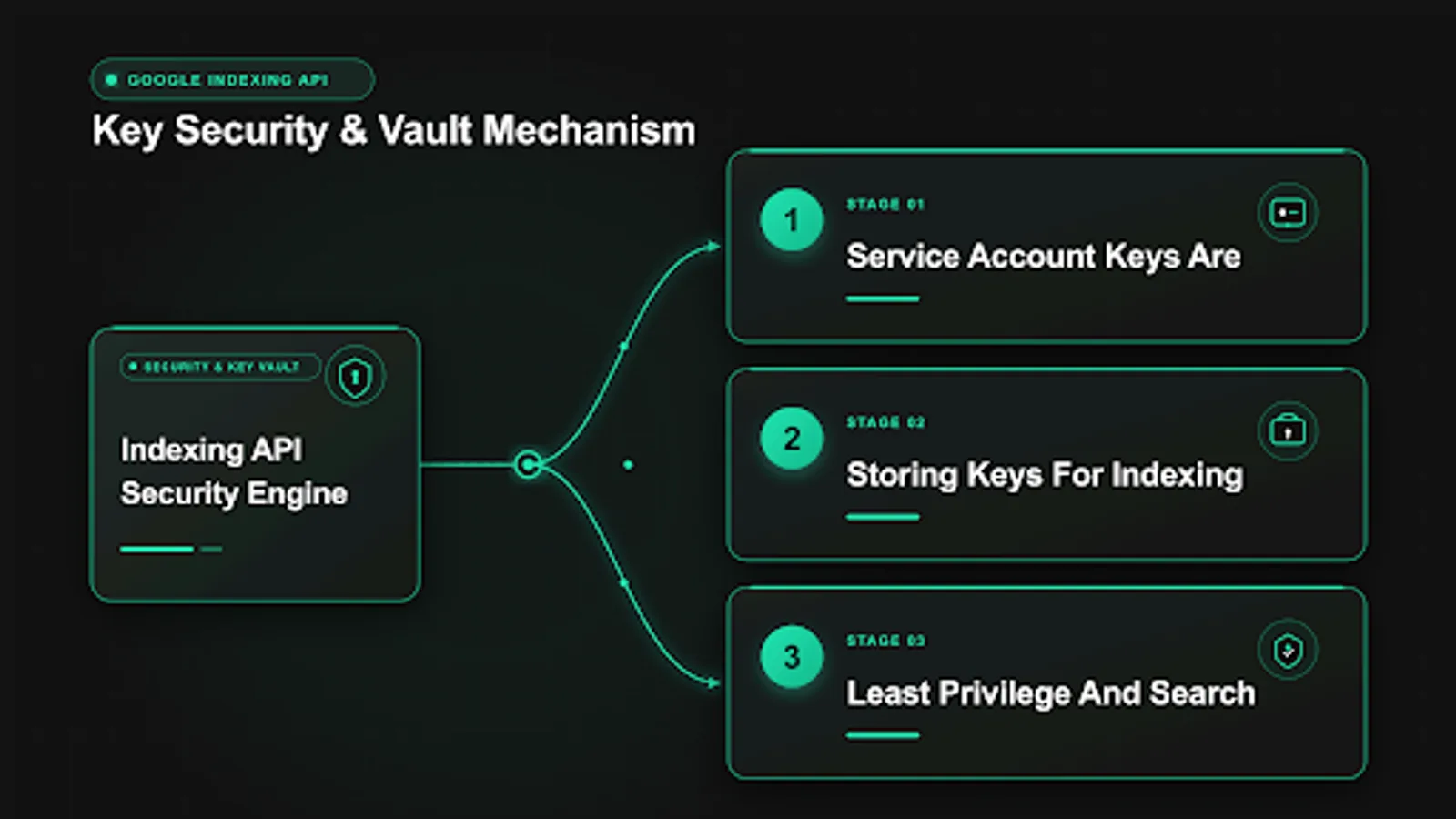 <!-- IMAGE-PROMPT diagram-01: 1600px max, DependsIt brand mint #22E3B0 on charcoal #121212, node-network line art, Clash Display style headings feel with General Sans clean labels, subject: indexing api security diagram with crawl and queue nodes, flat vector, accessible, no em dash in rendered text -->
Storing keys for indexing api security in a secret manager
This section covers storing keys in a secret manager in the context of indexing api security. A secret manager removes keys from code repos, backups, and chat logs. Cloud options include Google Secret Manager, AWS Secrets Manager, Azure Key Vault, and HashiCorp Vault for self hosted teams. The app reads the secret at runtime through IAM permission, never from a checked in file. Versioning lets you rotate without editing code. Enable audit logging so every read is recorded with identity and time. For small teams, even the built in secret store of a host like Cloudflare Workers or a CI system is far safer than a repo file. We keep the advice practical for owners without a large SEO team. Each step below uses plain checks you can run with Search Console, server logs and a small script. The goal is steady progress you can measure in coverage reports, not a one time spike. Keep notes on what you change and when, so you can link indexing movement to specific fixes.
Good secret management means api key storage lives in a vault with versioning and audit logs, not in code or chat. Require ticket approval for new keys, separate staging from production, and review readers monthly. These api key best practices keep rotation visible and reduce copy errors during busy launches.
The Google Indexing API only documents JobPosting and BroadcastEvent pages, which covers job listings and livestream video. Many site owners still test it for product or article URLs, but that use is off label and results vary. Google may process the hint, ignore it, or throttle it. State this plainly to stakeholders. Use the API for eligible content first, and rely on sitemaps, internal links and IndexNow for broad coverage on other page types.
Google does not support IndexNow, so plan for two ecosystems. IndexNow notifies Bing, Yandex, Naver, Seznam and other partners that share the protocol, while Google relies on sitemaps, Search Console inspection and the Indexing API for eligible types. A practical setup sends product updates to both paths at publish time. One worker prepares the URL list, then one branch pings IndexNow endpoints and another branch queues Google notifications within quota. Coverage improves without double counting.
JWT failures look cryptic but follow a pattern. Invalid signature often means the wrong key file or a corrupted newline in the private key. Invalid grant often means the service account is disabled or the project never enabled the API. Failed to parse often means the token was truncated in logs or copied with extra spaces. Keep token lifetimes short, request a fresh access token per batch, and log the key ID without logging the secret. Small hygiene steps remove most auth noise.
In practice, create a short runbook for storing keys in a secret manager and review it after each deploy. List who owns keys, who owns Search Console, where logs live, and what alert fires first. Test with five URLs before scaling to hourly batches. Record every response code and timestamp so patterns appear without guesswork. If errors rise, pause automation, fix the root cause, then resume at half pace. Steady, documented pacing restores submissions faster than rushing to catch up in one burst.
For official details, see developers.google.com docs which documents the expected fields and behavior.
File permissions and server layout
This section covers file permissions and server layout in the context of indexing api security. When a file based key is required, isolate it on disk with strict ownership and mode. Keep the JSON outside the web root, owned by the app user, readable only by that user. On Linux that means a dedicated directory with mode 700 and file mode 600. Block the path in web server config so it can never be served over HTTP. Separate staging and production keys so a test leak does not affect the live property. Document the path in runbooks without pasting the secret itself. We keep the advice practical for owners without a large SEO team. Each step below uses plain checks you can run with Search Console, server logs and a small script. The goal is steady progress you can measure in coverage reports, not a one time spike. Keep notes on what you change and when, so you can link indexing movement to specific fixes.
Combine mode 600 files with least privilege api grants and a documented key rotation google reminder to keep secure api usage steady. Only the app user reads the file, only its own property is authorized, and rotation never depends on one person.
Quotas shape every automation decision. Many projects start with about 200 publish requests per day for URL notifications, plus per minute limits that trigger 429 when bursts arrive. Track usage in Cloud Console under APIs and Services, set alerts at 60 percent and 85 percent, and log each publish with timestamp, URL, response code and notification type. When you know your burn rate by hour, you can pace jobs, defer low priority URLs and avoid midnight surprises.
| Item | What to record | Where to check |
|---|---|---|
| Request | URL plus notification type | Worker log row |
| Auth | Key ID plus scope | IAM and code config |
| Response | Status plus Retry After | API response body |
| Follow up | Next retry time | Queue next run field |
Quotas shape every automation decision. Many projects start with about 200 publish requests per day for URL notifications, plus per minute limits that trigger 429 when bursts arrive. Track usage in Cloud Console under APIs and Services, set alerts at 60 percent and 85 percent, and log each publish with timestamp, URL, response code and notification type. When you know your burn rate by hour, you can pace jobs, defer low priority URLs and avoid midnight surprises.
Logging turns guesses into fixes. For each submission store the URL, notification type, HTTP status, response body snippet, latency and a correlation ID. Keep success and error logs separate so you can scan error rates by hour. Export daily counts to a sheet or dashboard that shows submits, 200 responses, 403 responses, 429 responses and remaining quota. When stakeholders ask why a product is not visible, you can point to exact evidence instead of general theories.
In practice, create a short runbook for file permissions and server layout and review it after each deploy. List who owns keys, who owns Search Console, where logs live, and what alert fires first. Test with five URLs before scaling to hourly batches. Record every response code and timestamp so patterns appear without guesswork. If errors rise, pause automation, fix the root cause, then resume at half pace. Steady, documented pacing restores submissions faster than rushing to catch up in one burst.
To compare paths side by side, read quota limits explained before you commit quota to one route.
Least privilege and Search Console roles
This section covers least privilege and search console roles in the context of indexing api security. The service account only needs Owner on the specific Search Console property it will notify for, plus the indexing scope at runtime. Do not reuse one account across twenty unrelated sites if teams differ. Create one Cloud project per business unit, one service account per workload, and grant property access narrowly. Remove former staff access promptly by removing their IAM binding and rotating keys they may have seen. Review the owner list quarterly and drop stale entries before they become a risk. We keep the advice practical for owners without a large SEO team. Each step below uses plain checks you can run with Search Console, server logs and a small script. The goal is steady progress you can measure in coverage reports, not a one time spike. Keep notes on what you change and when, so you can link indexing movement to specific fixes.
A 403 usually points to permissions or scope. Confirm the service account email has Owner access in Search Console, confirm the OAuth scope includes the indexing scope, and confirm the JSON key file matches the active key in Cloud Console. Check clock skew on the server, since JWT auth fails when time drifts by more than a few minutes. Rotate keys on a schedule, store them in a secret manager, and never paste private keys into chat tools or shared docs.
- Step 1: Export the full URL list from your CMS or commerce platform with last change dates.
- Step 2: Join with Search Console coverage to flag Discovered, Crawled, Excluded and Indexed states.
- Step 3: Remove duplicates, 404s, noindex pages and non canonical variants from the submit set.
- Step 4: Sort by priority such as new, price change, availability change, then evergreen refresh.
- Step 5: Queue at a paced rate, log every response, and pause on repeated 429 or 403.
A 429 means slow down, not try harder. Read the Retry After header when present, then wait with exponential backoff and jitter before retrying. A common pattern waits 2 seconds, then 4, then 8, then 16, with a small random addition to avoid synchronized retries. Cap retries at 4 or 5 and move the URL to a delayed queue after that. Hammering the endpoint during a limit only extends the block and burns log space.
Internal linking does more for indexing than most teams expect. New URLs that sit four clicks from the home page may wait days for a visit, while URLs linked from a popular category or a recent posts block get visited quickly. Add new products to relevant category pages, link related items, and keep pagination crawlable with plain anchors. Avoid loading key links only through scripts that require clicks. Simple, stable links help both Google and IndexNow driven crawlers find changes fast.
In practice, create a short runbook for least privilege and search console roles and review it after each deploy. List who owns keys, who owns Search Console, where logs live, and what alert fires first. Test with five URLs before scaling to hourly batches. Record every response code and timestamp so patterns appear without guesswork. If errors rise, pause automation, fix the root cause, then resume at half pace. Steady, documented pacing restores submissions faster than rushing to catch up in one burst.
chmod 700 /etc/indexer/keys
chmod 600 /etc/indexer/keys/prod-key.json
REM verify no web route serves the directory
python3 -c "import json; d=json.load(open('/etc/indexer/keys/prod-key.json')); print(d['client_email'], d['private_key_id'])"
A rotation schedule that prevents downtime
This section covers a rotation schedule that prevents downtime in the context of indexing api security. Rotation replaces the active key with a new one while keeping submissions running. A ninety day cycle works for most teams, with thirty days for high turnover environments. The safe sequence is to create the second key, deploy it alongside the first, verify publishes succeed, then disable and delete the old key. Keep both key IDs in logs during overlap so you can trace which key signed each batch. Automate reminders in your calendar or CI so rotation does not slip during busy launches. We keep the advice practical for owners without a large SEO team. Each step below uses plain checks you can run with Search Console, server logs and a small script. The goal is steady progress you can measure in coverage reports, not a one time spike. Keep notes on what you change and when, so you can link indexing movement to specific fixes.
Logging turns guesses into fixes. For each submission store the URL, notification type, HTTP status, response body snippet, latency and a correlation ID. Keep success and error logs separate so you can scan error rates by hour. Export daily counts to a sheet or dashboard that shows submits, 200 responses, 403 responses, 429 responses and remaining quota. When stakeholders ask why a product is not visible, you can point to exact evidence instead of general theories.
A 403 usually points to permissions or scope. Confirm the service account email has Owner access in Search Console, confirm the OAuth scope includes the indexing scope, and confirm the JSON key file matches the active key in Cloud Console. Check clock skew on the server, since JWT auth fails when time drifts by more than a few minutes. Rotate keys on a schedule, store them in a secret manager, and never paste private keys into chat tools or shared docs.
Canonical tags decide which URL keeps the indexing credit. If variants with color, size or tracking parameters lack a canonical, Google may pick a different URL or delay indexing while it compares duplicates. Point each variant to the preferred canonical, keep the canonical self referencing on the main URL, and make sure sitemaps list only canonicals. For translated or regional pages, add hreflang and keep each locale self consistent. Clean signals shorten the decision time.
In practice, create a short runbook for a rotation schedule that prevents downtime and review it after each deploy. List who owns keys, who owns Search Console, where logs live, and what alert fires first. Test with five URLs before scaling to hourly batches. Record every response code and timestamp so patterns appear without guesswork. If errors rise, pause automation, fix the root cause, then resume at half pace. Steady, documented pacing restores submissions faster than rushing to catch up in one burst.
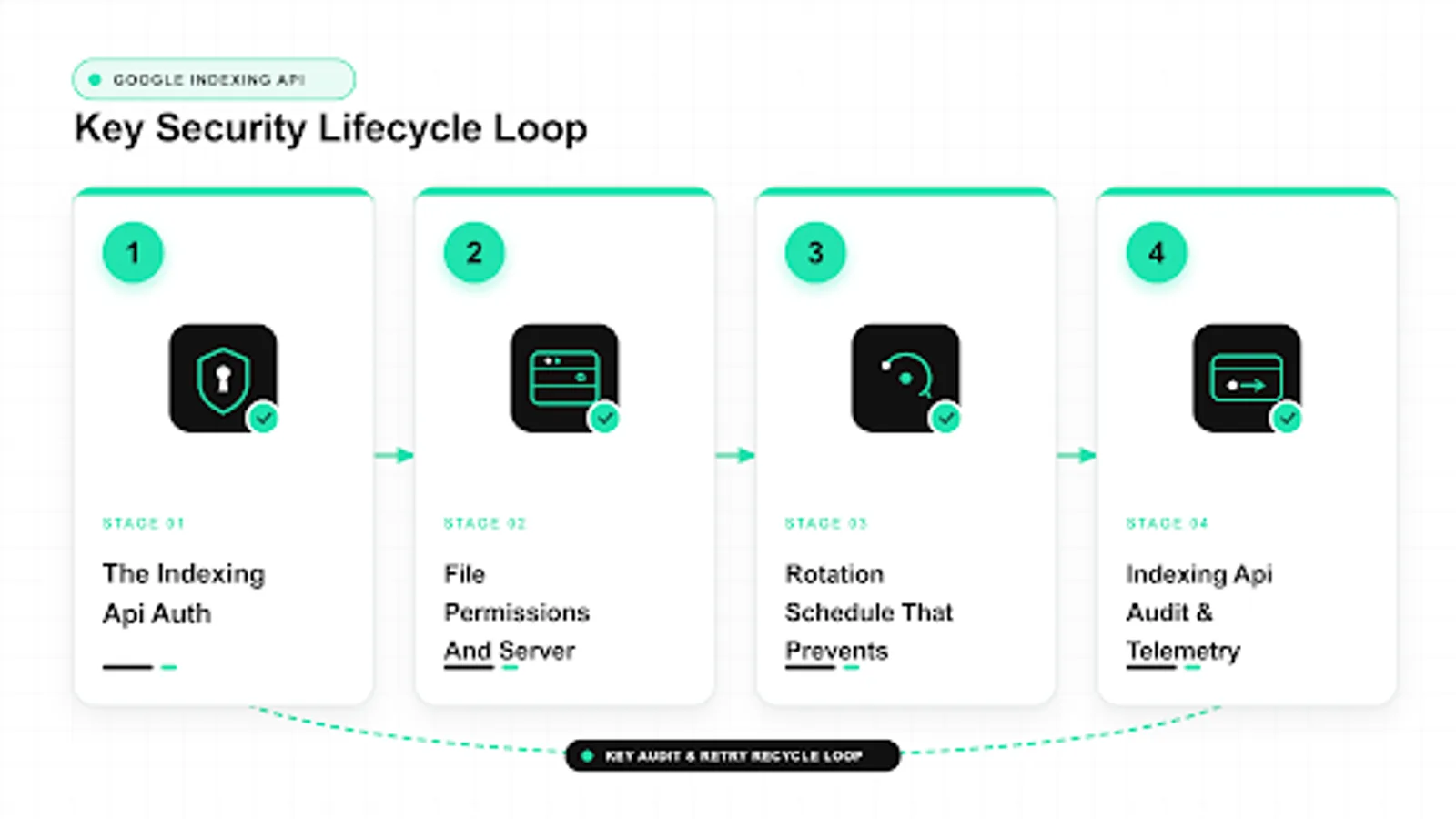 <!-- IMAGE-PROMPT workflow-02: 1600px max, DependsIt brand mint #22E3B0 on charcoal #121212 or white, node-network line art, Clash Display style headings feel with General Sans clean labels, subject: indexing api security workflow with retry and audit steps, flat vector, accessible, no em dash in rendered text -->
Detecting leaks and revoking keys fast
This section covers detecting leaks and revoking keys fast in the context of indexing api security. Leaks often surface through repo scans, log aggregators, or access alerts. Enable key usage metrics in Cloud Console and alert on spikes outside deploy windows. Scan repos with secret detectors on every push and block merges that contain private key headers. If a leak is confirmed, revoke the key in IAM immediately, generate a replacement, update the secret store, and redeploy. Then audit token logs for calls made between leak and revocation, and recheck Search Console owners for unknown additions. We keep the advice practical for owners without a large SEO team. Each step below uses plain checks you can run with Search Console, server logs and a small script. The goal is steady progress you can measure in coverage reports, not a one time spike. Keep notes on what you change and when, so you can link indexing movement to specific fixes.
Confirm google credentials safety after any suspected indexing api key leak by revoking in IAM, rotating the vault value, redeploying, and scanning logs for unknown calls. Pair this with json key protection such as push time secret scans, blocked uploads, and strict file modes so the same path does not leak twice.
Canonical tags decide which URL keeps the indexing credit. If variants with color, size or tracking parameters lack a canonical, Google may pick a different URL or delay indexing while it compares duplicates. Point each variant to the preferred canonical, keep the canonical self referencing on the main URL, and make sure sitemaps list only canonicals. For translated or regional pages, add hreflang and keep each locale self consistent. Clean signals shorten the decision time.
| Item | What to record | Where to check |
|---|---|---|
| Request | URL plus notification type | Worker log row |
| Auth | Key ID plus scope | IAM and code config |
| Response | Status plus Retry After | API response body |
| Follow up | Next retry time | Queue next run field |
JWT failures look cryptic but follow a pattern. Invalid signature often means the wrong key file or a corrupted newline in the private key. Invalid grant often means the service account is disabled or the project never enabled the API. Failed to parse often means the token was truncated in logs or copied with extra spaces. Keep token lifetimes short, request a fresh access token per batch, and log the key ID without logging the secret. Small hygiene steps remove most auth noise.
Robots directives and meta tags can silently block indexing. A stray noindex in a template, an X-Robots-Tag header from a staging config, or a disallow in robots that covers new paths will keep pages out even after successful submission. Audit headers with a fetch tool, render pages as Googlebot, and check the coverage report for Excluded by noindex or Blocked by robots. Fix the template once rather than patching URLs one by one.
In practice, create a short runbook for detecting leaks and revoking keys fast and review it after each deploy. List who owns keys, who owns Search Console, where logs live, and what alert fires first. Test with five URLs before scaling to hourly batches. Record every response code and timestamp so patterns appear without guesswork. If errors rise, pause automation, fix the root cause, then resume at half pace. Steady, documented pacing restores submissions faster than rushing to catch up in one burst.
When errors persist, review fixing JWT and permission errors to isolate auth, access and pacing causes with logs.
Risks of pasting keys into random tools
This section covers risks of pasting keys into random tools in the context of indexing api security. Browser based SEO tools that ask you to upload a service account JSON create lasting exposure. You lose control over storage, logging, and deletion once the file leaves your machine. Some tools log request bodies or cache uploads on shared infrastructure. Prefer bring your own key platforms that run in your account, or self hosted scripts where the key never leaves your server. If you must trial a tool, create a scoped test project with a throwaway account and delete it after evaluation. We keep the advice practical for owners without a large SEO team. Each step below uses plain checks you can run with Search Console, server logs and a small script. The goal is steady progress you can measure in coverage reports, not a one time spike. Keep notes on what you change and when, so you can link indexing movement to specific fixes.
Thin or duplicated content slows indexing because Google prioritizes pages likely to satisfy searchers. Short product descriptions copied from suppliers, empty category pages and near duplicate articles often sit in Discovered or Crawled without indexing. Add specific details such as dimensions, materials, compatibility, usage steps and original photos. Consolidate near duplicates into one strong page with redirects. Better content earns more frequent revisits and steadier indexing.
- Step 1: Confirm Cloud project ID, service account email, and active key ID in IAM.
- Step 2: Confirm the Indexing API is enabled in the API library for that project.
- Step 3: Confirm Search Console ownership on the exact property including scheme.
- Step 4: Send one metadata read, then one publish for a test URL, and inspect both responses.
- Step 5: Enable alerts at 60 and 85 percent of quota before resuming bulk work.
Logging turns guesses into fixes. For each submission store the URL, notification type, HTTP status, response body snippet, latency and a correlation ID. Keep success and error logs separate so you can scan error rates by hour. Export daily counts to a sheet or dashboard that shows submits, 200 responses, 403 responses, 429 responses and remaining quota. When stakeholders ask why a product is not visible, you can point to exact evidence instead of general theories.
Thin or duplicated content slows indexing because Google prioritizes pages likely to satisfy searchers. Short product descriptions copied from suppliers, empty category pages and near duplicate articles often sit in Discovered or Crawled without indexing. Add specific details such as dimensions, materials, compatibility, usage steps and original photos. Consolidate near duplicates into one strong page with redirects. Better content earns more frequent revisits and steadier indexing.
In practice, create a short runbook for risks of pasting keys into random tools and review it after each deploy. List who owns keys, who owns Search Console, where logs live, and what alert fires first. Test with five URLs before scaling to hourly batches. Record every response code and timestamp so patterns appear without guesswork. If errors rise, pause automation, fix the root cause, then resume at half pace. Steady, documented pacing restores submissions faster than rushing to catch up in one burst.
chmod 700 /etc/indexer/keys
chmod 600 /etc/indexer/keys/prod-key.json
REM verify no web route serves the directory
python3 -c "import json; d=json.load(open('/etc/indexer/keys/prod-key.json')); print(d['client_email'], d['private_key_id'])"
Logging without exposing secrets
This section covers logging without exposing secrets in the context of indexing api security. Good logs prove what happened without storing what must stay secret. Record timestamp, URL, notification type, HTTP status, latency, key ID, and correlation ID. Never log the private key, the full access token, or the raw JSON file. Redact the signature segment of JWTs and truncate tokens to the last four characters for tracing. Ship logs to a central store with retention rules, and restrict read access to on call staff. This balance speeds debugging while keeping auditors satisfied. We keep the advice practical for owners without a large SEO team. Each step below uses plain checks you can run with Search Console, server logs and a small script. The goal is steady progress you can measure in coverage reports, not a one time spike. Keep notes on what you change and when, so you can link indexing movement to specific fixes.
Sitemaps remain the backbone of discovery. A clean product or article sitemap lists only canonical, indexable URLs that return 200 and load quickly. Split large catalogs into chunks of 10,000 to 40,000 URLs, compress with gzip, and reference each chunk from a sitemap index. Update the lastmod field only when content truly changes. Submit the index in Search Console and keep it reachable. A tidy sitemap reduces wasted fetches and leaves room for priority pages.
Internal linking does more for indexing than most teams expect. New URLs that sit four clicks from the home page may wait days for a visit, while URLs linked from a popular category or a recent posts block get visited quickly. Add new products to relevant category pages, link related items, and keep pagination crawlable with plain anchors. Avoid loading key links only through scripts that require clicks. Simple, stable links help both Google and IndexNow driven crawlers find changes fast.
Google discovers most pages through crawl, not through a single submission. A submission is a hint that asks for a fresh look, but ranking and storage still depend on quality, uniqueness and site trust. That is why steady technical hygiene matters more than any one push. Keep response times low, avoid redirect chains, and return clear status codes. When the crawler can fetch quickly and without loops, each hint carries more weight and uses less of your daily allowance.
In practice, create a short runbook for logging without exposing secrets and review it after each deploy. List who owns keys, who owns Search Console, where logs live, and what alert fires first. Test with five URLs before scaling to hourly batches. Record every response code and timestamp so patterns appear without guesswork. If errors rise, pause automation, fix the root cause, then resume at half pace. Steady, documented pacing restores submissions faster than rushing to catch up in one burst.
For HTTP semantics, see status code reference which defines how clients should handle each response.
Backup and recovery for credentials
This section covers backup and recovery for credentials in the context of indexing api security. Losing the only copy of a key during a migration can stall eligible submissions for a day. Keep an encrypted offline backup in a vault controlled by two owners, separate from daily secret manager access. Document the recovery steps: who approves, where the backup lives, how to restore, and how to verify with a single metadata call before resuming bulk work. Test recovery yearly on a staging project. Keep the runbook short, with exact console paths and CLI commands, so recovery does not depend on one person. We keep the advice practical for owners without a large SEO team. Each step below uses plain checks you can run with Search Console, server logs and a small script. The goal is steady progress you can measure in coverage reports, not a one time spike. Keep notes on what you change and when, so you can link indexing movement to specific fixes.
Search Console verification is the gate for any Google submission. The service account that calls the API must be added as an Owner on the exact property, including the correct scheme and subdomain. Domain properties and URL prefix properties behave differently, so match the property you verify with the URLs you submit. If you see permission denied or 403, check sharing settings first, then OAuth scope, then key expiry. Most auth failures trace to a missed sharing step, not to code.
| Item | What to record | Where to check |
|---|---|---|
| Request | URL plus notification type | Worker log row |
| Auth | Key ID plus scope | IAM and code config |
| Response | Status plus Retry After | API response body |
| Follow up | Next retry time | Queue next run field |
Canonical tags decide which URL keeps the indexing credit. If variants with color, size or tracking parameters lack a canonical, Google may pick a different URL or delay indexing while it compares duplicates. Point each variant to the preferred canonical, keep the canonical self referencing on the main URL, and make sure sitemaps list only canonicals. For translated or regional pages, add hreflang and keep each locale self consistent. Clean signals shorten the decision time.
Sitemaps remain the backbone of discovery. A clean product or article sitemap lists only canonical, indexable URLs that return 200 and load quickly. Split large catalogs into chunks of 10,000 to 40,000 URLs, compress with gzip, and reference each chunk from a sitemap index. Update the lastmod field only when content truly changes. Submit the index in Search Console and keep it reachable. A tidy sitemap reduces wasted fetches and leaves room for priority pages.
In practice, create a short runbook for backup and recovery for credentials and review it after each deploy. List who owns keys, who owns Search Console, where logs live, and what alert fires first. Test with five URLs before scaling to hourly batches. Record every response code and timestamp so patterns appear without guesswork. If errors rise, pause automation, fix the root cause, then resume at half pace. Steady, documented pacing restores submissions faster than rushing to catch up in one burst.
A checklist for teams sharing access
This section covers a checklist for teams sharing access in the context of indexing api security. Teams need a shared routine that survives staff changes. Assign one owner for IAM, one for Search Console, and one for deploy secrets. Use groups rather than personal accounts for approvals. Require ticket references for key creation and deletion. Review access after each launch and each departure. Keep a one page sheet with project ID, service account email, property URLs, rotation date, and alert channel. Short, reviewed records prevent the slow drift that leads to leaks. We keep the advice practical for owners without a large SEO team. Each step below uses plain checks you can run with Search Console, server logs and a small script. The goal is steady progress you can measure in coverage reports, not a one time spike. Keep notes on what you change and when, so you can link indexing movement to specific fixes.
Google does not support IndexNow, so plan for two ecosystems. IndexNow notifies Bing, Yandex, Naver, Seznam and other partners that share the protocol, while Google relies on sitemaps, Search Console inspection and the Indexing API for eligible types. A practical setup sends product updates to both paths at publish time. One worker prepares the URL list, then one branch pings IndexNow endpoints and another branch queues Google notifications within quota. Coverage improves without double counting.
- Step 1: Export the full URL list from your CMS or commerce platform with last change dates.
- Step 2: Join with Search Console coverage to flag Discovered, Crawled, Excluded and Indexed states.
- Step 3: Remove duplicates, 404s, noindex pages and non canonical variants from the submit set.
- Step 4: Sort by priority such as new, price change, availability change, then evergreen refresh.
- Step 5: Queue at a paced rate, log every response, and pause on repeated 429 or 403.
Robots directives and meta tags can silently block indexing. A stray noindex in a template, an X-Robots-Tag header from a staging config, or a disallow in robots that covers new paths will keep pages out even after successful submission. Audit headers with a fetch tool, render pages as Googlebot, and check the coverage report for Excluded by noindex or Blocked by robots. Fix the template once rather than patching URLs one by one.
Crawl budget is often misunderstood. For small sites it rarely limits indexing, but for catalogs with 50,000 to 500,000 URLs it shapes what gets visited each day. Facets, session parameters, internal search results and duplicate variants can trap crawlers in low value loops. Use robots rules to block filtered views, use canonical tags to consolidate variants, and link best sellers from the home page and category hubs. Fewer dead ends means faster visits to new and updated pages.
In practice, create a short runbook for a checklist for teams sharing access and review it after each deploy. List who owns keys, who owns Search Console, where logs live, and what alert fires first. Test with five URLs before scaling to hourly batches. Record every response code and timestamp so patterns appear without guesswork. If errors rise, pause automation, fix the root cause, then resume at half pace. Steady, documented pacing restores submissions faster than rushing to catch up in one burst.
FAQ
Where does api key storage matter for service account key security?
Store production keys in a secret manager and inject them at runtime so api key storage stays out of repos, docs and chat logs. This service account key security habit limits exposure to the running worker only. Use versioned secrets, IAM scoped reads and audit logs for every access. For file based setups keep the JSON outside the web root with mode 600 and block the path in server config. These secret management steps plus quarterly reviews keep secure api usage steady without slowing deploys. Record key IDs, owners and rotation dates in a short runbook for the next audit.
What key rotation google schedule prevents downtime?
Use a ninety day cycle for most teams and thirty days for high turnover or high risk projects. A practical key rotation google routine creates the second key first, deploys it alongside the old one, verifies publishes with a single metadata call, then disables and deletes the old key. Log both key IDs during overlap so each batch traces to its signer. This service account key security pattern avoids midnight failures. Keep reminders in your calendar or CI and store the new value only in secret management with no copies in chat or tickets.
What is the fastest response to an indexing api key leak?
Treat any suspected indexing api key leak as urgent for google credentials safety. Revoke the key in IAM at once, create a replacement, update the vault, redeploy the worker, then audit token logs for calls made during exposure. Remove unknown Search Console owners and rotate nearby secrets that sat beside the leak. Strong json key protection such as secret scans on push, blocked JSON uploads and mode 600 files prevents repeats. Document cause, timeline and fix in a short incident note so the next review starts from evidence.
How does least privilege api scope limit sharing across sites?
A least privilege api setup grants Owner only on the exact Search Console property the worker must notify, nothing broader. Use one Cloud project per business unit, one service account per workload, and separate staging from production. This secure api usage pattern limits blast radius when a key leaks. Review owners quarterly, remove departed staff bindings at once, and require ticket approval for new keys. These api key best practices keep sharing safe while preserving clear audit trails for every publish and metadata read.
Is it safe to paste a key into an online tool?
Avoid pasting keys into browser tools because you lose control of google credentials safety once the file leaves your server. Some tools cache uploads or log request bodies on shared infrastructure. Prefer self hosted scripts or platforms that run inside your account where secure api usage stays under your IAM and logging. For trials create a scoped test project with a throwaway account, strict quotas and no production property access. Delete the test project after evaluation. These api key best practices protect production while still letting you compare tools safely.
What should logs record without risk?
Record time, URL, notification type, status code, latency, key ID and correlation ID while never storing private keys or full tokens. This json key protection habit lets you trace failures without creating a second secret store in logs. Truncate tokens to the last four characters, redact JWT signatures and centralize retention with limited read access. Good secret management for logs means on call staff can debug 403 and 429 patterns quickly. Export daily counts of submits, successes and errors so stakeholders see evidence instead of guesses.
Sources
- https://developers.google.com/search/apis/indexing-api/v3/prereqs
- https://developer.mozilla.org/en-US/docs/Web/HTTP/Status
- https://developers.google.com/search/apis/indexing-api/v3/errors