Building an Indexing Tool with BYOK Architecture

This guide is for developers and technical founders who want to build an indexing tool where customers connect their own API keys. The primary keyword is byok architecture, and the goal is a blueprint you can implement with a small team. BYOK keeps customer credentials isolated, submits through per tenant queues, and tracks quota and status without ever exposing secrets to the browser. Done well, it lowers your cost risk and gives customers transparency they cannot get from opaque shared key services.
You will learn how to store keys with encryption, scope access with least privilege, design queues and workers for Google and IndexNow, model URLs and jobs, handle retries and status, and observe the system without logging sensitive content. The guide includes minimal schemas, endpoint shapes, error handling patterns, and a launch checklist that covers testing, staging, and safe key handling in CI.
Key takeaways
- Isolate each tenant key with envelope encryption, scoped IAM, and no browser access to secrets.
- Use per tenant queues with throttling, backoff on 429, and durable status so retries never lose URLs.
- Submit to Google and IndexNow from one job model, but track quotas and responses separately per engine.
- Observe with redacted logs and tenant level metrics, so debugging never requires reading customer keys.
- What BYOK architecture looks like in practice
- Storing user keys with encryption and isolation
- Scoped tokens and least privilege by design
- Per tenant queues, quotas, and rate limiting
- Submitting to Google and IndexNow from one backend
- Handling errors, retries, and status tracking
- A minimal data model for URLs, jobs, and keys
- Frontend patterns that never expose secrets
- Observability without storing sensitive content
- Testing, staging, and safe key handling in CI
- Launch checklist for a maintainable BYOK service
- FAQ
- Sources
- Further reading
 <!-- IMAGE-META 1200 630 14 --> <!-- IMAGE-PROMPT cover: 1200x630, DependsIt brand, deep charcoal #121212 or clean white background, vibrant mint #22E3B0 accent glow, thin node-network line art, Clash Display style bold heading space on left, General Sans clean labels, subject: BYOK indexing backend with vault queues and per tenant workers, flat vector, high contrast, accessible, no photorealistic faces, no text smaller than 24px, no em dash in rendered text, export PNG then cwebp -q 82 to WEBP -->
What BYOK architecture looks like in practice
What BYOK architecture looks like in practice deserves a concrete plan because it controls whether bulk work stays predictable or turns into quota surprises. For what byok architecture looks like in practice, keep the trust boundary clear. Browsers and edge functions never see raw keys. They call your API with session auth and receive job IDs. Workers running in a private subnet fetch the tenant key reference, decrypt with the tenant data key via your KMS, perform the engine call, then drop the plaintext from memory. This shape limits exposure to one process, one tenant, one job at a time, which simplifies audits and incident scope.
Implementation order saves rework. Build for failure from day one. Google returns 403 for scope problems, 429 for quota pressure, and 5xx during incidents, while IndexNow returns 200, 202, 400, 403, 422, and 429 with distinct meanings for key, format, and URL issues. Map each code to retry, fix config, or drop with a clear message. Use exponential backoff with jitter, per tenant concurrency caps, and idempotency keys so a retry never double bills quota or creates duplicate work.
- Define tenant, key version, job, attempt, and quota counter tables before writing workers.
- Enforce server side only secret access with short lived decrypt grants and redacted logging.
- Set per tenant concurrency, daily caps, and backoff policies that differ per engine.
- Return job IDs immediately and update status asynchronously so the UI stays fast under bulk load.
- Add idempotency keys and dedup windows to survive retries without double submission.
Ship behind feature flags per tenant. Measure what tenants need without over collecting. Track queue depth, age of oldest job, attempts per URL, accept rate per engine, p95 submit latency, and quota headroom. Alert on sustained 429, growth in dead letter jobs, and KMS decrypt errors. Dashboards show counts and codes, never secrets or full URL lists for other tenants. When metrics are clean, support can resolve most tickets from job IDs alone. Roll out to one pilot tenant, watch quota and error mix, then expand with confidence.
Start with tenant isolation as a hard rule. Separate data encryption keys per tenant ensure one decrypt grant never opens another customer vault, which keeps incident scope narrow and audits simple. If you plan to build byok tool features in stages, start with isolation and key versioning before you add multi tenant api keys routing in the queue layer.
Storing user keys with encryption and isolation
Teams get storing user keys with encryption and isolation right by measuring first and automating second. For storing user keys with encryption and isolation, keep the trust boundary clear. Browsers and edge functions never see raw keys. They call your API with session auth and receive job IDs. Workers running in a private subnet fetch the tenant key reference, decrypt with the tenant data key via your KMS, perform the engine call, then drop the plaintext from memory. This shape limits exposure to one process, one tenant, one job at a time, which simplifies audits and incident scope.
Implementation order saves rework. Build for failure from day one. Google returns 403 for scope problems, 429 for quota pressure, and 5xx during incidents, while IndexNow returns 200, 202, 400, 403, 422, and 429 with distinct meanings for key, format, and URL issues. Map each code to retry, fix config, or drop with a clear message. Use exponential backoff with jitter, per tenant concurrency caps, and idempotency keys so a retry never double bills quota or creates duplicate work.
- Define tenant, key version, job, attempt, and quota counter tables before writing workers.
- Enforce server side only secret access with short lived decrypt grants and redacted logging.
- Set per tenant concurrency, daily caps, and backoff policies that differ per engine.
- Return job IDs immediately and update status asynchronously so the UI stays fast under bulk load.
- Add idempotency keys and dedup windows to survive retries without double submission.
Ship behind feature flags per tenant. Measure what tenants need without over collecting. Track queue depth, age of oldest job, attempts per URL, accept rate per engine, p95 submit latency, and quota headroom. Alert on sustained 429, growth in dead letter jobs, and KMS decrypt errors. Dashboards show counts and codes, never secrets or full URL lists for other tenants. When metrics are clean, support can resolve most tickets from job IDs alone. Roll out to one pilot tenant, watch quota and error mix, then expand with confidence.
Key versioning avoids downtime during rotation. Store a version identifier with each job, allow two active versions during rollover, and retire the old version only after in flight jobs drain. A sound byok backend design keeps a registry of how you store user api keys, including KMS key IDs, regions, and rotation dates, without ever persisting plaintext.
Scoped tokens and least privilege by design
Scoped tokens and least privilege by design is where theory meets logs, queues, and on call time. For scoped tokens and least privilege by design, keep the trust boundary clear. Browsers and edge functions never see raw keys. They call your API with session auth and receive job IDs. Workers running in a private subnet fetch the tenant key reference, decrypt with the tenant data key via your KMS, perform the engine call, then drop the plaintext from memory. This shape limits exposure to one process, one tenant, one job at a time, which simplifies audits and incident scope.
Implementation order saves rework. Build for failure from day one. Google returns 403 for scope problems, 429 for quota pressure, and 5xx during incidents, while IndexNow returns 200, 202, 400, 403, 422, and 429 with distinct meanings for key, format, and URL issues. Map each code to retry, fix config, or drop with a clear message. Use exponential backoff with jitter, per tenant concurrency caps, and idempotency keys so a retry never double bills quota or creates duplicate work.
- Define tenant, key version, job, attempt, and quota counter tables before writing workers.
- Enforce server side only secret access with short lived decrypt grants and redacted logging.
- Set per tenant concurrency, daily caps, and backoff policies that differ per engine.
- Return job IDs immediately and update status asynchronously so the UI stays fast under bulk load.
- Add idempotency keys and dedup windows to survive retries without double submission.
Ship behind feature flags per tenant. Measure what tenants need without over collecting. Track queue depth, age of oldest job, attempts per URL, accept rate per engine, p95 submit latency, and quota headroom. Alert on sustained 429, growth in dead letter jobs, and KMS decrypt errors. Dashboards show counts and codes, never secrets or full URL lists for other tenants. When metrics are clean, support can resolve most tickets from job IDs alone. Roll out to one pilot tenant, watch quota and error mix, then expand with confidence.
 <!-- IMAGE-META 1600 900 34 --> <!-- IMAGE-PROMPT diagram-01: 1600px max, DependsIt brand mint #22E3B0 on charcoal #121212 or white, node-network line art, subject: BYOK data model diagram for keys tenants jobs and submission logs, flat vector, accessible, no em dash, Clash Display headings feel and General Sans labels feel -->
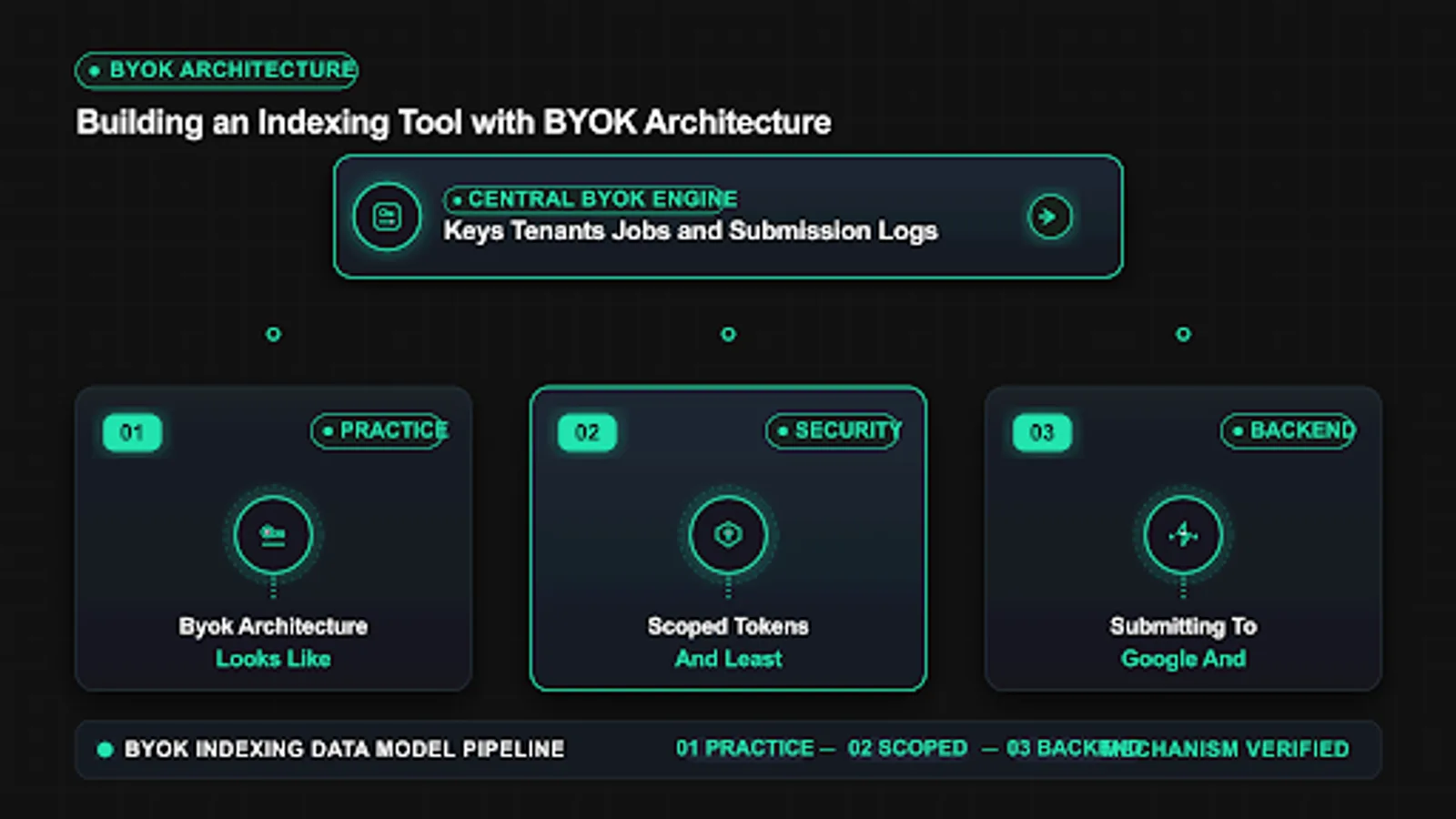
Queue design should separate intake from engine calls. Intake validates URLs and dedups quickly, while engine workers handle throttling and backoff without blocking new submissions.
Per tenant queues, quotas, and rate limiting
Per tenant queues, quotas, and rate limiting deserves a concrete plan because it controls whether bulk work stays predictable or turns into quota surprises. For per tenant queues, quotas, and rate limiting, keep the trust boundary clear. Browsers and edge functions never see raw keys. They call your API with session auth and receive job IDs. Workers running in a private subnet fetch the tenant key reference, decrypt with the tenant data key via your KMS, perform the engine call, then drop the plaintext from memory. This shape limits exposure to one process, one tenant, one job at a time, which simplifies audits and incident scope.
Implementation order saves rework. Build for failure from day one. Google returns 403 for scope problems, 429 for quota pressure, and 5xx during incidents, while IndexNow returns 200, 202, 400, 403, 422, and 429 with distinct meanings for key, format, and URL issues. Map each code to retry, fix config, or drop with a clear message. Use exponential backoff with jitter, per tenant concurrency caps, and idempotency keys so a retry never double bills quota or creates duplicate work. The walkthrough for a self hosted IndexNow submitter shows minimal submission shapes you can borrow.
- Define tenant, key version, job, attempt, and quota counter tables before writing workers.
- Enforce server side only secret access with short lived decrypt grants and redacted logging.
- Set per tenant concurrency, daily caps, and backoff policies that differ per engine.
- Return job IDs immediately and update status asynchronously so the UI stays fast under bulk load.
- Add idempotency keys and dedup windows to survive retries without double submission.
Ship behind feature flags per tenant. Measure what tenants need without over collecting. Track queue depth, age of oldest job, attempts per URL, accept rate per engine, p95 submit latency, and quota headroom. Alert on sustained 429, growth in dead letter jobs, and KMS decrypt errors. Dashboards show counts and codes, never secrets or full URL lists for other tenants. When metrics are clean, support can resolve most tickets from job IDs alone. Roll out to one pilot tenant, watch quota and error mix, then expand with confidence.
Concurrency caps protect shared quota. Set per tenant limits for Google and IndexNow separately, queue overflow with priority lanes, and surface wait time estimates in the UI. Document this byok implementation choice in runbooks so on call engineers know which dial to turn when 429 rates climb.
Submitting to Google and IndexNow from one backend
Teams get submitting to google and indexnow from one backend right by measuring first and automating second. For submitting to google and indexnow from one backend, keep the trust boundary clear. Browsers and edge functions never see raw keys. They call your API with session auth and receive job IDs. Workers running in a private subnet fetch the tenant key reference, decrypt with the tenant data key via your KMS, perform the engine call, then drop the plaintext from memory. This shape limits exposure to one process, one tenant, one job at a time, which simplifies audits and incident scope.
Implementation order saves rework. Build for failure from day one. Google returns 403 for scope problems, 429 for quota pressure, and 5xx during incidents, while IndexNow returns 200, 202, 400, 403, 422, and 429 with distinct meanings for key, format, and URL issues. Map each code to retry, fix config, or drop with a clear message. Use exponential backoff with jitter, per tenant concurrency caps, and idempotency keys so a retry never double bills quota or creates duplicate work.
- Define tenant, key version, job, attempt, and quota counter tables before writing workers.
- Enforce server side only secret access with short lived decrypt grants and redacted logging.
- Set per tenant concurrency, daily caps, and backoff policies that differ per engine.
- Return job IDs immediately and update status asynchronously so the UI stays fast under bulk load.
- Add idempotency keys and dedup windows to survive retries without double submission.
Ship behind feature flags per tenant. Measure what tenants need without over collecting. Track queue depth, age of oldest job, attempts per URL, accept rate per engine, p95 submit latency, and quota headroom. Alert on sustained 429, growth in dead letter jobs, and KMS decrypt errors. Dashboards show counts and codes, never secrets or full URL lists for other tenants. When metrics are clean, support can resolve most tickets from job IDs alone. Roll out to one pilot tenant, watch quota and error mix, then expand with confidence.
Error mapping needs explicit tables. Translate each engine code into retry, fix configuration, or drop with guidance, so tenants see actionable next steps instead of raw numbers.
Handling errors, retries, and status tracking
Handling errors, retries, and status tracking is where theory meets logs, queues, and on call time. For handling errors, retries, and status tracking, keep the trust boundary clear. Browsers and edge functions never see raw keys. They call your API with session auth and receive job IDs. Workers running in a private subnet fetch the tenant key reference, decrypt with the tenant data key via your KMS, perform the engine call, then drop the plaintext from memory. This shape limits exposure to one process, one tenant, one job at a time, which simplifies audits and incident scope.
Implementation order saves rework. Build for failure from day one. Google returns 403 for scope problems, 429 for quota pressure, and 5xx during incidents, while IndexNow returns 200, 202, 400, 403, 422, and 429 with distinct meanings for key, format, and URL issues. Map each code to retry, fix config, or drop with a clear message. Use exponential backoff with jitter, per tenant concurrency caps, and idempotency keys so a retry never double bills quota or creates duplicate work.
- Define tenant, key version, job, attempt, and quota counter tables before writing workers.
- Enforce server side only secret access with short lived decrypt grants and redacted logging.
- Set per tenant concurrency, daily caps, and backoff policies that differ per engine.
- Return job IDs immediately and update status asynchronously so the UI stays fast under bulk load.
- Add idempotency keys and dedup windows to survive retries without double submission.
// per tenant submit with backoff on 429
async function submitWithBackoff(task, attempt=0){
  const res = await enginePublish(task);
  if(res.status===429 && attempt<5){
    const wait = Math.min(60000, 1000 * 2 ** attempt + Math.random()*500);
    await new Promise(r=>setTimeout(r,wait));
    return submitWithBackoff(task, attempt+1);
  }
  return res;
}
Ship behind feature flags per tenant. Measure what tenants need without over collecting. Track queue depth, age of oldest job, attempts per URL, accept rate per engine, p95 submit latency, and quota headroom. Alert on sustained 429, growth in dead letter jobs, and KMS decrypt errors. Dashboards show counts and codes, never secrets or full URL lists for other tenants. When metrics are clean, support can resolve most tickets from job IDs alone. Roll out to one pilot tenant, watch quota and error mix, then expand with confidence.
Idempotency keeps retries safe. Hash tenant plus canonical URL plus action type into a dedup key with a 24 hour window, so repeated clicks never double spend quota.
A minimal data model for URLs, jobs, and keys
A minimal data model for URLs, jobs, and keys deserves a concrete plan because it controls whether bulk work stays predictable or turns into quota surprises. For a minimal data model for urls, jobs, and keys, keep the trust boundary clear. Browsers and edge functions never see raw keys. They call your API with session auth and receive job IDs. Workers running in a private subnet fetch the tenant key reference, decrypt with the tenant data key via your KMS, perform the engine call, then drop the plaintext from memory. This shape limits exposure to one process, one tenant, one job at a time, which simplifies audits and incident scope.
Implementation order saves rework. Build for failure from day one. Google returns 403 for scope problems, 429 for quota pressure, and 5xx during incidents, while IndexNow returns 200, 202, 400, 403, 422, and 429 with distinct meanings for key, format, and URL issues. Map each code to retry, fix config, or drop with a clear message. Use exponential backoff with jitter, per tenant concurrency caps, and idempotency keys so a retry never double bills quota or creates duplicate work.
- Define tenant, key version, job, attempt, and quota counter tables before writing workers.
- Enforce server side only secret access with short lived decrypt grants and redacted logging.
- Set per tenant concurrency, daily caps, and backoff policies that differ per engine.
- Return job IDs immediately and update status asynchronously so the UI stays fast under bulk load.
- Add idempotency keys and dedup windows to survive retries without double submission.
Ship behind feature flags per tenant. Measure what tenants need without over collecting. Track queue depth, age of oldest job, attempts per URL, accept rate per engine, p95 submit latency, and quota headroom. Alert on sustained 429, growth in dead letter jobs, and KMS decrypt errors. Dashboards show counts and codes, never secrets or full URL lists for other tenants. When metrics are clean, support can resolve most tickets from job IDs alone. Roll out to one pilot tenant, watch quota and error mix, then expand with confidence.
 <!-- IMAGE-META 1600 900 36 --> <!-- IMAGE-PROMPT workflow-02: 1600px max, DependsIt brand mint #22E3B0 on charcoal #121212 or white, node-network line art, subject: BYOK submission workflow from key connect to queue publish and status, flat vector, accessible, no em dash, Clash Display headings feel and General Sans labels feel -->
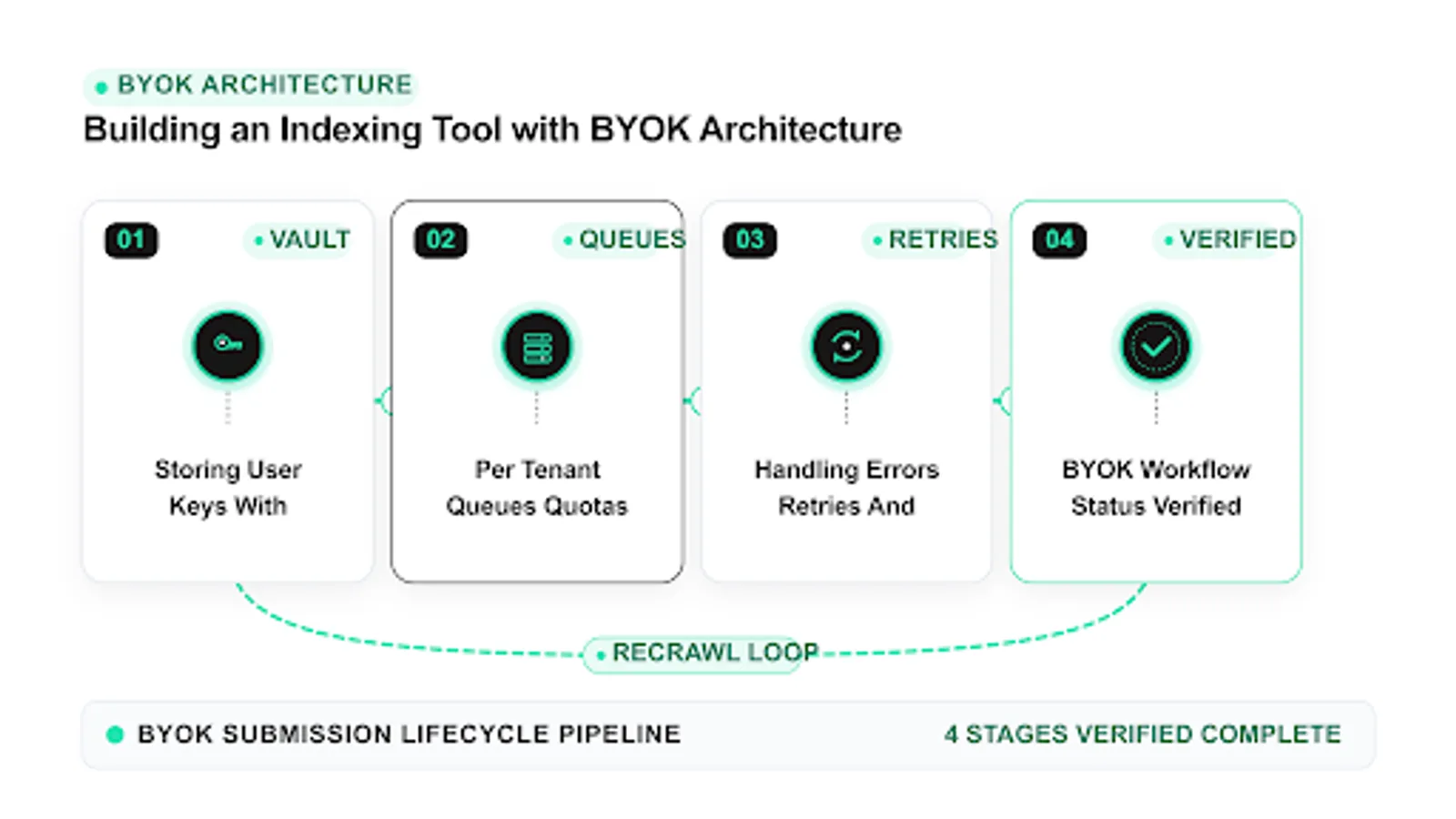
Status APIs should be fast and redacted. Return job state, attempt counts, and last response codes, but never tokens, raw keys, or full cross tenant URL lists.
Frontend patterns that never expose secrets
Teams get frontend patterns that never expose secrets right by measuring first and automating second. For frontend patterns that never expose secrets, keep the trust boundary clear. Browsers and edge functions never see raw keys. They call your API with session auth and receive job IDs. Workers running in a private subnet fetch the tenant key reference, decrypt with the tenant data key via your KMS, perform the engine call, then drop the plaintext from memory. This shape limits exposure to one process, one tenant, one job at a time, which simplifies audits and incident scope.
Implementation order saves rework. Build for failure from day one. Google returns 403 for scope problems, 429 for quota pressure, and 5xx during incidents, while IndexNow returns 200, 202, 400, 403, 422, and 429 with distinct meanings for key, format, and URL issues. Map each code to retry, fix config, or drop with a clear message. Use exponential backoff with jitter, per tenant concurrency caps, and idempotency keys so a retry never double bills quota or creates duplicate work. Definitions for IndexNow protocol documentation and status handling in MDN on HTTP status codes keep field names correct.
- Define tenant, key version, job, attempt, and quota counter tables before writing workers.
- Enforce server side only secret access with short lived decrypt grants and redacted logging.
- Set per tenant concurrency, daily caps, and backoff policies that differ per engine.
- Return job IDs immediately and update status asynchronously so the UI stays fast under bulk load.
- Add idempotency keys and dedup windows to survive retries without double submission.
Ship behind feature flags per tenant. Measure what tenants need without over collecting. Track queue depth, age of oldest job, attempts per URL, accept rate per engine, p95 submit latency, and quota headroom. Alert on sustained 429, growth in dead letter jobs, and KMS decrypt errors. Dashboards show counts and codes, never secrets or full URL lists for other tenants. When metrics are clean, support can resolve most tickets from job IDs alone. Roll out to one pilot tenant, watch quota and error mix, then expand with confidence.
Frontend work stays server side for secrets. Review bundles in CI to prove no key strings ship to browsers, enforce session auth on every action, and rate limit UI endpoints. This byok design pattern matches how mature saas with user keys products separate browser actions from server side secret use.
Observability without storing sensitive content
Observability without storing sensitive content is where theory meets logs, queues, and on call time. For observability without storing sensitive content, keep the trust boundary clear. Browsers and edge functions never see raw keys. They call your API with session auth and receive job IDs. Workers running in a private subnet fetch the tenant key reference, decrypt with the tenant data key via your KMS, perform the engine call, then drop the plaintext from memory. This shape limits exposure to one process, one tenant, one job at a time, which simplifies audits and incident scope.
Implementation order saves rework. Build for failure from day one. Google returns 403 for scope problems, 429 for quota pressure, and 5xx during incidents, while IndexNow returns 200, 202, 400, 403, 422, and 429 with distinct meanings for key, format, and URL issues. Map each code to retry, fix config, or drop with a clear message. Use exponential backoff with jitter, per tenant concurrency caps, and idempotency keys so a retry never double bills quota or creates duplicate work.
- Define tenant, key version, job, attempt, and quota counter tables before writing workers.
- Enforce server side only secret access with short lived decrypt grants and redacted logging.
- Set per tenant concurrency, daily caps, and backoff policies that differ per engine.
- Return job IDs immediately and update status asynchronously so the UI stays fast under bulk load.
- Add idempotency keys and dedup windows to survive retries without double submission.
Ship behind feature flags per tenant. Measure what tenants need without over collecting. Track queue depth, age of oldest job, attempts per URL, accept rate per engine, p95 submit latency, and quota headroom. Alert on sustained 429, growth in dead letter jobs, and KMS decrypt errors. Dashboards show counts and codes, never secrets or full URL lists for other tenants. When metrics are clean, support can resolve most tickets from job IDs alone. Roll out to one pilot tenant, watch quota and error mix, then expand with confidence.
Metrics guide capacity planning. Track queue depth, oldest job age, accept rate per engine, p95 latency, and decrypt error rate with alerts on sustained pressure.
Testing, staging, and safe key handling in CI
Testing, staging, and safe key handling in CI deserves a concrete plan because it controls whether bulk work stays predictable or turns into quota surprises. For testing, staging, and safe key handling in ci, keep the trust boundary clear. Browsers and edge functions never see raw keys. They call your API with session auth and receive job IDs. Workers running in a private subnet fetch the tenant key reference, decrypt with the tenant data key via your KMS, perform the engine call, then drop the plaintext from memory. This shape limits exposure to one process, one tenant, one job at a time, which simplifies audits and incident scope.
Implementation order saves rework. Build for failure from day one. Google returns 403 for scope problems, 429 for quota pressure, and 5xx during incidents, while IndexNow returns 200, 202, 400, 403, 422, and 429 with distinct meanings for key, format, and URL issues. Map each code to retry, fix config, or drop with a clear message. Use exponential backoff with jitter, per tenant concurrency caps, and idempotency keys so a retry never double bills quota or creates duplicate work.
- Define tenant, key version, job, attempt, and quota counter tables before writing workers.
- Enforce server side only secret access with short lived decrypt grants and redacted logging.
- Set per tenant concurrency, daily caps, and backoff policies that differ per engine.
- Return job IDs immediately and update status asynchronously so the UI stays fast under bulk load.
- Add idempotency keys and dedup windows to survive retries without double submission.
Ship behind feature flags per tenant. Measure what tenants need without over collecting. Track queue depth, age of oldest job, attempts per URL, accept rate per engine, p95 submit latency, and quota headroom. Alert on sustained 429, growth in dead letter jobs, and KMS decrypt errors. Dashboards show counts and codes, never secrets or full URL lists for other tenants. When metrics are clean, support can resolve most tickets from job IDs alone. Roll out to one pilot tenant, watch quota and error mix, then expand with confidence.
Staging must mirror production shapes without touching real quota. Use mock engines for unit tests and a sandbox project for contract tests before any tenant rollout.
Launch checklist for a maintainable BYOK service
Teams get launch checklist for a maintainable byok service right by measuring first and automating second. For launch checklist for a maintainable byok service, keep the trust boundary clear. Browsers and edge functions never see raw keys. They call your API with session auth and receive job IDs. Workers running in a private subnet fetch the tenant key reference, decrypt with the tenant data key via your KMS, perform the engine call, then drop the plaintext from memory. This shape limits exposure to one process, one tenant, one job at a time, which simplifies audits and incident scope.
Implementation order saves rework. Build for failure from day one. Google returns 403 for scope problems, 429 for quota pressure, and 5xx during incidents, while IndexNow returns 200, 202, 400, 403, 422, and 429 with distinct meanings for key, format, and URL issues. Map each code to retry, fix config, or drop with a clear message. Use exponential backoff with jitter, per tenant concurrency caps, and idempotency keys so a retry never double bills quota or creates duplicate work.
- Define tenant, key version, job, attempt, and quota counter tables before writing workers.
- Enforce server side only secret access with short lived decrypt grants and redacted logging.
- Set per tenant concurrency, daily caps, and backoff policies that differ per engine.
- Return job IDs immediately and update status asynchronously so the UI stays fast under bulk load.
- Add idempotency keys and dedup windows to survive retries without double submission.
Ship behind feature flags per tenant. Measure what tenants need without over collecting. Track queue depth, age of oldest job, attempts per URL, accept rate per engine, p95 submit latency, and quota headroom. Alert on sustained 429, growth in dead letter jobs, and KMS decrypt errors. Dashboards show counts and codes, never secrets or full URL lists for other tenants. When metrics are clean, support can resolve most tickets from job IDs alone. Roll out to one pilot tenant, watch quota and error mix, then expand with confidence.
Launch readiness includes docs and runbooks. Publish scope minimums, rotation steps, error meanings, and support SLAs so early tenants succeed without custom help.
FAQ
Why choose BYOK instead of one shared key?
Shared keys mix all customers into one quota and one blast radius. One abuse spike or leak affects everyone and hides who spent what. BYOK gives each tenant its own quota, audit trail, and revocation path. Your platform scales by adding tenants, not by begging for higher shared caps. That separation is also why byok development teams prefer per tenant keys during testing, since staging spikes never touch production quota.
How should we store tenant keys?
Use envelope encryption with a key management service, per tenant data encryption keys, and strict IAM so only workers can decrypt at job time. Never return secrets to the browser, never log them, and version keys so rotation does not break in flight jobs. Review the layout against a documented byok security architecture checklist that covers KMS ownership, decrypt grants, and redaction.
How do we handle Google and IndexNow together?
Model one URL job with two engine tasks that track quota and responses separately. Google uses OAuth service account flow with URL_UPDATED and URL_DELETED for eligible types, while IndexNow uses a site key file and simple POST batches. A unified queue fans out to both, but backoff and limits stay per engine.
What belongs in the database?
Keep tenants, key references and versions, URL jobs with canonical finals, attempt history with status codes, quota counters, and redacted logs. Do not store raw secrets or full page content. Index by tenant and URL so status lookups and dedup stay fast.
How do we avoid leaking secrets in the frontend?
Keep all API calls server side behind session auth and scoped actions. The browser only sees job IDs and status, never tokens or JSON keys. Add CSRF protection, rate limit the UI, and review bundles to prove no secret strings ship to clients.
How do we test without risking customer quota?
Use staging tenants with throwaway keys, mock engine endpoints for unit tests, and a sandbox project for live contract tests. Run load tests against mocks, not production quotas, and gate deploys on checks that assert no secret logging and correct backoff behavior.
Sources
- https://www.indexnow.org/documentation
- https://developers.google.com/search/apis/indexing-api/v3/reference/indexing/rest/v3/urlNotifications/publish
- https://developer.mozilla.org/en-US/docs/Web/HTTP/Status