Getting Into Google AI Overviews: What the Data Shows
If you track search visibility, google ai overviews visibility is now a practical concern, not a future trend. AI Overviews appear above classic results for many informational queries and cite a small set of sources with links. For site owners, the question is direct. What do cited pages have in common, and what can you change on your own pages to earn those citations. This guide answers that question with patterns reported across public studies, plus hands on steps you can apply this week.
This guide is for content owners, SEOs, and developers who already understand crawling and indexing and want to adapt that foundation for AI search. You will learn where AI Overviews appear, how source selection works, which query types trigger them, which formats get cited, and how technical health supports eligibility. You will also get a workflow to audit pages, improve structure, and measure progress without relying on guesswork. By the end, you will have a clear 90 day plan and a checklist you can reuse for every important page.
Key takeaways
- AI Overviews cite a small set of pages per query, often 3 to 8 visible cards, selected from pages Google already crawls and indexes.
- Studies consistently link citations to clear structure, direct answers, original detail, and strong topical coverage, not to a separate submission process.
- Informational and how to queries trigger AI Overviews most often, while transactional and navigational queries show them less.
- Technical health still matters. If a page is not crawled, not indexed, or blocked, it cannot be cited.
- Progress is measurable with rank tracking, Search Console impressions, referral checks, and manual sampling, even without an official AI Overviews report.
- What AI Overviews are and where they appear
- How AI Overviews select sources
- What the studies say about citation patterns
- Which query types trigger AI Overviews
- Content formats that earn citations
- Expertise signals and brand presence
- Technical foundations that keep you eligible
- A practical workflow to become citable
- Measuring google ai overviews visibility over time
- Common mistakes that keep pages out
- A 90 day plan for steady progress
- FAQ
- Sources
- Further reading
 <!-- IMAGE-PROMPT cover: 1200x630, DependsIt brand, deep charcoal #121212 background, vibrant mint #22E3B0 accent glow, thin node-network line art, Clash Display style bold heading space on left, General Sans clean labels, subject: Google search results page with AI Overviews answer panel and source cards above classic listings, flat vector, high contrast, accessible, no photorealistic faces, no text smaller than 24px, no em dash in rendered text, export PNG then cwebp -q 82 to WEBP -->
What AI Overviews are and where they appear
AI Overviews are generated summaries that Google shows at the top of results for selected queries. Each overview answers the query in a few paragraphs or steps and includes links to supporting pages. The user can expand the panel, follow a source link, or continue with classic results below. From an owner perspective, the key point is placement. The overview sits where the first organic result used to capture most attention, so even a page that ranks well can receive fewer clicks if the overview answers the query directly.
Appearance varies by query, country, device, and signed in state. Google has expanded and adjusted AI Overviews over time, so you should treat any single screenshot as a snapshot, not a rule. In practice, you will see them most often on desktop and mobile for open ended informational questions, comparisons, and multi step tasks. You will see them less often for simple navigational searches, such as a brand name, and for many transactional searches where product listings and local packs dominate. The layout also varies. Some overviews show two or three source cards on the right. Others show inline links within the text. Some include follow up suggestions. All of these formats still draw from indexed web content.
To understand exposure for your own site, start with manual sampling. List 30 to 50 queries that already send you traffic or that you want to win. Check each query in a clean browser session and record whether an overview appears, how many sources are shown, and whether your domain is cited. Repeat this monthly. This simple log gives you a baseline that is more useful than general industry stats, because trigger rates differ by niche. A health publisher and a plumbing supplier will not see the same pattern, even if both target how to content.
It also helps to explain AI Overviews to stakeholders in plain terms. They are not a separate index. They are not a paid placement. They are a presentation layer built on top of crawling, indexing, and ranking systems you already know. That is why classic SEO health still matters. A page that is slow, thin, duplicated, or excluded from the index has little chance of being selected as a source. If you need a refresher on index eligibility, review how to count your indexed pages accurately. That check confirms that your important URLs are actually available for any search feature, including AI Overviews.
Finally, set expectations. Earning a citation is not the same as earning a click. Users may read the summary and leave. That reality shapes the rest of this guide. You want to earn citations for authority and for the visits that do flow through, while also building content that serves needs beyond a quick summary. Sections below show which formats balance both goals and how to measure the result.
How AI Overviews select sources
Google has not published a full formula for source selection, but public documentation and repeated studies point to a consistent picture. AI Overviews draw on content that Google can crawl, render, index, and understand with confidence. Selection favors pages that directly answer the query, cover the topic in depth, present information in a clear structure, and show signs of reliability. In other words, the same qualities that support classic rankings also support AI citations, with extra weight on clarity and completeness.
Think of the process in four stages. First, Google must discover and crawl the page. If your sitemap is stale, your internal links are weak, or your robots rules block rendering resources, the page may never enter the candidate pool. Second, Google must index the page and assign it to relevant queries. Thin pages, soft 404 patterns, and duplicate clusters often fail here. Third, for queries that trigger an overview, Google must judge the page as useful for the generated answer. This is where headings, definitions, steps, tables, and original data help, because they give the system quotable passages. Fourth, Google must present the page as a link card or inline citation. Clear titles, accurate meta descriptions, and accessible layout make that presentation more likely.
A useful way to audit a page is to ask five questions. Can Googlebot fetch the URL without errors. Is the URL indexed and does it appear for its core query. Does the first screen state the answer in plain language. Does the page include specifics that a general summary cannot invent, such as measurements, thresholds, product names, dates, or process details. Does the page show who wrote it, when it was updated, and what sources it used. If any answer is no, fix that gap before you chase advanced tactics. Many pages fail at stage one or two, not at stage four.
Internal linking also plays a larger role than most teams expect. A well linked page receives more crawl attention and clearer topical signals. When you publish a guide that should earn citations, link to it from relevant hub pages, navigation, and related posts with descriptive anchors. Avoid orphaning important content three clicks deep with no inbound links. For a practical method, see how internal linking speeds up indexing with examples. The same links that help indexing also help AI systems understand context and importance.
Structured data does not guarantee a citation, but it reduces ambiguity. Article, FAQ, HowTo, Product, and LocalBusiness markup help Google parse titles, steps, ratings, and business facts. Keep markup honest and visible. Mark up content that users can actually see on the page, validate it, and keep it in sync when you edit copy. For background on how Google crawls and evaluates pages, see the Google documentation on crawling and indexing. That documentation explains crawling and indexing in neutral terms that apply to every search feature.
What the studies say about citation patterns
Multiple independent studies of AI Overviews have reported overlapping patterns, even as exact percentages shift by sample and date. The most stable findings are worth building on. First, the number of cited sources per overview is small. Most samples show 3 to 8 cited links per query, with a long tail of pages that appear across related queries. Second, cited pages often rank in the top 20 for the same query, but not always in the top 3. This means pages on page one and upper page two can still earn citations if they answer clearly. Third, domains with broad topical authority appear repeatedly, yet niche specialists also win when their page is the clearest match for a specific question.
Another consistent pattern concerns answer style. Studies often find that cited passages come from sections with direct definitions, numbered steps, comparison tables, or concise lists. That makes sense. A generated summary needs source material that can be quoted without heavy rewriting. Pages that bury the answer under long introductions, vague claims, or promotional copy give the system little to cite. Pages that state the answer in the first 150 words and then expand with detail give the system both a quote and supporting context. One recent ai overviews study sampled several thousand queries and found that ai overviews citations favor pages that clearly list ai overviews sources with tables and steps.
Length alone is not the driver. Very long pages do not automatically earn more citations than focused pages. What matters is complete coverage of the query plus adjacent questions. For example, a page about fixing a crawl error should define the error, list causes, show exact steps, note edge cases, and answer follow up questions about prevention. That structure mirrors how overviews are built. It also matches classic guidance to answer the query fully plus adjacent queries. Studies also note that fresh content has an edge for time sensitive topics, such as product reviews, pricing, and policy changes. An updated date, a changelog, and current screenshots signal that the page reflects present reality.
You should also note what studies do not claim. No credible study shows a secret tag, a special submission endpoint, or a paid path into AI Overviews. There is no equivalent of a sitemap ping that forces inclusion. Claims about hidden tricks should be treated with care. The reliable path is the same one search teams have used for years. Publish accurate content, keep it technically accessible, structure it for scanning, and earn topical authority over time. The difference now is that you must also write quotable sections and monitor citation level visibility, not just classic positions.
To apply this, pick five queries where an overview appears but you are not cited. Open the cited sources and compare them with your page side by side. Note differences in headings, first paragraph clarity, tables, steps, examples, dates, and author signals. Then rewrite one page as a test, track it for four weeks, and expand what works. Small controlled tests beat sweeping rewrites across the whole site.
Which query types trigger AI Overviews
Trigger rates differ sharply by intent. Informational queries trigger AI Overviews most often, especially questions that start with what, how, why, and which. How to tasks, explanations, definitions, and comparisons are strong candidates because a generated summary can combine multiple sources into a useful answer. Multi faceted queries also trigger often, such as planning a trip, choosing between two products, or troubleshooting an error with several possible causes. In these cases, the overview acts as a starting brief before the user clicks deeper.
Navigational queries rarely show overviews. When a user searches for a brand name, a login page, or a specific site, Google usually shows sitelinks and official pages instead of a summary. Transactional queries are mixed. Product searches often show shopping modules, reviews, and store listings rather than a long AI summary, though advice style queries around a purchase can still trigger one. For example, a model number search may show products, while a best option for small kitchen search may show an overview plus products. Local queries are also mixed. A restaurant near me search leans on maps, while a how to file a local permit search may show an overview with civic sources.
Length and specificity matter too. Very short head queries are less consistent, while longer natural language queries trigger more often because they express a complex need. Question style queries, task style queries, and comparison queries deserve priority in your audit. If your site depends on short head terms, do not assume you are safe or exposed based on headlines alone. Sample your own keyword set, label each query by intent, and record trigger status. That table becomes your editorial map.
A simple classification helps teams prioritize. Create four buckets. Bucket one is high trigger and high value, such as core how to guides that already rank. These pages deserve immediate rewrites for quotability. Bucket two is high trigger and low current rank, such as adjacent questions you could win with new sections. Bucket three is low trigger and high value, such as transactional pages that still earn clicks from classic results. Protect these with conversion focused improvements, not AI focused rewrites. Bucket four is low trigger and low value, which you can deprioritize. This method keeps effort focused where AI Overviews actually affect outcomes.
Finally, remember that trigger behavior changes. Google adjusts thresholds, layouts, and coverage over time. A query that shows no overview today may show one next quarter. Re sample quarterly and after major content launches. Consistent sampling matters more than reacting to any single week of volatility.
 <!-- IMAGE-PROMPT diagram-01: 1600px max, DependsIt brand mint #22E3B0 on charcoal #121212, node-network line art, subject: AI Overviews source selection flow from crawl and index to query match to citation cards diagram, flat vector, accessible, no em dash, Clash Display style headings, General Sans clean labels -->
Content formats that earn citations
Certain formats are easier to cite because they present facts in a stable order. Definition blocks are first. A page that opens with a one sentence definition followed by a slightly longer explanation gives the system a clean quote. Step by step instructions are second. Numbered steps with verbs in the heading, such as verify ownership or submit the key file, are easy to summarize and link. Comparison tables are third. A table that lists options, limits, costs, and best use cases compresses research into a citable shape. Pros and cons lists, checklists, and FAQ blocks follow for the same reason. They break a topic into testable parts.
Original detail separates citable pages from generic ones. Studies repeatedly find that pages with specific numbers, product names, error codes, thresholds, dates, and screenshots earn citations more often than pages with general advice. For example, instead of writing that bulk submission has limits, state the exact batch size, the daily quota behavior, and what happens on a 429 response, then show how you handle it. That level of specificity is harder to replace with a generic summary, so the overview is more likely to link to you as the source. It also earns trust with human readers who need to act on the advice.
Media should support scanning, not decorate. Use one clear diagram to explain a flow, one table to compare options, and short paragraphs under descriptive H2 and H3 headings. Keep sentences under 25 words where possible and avoid jargon without definition. When you introduce a term, define it once, then use it consistently. Inconsistent terminology confuses both readers and automated systems. If your site uses multiple names for the same feature, pick one primary name and redirect or update the variants.
Freshness signals deserve attention for topics that change. Show a visible updated date, note what changed, and replace outdated screenshots and version numbers. For evergreen explainers, freshness matters less, but you should still review annually. A page that references a retired tool or an old interface loses credibility quickly. Users notice, and citation patterns shift toward pages that reflect current reality.
Internal examples help here. A guide that explains IndexNow versus XML sitemaps with a clear table and direct answer is easier to cite than a long opinion piece without structure. The same principle applies to AI topics. State the answer, show the options, list the steps, and close with next actions. That shape works for humans and for AI summaries alike.
Expertise signals and brand presence
AI Overviews favor pages that look accountable. That means visible authorship, clear dates, cited sources, and consistent topical focus. An article with a named author, a short bio that states relevant experience, a publication date, an updated date, and links to primary documentation reads as more reliable than an anonymous page with no references. This does not require academic credentials for every topic. It requires that a real person or team stands behind the claims and that readers can verify key facts.
Topical authority matters at the site level. A domain that publishes a coherent cluster on indexing, crawling, and technical SEO is more likely to be cited for an indexing question than a generalist site with one isolated post. Build clusters deliberately. Start with a pillar that covers the topic broadly, then add supporting pages for subtopics, errors, tools, and workflows. Link them with descriptive anchors so both users and crawlers see the relationship. Over time, this cluster signals depth that a single page cannot convey alone.
Brand search volume and mentions also correlate with citations in several studies, though correlation is not proof of causation. Well known sources are cited often, partly because they publish consistently and partly because users expect them. Smaller sites can still win by being the clearest answer for a narrow query. If you cannot compete on brand for a head term, target specific long tail questions where your experience is strongest. A detailed guide for a single error code or a single CMS setup can outrank general advice for that precise need.
Reviews, testimonials, and user generated content need care. First hand experience helps, but unverified claims hurt. If you cite test results, describe your method, sample size, dates, and limits. If you quote users, attribute clearly. Avoid vague statements such as many users report or experts agree without naming who and when. Specific attribution builds trust. Vague attribution reduces it.
Finally, keep your About, Contact, and editorial policy pages current. These pages rarely earn citations themselves, but they support every citation you do earn by showing that the site is operated by real people with a stated standard. A clear correction policy and a simple contact method are small signals that add up across a cluster.
Technical foundations that keep you eligible
No content tactic can overcome a crawl or index block. Before you rewrite, confirm that your important pages are technically eligible. Check robots.txt to ensure you are not blocking AI relevant paths or essential assets. Check meta robots tags and HTTP headers for accidental noindex. Check canonical tags to ensure the correct URL is indexed, not a duplicate variant. Check rendering to ensure key text appears in HTML or in rendered output without requiring interaction. Check speed and stability to ensure the page loads reliably on mobile.
Sitemaps and internal links remain essential. Keep your XML sitemap clean and current, with lastmod dates that reflect real changes. Submit it in Search Console and monitor coverage. Link new guides from hubs and related posts promptly so they are discovered quickly. For large sites, prioritize URLs that should earn citations and avoid flooding the sitemap with thin tag pages, expired listings, or duplicate faceted URLs. A focused sitemap helps crawlers spend budget on pages that matter. For sitemap hygiene, see XML sitemap best practices for faster indexing.
Duplicate handling deserves special care. AI systems need a single clear source to cite. If five near duplicate URLs cover the same question, none of them looks authoritative. Consolidate duplicates, set canonicals correctly, and redirect retired variants. Watch Search Console for duplicate without user selected canonical and alternate page with proper canonical patterns. Those statuses tell you where consolidation is needed. Clean canonicalization often lifts both classic rank and citation frequency.
JavaScript rendering is another common barrier. If your answer text loads only after user interaction, or if it depends on a script that fails for crawlers, the content may be missed. Test with URL Inspection, view rendered HTML, and confirm that headings, answers, tables, and FAQ text appear without clicks. Prefer server rendered content for core answers. Use client side enhancements for interactivity, not for the answer itself. For background on rendering, see the MDN guide to robot meta handling which explains crawler directives in plain technical terms.
Security and access controls also affect eligibility. Pages behind login, aggressive bot blocks, or unstable hosting cannot be cited reliably. If you must restrict AI crawlers for policy reasons, do so deliberately and understand that restricted pages will not appear as sources. Document the decision so content and engineering stay aligned. Technical eligibility is the floor. Everything else in this guide builds on it.
A practical workflow to become citable
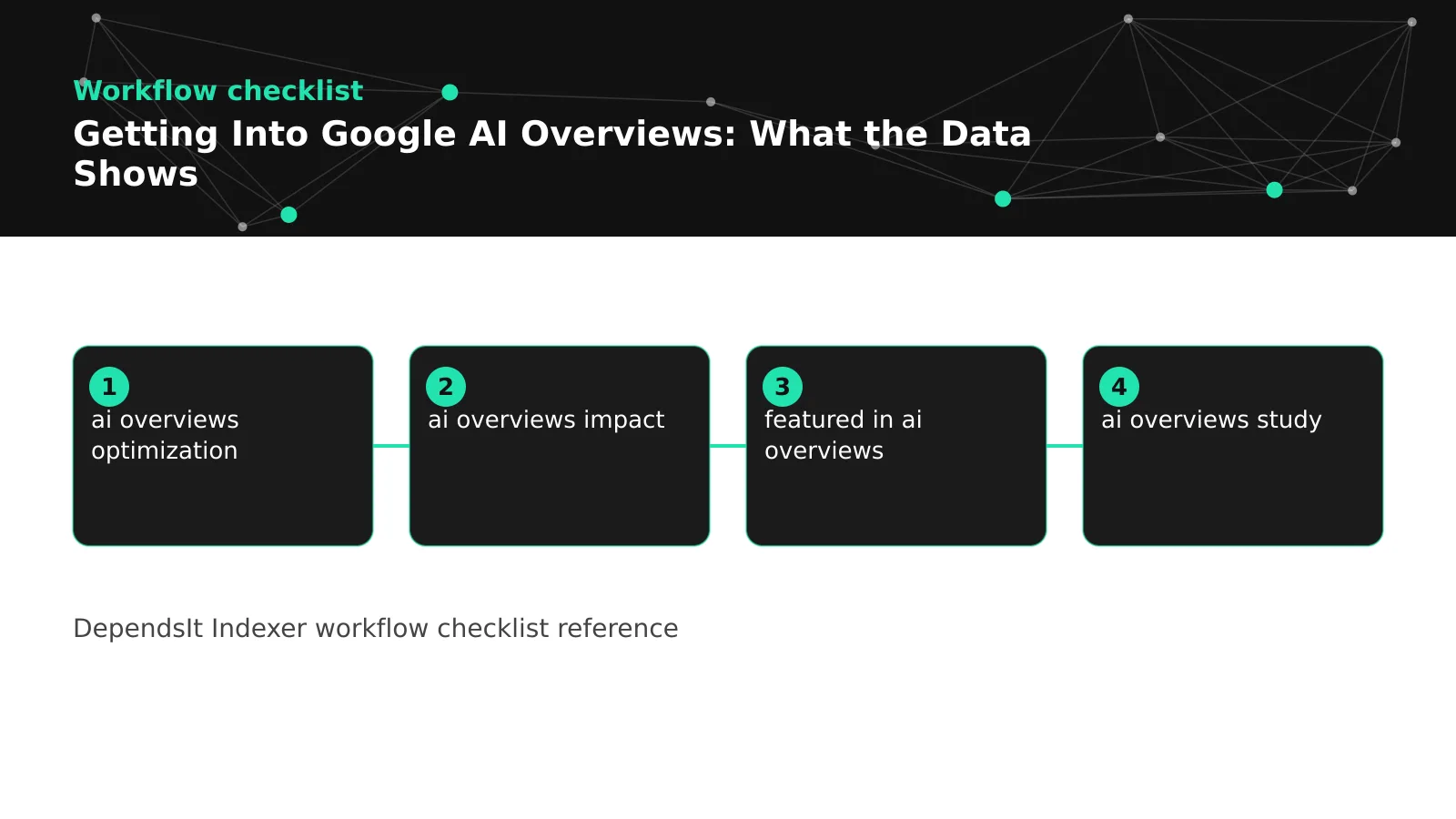
A repeatable workflow beats one off rewrites. Start with a query inventory. Export your top 200 queries from Search Console, add target queries from keyword research, label each by intent, and sample AI Overview presence manually. Mark whether you are cited, whether competitors are cited, and what format the overview uses. This sheet becomes your priority list. Focus first on pages that rank in positions 4 to 20 for queries with an overview. These are close enough to win with better structure.
Next, audit each priority page against a short checklist. Does the H1 match the query. Does the first 150 words give a direct answer with the primary keyword. Are H2 headings phrased as questions or tasks users actually search. Is there a definition block, a step list, or a comparison table near the top. Are specifics present, such as numbers, names, codes, and dates. Are images descriptive with useful alt text. Is the author, date, and sources section visible. Score each item yes or no. Pages with three or more no answers are strong rewrite candidates. Treat this as a short ai overviews seo checklist and repeat the same ai overviews optimization steps for each priority page so improvements stay consistent.
When you rewrite, keep the URL stable and preserve what already works. Tighten the intro to answer directly. Break long sections into H2 and H3 blocks with parallel headings. Add a table where options are compared. Convert buried steps into a numbered list. Add an FAQ that answers real follow up questions, not filler. Add or update structured data to match visible content. Keep the tone plain and specific. Avoid promotional claims that cannot be verified. Link to two or three related internal guides with descriptive anchors so readers can go deeper.
Before publishing, validate. Check rendering, check structured data, check internal links, check alt text, and preview on mobile. After publishing, request a fresh crawl through URL Inspection for important URLs, update the sitemap lastmod, and share the page through normal channels such as navigation or newsletters so it gains internal and external attention. Then wait two to four weeks before judging. AI citation patterns update as Google recrawls and re evaluates, not instantly on publish.
Document every change. Record the date, the sections edited, the queries targeted, and the baseline citation status. This log turns isolated edits into a test program. Over a quarter, you will see which patterns move the needle for your niche, which is far more valuable than applying generic advice blindly.
 <!-- IMAGE-PROMPT workflow-02: 1600px max, DependsIt brand, deep charcoal #121212 background, vibrant mint #22E3B0 accent glow, thin node-network line art, subject: content audit workflow from query inventory to rewrite to validation to citation tracking, flat vector, accessible, no em dash, Clash Display style headings, General Sans clean labels -->
Measuring google ai overviews visibility over time
There is no official Search Console report dedicated to AI Overviews, so you need a blended approach. Combine four signals. First, manual sampling of your priority queries each month, recording overview presence and citation status. Second, rank tracking tools that flag AI Overview features for your keywords, if your tracker supports them. Third, Search Console performance data for impressions, average position, and click through rate on affected queries. Fourth, referral and engagement data for pages that earn citations, to see whether citations send visits or only exposure. Track ai overviews traffic separately from classic clicks so you can explain ai overviews impact to stakeholders with clean numbers.
Click through rate deserves careful reading. A drop in CTR on queries with new overviews does not always mean lower rankings. It can mean the same position now receives fewer clicks because the overview absorbs intent. Segment your analysis. Compare CTR for queries with overviews versus queries without, before and after the overview appears. Look at total impressions as well as clicks. If impressions hold while CTR falls, the page is still visible but the SERP now satisfies more users without a click. That insight guides content shifts described in the companion guide on traffic adaptation.
Manual sampling should be consistent. Use the same location, device type, and signed out state each time, or document variations if you test multiple states. Record the date, the query, whether an overview appeared, how many sources were shown, which domains were cited, and whether your page was cited. A simple spreadsheet works. Over three months, this log reveals which rewrites earned citations and which queries are too volatile to target.
Also track assisted value, not just last click. A citation that does not send an immediate click can still build familiarity that leads to a later branded search or direct visit. Monitor branded search volume, direct traffic to cited guides, newsletter signups from those guides, and contact requests that mention the guide. These proxy metrics capture value that a narrow CTR view misses. They also help you explain AI search to stakeholders who only ask about clicks.
Finally, set review thresholds. If a page earns citations for eight weeks and holds or grows impressions, expand the cluster around it. If a page shows no citation after two rewrite cycles and three months, reconsider the query. The intent may be served better by a different format, such as video, tools, or local results, or the competition may be too entrenched for the effort required.
Common mistakes that keep pages out
The most common mistake is writing for crawlers instead of readers, which produces generic text with no quotable facts. Pages filled with broad statements, repeated keywords, and no specifics give AI systems nothing to cite. Fix this by adding measurements, names, thresholds, dates, and worked examples. Every important claim should be testable or traceable to a source. If a paragraph could apply to any site in any industry, rewrite it with details from your own experience.
The second mistake is burying the answer. Long brand stories, oversized heroes, and meandering introductions push the direct answer far down the page. Both users and AI systems prefer a clear answer near the top. State the answer in the first 150 words, then expand. Keep the intro focused on who the page helps, what problem it solves, and what the reader will be able to do. Avoid hype and keep sentences short.
The third mistake is weak structure. Walls of text without descriptive headings, single H2 pages that cover five subtopics, and inconsistent terminology all reduce citability. Break content into H2 and H3 blocks with parallel phrasing. Use tables for comparisons, lists for steps, and FAQ blocks for follow ups. Keep headings stable and descriptive so they can be referenced.
The fourth mistake is technical neglect. Blocked resources, slow templates, duplicate clusters, and stale sitemaps keep good content out of the candidate pool. Run monthly checks on coverage, speed, and canonicals. Fix crawled currently not indexed patterns promptly, because a page that is crawled but not indexed cannot be cited. The same applies to soft 404 and server error patterns that remove pages quietly.
The fifth mistake is chasing every query. Not all queries should trigger a rewrite. Transactional and local pages often perform better with conversion focused improvements than with AI focused summaries. Spreading AI rewrite effort across the whole site dilutes quality and slows learning. Focus on informational clusters where overviews actually appear and where your expertise is strongest, then expand based on measured wins.
A 90 day plan for steady progress
A focused quarter is enough to move from baseline to repeatable wins. In weeks one to two, build your inventory. Export queries, label intent, sample overview presence, and select 10 priority pages that rank near page one for queries with overviews. Confirm technical eligibility for each page, including index status, canonicals, rendering, and speed. Fix any blocking issues before you edit copy. This foundation prevents wasted rewrites on pages that cannot be cited.
In weeks three to six, rewrite the first five pages. Apply the checklist from earlier sections. Tighten intros, add definition blocks, convert steps to numbered lists, add one comparison table per guide where relevant, and add FAQ blocks that answer real follow ups. Update dates, authors, and sources. Validate structured data and mobile layout. Request recrawls for the edited URLs and update sitemap lastmod. Log every change with dates so you can attribute results.
In weeks seven to ten, rewrite the next five pages and start measuring the first batch. Sample citations weekly for the first batch, biweekly for the rest. Watch Search Console for impression and CTR shifts on targeted queries. Note which formats earned citations fastest. Double down on those formats in the second batch. If a page shows no movement after four weeks, review competitors cited for that query and adjust headings and specifics, not just length.
In weeks eleven to thirteen, consolidate and expand. Turn one page wins into cluster wins by adding supporting pages for related questions and linking them clearly. Refresh one older guide that lost relevance. Document what worked in a one page playbook for your team, including heading patterns, table templates, and QA steps. Schedule quarterly resampling and monthly technical checks so gains persist. By the end of 90 days, you should have 10 improved pages, a citation log, and a clear sense of which query types respond best in your niche.
This plan works because it is narrow and measurable. Ten pages, one log, one checklist, and consistent sampling beat broad promises. AI search will keep changing, but a team that can audit, rewrite, validate, and measure will adapt faster than a team that chases each update with new tactics.
FAQ
What are Google AI Overviews?
AI Overviews are generated summaries shown above classic results for selected queries. They answer the query briefly and link to supporting sources. They draw on crawled and indexed web content, so technical eligibility and clear structure both affect whether a page is cited.
How can I appear in AI Overviews?
Publish pages that Google can crawl and index, answer the query directly near the top, cover the topic completely, include specifics such as steps, tables, and data, and show authorship and dates. Then validate rendering and structured data and track citations over several weeks. Pages that get featured in ai overviews often share the same traits that help aio ranking trackers flag high visibility queries, so use those reports to prioritize rewrites.
Do I need special markup for AI Overviews?
No special markup guarantees inclusion. Standard Article, FAQ, HowTo, and other relevant types help Google parse your content, but they work only when the visible copy is clear and accurate. Keep markup honest, visible, and in sync with on page text.
Why do competitors get cited instead of my page?
Common reasons include clearer structure, more specific detail, stronger topical coverage, fresher content, or better technical health. Compare cited pages side by side with yours for headings, first paragraph clarity, tables, dates, and author signals, then test one focused rewrite.
Do ai overviews citations send ai overviews traffic?
Sometimes. Some citations send qualified visits, especially for complex tasks where users want detail. Many informational queries now end without a click because the summary satisfies intent. Track citations plus impressions, CTR, branded search, and direct visits to see full value.
How long does it take to earn a citation?
Most teams see movement in two to eight weeks after a rewrite and recrawl, depending on crawl frequency and competition. Highly competitive queries can take longer. If there is no change after two rewrite cycles and three months, reconsider the query or format. Build ai overviews optimization into your normal publishing checklist so each new guide starts with clear answers, tables, and dates.
Sources
- https://developers.google.com/search/docs/crawling-indexing/overview
- https://support.google.com/webmasters/answer/7443459