BYOK and Data Governance: Keeping Compliance Happy

This guide is for SEO leads, platform owners, and compliance reviewers who use bring your own key tools for indexing. The primary keyword is byok compliance, and the focus is how customer held keys change data ownership, auditability, and vendor risk. Indexing tools see your most sensitive plans, including unpublished URLs, client lists, inventory changes, and launch timing. Governance decides who can see that data, how long it is kept, where it lives, and how you prove control during a review.
You will learn what BYOK changes compared with shared key SaaS, which audit trails and retention controls to require, how to run vendor reviews, and how to write practical policies for access, logging, and incident response. The guide includes checklists for regulated teams, contract language to look for, and logging patterns that keep URL strategy private while still giving compliance the evidence it needs.
Key takeaways
- BYOK keeps keys and usage in your cloud, which simplifies ownership, audits, and deletion proof.
- Require immutable audit logs, scoped access, retention limits, and clear data residency for every indexing vendor.
- Log submission metadata without storing full strategy, and review who can read logs as carefully as who can submit.
- Contracts should name data roles, subprocessors, breach notice times, and deletion duties in plain terms.
- What BYOK means for data ownership and control
- Why compliance teams prefer customer held keys
- Data residency, retention, and deletion in BYOK tools
- Audit trails every regulated team should require
- Access controls and least privilege with shared APIs
- Vendor risk reviews for indexing platforms
- Logging URL submissions without leaking strategy
- Contracts, DPAs, and shared responsibility
- Incident response when a key is exposed
- Retention policies for logs and metadata
- A byok compliance checklist for SEO and platform teams
- FAQ
- Sources
- Further reading
 <!-- IMAGE-META 1200 630 16 --> <!-- IMAGE-PROMPT cover: 1200x630, DependsIt brand, deep charcoal #121212 or clean white background, vibrant mint #22E3B0 accent glow, thin node-network line art, Clash Display style bold heading space on left, General Sans clean labels, subject: BYOK governance with shield audit log and key vault for compliance teams, flat vector, high contrast, accessible, no photorealistic faces, no text smaller than 24px, no em dash in rendered text, export PNG then cwebp -q 82 to WEBP -->
What BYOK means for data ownership and control
What BYOK means for data ownership and control deserves a concrete plan because it controls whether bulk work stays predictable or turns into quota surprises. For what byok means for data ownership and control, begin with ownership. In a BYOK setup the customer creates keys in its own cloud, grants minimum scope to named properties, and stores secrets in its own manager. The vendor operates software that uses short lived access at job time and writes redacted logs. This split matters for governance because it places rotation, revocation, and access review where your existing controls already live, instead of inside a vendor dashboard with different rules.
Make controls visible in daily work. Then define evidence. Every submission should record tenant, actor, timestamp, URL hash, action type, engine, response code, and job ID, without storing full page content or strategy notes. Keep debug logs for 30 days and aggregated metrics for 12 months, or match the longer of your framework and client contracts. Make exports self serve so an auditor never waits on support to prove who submitted what and when access changed.
- Name the data owner, key custodian, and log reviewer for each site group, with deputies for leave coverage.
- Map where keys, submission logs, and support tickets live, including regions and retention windows.
- Require scoped access with expiry for vendors, agencies, and internal transfers between teams.
- Schedule quarterly access reviews and yearly contract reviews with clear pass criteria.
- Keep deletion and incident steps on one page, with contacts and expected timelines.
Treat governance as product quality. Close the loop with reviews. Revisit scopes quarterly, remove dormant grants, confirm residency for keys and logs, and test deletion on a sample tenant. Record decisions in a short decision log that names the approver and the reason. When reviews are routine, compliance stops being a yearly scramble and becomes a set of small habits the SEO and platform teams can sustain. Small steady checks beat a large annual effort that finds problems too late to fix cheaply.
Ownership clarity prevents most governance disputes. Name one owner for key creation, one custodian for rotation, and one reviewer for logs. Write those names in your runbook so audits never start with guesswork about responsibility. A written byok data governance map that names owners, regions, and retention windows gives auditors a single page to verify against your governance framework.
Why compliance teams prefer customer held keys
Teams get why compliance teams prefer customer held keys right by measuring first and automating second. For why compliance teams prefer customer held keys, begin with ownership. In a BYOK setup the customer creates keys in its own cloud, grants minimum scope to named properties, and stores secrets in its own manager. The vendor operates software that uses short lived access at job time and writes redacted logs. This split matters for governance because it places rotation, revocation, and access review where your existing controls already live, instead of inside a vendor dashboard with different rules.
Make controls visible in daily work. Then define evidence. Every submission should record tenant, actor, timestamp, URL hash, action type, engine, response code, and job ID, without storing full page content or strategy notes. Keep debug logs for 30 days and aggregated metrics for 12 months, or match the longer of your framework and client contracts. Make exports self serve so an auditor never waits on support to prove who submitted what and when access changed.
- Name the data owner, key custodian, and log reviewer for each site group, with deputies for leave coverage.
- Map where keys, submission logs, and support tickets live, including regions and retention windows.
- Require scoped access with expiry for vendors, agencies, and internal transfers between teams.
- Schedule quarterly access reviews and yearly contract reviews with clear pass criteria.
- Keep deletion and incident steps on one page, with contacts and expected timelines.
Treat governance as product quality. Close the loop with reviews. Revisit scopes quarterly, remove dormant grants, confirm residency for keys and logs, and test deletion on a sample tenant. Record decisions in a short decision log that names the approver and the reason. When reviews are routine, compliance stops being a yearly scramble and becomes a set of small habits the SEO and platform teams can sustain. Small steady checks beat a large annual effort that finds problems too late to fix cheaply.
Scope reviews work best on a calendar. Every quarter, export active grants, compare them with current site lists, and remove anything unused. Keep the export with the review date for your audit file.
Data residency, retention, and deletion in BYOK tools
Data residency, retention, and deletion in BYOK tools is where theory meets logs, queues, and on call time. For data residency, retention, and deletion in byok tools, begin with ownership. In a BYOK setup the customer creates keys in its own cloud, grants minimum scope to named properties, and stores secrets in its own manager. The vendor operates software that uses short lived access at job time and writes redacted logs. This split matters for governance because it places rotation, revocation, and access review where your existing controls already live, instead of inside a vendor dashboard with different rules.
Make controls visible in daily work. Then define evidence. Every submission should record tenant, actor, timestamp, URL hash, action type, engine, response code, and job ID, without storing full page content or strategy notes. Keep debug logs for 30 days and aggregated metrics for 12 months, or match the longer of your framework and client contracts. Make exports self serve so an auditor never waits on support to prove who submitted what and when access changed.
- Name the data owner, key custodian, and log reviewer for each site group, with deputies for leave coverage.
- Map where keys, submission logs, and support tickets live, including regions and retention windows.
- Require scoped access with expiry for vendors, agencies, and internal transfers between teams.
- Schedule quarterly access reviews and yearly contract reviews with clear pass criteria.
- Keep deletion and incident steps on one page, with contacts and expected timelines.
Treat governance as product quality. Close the loop with reviews. Revisit scopes quarterly, remove dormant grants, confirm residency for keys and logs, and test deletion on a sample tenant. Record decisions in a short decision log that names the approver and the reason. When reviews are routine, compliance stops being a yearly scramble and becomes a set of small habits the SEO and platform teams can sustain. Small steady checks beat a large annual effort that finds problems too late to fix cheaply.
 <!-- IMAGE-META 1600 900 37 --> <!-- IMAGE-PROMPT diagram-01: 1600px max, DependsIt brand mint #22E3B0 on charcoal #121212 or white, node-network line art, subject: data governance diagram showing key ownership audit trail and retention, flat vector, accessible, no em dash, Clash Display headings feel and General Sans labels feel -->
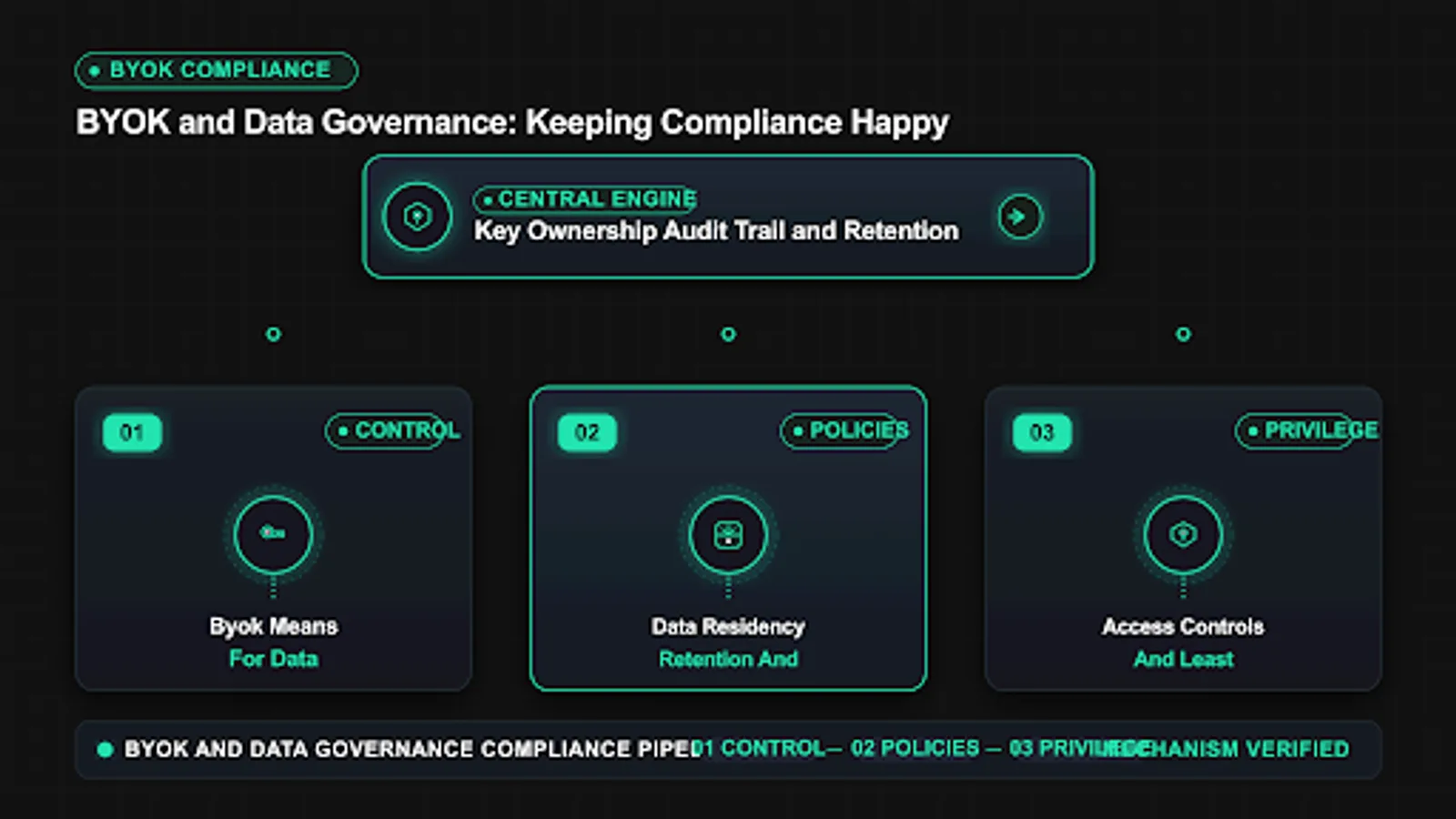
Retention rules need two tiers. Keep detailed debug logs for thirty days to fix delivery issues, then keep aggregated counts and codes for twelve months to show trends without storing strategy. Pin data residency keys to the regions named in your policy and confirm backup regions match before you connect a new vendor.
Audit trails every regulated team should require
Audit trails every regulated team should require deserves a concrete plan because it controls whether bulk work stays predictable or turns into quota surprises. For audit trails every regulated team should require, begin with ownership. In a BYOK setup the customer creates keys in its own cloud, grants minimum scope to named properties, and stores secrets in its own manager. The vendor operates software that uses short lived access at job time and writes redacted logs. This split matters for governance because it places rotation, revocation, and access review where your existing controls already live, instead of inside a vendor dashboard with different rules.
Make controls visible in daily work. Then define evidence. Every submission should record tenant, actor, timestamp, URL hash, action type, engine, response code, and job ID, without storing full page content or strategy notes. Keep debug logs for 30 days and aggregated metrics for 12 months, or match the longer of your framework and client contracts. Make exports self serve so an auditor never waits on support to prove who submitted what and when access changed. For background on credential hygiene, see how to keep service account keys secure.
- Name the data owner, key custodian, and log reviewer for each site group, with deputies for leave coverage.
- Map where keys, submission logs, and support tickets live, including regions and retention windows.
- Require scoped access with expiry for vendors, agencies, and internal transfers between teams.
- Schedule quarterly access reviews and yearly contract reviews with clear pass criteria.
- Keep deletion and incident steps on one page, with contacts and expected timelines.
{
  "tenant": "acme-eu",
  "actor": "seo-lead@example.com",
  "url_hash": "sha256:9f2c...",
  "action": "indexnow.submit",
  "engine_status": 202,
  "job_id": "job_01J9..."
}
Treat governance as product quality. Close the loop with reviews. Revisit scopes quarterly, remove dormant grants, confirm residency for keys and logs, and test deletion on a sample tenant. Record decisions in a short decision log that names the approver and the reason. When reviews are routine, compliance stops being a yearly scramble and becomes a set of small habits the SEO and platform teams can sustain. Small steady checks beat a large annual effort that finds problems too late to fix cheaply.
Residency checks are simple when keys stay in your cloud. Confirm the secret manager region, the log bucket region, and backup regions match policy before you connect a new vendor. Schedule a monthly audit api usage review that exports actor, batch, and result counts for the audit file.
Access controls and least privilege with shared APIs
Teams get access controls and least privilege with shared apis right by measuring first and automating second. For access controls and least privilege with shared apis, begin with ownership. In a BYOK setup the customer creates keys in its own cloud, grants minimum scope to named properties, and stores secrets in its own manager. The vendor operates software that uses short lived access at job time and writes redacted logs. This split matters for governance because it places rotation, revocation, and access review where your existing controls already live, instead of inside a vendor dashboard with different rules.
Make controls visible in daily work. Then define evidence. Every submission should record tenant, actor, timestamp, URL hash, action type, engine, response code, and job ID, without storing full page content or strategy notes. Keep debug logs for 30 days and aggregated metrics for 12 months, or match the longer of your framework and client contracts. Make exports self serve so an auditor never waits on support to prove who submitted what and when access changed.
- Name the data owner, key custodian, and log reviewer for each site group, with deputies for leave coverage.
- Map where keys, submission logs, and support tickets live, including regions and retention windows.
- Require scoped access with expiry for vendors, agencies, and internal transfers between teams.
- Schedule quarterly access reviews and yearly contract reviews with clear pass criteria.
- Keep deletion and incident steps on one page, with contacts and expected timelines.
Treat governance as product quality. Close the loop with reviews. Revisit scopes quarterly, remove dormant grants, confirm residency for keys and logs, and test deletion on a sample tenant. Record decisions in a short decision log that names the approver and the reason. When reviews are routine, compliance stops being a yearly scramble and becomes a set of small habits the SEO and platform teams can sustain. Small steady checks beat a large annual effort that finds problems too late to fix cheaply.
Vendor questionnaires should ask for subprocessors, breach notice time, support access to secrets, and deletion steps. Short specific answers beat long generic policies. Write the answers into a short key policy that states who may hold compliance api keys and how long grants last.
Vendor risk reviews for indexing platforms
Vendor risk reviews for indexing platforms is where theory meets logs, queues, and on call time. For vendor risk reviews for indexing platforms, begin with ownership. In a BYOK setup the customer creates keys in its own cloud, grants minimum scope to named properties, and stores secrets in its own manager. The vendor operates software that uses short lived access at job time and writes redacted logs. This split matters for governance because it places rotation, revocation, and access review where your existing controls already live, instead of inside a vendor dashboard with different rules.
Make controls visible in daily work. Then define evidence. Every submission should record tenant, actor, timestamp, URL hash, action type, engine, response code, and job ID, without storing full page content or strategy notes. Keep debug logs for 30 days and aggregated metrics for 12 months, or match the longer of your framework and client contracts. Make exports self serve so an auditor never waits on support to prove who submitted what and when access changed.
- Name the data owner, key custodian, and log reviewer for each site group, with deputies for leave coverage.
- Map where keys, submission logs, and support tickets live, including regions and retention windows.
- Require scoped access with expiry for vendors, agencies, and internal transfers between teams.
- Schedule quarterly access reviews and yearly contract reviews with clear pass criteria.
- Keep deletion and incident steps on one page, with contacts and expected timelines.
Treat governance as product quality. Close the loop with reviews. Revisit scopes quarterly, remove dormant grants, confirm residency for keys and logs, and test deletion on a sample tenant. Record decisions in a short decision log that names the approver and the reason. When reviews are routine, compliance stops being a yearly scramble and becomes a set of small habits the SEO and platform teams can sustain. Small steady checks beat a large annual effort that finds problems too late to fix cheaply.
Ticket hygiene matters because support threads often collect URLs and keys. Set a rule to redact secrets before posting, link job IDs instead of pasting lists, and close tickets with deletion notes. Score each vendor with the same rubric you use for other compliance seo tools so results stay comparable across reviews.
Logging URL submissions without leaking strategy
Logging URL submissions without leaking strategy deserves a concrete plan because it controls whether bulk work stays predictable or turns into quota surprises. For logging url submissions without leaking strategy, begin with ownership. In a BYOK setup the customer creates keys in its own cloud, grants minimum scope to named properties, and stores secrets in its own manager. The vendor operates software that uses short lived access at job time and writes redacted logs. This split matters for governance because it places rotation, revocation, and access review where your existing controls already live, instead of inside a vendor dashboard with different rules.
Make controls visible in daily work. Then define evidence. Every submission should record tenant, actor, timestamp, URL hash, action type, engine, response code, and job ID, without storing full page content or strategy notes. Keep debug logs for 30 days and aggregated metrics for 12 months, or match the longer of your framework and client contracts. Make exports self serve so an auditor never waits on support to prove who submitted what and when access changed.
- Name the data owner, key custodian, and log reviewer for each site group, with deputies for leave coverage.
- Map where keys, submission logs, and support tickets live, including regions and retention windows.
- Require scoped access with expiry for vendors, agencies, and internal transfers between teams.
- Schedule quarterly access reviews and yearly contract reviews with clear pass criteria.
- Keep deletion and incident steps on one page, with contacts and expected timelines.
Treat governance as product quality. Close the loop with reviews. Revisit scopes quarterly, remove dormant grants, confirm residency for keys and logs, and test deletion on a sample tenant. Record decisions in a short decision log that names the approver and the reason. When reviews are routine, compliance stops being a yearly scramble and becomes a set of small habits the SEO and platform teams can sustain. Small steady checks beat a large annual effort that finds problems too late to fix cheaply.
 <!-- IMAGE-META 1600 900 38 --> <!-- IMAGE-PROMPT workflow-02: 1600px max, DependsIt brand mint #22E3B0 on charcoal #121212 or white, node-network line art, subject: compliance review workflow from vendor check to audit and retention, flat vector, accessible, no em dash, Clash Display headings feel and General Sans labels feel -->
Access for agencies should expire by default. Create time bound roles tied to active statements of work, require ticket references for bulk jobs, and remove seats within one business day of project close.
Contracts, DPAs, and shared responsibility
Teams get contracts, dpas, and shared responsibility right by measuring first and automating second. For contracts, dpas, and shared responsibility, begin with ownership. In a BYOK setup the customer creates keys in its own cloud, grants minimum scope to named properties, and stores secrets in its own manager. The vendor operates software that uses short lived access at job time and writes redacted logs. This split matters for governance because it places rotation, revocation, and access review where your existing controls already live, instead of inside a vendor dashboard with different rules.
Make controls visible in daily work. Then define evidence. Every submission should record tenant, actor, timestamp, URL hash, action type, engine, response code, and job ID, without storing full page content or strategy notes. Keep debug logs for 30 days and aggregated metrics for 12 months, or match the longer of your framework and client contracts. Make exports self serve so an auditor never waits on support to prove who submitted what and when access changed. Ground protocol facts in IndexNow protocol documentation and review Google Search Central on access control.
- Name the data owner, key custodian, and log reviewer for each site group, with deputies for leave coverage.
- Map where keys, submission logs, and support tickets live, including regions and retention windows.
- Require scoped access with expiry for vendors, agencies, and internal transfers between teams.
- Schedule quarterly access reviews and yearly contract reviews with clear pass criteria.
- Keep deletion and incident steps on one page, with contacts and expected timelines.
Treat governance as product quality. Close the loop with reviews. Revisit scopes quarterly, remove dormant grants, confirm residency for keys and logs, and test deletion on a sample tenant. Record decisions in a short decision log that names the approver and the reason. When reviews are routine, compliance stops being a yearly scramble and becomes a set of small habits the SEO and platform teams can sustain. Small steady checks beat a large annual effort that finds problems too late to fix cheaply.
Incident drills save time when a real leak occurs. Practice rotation twice per year, time each step, and keep contact details for cloud, Search Console, and vendor support on one page. For enterprise byok contracts, name data roles, subprocessors, breach notice times, and deletion duties in plain terms.
Incident response when a key is exposed
Incident response when a key is exposed is where theory meets logs, queues, and on call time. For incident response when a key is exposed, begin with ownership. In a BYOK setup the customer creates keys in its own cloud, grants minimum scope to named properties, and stores secrets in its own manager. The vendor operates software that uses short lived access at job time and writes redacted logs. This split matters for governance because it places rotation, revocation, and access review where your existing controls already live, instead of inside a vendor dashboard with different rules.
Make controls visible in daily work. Then define evidence. Every submission should record tenant, actor, timestamp, URL hash, action type, engine, response code, and job ID, without storing full page content or strategy notes. Keep debug logs for 30 days and aggregated metrics for 12 months, or match the longer of your framework and client contracts. Make exports self serve so an auditor never waits on support to prove who submitted what and when access changed.
- Name the data owner, key custodian, and log reviewer for each site group, with deputies for leave coverage.
- Map where keys, submission logs, and support tickets live, including regions and retention windows.
- Require scoped access with expiry for vendors, agencies, and internal transfers between teams.
- Schedule quarterly access reviews and yearly contract reviews with clear pass criteria.
- Keep deletion and incident steps on one page, with contacts and expected timelines.
Treat governance as product quality. Close the loop with reviews. Revisit scopes quarterly, remove dormant grants, confirm residency for keys and logs, and test deletion on a sample tenant. Record decisions in a short decision log that names the approver and the reason. When reviews are routine, compliance stops being a yearly scramble and becomes a set of small habits the SEO and platform teams can sustain. Small steady checks beat a large annual effort that finds problems too late to fix cheaply.
Deletion proof closes the loop. After offboarding a vendor, request confirmation of key removal and log deletion, save the confirmation, and verify quota activity returns to expected baselines.
Retention policies for logs and metadata
Retention policies for logs and metadata deserves a concrete plan because it controls whether bulk work stays predictable or turns into quota surprises. For retention policies for logs and metadata, begin with ownership. In a BYOK setup the customer creates keys in its own cloud, grants minimum scope to named properties, and stores secrets in its own manager. The vendor operates software that uses short lived access at job time and writes redacted logs. This split matters for governance because it places rotation, revocation, and access review where your existing controls already live, instead of inside a vendor dashboard with different rules.
Make controls visible in daily work. Then define evidence. Every submission should record tenant, actor, timestamp, URL hash, action type, engine, response code, and job ID, without storing full page content or strategy notes. Keep debug logs for 30 days and aggregated metrics for 12 months, or match the longer of your framework and client contracts. Make exports self serve so an auditor never waits on support to prove who submitted what and when access changed.
- Name the data owner, key custodian, and log reviewer for each site group, with deputies for leave coverage.
- Map where keys, submission logs, and support tickets live, including regions and retention windows.
- Require scoped access with expiry for vendors, agencies, and internal transfers between teams.
- Schedule quarterly access reviews and yearly contract reviews with clear pass criteria.
- Keep deletion and incident steps on one page, with contacts and expected timelines.
Treat governance as product quality. Close the loop with reviews. Revisit scopes quarterly, remove dormant grants, confirm residency for keys and logs, and test deletion on a sample tenant. Record decisions in a short decision log that names the approver and the reason. When reviews are routine, compliance stops being a yearly scramble and becomes a set of small habits the SEO and platform teams can sustain. Small steady checks beat a large annual effort that finds problems too late to fix cheaply.
Training keeps controls alive. Show new SEO hires where keys live, how to request scoped access, and what never to paste in chat. A fifteen minute session prevents most common mistakes.
A byok compliance checklist for SEO and platform teams
Teams get a compliance checklist for seo and platform teams right by measuring first and automating second. For a compliance checklist for seo and platform teams, begin with ownership. In a BYOK setup the customer creates keys in its own cloud, grants minimum scope to named properties, and stores secrets in its own manager. The vendor operates software that uses short lived access at job time and writes redacted logs. This split matters for governance because it places rotation, revocation, and access review where your existing controls already live, instead of inside a vendor dashboard with different rules.
Make controls visible in daily work. Then define evidence. Every submission should record tenant, actor, timestamp, URL hash, action type, engine, response code, and job ID, without storing full page content or strategy notes. Keep debug logs for 30 days and aggregated metrics for 12 months, or match the longer of your framework and client contracts. Make exports self serve so an auditor never waits on support to prove who submitted what and when access changed.
- Name the data owner, key custodian, and log reviewer for each site group, with deputies for leave coverage.
- Map where keys, submission logs, and support tickets live, including regions and retention windows.
- Require scoped access with expiry for vendors, agencies, and internal transfers between teams.
- Schedule quarterly access reviews and yearly contract reviews with clear pass criteria.
- Keep deletion and incident steps on one page, with contacts and expected timelines.
Treat governance as product quality. Close the loop with reviews. Revisit scopes quarterly, remove dormant grants, confirm residency for keys and logs, and test deletion on a sample tenant. Record decisions in a short decision log that names the approver and the reason. When reviews are routine, compliance stops being a yearly scramble and becomes a set of small habits the SEO and platform teams can sustain. Small steady checks beat a large annual effort that finds problems too late to fix cheaply.
Reporting to leadership should use plain counts. Show submissions per site, accept rates, rotation dates, and open review items. Clear metrics keep governance funded and visible.
FAQ
What does BYOK change for compliance?
BYOK moves API credentials and usage metering into your cloud account while the vendor runs scoped software. That means you own rotation, revocation, and access logs, and you can show auditors exactly where keys live and who touched them. Vendors see less standing access, which narrows breach scope and simplifies data maps. Teams in regulated industries saas setups use this split to keep client data inside their own boundary while vendors run scoped jobs.
Do we still need a DPA with a BYOK vendor?
In most cases yes. Even when keys stay yours, vendors often process URLs, timestamps, response codes, and support tickets that can reveal strategy or personal data. A data processing addendum should name roles, subprocessors, retention, deletion, and breach notice duties. Keep the list short and review it yearly.
Where should keys and logs live?
Keys belong in your secret manager with envelope encryption and regional controls that match policy. Submission logs belong in your project with short retention for debug and longer aggregated metrics for trends. Avoid scattering copies in chat, tickets, or vendor dashboards with broad access.
What audit evidence should we keep?
Keep key creation and rotation events, permission grants, submission batches with actor and result, access reviews, and deletion confirmations. Store them immutably for the period your framework requires, often 12 months, and make them exportable without vendor help.
How do we handle agencies and freelancers?
Give external users scoped roles in your central service, never raw keys. Limit to specific sites, set expiry dates, and require ticket references for bulk jobs. Remove access on project close and keep the log of what they submitted for the client record. Larger byok enterprise rollouts add expiry tied to statements of work and a quarterly review of every external grant.
What happens if a key leaks?
Revoke and rotate immediately, review logs for unknown submissions, tighten scopes, and notify per policy. Because BYOK keeps the key in your control, you can act without waiting on a vendor. Record the timeline for the incident file and add a preventive check so the same path cannot recur.
Sources
- https://developers.google.com/search/docs/crawling-indexing/sitemaps/build-sitemap
- https://www.indexnow.org/documentation
- https://developers.cloudflare.com/workers/configuration/secrets/