The Two-API Workflow: Covering Google and IndexNow Together

Google and indexnow together is the normal setup for sites that serve both Google users and Bing powered audiences. IndexNow is an open protocol co-developed by Microsoft Bing and Yandex that reaches Bing, Yandex, Naver, Seznam, and related supporters. The Google Indexing API is a separate Google only endpoint for JobPosting and BroadcastEvent pages that uses URL_UPDATED and URL_DELETED notices. One publish event can feed both tracks when queues stay separate and clean.
In this guide you will build a single workflow that submits each changed canonical URL to the right tracks at publish time, with deduplication, pacing, logging, and backoff per track. It is written for developers, SEOs, and publishers who run blogs, job boards, stores, or news sites and want full coverage without double work. You will finish with queue rules, error handling tables, test steps, and a starter setup you can operate weekly.
Key takeaways
- Google and IndexNow cover different engines, so one publish event should fan out to both tracks.
- Each track keeps its own auth, quota, logs, and retry rules to avoid cross contamination.
- Deduplication plus pacing keeps both systems inside limits during launches.
- A small control set and per track timestamps show which engine responded and when.
- Why two tracks exist and why one ping cannot cover all
- Coverage map which URLs go to which track
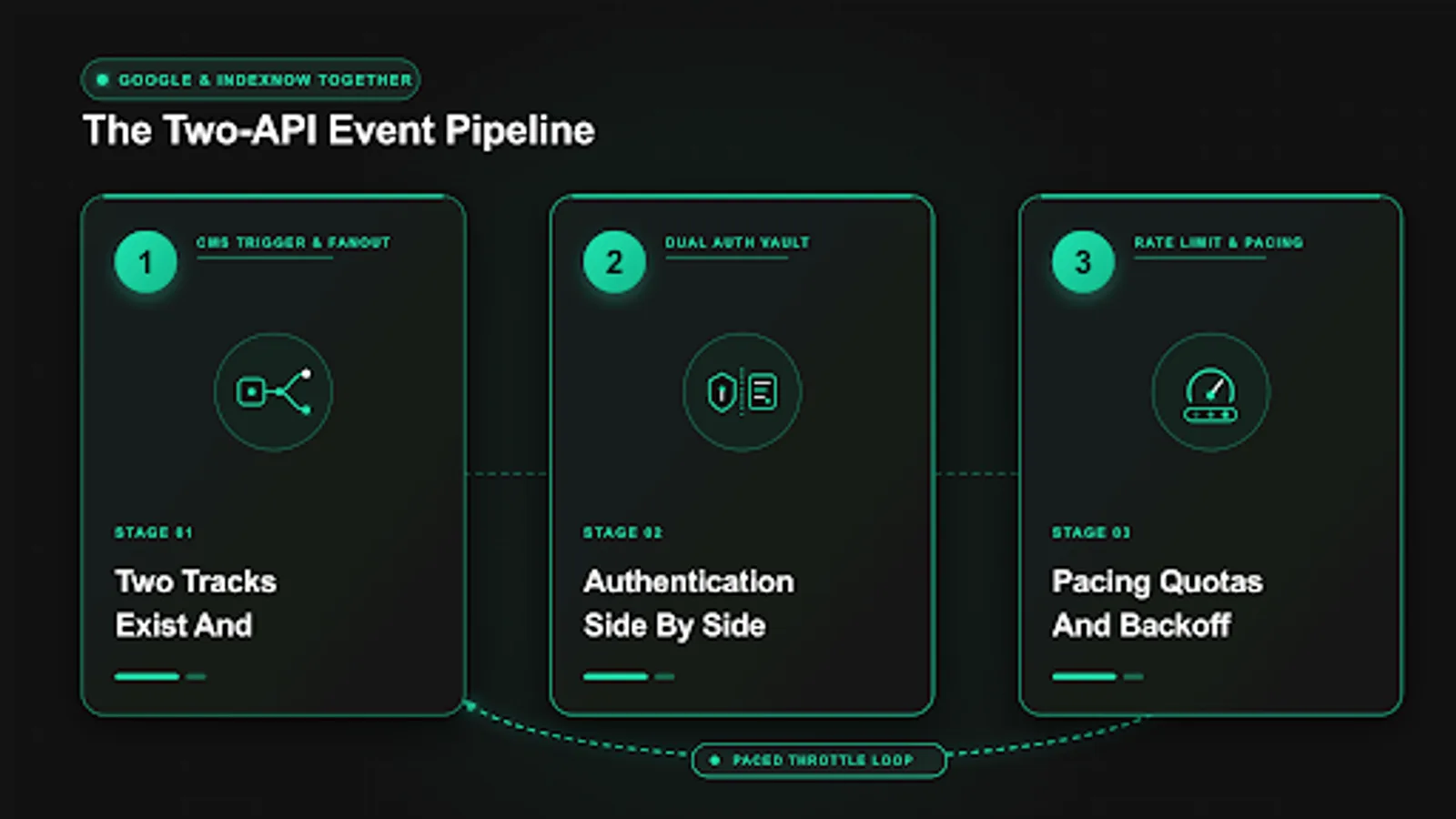
- Authentication side by side without mixing secrets
- Queue design with deduplication built in
- Pacing quotas and backoff that respect both systems
- CMS hooks and deploy hooks that fire once per change
- Logging and request IDs per track
- Error handling matrix for both tracks
- Testing before scale with a small control set
- Operating cost and maintenance reality
- Google and IndexNow Together: Recommended Starter Setup
 <!-- IMAGE-PROMPT cover: 1200x630, DependsIt brand, deep charcoal #121212 background with vibrant mint #22E3B0 accent glow, thin node-network line art, Clash Display style bold heading space on left, General Sans clean labels, subject: two track indexing workflow with Google and IndexNow paths and network nodes, flat vector, high contrast, accessible, no photorealistic faces, no text smaller than 24px, no em dash in rendered text, export PNG then cwebp -q 82 to WEBP -->
Why two tracks exist and why one ping cannot cover all
Search engines split into two groups for notification purposes. IndexNow supporters accept an open key based ping for many general page types, while Google does not support IndexNow and offers its own authenticated API for narrow eligible types plus sitemaps and Search Console for everything else. No single request reaches both groups, so sites that care about both audiences run two tracks from the same publish event.
The split is practical rather than political for daily work. Each track has its own auth, batch shape, quota, and response codes, which means shared code without separation creates confusing logs. Treat the CMS publish as the single source of truth, then fan out to a Google queue and an IndexNow queue with separate workers. Coverage becomes a routing question instead of a guessing game.
For teams tracking google and indexnow together, the practical link to why two tracks exist and why one ping cannot cover all is discovery speed, not a direct position change. When a changed URL is pinged cleanly, participating engines can fetch it sooner, which shortens the wait between publish and crawl. That earlier crawl still passes through the normal quality checks, so relevance, intent match, and page experience decide where the page can rank. Treat why two tracks exist and why one ping cannot cover all as a way to remove delay, then let content quality do the ranking work.
A common mistake around why two tracks exist and why one ping cannot cover all is sending noisy signals and then reading the noise as a ranking effect. Repeated pings for unchanged URLs, pings for non canonical variants, and pings for thin pages all waste attention and can slow trust. Deduplicate the queue, ping only canonical URLs that actually changed, and space batches so engines see a steady pattern. Clean sends make crawl logs easier to read and keep google and indexnow together work credible with stakeholders.
Stakeholder reporting on why two tracks exist and why one ping cannot cover all should separate three clocks: time to ping, time to crawl, and time to rank. The first two often improve with google and indexnow together because engines learn about changes sooner. The third depends on competition, query intent, and page quality, which pings cannot change. Report all three side by side so faster discovery is visible even when positions move slowly. That honest split builds trust in the indexing work.
When you review why two tracks exist and why one ping cannot cover all, keep sitemaps, internal links, canonical tags, and server health in the same picture. IndexNow complements these foundations, it does not replace them. A clean XML sitemap still lists the canonical set, internal links still pass context, and a stable server still lets crawlers finish the job. If any of those basics are broken, faster pings cannot fix the outcome. Fix structure first, then use google and indexnow together pings to surface fresh URLs sooner.
Checklist for this section:
- IndexNow reaches Bing, Yandex, Naver, Seznam, and related supporters.
- Google API reaches Google for eligible job and livestream pages.
- Sitemaps and links still carry Google general pages.
- One publish event feeds two separate queues.
Start with protocol basics in the complete IndexNow protocol guide so routing decisions rest on the real spec.
Work through this part before moving on, and record the date and result so later reviews have facts to use.
Coverage map which URLs go to which track
Route by engine and page type rather than by habit. Teams that need to submit to Google and Bing from one publish event should route general posts, product pages, docs, and category pages to IndexNow plus sitemaps, because supporters accept broad types. Job postings with valid markup can use indexnow plus google api handling when both audiences matter. Job postings and livestream pages with valid JobPosting or BroadcastEvent markup go to both IndexNow and the Google API when the site targets Google jobs or video surfaces. Normal pages stay off the Google API outside its documented scope.
A simple routing table in code or config prevents off label sends. Tag each URL with content type at publish time, then let the router decide which queues receive it. Log routing decisions with the URL so audits can show why a page went to one track, both tracks, or sitemap only. Clear routing also keeps quota spend tied to eligible URLs.
When you review coverage map which urls go to which track, keep sitemaps, internal links, canonical tags, and server health in the same picture. IndexNow complements these foundations, it does not replace them. A clean XML sitemap still lists the canonical set, internal links still pass context, and a stable server still lets crawlers finish the job. If any of those basics are broken, faster pings cannot fix the outcome. Fix structure first, then use google and indexnow together pings to surface fresh URLs sooner.
From an operations view, coverage map which urls go to which track needs a short checklist and one owner. Confirm the key file is reachable, confirm each batch used valid JSON with host and key fields, confirm response codes were logged, and confirm the crawl followed within the expected window. When a step fails, fix that step before resending the same URLs. This keeps google and indexnow together effort tied to verifiable actions instead of guesses about ranking moves.
When coverage map which urls go to which track involves Bing or Yandex, remember that each supporter applies its own crawl and quality filters after the ping. A 200 or 202 response means the submission was accepted, not that the URL will be indexed or ranked. Watch bot hits in server logs, then check index coverage in the relevant webmaster tools. Use that chain as proof that google and indexnow together did its part, and treat ranking separately as a content and relevance task.
Measurement for coverage map which urls go to which track works best with dates and server logs rather than rank snapshots alone. Record when each URL was published, when it was pinged, when the engine fetched it, and when it first appeared in results. Compare pinged URLs against a small control set that was left to natural discovery. This shows whether google and indexnow together shortened time to crawl without confusing crawl speed with ranking strength. Keep the test window to a few weeks so seasonal moves do not blur the read.
| Content type | IndexNow | Google API | Sitemap |
|---|---|---|---|
| Blog post | Yes | No | Yes |
| Product page | Yes | No | Yes |
| Job posting | Yes | Yes if eligible | Yes |
| Livestream page | Yes | Yes if eligible | Yes |
Checklist for this section:
- General pages go to IndexNow plus sitemaps.
- Jobs and livestreams go to both tracks when eligible.
- Normal pages skip the Google API.
- Log routing choice per URL.
Work through this part before moving on, and record the date and result so later reviews have facts to use.
Authentication side by side without mixing secrets
IndexNow auth is a public random key plus a matching text file at the site root, with the same key inside each JSON batch. Setup takes minutes, rotation means publishing a new file, and monitoring means checking that the file returns HTTP 200 with exact content. The key is public by design, so storage rules stay simple as long as the file stays reachable.
Google API auth is a private Cloud service account with a JSON key, OAuth tokens, and Search Console permissions on the property. Setup takes longer, rotation means new keys plus secret updates, and monitoring means watching token errors and permission failures. Keep the two credential sets apart in config and logs, with the IndexNow key marked public and the Google JSON marked secret with limited access.
Measurement for authentication side by side without mixing secrets works best with dates and server logs rather than rank snapshots alone. Record when each URL was published, when it was pinged, when the engine fetched it, and when it first appeared in results. Compare pinged URLs against a small control set that was left to natural discovery. This shows whether google and indexnow together shortened time to crawl without confusing crawl speed with ranking strength. Keep the test window to a few weeks so seasonal moves do not blur the read.
For authentication side by side without mixing secrets, think in terms of crawl budget and priority rather than positions. Engines allocate fetch capacity based on site trust, change rate, and URL value. A focused set of changed canonical URLs earns faster revisits than a bulk dump of everything. Prioritize updated posts, changed product pages, and corrected canonicals, and leave evergreen URLs to sitemaps and natural recrawl. This is how google and indexnow together helps important pages get seen sooner without spamming.
For teams tracking google and indexnow together, the practical link to authentication side by side without mixing secrets is discovery speed, not a direct position change. When a changed URL is pinged cleanly, participating engines can fetch it sooner, which shortens the wait between publish and crawl. That earlier crawl still passes through the normal quality checks, so relevance, intent match, and page experience decide where the page can rank. Treat authentication side by side without mixing secrets as a way to remove delay, then let content quality do the ranking work.
A common mistake around authentication side by side without mixing secrets is sending noisy signals and then reading the noise as a ranking effect. Repeated pings for unchanged URLs, pings for non canonical variants, and pings for thin pages all waste attention and can slow trust. Deduplicate the queue, ping only canonical URLs that actually changed, and space batches so engines see a steady pattern. Clean sends make crawl logs easier to read and keep google and indexnow together work credible with stakeholders.
Checklist for this section:
- IndexNow key file stays public at root.
- Google service JSON stays private with limited access.
- Rotate each on its own schedule.
- Monitor file uptime and token errors separately.
Key setup details live in how to generate and host your IndexNow API key including file placement and verification.
Work through this part before moving on, and record the date and result so later reviews have facts to use.
 <!-- IMAGE-PROMPT diagram-01: 1600px max, DependsIt brand mint #22E3B0 on charcoal #121212, node-network line art, Clash Display style headings, General Sans clean labels, subject: CMS publish fan out to Google and IndexNow queues diagram, flat vector, accessible, high contrast, no em dash in rendered text -->
Queue design with deduplication built in
Each track needs its own persistent queue with URL normalization, because the same publish event can fire twice during edits and deploys. Normalize scheme, host, trailing slash, and query strings to the canonical form before enqueue, then drop repeats within a short window. Store first seen time, change type, and source so retries do not create new entries for the same change. Dedup protects quota on both systems.
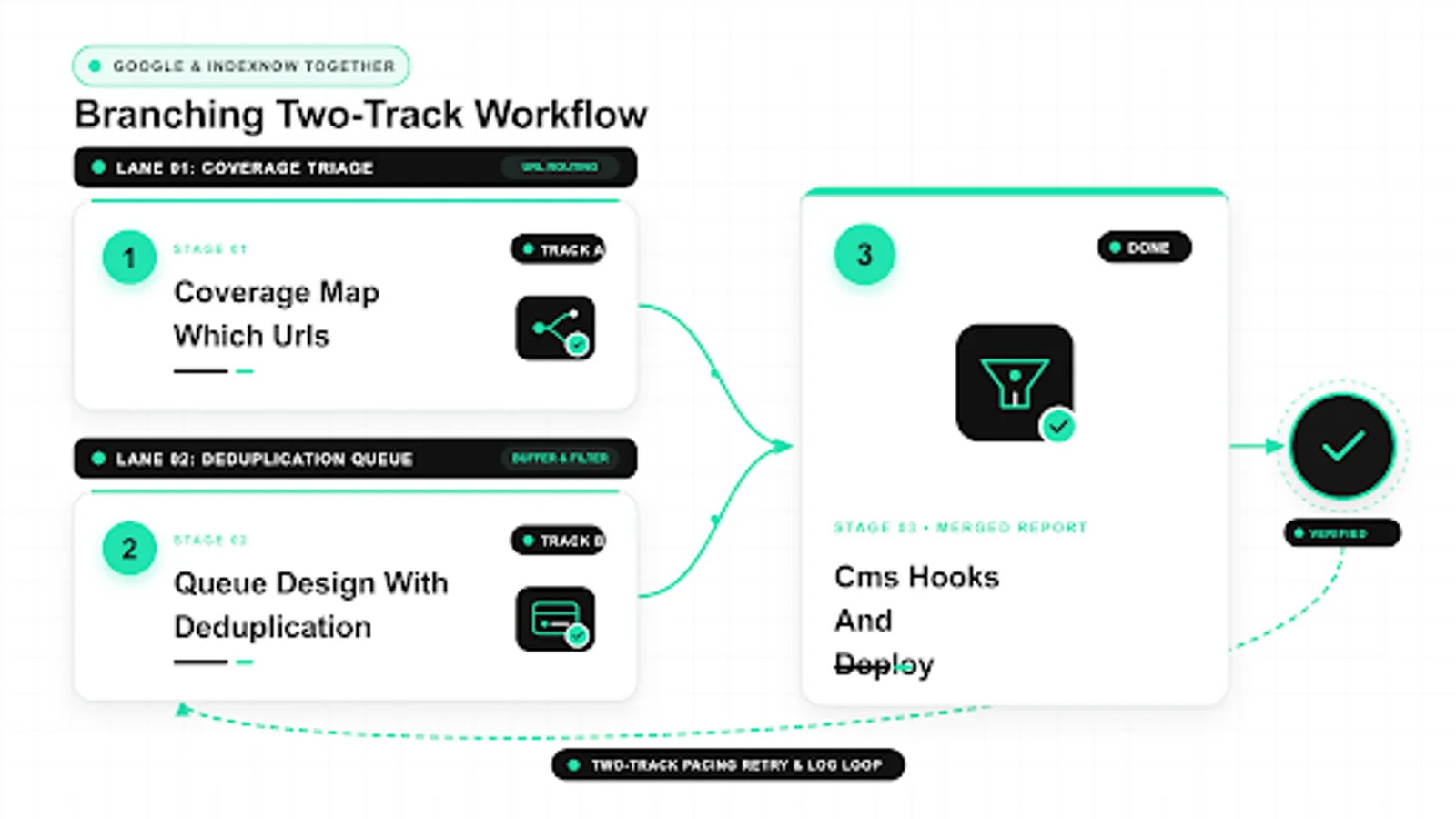
Workers pull from each queue independently with different pacing and batch shapes. The IndexNow worker groups up to 10000 URLs per request with key fields, while the Google worker sends one URL per publish call with URL_UPDATED or URL_DELETED. Separate dead letter queues hold failed items with error codes for review. This layout lets one track pause for backoff while the other keeps moving.
A common mistake around queue design with deduplication built in is sending noisy signals and then reading the noise as a ranking effect. Repeated pings for unchanged URLs, pings for non canonical variants, and pings for thin pages all waste attention and can slow trust. Deduplicate the queue, ping only canonical URLs that actually changed, and space batches so engines see a steady pattern. Clean sends make crawl logs easier to read and keep google and indexnow together work credible with stakeholders.
Stakeholder reporting on queue design with deduplication built in should separate three clocks: time to ping, time to crawl, and time to rank. The first two often improve with google and indexnow together because engines learn about changes sooner. The third depends on competition, query intent, and page quality, which pings cannot change. Report all three side by side so faster discovery is visible even when positions move slowly. That honest split builds trust in the indexing work.
When you review queue design with deduplication built in, keep sitemaps, internal links, canonical tags, and server health in the same picture. IndexNow complements these foundations, it does not replace them. A clean XML sitemap still lists the canonical set, internal links still pass context, and a stable server still lets crawlers finish the job. If any of those basics are broken, faster pings cannot fix the outcome. Fix structure first, then use google and indexnow together pings to surface fresh URLs sooner.
From an operations view, queue design with deduplication built in needs a short checklist and one owner. Confirm the key file is reachable, confirm each batch used valid JSON with host and key fields, confirm response codes were logged, and confirm the crawl followed within the expected window. When a step fails, fix that step before resending the same URLs. This keeps google and indexnow together effort tied to verifiable actions instead of guesses about ranking moves.
Checklist for this section:
- Normalize to canonical before enqueue.
- Drop repeats inside a short window.
- Batch IndexNow, single send Google API.
- Separate dead letter queues per track.
Work through this part before moving on, and record the date and result so later reviews have facts to use.
Pacing quotas and backoff that respect both systems
Quota models differ, so pacing rules differ. IndexNow allows large batches but throttles aggressive hosts with 429 responses, while the Google API enforces daily publish quotas visible in Cloud console plus per minute limits. Design both workers with caps, delays between sends, and exponential backoff with jitter on 429. Never hammer endpoints after failures, since aggressive retries delay real crawling and burn trust.
Alert thresholds keep launches safe. Warn at 70 percent of Google daily quota and pause non urgent sends at 90 percent, resuming in the next window. For IndexNow, slow the send rate when 429 appears and resume after the wait period with smaller batches. Log every wait and resume with timestamps so quota reviews show calm operation instead of spikes.
From an operations view, pacing quotas and backoff that respect both systems needs a short checklist and one owner. Confirm the key file is reachable, confirm each batch used valid JSON with host and key fields, confirm response codes were logged, and confirm the crawl followed within the expected window. When a step fails, fix that step before resending the same URLs. This keeps google and indexnow together effort tied to verifiable actions instead of guesses about ranking moves.
When pacing quotas and backoff that respect both systems involves Bing or Yandex, remember that each supporter applies its own crawl and quality filters after the ping. A 200 or 202 response means the submission was accepted, not that the URL will be indexed or ranked. Watch bot hits in server logs, then check index coverage in the relevant webmaster tools. Use that chain as proof that google and indexnow together did its part, and treat ranking separately as a content and relevance task.
Measurement for pacing quotas and backoff that respect both systems works best with dates and server logs rather than rank snapshots alone. Record when each URL was published, when it was pinged, when the engine fetched it, and when it first appeared in results. Compare pinged URLs against a small control set that was left to natural discovery. This shows whether google and indexnow together shortened time to crawl without confusing crawl speed with ranking strength. Keep the test window to a few weeks so seasonal moves do not blur the read.
For pacing quotas and backoff that respect both systems, think in terms of crawl budget and priority rather than positions. Engines allocate fetch capacity based on site trust, change rate, and URL value. A focused set of changed canonical URLs earns faster revisits than a bulk dump of everything. Prioritize updated posts, changed product pages, and corrected canonicals, and leave evergreen URLs to sitemaps and natural recrawl. This is how google and indexnow together helps important pages get seen sooner without spamming.
Checklist for this section:
- Cap daily totals per track.
- Back off exponentially with jitter on 429.
- Warn at 70 percent, pause at 90 percent.
- Log waits and resumes with timestamps.
Work through this part before moving on, and record the date and result so later reviews have facts to use.
CMS hooks and deploy hooks that fire once per change
Wire the router to publish and update events in the CMS so each final save enqueues the canonical URL once. For WordPress style systems use save and update hooks with a guard against revisions and autosaves. For static builds use post deploy hooks that diff the new sitemap against the previous one and enqueue only added or changed URLs. Both paths must skip drafts, previews, and non canonical variants.
Test hooks with a handful of URLs before enabling site wide automation. Publish a test post, update it, then delete the test, and confirm each action created exactly one queue entry per track with the right change type. Check that rapid double saves still produce one entry after dedup. Stable hooks matter more than fast hooks, because duplicate automation wastes quota for months once enabled.
For cms hooks and deploy hooks that fire once per change, think in terms of crawl budget and priority rather than positions. Engines allocate fetch capacity based on site trust, change rate, and URL value. A focused set of changed canonical URLs earns faster revisits than a bulk dump of everything. Prioritize updated posts, changed product pages, and corrected canonicals, and leave evergreen URLs to sitemaps and natural recrawl. This is how google and indexnow together helps important pages get seen sooner without spamming.
For teams tracking google and indexnow together, the practical link to cms hooks and deploy hooks that fire once per change is discovery speed, not a direct position change. When a changed URL is pinged cleanly, participating engines can fetch it sooner, which shortens the wait between publish and crawl. That earlier crawl still passes through the normal quality checks, so relevance, intent match, and page experience decide where the page can rank. Treat cms hooks and deploy hooks that fire once per change as a way to remove delay, then let content quality do the ranking work.
A common mistake around cms hooks and deploy hooks that fire once per change is sending noisy signals and then reading the noise as a ranking effect. Repeated pings for unchanged URLs, pings for non canonical variants, and pings for thin pages all waste attention and can slow trust. Deduplicate the queue, ping only canonical URLs that actually changed, and space batches so engines see a steady pattern. Clean sends make crawl logs easier to read and keep google and indexnow together work credible with stakeholders.
Stakeholder reporting on cms hooks and deploy hooks that fire once per change should separate three clocks: time to ping, time to crawl, and time to rank. The first two often improve with google and indexnow together because engines learn about changes sooner. The third depends on competition, query intent, and page quality, which pings cannot change. Report all three side by side so faster discovery is visible even when positions move slowly. That honest split builds trust in the indexing work.
Checklist for this section:
- Fire on final save, not on autosave.
- Diff sitemaps on static deploys.
- Skip drafts and non canonical variants.
- Verify one entry per action before scaling.
Work through this part before moving on, and record the date and result so later reviews have facts to use.
Logging and request IDs per track
Log each send with timestamp, track name, URL, change type, response code, and latency, plus a batch ID for IndexNow groups and a request ID where the API returns one. Keep Google and IndexNow logs in separate files or tables so per engine analysis stays simple. Include routing reason so later reviews can explain why a URL went to one track or both. Good logs turn coverage debates into short lookups.
Review logs on a weekly rhythm that matches publishing pace. Count sends, accepts, 4xx fixes needed, 429 waits, and first bot fetches per track. Compare against server logs for Bingbot, Yandex, and Googlebot hits to confirm pings led to fetches. When a track shows accepts without fetches, check quality blockers such as thin content or canonical conflicts before increasing send rate.
Stakeholder reporting on logging and request ids per track should separate three clocks: time to ping, time to crawl, and time to rank. The first two often improve with google and indexnow together because engines learn about changes sooner. The third depends on competition, query intent, and page quality, which pings cannot change. Report all three side by side so faster discovery is visible even when positions move slowly. That honest split builds trust in the indexing work.
When you review logging and request ids per track, keep sitemaps, internal links, canonical tags, and server health in the same picture. IndexNow complements these foundations, it does not replace them. A clean XML sitemap still lists the canonical set, internal links still pass context, and a stable server still lets crawlers finish the job. If any of those basics are broken, faster pings cannot fix the outcome. Fix structure first, then use google and indexnow together pings to surface fresh URLs sooner.
From an operations view, logging and request ids per track needs a short checklist and one owner. Confirm the key file is reachable, confirm each batch used valid JSON with host and key fields, confirm response codes were logged, and confirm the crawl followed within the expected window. When a step fails, fix that step before resending the same URLs. This keeps google and indexnow together effort tied to verifiable actions instead of guesses about ranking moves.
When logging and request ids per track involves Bing or Yandex, remember that each supporter applies its own crawl and quality filters after the ping. A 200 or 202 response means the submission was accepted, not that the URL will be indexed or ranked. Watch bot hits in server logs, then check index coverage in the relevant webmaster tools. Use that chain as proof that google and indexnow together did its part, and treat ranking separately as a content and relevance task.
Checklist for this section:
- Log timestamp, track, URL, code, and latency.
- Separate tables per track.
- Include routing reason per URL.
- Review weekly against bot hits.
{
  "host": "www.example.com",
  "key": "f3a9c1e27b4d4a8c9e0f123456789abc",
  "keyLocation": "https://www.example.com/f3a9c1e27b4d4a8c9e0f123456789abc.txt",
  "urlList": [
    "https://www.example.com/jobs/senior-developer/",
    "https://www.example.com/blog/launch-notes/"
  ]
}
Work through this part before moving on, and record the date and result so later reviews have facts to use.
 <!-- IMAGE-PROMPT workflow-02: 1600px max, DependsIt brand mint #22E3B0 on charcoal #121212, node-network line art, Clash Display style headings, General Sans clean labels, subject: two track pacing retry and logging workflow, flat vector, accessible, high contrast, no em dash in rendered text -->
Error handling matrix for both tracks
Handle errors by track because codes mean different next steps. On IndexNow, 400 or 422 means fix JSON or URL format, 403 means fix key file name and content, and 429 means slow down and resume later. On the Google API, 400 means fix payload, 403 means fix Search Console permissions and roles, and 429 means check quota dashboards and resume in the next window. Never retry 4xx without a fix, since repeats burn quota and hide the real cause.
Keep a one page matrix near the code so on call staff act fast. Map each code to owner, fix location, and resend rule, with separate rows per track even when codes look similar. Record every incident with URL sample, code, fix, and resend result. Over a quarter this log becomes a runbook that shortens every future incident.
When error handling matrix for both tracks involves Bing or Yandex, remember that each supporter applies its own crawl and quality filters after the ping. A 200 or 202 response means the submission was accepted, not that the URL will be indexed or ranked. Watch bot hits in server logs, then check index coverage in the relevant webmaster tools. Use that chain as proof that google and indexnow together did its part, and treat ranking separately as a content and relevance task.
Measurement for error handling matrix for both tracks works best with dates and server logs rather than rank snapshots alone. Record when each URL was published, when it was pinged, when the engine fetched it, and when it first appeared in results. Compare pinged URLs against a small control set that was left to natural discovery. This shows whether google and indexnow together shortened time to crawl without confusing crawl speed with ranking strength. Keep the test window to a few weeks so seasonal moves do not blur the read.
For error handling matrix for both tracks, think in terms of crawl budget and priority rather than positions. Engines allocate fetch capacity based on site trust, change rate, and URL value. A focused set of changed canonical URLs earns faster revisits than a bulk dump of everything. Prioritize updated posts, changed product pages, and corrected canonicals, and leave evergreen URLs to sitemaps and natural recrawl. This is how google and indexnow together helps important pages get seen sooner without spamming.
For teams tracking google and indexnow together, the practical link to error handling matrix for both tracks is discovery speed, not a direct position change. When a changed URL is pinged cleanly, participating engines can fetch it sooner, which shortens the wait between publish and crawl. That earlier crawl still passes through the normal quality checks, so relevance, intent match, and page experience decide where the page can rank. Treat error handling matrix for both tracks as a way to remove delay, then let content quality do the ranking work.
| Code | IndexNow next step | Google API next step |
|---|---|---|
| 200 or 202 | Continue steady pace | Continue steady pace |
| 400 or 422 | Fix JSON or URLs | Fix payload or scope |
| 403 | Fix key file | Fix permissions and roles |
| 429 | Back off and resume | Check quota, resume next window |
Checklist for this section:
- Fix 4xx before any resend.
- Back off on 429 per track rules.
- Map code to owner and fix location.
- Record incidents for the runbook.
Response meanings for the IndexNow side are covered in IndexNow response codes explained with per code next steps.
The open field list is short, see IndexNow documentation for exact host, key, and URL list shapes.
Work through this part before moving on, and record the date and result so later reviews have facts to use.
Testing before scale with a small control set
Start with ten changed canonical URLs split into pinged and control groups with matched type and depth. This small dual api indexing test shows whether a unified indexing workflow shortens discovery for your catalog before you automate everything. Send the pinged set through both eligible tracks, leave the control set to sitemaps and natural discovery, then record publish, send, first fetch, and first impression dates per engine. Run for two weeks and compare time to crawl per track. The gap shows whether the workflow shortens discovery for your catalog.
Promote to full automation only when the small test is clean. Confirm no duplicates in queues, no 403 errors, no quota alerts, and bot fetches that follow sends within the expected window. Fix routing, auth, or pacing issues at small scale where mistakes cost little. Scaling a clean workflow multiplies wins, while scaling a noisy one multiplies quota burn.
For teams tracking google and indexnow together, the practical link to testing before scale with a small control set is discovery speed, not a direct position change. When a changed URL is pinged cleanly, participating engines can fetch it sooner, which shortens the wait between publish and crawl. That earlier crawl still passes through the normal quality checks, so relevance, intent match, and page experience decide where the page can rank. Treat testing before scale with a small control set as a way to remove delay, then let content quality do the ranking work.
A common mistake around testing before scale with a small control set is sending noisy signals and then reading the noise as a ranking effect. Repeated pings for unchanged URLs, pings for non canonical variants, and pings for thin pages all waste attention and can slow trust. Deduplicate the queue, ping only canonical URLs that actually changed, and space batches so engines see a steady pattern. Clean sends make crawl logs easier to read and keep google and indexnow together work credible with stakeholders.
Stakeholder reporting on testing before scale with a small control set should separate three clocks: time to ping, time to crawl, and time to rank. The first two often improve with google and indexnow together because engines learn about changes sooner. The third depends on competition, query intent, and page quality, which pings cannot change. Report all three side by side so faster discovery is visible even when positions move slowly. That honest split builds trust in the indexing work.
When you review testing before scale with a small control set, keep sitemaps, internal links, canonical tags, and server health in the same picture. IndexNow complements these foundations, it does not replace them. A clean XML sitemap still lists the canonical set, internal links still pass context, and a stable server still lets crawlers finish the job. If any of those basics are broken, faster pings cannot fix the outcome. Fix structure first, then use google and indexnow together pings to surface fresh URLs sooner.
Checklist for this section:
- Test with ten matched URLs first.
- Record four dates per URL per engine.
- Require zero auth errors before scaling.
- Fix small, then automate fully.
Work through this part before moving on, and record the date and result so later reviews have facts to use.
Operating cost and maintenance reality
Running both tracks costs engineering time more than API fees, since IndexNow itself and the Google API carry no per call charge in normal use. Budget for initial hook work, queue hosting, log storage, key rotation, and weekly reviews. Larger catalogs add batch tuning and quota monitoring, while small blogs run for months on a simple worker plus uptime checks. Track hours quarterly so the workflow keeps its funding.
Maintenance stays light when ownership is clear. Assign one owner for keys and secrets, one for queue health, and one for weekly coverage review. Document rotation dates, quota dashboards, and incident contacts in a single page. Replace ad hoc curl sends with the queue as soon as volume grows, because manual sends skip dedup and logging and create invisible gaps.
When you review operating cost and maintenance reality, keep sitemaps, internal links, canonical tags, and server health in the same picture. IndexNow complements these foundations, it does not replace them. A clean XML sitemap still lists the canonical set, internal links still pass context, and a stable server still lets crawlers finish the job. If any of those basics are broken, faster pings cannot fix the outcome. Fix structure first, then use google and indexnow together pings to surface fresh URLs sooner.
From an operations view, operating cost and maintenance reality needs a short checklist and one owner. Confirm the key file is reachable, confirm each batch used valid JSON with host and key fields, confirm response codes were logged, and confirm the crawl followed within the expected window. When a step fails, fix that step before resending the same URLs. This keeps google and indexnow together effort tied to verifiable actions instead of guesses about ranking moves.
When operating cost and maintenance reality involves Bing or Yandex, remember that each supporter applies its own crawl and quality filters after the ping. A 200 or 202 response means the submission was accepted, not that the URL will be indexed or ranked. Watch bot hits in server logs, then check index coverage in the relevant webmaster tools. Use that chain as proof that google and indexnow together did its part, and treat ranking separately as a content and relevance task.
Measurement for operating cost and maintenance reality works best with dates and server logs rather than rank snapshots alone. Record when each URL was published, when it was pinged, when the engine fetched it, and when it first appeared in results. Compare pinged URLs against a small control set that was left to natural discovery. This shows whether google and indexnow together shortened time to crawl without confusing crawl speed with ranking strength. Keep the test window to a few weeks so seasonal moves do not blur the read.
Checklist for this section:
- Budget hours, not per call fees.
- Assign owners for keys, queues, and reviews.
- Document dashboards and contacts.
- Replace manual sends with queues.
Work through this part before moving on, and record the date and result so later reviews have facts to use.
Google and IndexNow Together: Recommended Starter Setup
A practical starter uses CMS hooks for dynamic sites or sitemap diffs for static builds, two small queues with dedup, and two workers with conservative pacing. Many teams run this as a small google bing indexing tool with per track logs rather than manual sends. Add key file uptime monitoring plus Google quota alerts at 70 and 90 percent, and keep a weekly log review on the calendar. Start with new and updated canonicals only, then add larger batches after two clean weeks. This scope fits in days and proves value fast.
Expand by adding deploy hooks, dead letter reviews, and a monthly coverage check in Search Console and Bing Webmaster Tools. Keep sitemaps current throughout, since both tracks assume the canonical inventory is correct. Report per track time to crawl so stakeholders see which audience benefited. Steady operation beats burst sends for long term trust on both systems.
Measurement for recommended starter setup you can run this week works best with dates and server logs rather than rank snapshots alone. Record when each URL was published, when it was pinged, when the engine fetched it, and when it first appeared in results. Compare pinged URLs against a small control set that was left to natural discovery. This shows whether google and indexnow together shortened time to crawl without confusing crawl speed with ranking strength. Keep the test window to a few weeks so seasonal moves do not blur the read.
For recommended starter setup you can run this week, think in terms of crawl budget and priority rather than positions. Engines allocate fetch capacity based on site trust, change rate, and URL value. A focused set of changed canonical URLs earns faster revisits than a bulk dump of everything. Prioritize updated posts, changed product pages, and corrected canonicals, and leave evergreen URLs to sitemaps and natural recrawl. This is how google and indexnow together helps important pages get seen sooner without spamming.
For teams tracking google and indexnow together, the practical link to recommended starter setup you can run this week is discovery speed, not a direct position change. When a changed URL is pinged cleanly, participating engines can fetch it sooner, which shortens the wait between publish and crawl. That earlier crawl still passes through the normal quality checks, so relevance, intent match, and page experience decide where the page can rank. Treat recommended starter setup you can run this week as a way to remove delay, then let content quality do the ranking work.
A common mistake around recommended starter setup you can run this week is sending noisy signals and then reading the noise as a ranking effect. Repeated pings for unchanged URLs, pings for non canonical variants, and pings for thin pages all waste attention and can slow trust. Deduplicate the queue, ping only canonical URLs that actually changed, and space batches so engines see a steady pattern. Clean sends make crawl logs easier to read and keep google and indexnow together work credible with stakeholders.
Checklist for this section:
- Start with new and updated canonicals.
- Add monitoring and weekly reviews first.
- Expand after two clean weeks.
- Report per track crawl gains.
Work through this part before moving on, and record the date and result so later reviews have facts to use.
FAQ
Which URLs deserve indexing both APIs tracks?
Job postings and livestream pages with valid markup that target both Google and Bing audiences deserve indexing both apis when the site serves two search ecosystems. General posts, product pages, docs, and categories go to IndexNow plus sitemaps, since the Google API documents narrow eligible types for normal pages. Tag content type at publish so the router can submit to Google and Bing correctly without off label sends. Log the routing reason per URL so audits show why each page went to one track, both tracks, or sitemap only.
How does dual API indexing avoid double quota burn?
Good dual api indexing normalizes every URL to its canonical form before enqueue, then deduplicates repeats within a short window so double saves do not create double sends. Keep separate queues per track, batch IndexNow sends up to the documented limit, and send Google notices one URL per call with URL_UPDATED or URL_DELETED. A shared router with per track workers lets one track pause for backoff while the other keeps moving. Log routing reasons and batch IDs so audits show calm quota use instead of spikes.
What happens in a unified indexing workflow when one track hits 429?
In a unified indexing workflow you pause only the throttled track with exponential backoff and jitter, then resume with smaller batches after the wait window. The healthy track continues normally, which is why separate queues and separate log tables matter for multi engine indexing. IndexNow throttles aggressive hosts with 429, while the Google API enforces daily plus per minute limits visible in Cloud console. Log every wait and resume with timestamps, warn at 70 percent of quota, and pause non urgent sends at 90 percent.
How do we test safely before claiming complete index coverage?
Use ten matched URLs split into pinged and control sets, send only the pinged set through eligible tracks, and record publish, send, first fetch, and first impression per engine. Require zero auth errors, no duplicates in queues, and visible bot fetches before enabling site wide automation. True complete index coverage means each engine fetched its routed URLs, not just that all search engines submission calls returned 200 or 202. Run the pilot for two weeks, fix routing or pacing at small scale, and only then promote to full automation.
Do we still need sitemaps with all search engines submission?
Yes. Even with all search engines submission wired to publish events, sitemaps carry the canonical inventory that makes pings interpretable for every engine. They remain the main path for Google general pages outside JobPosting and BroadcastEvent scope, and they help Bing and Yandex reconcile IndexNow hints against the full site. Keep sitemaps current, clean of 404s and non canonicals, split by section with real last modified dates. Use indexnow plus google api pings for fresh changes on top of that trustworthy base.
Who owns multi engine indexing weekly when one tool all engines is the goal?
Assign one owner for keys and secrets, one for queue health, and one for coverage review so multi engine indexing stays calm across teams. Even the best google bing indexing tool needs human review of accept rates, 429 waits, bot fetches, and coverage movement per track. The idea of one tool all engines works when dashboards separate Google and IndexNow logs instead of blending them. Document rotation dates, quota dashboards, and incident contacts on one page, and hold a short weekly log review that reports per track time to crawl.
Sources
- https://www.indexnow.org/documentation
- https://developers.google.com/search/apis/indexing-api/v3/using-api