How to Generate and Host Your IndexNow API Key

The IndexNow key proves you own the site you are notifying. Engines fetch a small text file from your site root and compare its content to the key in your submission. When they match, your URL lists are trusted for scheduling. When the file is missing, mismatched, or blocked, submissions fail with key errors that look like protocol problems but are really hosting gaps. This guide is for owners, SEOs, and developers who want a key that works the first time and keeps working through redesigns. The primary keyword is indexnow api key, and each section moves from generation to hosting to validation to rotation.
You will learn what the key is, format rules that prevent errors, how to generate a trustworthy value, how to host it correctly at the root, how to validate before submitting, how to submit first URLs, how to cover subdomains and multiple hosts, how to fix common hosting failures, how to rotate without losing submissions, and hygiene for keys and logs. By the end you will have a validated key file plus a checklist for long term health. For the broader protocol context around keys, see the IndexNow complete guide.
Key takeaways
- The key is a random string hosted as a plain text file at your site root named {key}.txt containing exactly the key.
- Use cryptographic randomness with letters and numbers, store the key in secrets, and log fingerprints rather than raw values.
- Serve the file publicly as text/plain at https://example.com/{key}.txt with no login wall and short CDN caching.
- Validate with anonymous fetch plus diff before any submission, and re validate after redesigns, migrations, or CDN changes.
- Rotate with overlap by hosting old and new files together, switching senders, verifying, then removing the old file.
- What the key is and why engines require it
- Key format rules that prevent errors
- Generate an indexnow api key you can trust
- Host the key file at the root correctly
- Validate the key file before you submit
- Submit your first URLs with the new key
- Use one key across subdomains and hosts
- Fix common hosting failures
- Rotate to a new key without losing submissions
- Security hygiene for keys and logs
- Checklist and next steps after the key works
- FAQ
- Sources
- Further reading
 <!-- IMAGE-PROMPT cover: 1200x630, DependsIt brand, deep charcoal #121212 background, vibrant mint #22E3B0 accent glow, thin node-network line art, Clash Display style bold heading space on left, General Sans clean labels, subject: IndexNow API key file generation hosting at site root validation, flat vector, high contrast, accessible, no photorealistic faces, no text smaller than 24px, no em dash in rendered text, export PNG then cwebp -q 82 to WEBP -->
What the key is and why engines require it
The key is a shared secret between you and participating engines. You generate a random string, publish it in a file at your site root, and include the same string in every submission. Engines verify ownership by fetching the file and comparing. That comparison replaces per engine accounts and passwords for submission purposes. It proves control of the host without granting access to analytics, content, or settings. One key can cover a host for months or years if hosted stably and rotated on schedule.
The file pattern is fixed. A key such as a1b2c3d4e5f6g7h8i9j0k1l2m3n4o5p6 produces file https://example.com/a1b2c3d4e5f6g7h8i9j0k1l2m3n4o5p6.txt containing exactly a1b2c3d4e5f6g7h8i9j0k1l2m3n4o5p6. No HTML wrapper, no extra whitespace, no JSON envelope. Engines expect plain text that matches byte for byte. That strictness is useful because failures are unambiguous. Either the fetch returns the exact string or it does not. There is no partial credit for near matches with extra markup from a theme template.
Why engines require this step is straightforward. Open submission endpoints without ownership proof would invite spam for other sites. The key file proves you can publish to the host root, which only an owner or authorized operator can do. That proof is lightweight to maintain and easy to re check on every submission. It also makes multi engine fanout safe. One submission with one key can be trusted by Bing, Yandex, Naver, Seznam, and others listed on indexnow.org, because each engine can independently fetch the same file. For the canonical field definitions, see the official IndexNow documentation.
The key does not grant Google coverage. Google does not support IndexNow, so IndexNow keys have no effect on Google crawling. Plan a separate Google workflow with sitemaps and, where eligible, the Indexing API for JobPosting and BroadcastEvent pages. Many sites run both from the same publish event with separate queues. That separation keeps expectations honest when stakeholders ask why Google charts did not shift after IndexNow validation succeeded on other engines.
| Element | Example | Purpose |
|---|---|---|
| Key string | 32 char random alphanumeric | Shared secret with engines |
| Key file name | {key}.txt | Fetchable proof at root |
| Key file URL | https://example.com/{key}.txt | Engine verification target |
| File content | Exact key string | Byte for byte comparison |
| Submission field | key plus keyLocation plus host | Links request to proof |
By the end of this section you should be able to explain the key in one sentence: it is the published secret that lets engines confirm you control the host before trusting your URL lists. That definition guides every later decision about generation, hosting, and rotation.
Key format rules that prevent 400 errors
Format discipline prevents most validation failures before they leave your system. Use letters and numbers with enough length to avoid guessing, typically 32 characters or more from a cryptographic random source. Avoid characters that need URL encoding in file names, such as slashes, spaces, question marks, and hashes. Stick to lowercase alphanumeric plus hyphen where allowed by your stack, and test the file name on your server before committing. A key that cannot be served as a static file name on your platform will fail every submission regardless of randomness quality.
Length and charset choices affect both security and operability. Short keys under 16 characters are easier to mistype and easier to guess. Very long keys over 128 characters add no practical security for this use case and can hit file name limits on some systems. A 32 to 64 character alphanumeric string balances safety and handling. Generate once, store in secrets, and reuse across submissions for that host until planned rotation. Do not regenerate per request. Per request keys would require constant file updates and break engine caching of verification.
File content rules are stricter than key string rules. The file must contain exactly the key with no extra lines, no byte order mark issues that alter comparison, no HTML template wrapper, and no trailing spaces that some editors add silently. Serve as text/plain with UTF-8 without BOM where your server allows explicit control. Confirm with a hex or diff check after first hosting rather than trusting visual view in a browser, because browsers hide whitespace differences that engines compare strictly. That one diff saves hours of resubmission guessing.
Request fields must reference the key consistently. Host is the domain without protocol, for example example.com. Key is the string matching file content. KeyLocation is the full https URL to the file. UrlList holds absolute URLs on that host. Inconsistent triples, such as key A with keyLocation pointing to key B file, fail validation even when both files exist. Centralize these three values in one config so all senders share the same triple. That single source of truth prevents drift between manual tests and automation.
| Rule | Good example | Bad example that fails |
|---|---|---|
| Charset | Lowercase alphanumeric, 32 chars | Key with slashes or spaces |
| Length | 32 to 64 characters | 8 char guessable string |
| File name | {key}.txt at root | Key file in subfolder only |
| File content | Exact key, no wrapper | HTML page wrapping the key |
| Request triple | key matches keyLocation content | key A with keyLocation for key B |
Add a pre send validator to your queue that checks charset, length, host purity, absolute URLs, and triple consistency. That validator turns an entire class of 400 errors into skipped with reason log lines that you can fix without failed submissions. It also makes onboarding concrete, because new teammates see the rules enforced in code rather than described in prose.
When you generate indexnow key values, use a cryptographic random source and record the value in secrets the same day. That timing avoids confusion about which key is current during the first week. Before hosting, review the indexnow key format rules for charset and length so the file name serves cleanly on your platform. After hosting, run indexnow key validation with anonymous curl plus diff and header checks before any submission. That generate, review, validate sequence isolates failures at the right layer and prevents a week of mixed errors.
Generate an indexnow api key you can trust
Generation should use a cryptographic random source, not a memorable phrase or a timestamp. On Linux, read from the system random pool or use a language standard library marked for security. In Python, use the secrets module. In Node.js, use crypto randomBytes. In PHP, use random_bytes. In terminal, use openssl rand with hex or base64 filtered to your allowed charset. Record the value immediately in secrets management with a label that includes host, creation date, and owner. Do not paste it into tickets, docs, or chat history.
A practical generation pattern produces 32 alphanumeric characters. That length fits comfortably in file names, URLs, and logs while providing ample entropy against guessing. If your organization requires longer secrets, 48 or 64 characters remain easy to host. Avoid embedding meaningful words, dates, or client names in the key. Meaningful patterns leak context in logs and make rotation tracking harder. Random strings with a separate registry entry for host and purpose keep secrets opaque and management clear.
Registry discipline matters from day one. Each key row should list host, key fingerprint rather than raw value where possible, file URL, creation date, creator, sender configs that use it, and rotation due date. Store the raw key only in secrets management with restricted access. Store the fingerprint plus metadata in your runbook where the team can see it without exposing the secret. That split lets anyone verify which key is live without being able to copy it from docs. When auditors ask for evidence, the registry plus secrets access log answers without leaking values.
# Generate a 32 character alphanumeric key on Linux
openssl rand -hex 16
python3 -c "import secrets, string; print(''.join(secrets.choice(string.ascii_lowercase + string.digits) for _ in range(32)))"
// Node: cryptographic random key
// const crypto = require("crypto");
// const key = crypto.randomBytes(24).toString("hex").slice(0, 32);<?php
// PHP: cryptographic random key
// $key = substr(bin2hex(random_bytes(24)), 0, 32);After generation, do not submit yet. Host the file first, then validate fetch, then test with one URL. That order isolates failures. If generation produced an unsuitable character for your file system, you will catch it at hosting rather than after failed submissions. If secrets injection is misconfigured, you will catch it at validation rather than during bulk sends. One careful sequence at the start prevents a week of mixed errors later.
| Method | Command or call | Note |
|---|---|---|
| Terminal | openssl rand hex | Quick, filter to allowed charset |
| Python | secrets choice 32 chars | Preferred for readability |
| Node | crypto randomBytes | Good for JS pipelines |
| PHP | random_bytes hex | Good for WordPress stacks |
| Manager UI | Generate in secrets manager | Best audit trail where available |
Keep generation and hosting on the same calendar day so the key does not sit unused in secrets while an old key remains live in senders. That same day pairing reduces confusion about which key is current during the first week.
Host the key file at the root correctly
Hosting places the key string in a file named {key}.txt at your site root, served publicly as plain text. Create the file with exact content and no extra newline handling surprises. Upload to the document root or configure your CMS to serve that path statically. Confirm the URL pattern is https://example.com/{key}.txt and that anonymous GET returns 200 with the exact key body. Test from outside your network, not just localhost, so firewall and auth rules are included in the check. For engine side expectations on hosting and submission, Bing guidance in Bing IndexNow guidance pairs well with the protocol spec.
Server specifics vary, but the requirements do not. Allow anonymous GET for that path. Exclude it from login walls, bot challenge pages, and maintenance mode blocks. Serve Content-Type text/plain. Keep response small and fast. Avoid redirect chains where possible by linking the https root file directly in keyLocation. Where redirects exist, ensure they preserve fetchability and do not convert GET to a blocked POST or add auth. After any CDN, WAF, or redirect rule change, re validate the file the same day. Security tightening is the most common cause of sudden key failures that look like protocol outages.
CMS and static hosting each need one explicit rule. In WordPress, ensure the file exists on disk at the web root and is not intercepted by permalink rewrites. Test with curl after flushing cache plugins. In static builds on Astro, Cloudflare Pages, Netlify, or similar, ensure the file is copied to the publish directory on every build and is not excluded by ignore rules. Add it to your build manifest or public folder so rebuilds cannot delete it. In container deploys, bake the file into the image or mount it consistently across replicas so every instance serves the same body.
Caching should be short but not zero. Allow brief public caching for a few minutes to handle verification bursts, but avoid week long edge caching that serves stale content after rotation. Purge the key URL on rotation and confirm edge plus origin return the new body before switching senders. Log the purge with timestamp so later diffs have context. That purge plus check routine takes two minutes and prevents the most frustrating rotation failure: senders use the new key while edges still serve the old file.
| Hosting layer | Setting | Verify |
|---|---|---|
| File location | Document root, {key}.txt | Direct https GET returns 200 |
| Content | Exact key, no wrapper | Diff fetched body versus stored key |
| Headers | text/plain, public short cache | Check response headers |
| Access | Anonymous GET allowed | Outside network fetch succeeds |
| Build persistence | Included in every build | Re check after next deploy |
By the end of this section the key file should be live, public, exact, and persistent across builds. Do not proceed to bulk submissions until validation in the next section passes. One stable file underpins every later success.
The core task is simple: hosting key file root placement with exact content and public access. For key.txt hosting, create the file at the document root, exclude the path from auth walls and bot challenges, and serve it as text/plain with short caching. Confirm the indexnow key location uses direct https to the root file in keyLocation, then test from outside your network. After any CDN, WAF or redirect change, re validate the same day, because security tightening is the most common cause of sudden key failures.
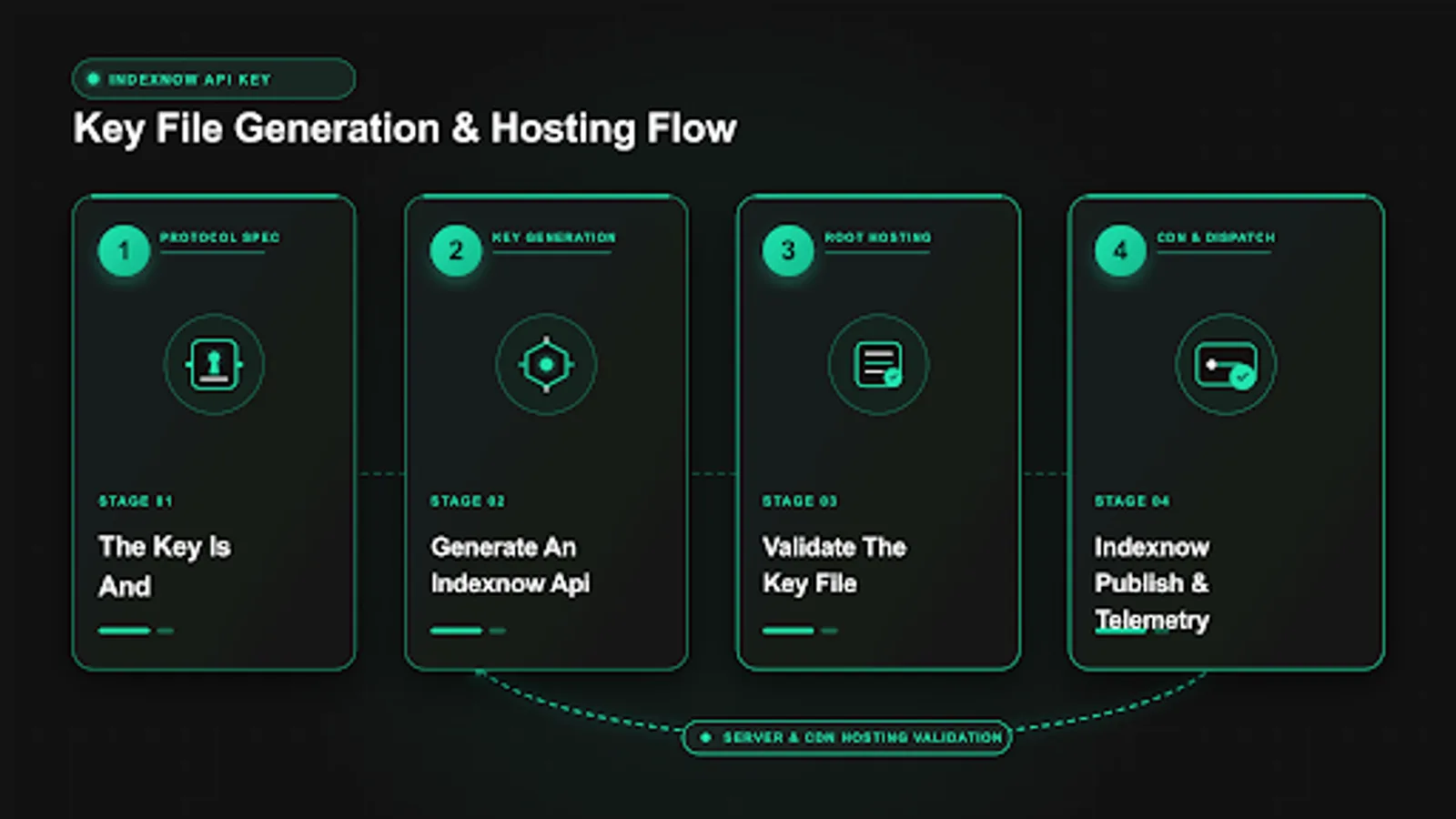 <!-- IMAGE-PROMPT diagram-01: 1600px max, DependsIt brand mint #22E3B0 on charcoal #121212 or white, node-network line art, subject: IndexNow key file hosting validation across server CDN layers, flat vector, accessible, no em dash, Clash Display and General Sans feel -->
Validate the key file before you submit
Validation proves hosting works before submissions spend trust. Run three checks in order: public fetch, exact diff, and header review. Public fetch uses anonymous curl from outside your network to GET the key file URL. Exact diff compares the fetched body to the stored key byte for byte. Header review confirms status 200, content type text/plain, and sane caching. All three must pass. If any fails, fix hosting before sending IndexNow requests, because submissions with an unverifiable key will fail and clutter logs without providing crawl benefit.
Automate validation so it runs on every deploy and on schedule. Add a deploy hook that fetches the key URL after publish and fails the build if the body mismatches. Add a daily monitor that checks status, body hash, and response time with an alert on change. That pair catches both deploy deletions and slow CDN drift. Keep validation logs with timestamp, URL, status, body hash, and edge versus origin indicator. Those logs prove key health during incident reviews when submissions suddenly return key errors after a quiet period.
Manual validation commands should live in your runbook for on call use. They require no special tooling beyond curl and diff, so any teammate can run them in one minute. Include both origin and edge checks where a CDN is in front, because origin success with edge staleness points to purge rather than file loss. Include http to https behavior where legacy links exist, but standardize on direct https in keyLocation to avoid redirect edge cases. Record the validation date alongside the participants list check from indexnow.org so key health and engine coverage are reviewed together.
# Public fetch plus headers plus body save
curl -s -D /tmp/key.headers "https://example.com/YOUR_KEY.txt" -o /tmp/key.body
cat /tmp/key.headers
cat /tmp/key.body
diff /tmp/key.body /secure/path/expected_key.txt| Check | Command or view | Pass criteria |
|---|---|---|
| Status | curl headers | 200, no login redirect |
| Body exact | diff fetched versus stored | No diff output |
| Content type | headers | text/plain |
| Edge versus origin | Fetch via edge and direct origin | Same body both paths |
| Deploy persistence | Re check after next build | Still exact match |
Only after all three checks pass should you send the first submission. That gate takes five minutes and prevents the most common support loop: submissions fail, key file is blamed, file looks fine in browser, but curl shows HTML wrapper or stale edge that visual checks hid. Byte level validation removes guesswork.
Submit your first URLs with the new key
Start with one safe URL on your own host where a quick engine fetch is harmless. Use GET for the single URL test to prove the round trip, then switch to POST with JSON for real batches. Include host without protocol, key matching the hosted file, keyLocation as the full https file URL, and urlList with one absolute https URL on that host. Send to a participating engine endpoint, confirm a success code, then watch server logs for key file fetch followed by URL fetch. That pair proves verification plus scheduling. For Bing specific endpoint behavior, see how to submit URLs to Bing with IndexNow.
Keep the first submission minimal and logged. Record timestamp, endpoint, host, key fingerprint, URL count of one, status, and response snippet. Save the request shape alongside the response so later automation can copy a known good template. If the first call returns a client error, do not bulk retry. Read the body, fix the named field once, re validate the key file, then resend once. Most first run failures are triple mismatch, host impurity, or relative URL in the list. Each has a one line fix that a validator would have caught, so add that validator before the second attempt.
# Single URL test, replace host and key with your own
curl -s "https://www.bing.com/indexnow?url=https://example.com/docs/first-test&key=YOUR_KEY&keyLocation=https://example.com/YOUR_KEY.txt&host=example.com"
{
"host": "example.com",
"key": "YOUR_KEY",
"keyLocation": "https://example.com/YOUR_KEY.txt",
"urlList": [
"https://example.com/docs/first-test"
]
}After single URL success, send a small batch of three to five real changed URLs via POST. Confirm success code, confirm log entry, and confirm no 400 or 422 for the batch. That small batch proves list handling without risking rate pressure. Only then should you wire automation for new publishes. Backfills of history wait until steady operation proves healthy for a week. That order delivers confidence before volume.
| Stage | Request | Success signal |
|---|---|---|
| Single GET | One URL, query form | 200 or 202, key fetch in logs |
| Small POST | 3 to 5 URLs, JSON body | 200 or 202, URL fetches follow |
| Steady automation | New publishes only | Daily success rate near 100 percent |
| Paced backfill | History in small daily slices | No 429, honest volume |
If the first submissions succeed but no engine fetch appears within a day, check that notified URLs are crawlable: public 200, not blocked by robots, not noindex, reasonably fast. Notification cannot overcome inaccessible content. Fix accessibility, then notify once more. That pairing of signal plus crawlability is what turns validation into faster evaluation.
Use one key across subdomains and multiple hosts
Key scope is per host, so multi host estates need explicit planning. The simplest pattern for hosts you control is one shared key with a file hosted at each host root containing the same string. Submissions for each host reference that host plus the shared key plus that host keyLocation. That pattern simplifies rotation to one secret change plus per host file updates. It suits portfolios with consistent deploys and central secrets. Document the shared value once in secrets and list every host file that carries it.
Per host keys suit estates with different owners, vendors, or risk profiles. Each host gets its own random key and file, and senders for that host use only that triple. Compromise of one host key does not affect others. Rotation can proceed host by host without coordination. The tradeoff is more secrets to track and more files to monitor. Use a registry table with host, fingerprint, file URL, owner, and rotation date to keep the estate readable. That table is the first page you open when one host returns key errors while others succeed.
Subdomains deserve a decision, not an accident. A domain property mindset helps: if subdomains serve the same CMS and deploy together, a shared key with per subdomain files keeps verification uniform. If subdomains are operated by different teams or vendors, per host keys enforce boundaries. In both cases keep requests host pure. One submission carries URLs for one host only. Mixed host lists fail validation and complicate logs. Your queue should partition by host before batching so purity is structural rather than manual.
Vendor hosts need isolation. When a vendor operates blog.example.com on your behalf, give that host its own key, delegate file hosting responsibility explicitly in writing, and monitor it separately. Log submissions per host with key fingerprint so vendor traffic is separable. On contract end, rotate that host key, update files, and archive logs. Do not share your root domain key with vendors to save setup time. That shortcut couples revocation and expands blast radius for no lasting benefit.
| Pattern | When to use | Tradeoff |
|---|---|---|
| Shared key, per host files | Central team, consistent deploys | Simple rotation, shared blast radius |
| Per host keys | Many owners or vendors | Isolated risk, more secrets to track |
| Subdomain shared | Same CMS and deploy | Uniform verification, joint rotation |
| Subdomain separate | Different teams or vendors | Clear boundary, extra monitoring |
Record your choice per host with reason and owner. That one line per host prevents future improvisation where a new subdomain copies the wrong pattern and fails validation for weeks before anyone checks the file.
Fix common hosting failures 404 content type CDN
Most key incidents fall into four buckets: file missing, wrong content, blocked access, or stale cache. Each has a distinct signal. File missing returns 404 on anonymous fetch and produces key errors on submission. Wrong content returns 200 but body diff fails, often due to HTML wrapping by a theme template or extra whitespace from an editor. Blocked access returns 401, 403, or challenge page instead of the key, caused by auth rules, WAF, or maintenance mode. Stale cache returns old body from edge while origin is correct, caused by long TTL plus missed purge after rotation. For a full diagnostic flow beyond keys, the IndexNow troubleshooting checklist pairs well with this section.
Diagnose in order: fetch anonymously, diff body, inspect headers, compare edge versus origin. Fetch shows presence and status. Diff shows exactness. Headers show content type and caching. Edge versus origin split shows purge need versus file loss. Fix the named layer once, purge where caching applies, re validate, then resend one test submission. Do not bulk resubmit through a key failure. Queued URLs wait safely while you fix hosting, then send once with success rather than repeatedly with errors.
CMS specific fixes are usually one setting. In WordPress, ensure the file exists on disk at web root and permalink rules do not intercept the .txt path. Flush cache plugins and test with curl query busting to bypass page cache. In static builds, ensure the file is in the public folder and copied on every build. Check ignore files and build logs for exclusion. In containers, ensure all replicas mount the same file version. A rolling deploy with mixed versions can serve different bodies per request, which looks like intermittent key failure but is really version skew.
| Signal | Likely cause | Fix |
|---|---|---|
| 404 on key URL | File deleted or never deployed | Restore file, add to build manifest |
| 200 but diff fails | HTML wrapper or whitespace | Serve plain text exact, fix template |
| 401 or 403 or challenge | Auth, WAF, maintenance block | Allowlist anonymous GET for key path |
| Edge stale, origin correct | Long TTL plus missed purge | Purge key URL, shorten TTL, re check |
| Intermittent mismatch | Replica version skew | Bake or mount same file all replicas |
Log every hosting fix with timestamp, layer, change, purge record, and validation result. That record turns the next identical incident into a one line answer. Add new patterns to your runbook table with the fix you used. Over a quarter, that table becomes the fastest diagnostic page for key health.
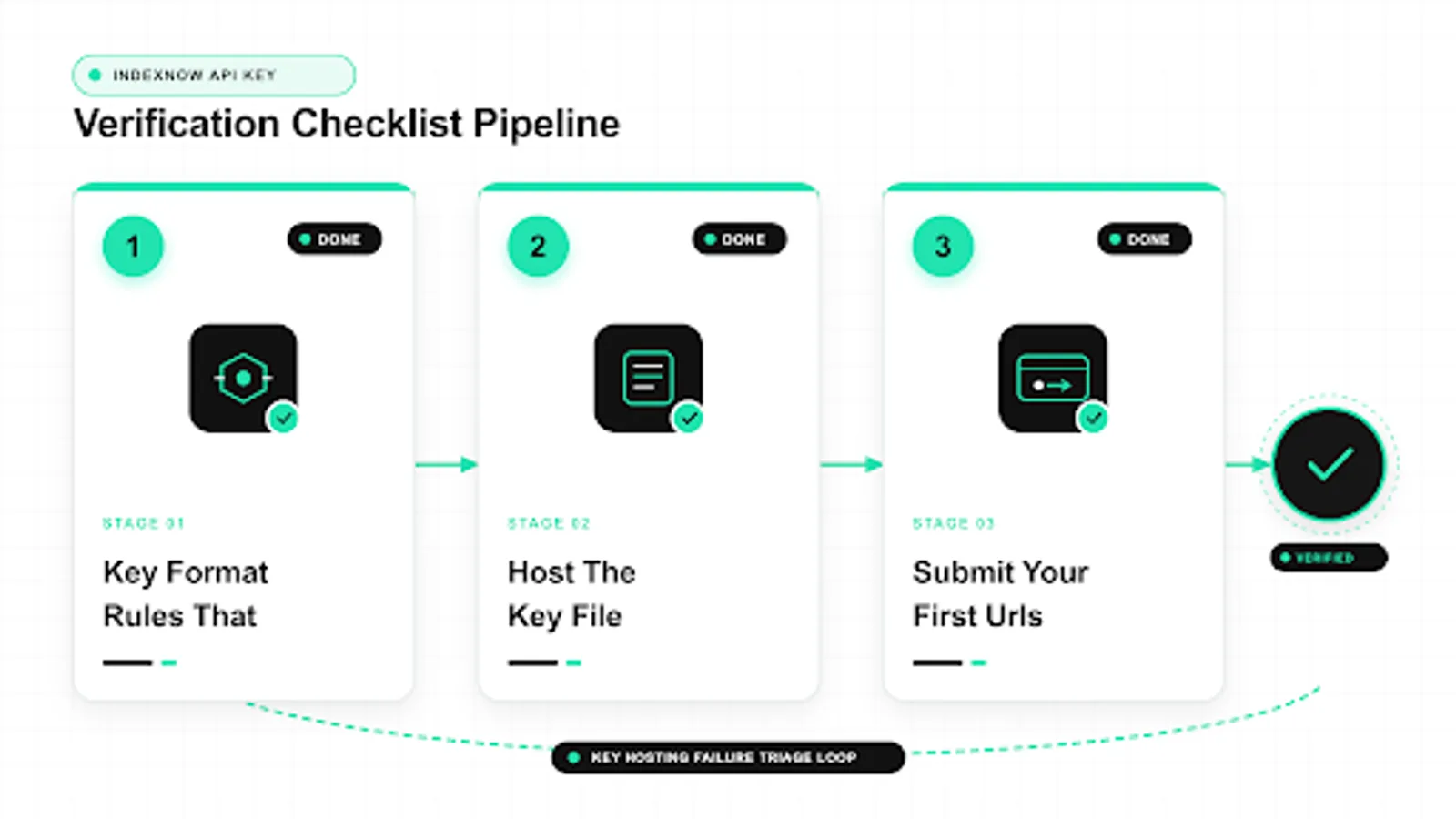 <!-- IMAGE-PROMPT workflow-02: 1600px max, DependsIt brand, subject: IndexNow key hosting failure triage flowchart, flat vector, accessible, no em dash, mint #22E3B0 on charcoal #121212, node-network line art, Clash Display and General Sans feel -->
Rotate to a new key without losing submissions
Rotation replaces the secret while keeping submissions flowing. Use overlap, not cutover. Generate a new key, host the new file alongside the old file so both URLs return 200 with their respective exact bodies, switch senders to the new triple in stages, verify success, then remove the old file after a week of clean operation. Removing the old file immediately breaks any worker still using it. Keeping both files during overlap costs nothing and prevents downtime. That patience is the whole technique.
Staged sender switching reduces risk. Start with manual tests using the new key, then move one low volume sender such as staging, then move production senders one by one. Verify each stage with success codes plus key file fetch logs. Keep old senders on the old key until their turn comes. Do not rotate prod and test at the same hour. Stagger changes so one environment remains known good. In CI, inject the new key per branch and gate promotion on single URL success with the new triple. That gate catches injection mistakes before they reach prod traffic.
Purge and validation sit between stages. After hosting the new file, purge the key URL at CDN and confirm edge plus origin return the new body. After switching a sender, validate that sender triple: key matches file, keyLocation points to the new file, host matches notified URLs. Log rotation events with date, actor, key fingerprints old and new, file URLs, purge record, and verification result. That log answers audit questions and speeds rollback if a missed worker surfaces later. Rollback is simply switching that worker back to the old triple while both files remain hosted during overlap.
| Step | Action | Verify |
|---|---|---|
| 1. Generate | New random key in secrets | Registry updated, fingerprint recorded |
| 2. Host both | New file live alongside old | Both URLs return exact bodies |
| 3. Purge | Clear CDN for new file URL | Edge plus origin match new body |
| 4. Switch staged | Manual, then staging, then prod | Success codes plus fetch logs per stage |
| 5. Observe | One week clean operation | No old key submissions in logs |
| 6. Remove old | Delete old file, archive record | New key still validates, old URL 404 expected |
Schedule rotation yearly or on staff and vendor changes, and test the routine in non prod first. Never delete the only working key on a Friday afternoon. Never rotate during a migration that already changes hosting. Separate the two changes by a week so failures have a single likely cause. That separation keeps triage fast when timing is otherwise confusing.
Security hygiene for keys and logs
Keys are secrets with limited but real power. Anyone with your key can submit URL lists for your host that engines will consider for scheduling. That could waste crawl attention on junk URLs or mask real changes in noise. Store raw keys only in secrets management with restricted access and audit logging. Inject at runtime via environment or mounted secret. Never commit to Git, never paste into tickets or docs, never embed in front end code where browsers expose them. Record fingerprints plus metadata in runbooks where the team can see which key is live without being able to copy it.
Logs should prove activity without leaking secrets. Log key fingerprint or key ID, not raw key, alongside timestamp, endpoint, host, URL count, status, and response snippet. That set answers what was sent and what happened without enabling replay by log readers. Scrub raw keys from error bodies and request dumps before storage. Retain 90 days to support quarterly reviews and incident lookbacks. Archive with your regular backups under the same access controls as other operational secrets metadata.
Access control completes hygiene. Limit who may view raw keys to admins and the runtime identity. Limit who may change files at web root to deploy pipelines and admins. Review both lists quarterly alongside submission volume. Remove dormant access on staff and vendor changes the same day. Rotate promptly if a key appeared in a log, ticket, or repo, even briefly. Treat any exposure as rotation trigger, not as minor cleanup. The overlap routine makes emergency rotation calm rather than disruptive.
| Practice | Implementation | Benefit |
|---|---|---|
| Secrets storage | Manager plus runtime injection | No repo or ticket exposure |
| Fingerprint logging | Hash or ID in logs, not raw key | Shareable logs without leak |
| Scrubbing | Strip keys from dumps before store | Safe retention and sharing |
| Least access | Admins plus runtime only | Smaller compromise window |
| Prompt rotation on exposure | Overlap routine immediately | Contained incident, clean recovery |
Pair key hygiene with your Google credential hygiene on the same quarterly date. One calendar event covers IndexNow keys plus service account JSONs, scopes, and Search Console delegation. That joint review takes 30 minutes and keeps both engine workflows trustworthy without extra process.
Checklist and next steps after the key works
Once validation passes and first submissions succeed, shift from setup to steady operation. Confirm the file persists across builds by re checking after the next deploy. Confirm automation sends only changed URLs with deduplication, host purity, batching, and logging. Confirm alerts exist for key file changes, persistent 4xx, and 429 pressure. Confirm the registry lists host, fingerprint, file URL, owner, and rotation due date. Those four confirmations turn a working key into a reliable workflow that survives staff changes and redesigns.
Next steps should expand in order: automate new publishes, then updates and deletes with eligibility prechecks, then limited paced backfills for important history. Each stage gets its own success criteria and log filter so reporting distinguishes live flow from catch up. For batch sizing and pacing once automation grows, the bulk rule guide is useful background. Keep backfills separate in logs so volume spikes remain explainable during reviews.
| Task after key works | Action | Signal of health |
|---|---|---|
| Persistence | Re check after next deploy | Still exact match, no action |
| Automation | Event driven queue for new URLs | Submissions match CMS publishes |
| Eligibility | Precheck public, indexable, correct host | Near zero persistent 4xx |
| Alerts | Key change, 4xx, 429 monitors | Alerts fire on test, quiet otherwise |
| Registry | Host, fingerprint, owner, rotation date | Reviewable in one minute |
Finally, remember scope honesty as you grow. IndexNow covers participating engines, not Google. Keep sitemaps fresh, internal linking shallow, canonicals clean, and server performance solid for all engines, and run a separate Google workflow where needed. A validated key plus honest scope keeps expectations aligned and results measurable. That is the whole point of careful key work.
FAQ
How long should my IndexNow key be?
Use 32 to 64 alphanumeric characters from a cryptographic random source for your indexnow key file secret. That range fits file names and URLs comfortably while providing ample entropy against guessing. Shorter keys are easier to mistype and guess. Much longer keys add no practical security here and can hit file name limits. Generate once, store in secrets, reuse until planned rotation, and record a fingerprint plus metadata in your runbook so the team knows which key is live without copying the raw value.
Can I use the same key for multiple domains?
You may share one key across hosts you control by hosting the same string in a file at each host root, with submissions per host referencing that host plus shared key plus that host file URL. When you place indexnow key values this way, document every host file URL in a registry with owner and rotation date. That simplifies rotation but shares blast radius. Per host keys isolate risk and suit different owners or vendors. Either pattern works if documented per host, and requests must stay host pure in both patterns to pass validation.
Why does verification fail even though the file looks fine in a browser?
Browsers hide whitespace, HTML wrappers and stale edge content that engines compare strictly. Validate with anonymous curl plus diff against the stored key, inspect headers for content type and caching, and compare edge versus origin for the same key file url. Common causes are theme templates wrapping .txt paths, editors adding trailing spaces, auth rules blocking the path, and CDN serving stale bodies after rotation. Byte level checks reveal the cause in one minute, while visual browser views miss the exact mismatch that engines reject.
How often should I rotate the key?
Rotate yearly or on staff and vendor changes, and immediately on any exposure in logs, tickets or repos. Use overlap: host old and new files together, switch senders in stages, verify success, observe a week, then remove the old file. Purge CDN for the new file URL and confirm edge plus origin match before switching senders in production. Log date, actor, fingerprints, purge record and verification result for audit. Never delete the only working key on a Friday afternoon or during a migration that already changes hosting behavior.
Does the key help with Google indexing?
No. Google does not support IndexNow, so IndexNow keys have no effect on Google crawling or indexing. For Google, maintain sitemaps, Search Console verification, internal linking and, where eligible, the Indexing API for JobPosting and BroadcastEvent pages. Run IndexNow for participating engines plus a separate Google workflow from the same publish event with independent queues and logs. That separation keeps expectations honest when stakeholders ask why Google charts stayed flat after IndexNow validation succeeded elsewhere. Keep sitemaps fresh and internal linking shallow so notified URLs get evaluated quickly on all engines.
What should I do first if submissions suddenly return key errors?
Re validate the file before changing senders, because most failures trace to indexnow authentication proof rather than endpoint issues. Fetch anonymously, diff body, check headers, compare edge versus origin, and confirm the request triple of key plus keyLocation plus host. Most sudden failures trace to redesigns, CDN or WAF changes, or rotation without purge. Fix hosting once, purge where needed, re validate, then resend one test submission. Log the cause and fix so the next identical incident resolves in minutes without bulk retries.
Sources
- https://www.indexnow.org/documentation
- https://www.bing.com/webmasters/help
- https://yandex.com/support/webmaster/indexnow/indexnow.html
- https://help.bing.com/pages/view/148490
- https://developers.google.com/search/docs/crawling-indexing/sitemaps/build-sitemap