IndexNow Bulk Submissions: The 10,000-URL Rule

Bulk submission is where IndexNow saves the most time for large sites, yet it is also where mistakes scale fastest. A single POST can carry up to 10,000 URLs, which tempts teams to ping entire sitemaps daily. That approach floods engines with unchanged or low value URLs and weakens trust in your signals. This guide explains the 10,000 URL rule in practical terms, with correct JSON, safe batching, queue design, prioritization, validation, logging and code you can adapt. You will learn when bulk makes sense, how to split 50,000 URLs into manageable batches, how to handle throttling and how to prove impact through crawl data. This indexnow bulk submission workflow respects quotas and keeps acceptance high on Bing, Yandex, Naver and Seznam.
Key takeaways
- Up to 10,000 URLs fit in one POST, but small validated batches of changed canonicals perform better.
- Split large refreshes by priority and host, space batches minutes apart and honor 429 with backoff.
- Validate status, canonical, robots and absolute form before send to avoid 400 and 422.
- Log every batch and join to Bing and Yandex crawl data to prove discovery gains.
- What the 10,000 URL rule actually says
- Single URL submits versus bulk POST requests
- The JSON structure engines actually accept
- How to split 50,000 URLs into safe batches
- Queue design, throttling and backoff that respect quotas
- Priority ordering so important URLs go first
- Deduplication and canonical filtering before you submit
- Logging, request IDs and submission history
- Code patterns for bulk with cURL, Python, Node and PHP
- Monitoring crawl response after bulk pings
- What not to do with indexnow bulk submission
- FAQ
- Sources
- Further reading
 <!-- IMAGE-PROMPT cover: 1200x630, DependsIt brand, deep charcoal #121212 background, vibrant mint #22E3B0 accent glow, thin node-network line art, Clash Display style bold heading space on left, General Sans clean labels, subject: indexnow bulk submission concept art for search discovery, flat vector, high contrast, accessible, no photorealistic faces, no text smaller than 24px, no em dash in rendered text, export PNG then cwebp -q 82 to WEBP -->
What the 10,000 URL rule actually says
The IndexNow specification allows up to 10,000 URLs in a single POST request through the urlList array. That number is a protocol ceiling, not a recommendation to send 10,000 URLs every time. Engines accept large payloads, but they evaluate signal quality, host consistency, key validity and change reality before scheduling crawls. A single request with 10,000 unchanged or low value URLs can dilute trust faster than ten small requests with fresh canonical pages. For most sites, the practical rule is simple. Use bulk capability to reduce HTTP overhead when many pages genuinely changed, such as after a migration, template fix or catalog refresh, and use small targeted batches for daily operations. Always send absolute https URLs that share one host, include a valid key and keyLocation, and keep JSON well formed. Log response codes per batch so you can prove acceptance and correlate later crawls in Bing and Yandex Webmaster Tools.
IndexNow is an open protocol co-developed by Microsoft Bing and Yandex. Current supporters include Bing, Yandex, Naver, Seznam and other engines listed on the official IndexNow site, with DuckDuckGo routing through Bing for discovery. Always confirm the live list on the official documentation during planning, since partnerships evolve and no blog post should present a stale list as exhaustive. Google does not support IndexNow. Google relies on sitemaps, Search Console URL Inspection and Request Indexing, plus the Google Indexing API for JobPosting and BroadcastEvent pages only. Never claim an IndexNow ping reaches Google. Track IndexNow outcomes in Bing and Yandex portals and Google outcomes separately in Search Console. IndexNow complements sitemaps, internal linking, canonical tags, robots.txt and crawl budget work. It does not replace them.
- Submit canonical https URLs only, without tracking parameters or variants.
- Deduplicate edits so one page updated five times pings once per cycle.
- Space batches minutes apart and watch for 429 throttling signals.
- Validate status, canonical and robots before every batch.
- Keep sitemap lastmod accurate so pings and sitemap tell the same story.
Bulk discipline protects signal quality. IndexNow allows up to 10,000 URLs per POST, but practical use favors small batches of changed canonical URLs spaced minutes apart. Queue pending URLs, deduplicate repeats, throttle to a gentle pace, use exponential backoff on HTTP 429, honor any Retry After hint, and log request IDs with timestamps and response codes. Never hammer endpoints with parallel loops or resubmit unchanged URLs daily. Engines learn which senders provide fresh meaningful changes and which send noise. A clean queue with prioritization, validation and logging keeps acceptance high and makes debugging straightforward when a batch returns 400, 403, 422 or 429.
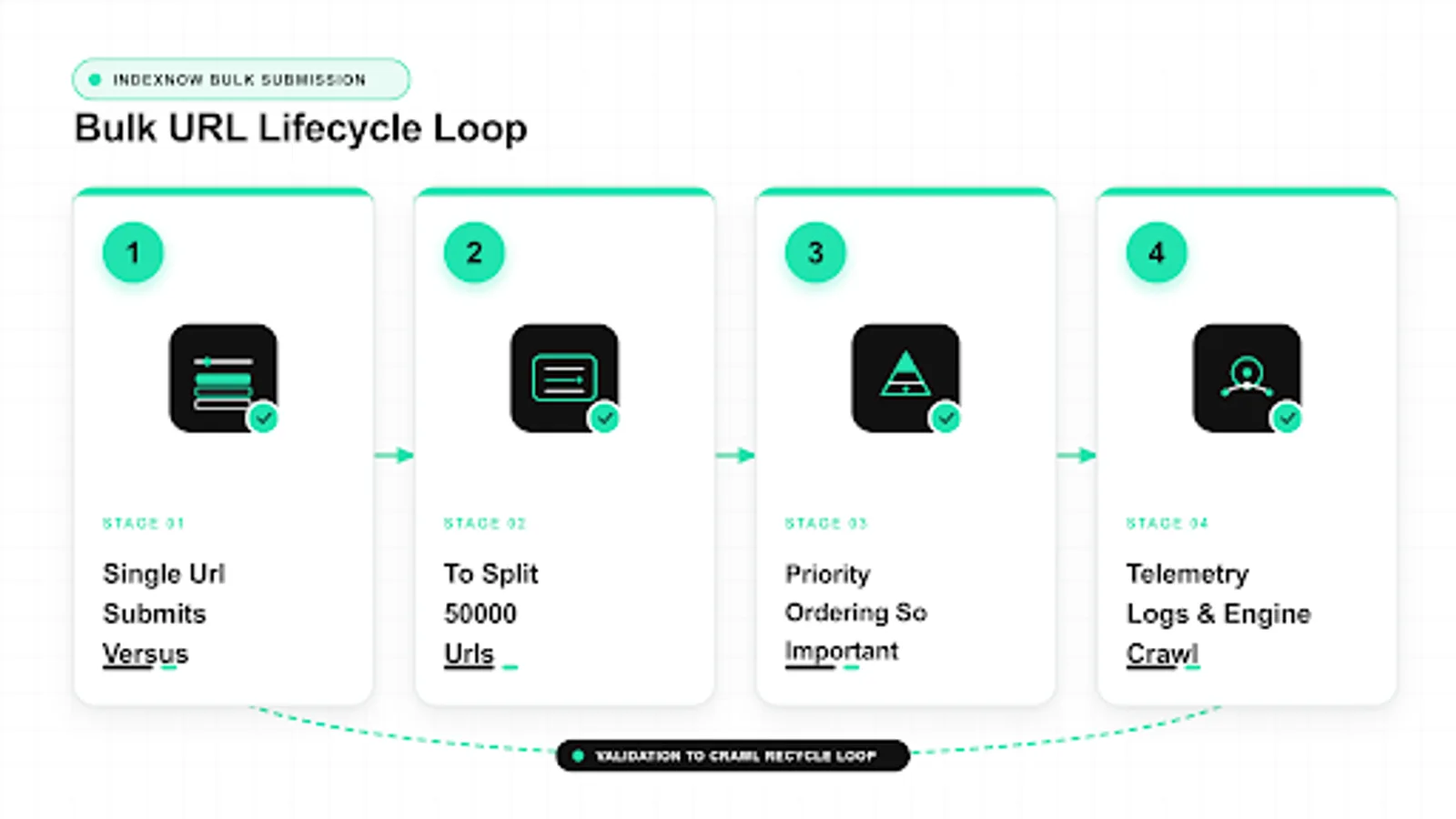
Measurement closes the loop between submission and outcome. Record every submitted URL with change type, submit time and response code, then check first crawl timestamps in Bing and Yandex Webmaster Tools and index status after seven days. Compare against your pre IndexNow baseline for similar launches. If discovery shortens from days to hours while quality and linking stay constant, the workflow is helping. If pings return success but crawls never arrive, look at content depth, internal link depth, canonical consistency, sitemap lastmod accuracy, server response times and robots rules before increasing volume. Keep Google metrics separate, since those engines follow independent scheduling and quality evaluation.
Single URL submits versus bulk POST requests
Single URL submission through GET is useful for testing and for stores that change a handful of pages per week. You append host, url, key and keyLocation as query parameters and receive a quick 200 or 202 for acceptance. Bulk POST moves the same fields into JSON with host, key, keyLocation and urlList, which scales better and keeps logs cleaner. The trade off is validation complexity. One malformed URL in a 5,000 item list can trigger 400 or 422 for the batch, while a single URL failure is isolated and obvious. A reliable pattern is to test with GET for one canonical URL, then switch to POST for batches once validation passes. Keep both paths in your toolkit. Use GET to debug key hosting and host mapping, use POST for production batches with deduplication, prioritization and throttling. Document which path each automation job uses so on call staff can reproduce failures without guessing request shapes. See also the IndexNow complete guide for background that pairs with this step.
IndexNow is an open protocol co-developed by Microsoft Bing and Yandex. Current supporters include Bing, Yandex, Naver, Seznam and other engines listed on the official IndexNow site, with DuckDuckGo routing through Bing for discovery. Always confirm the live list on the official documentation during planning, since partnerships evolve and no blog post should present a stale list as exhaustive. Google does not support IndexNow. Google relies on sitemaps, Search Console URL Inspection and Request Indexing, plus the Google Indexing API for JobPosting and BroadcastEvent pages only. Never claim an IndexNow ping reaches Google. Track IndexNow outcomes in Bing and Yandex portals and Google outcomes separately in Search Console. IndexNow complements sitemaps, internal linking, canonical tags, robots.txt and crawl budget work. It does not replace them.
| Check | What to confirm | How to verify |
|---|---|---|
| Host consistency | All URLs share one host per request | Normalize domain and split markets |
| Key accessibility | Key file returns exact string | Fetch key URL in browser and API client |
| Canonical form | Submit preferred URL only | Inspect canonical tag and status |
| Crawlability | Page returns 200 with content | Fetch as bot and review robots |
| Change reality | Content actually changed | Compare lastmod and page diff |
Bulk discipline protects signal quality. IndexNow allows up to 10,000 URLs per POST, but practical use favors small batches of changed canonical URLs spaced minutes apart. Queue pending URLs, deduplicate repeats, throttle to a gentle pace, use exponential backoff on HTTP 429, honor any Retry After hint, and log request IDs with timestamps and response codes. Never hammer endpoints with parallel loops or resubmit unchanged URLs daily. Engines learn which senders provide fresh meaningful changes and which send noise. A clean queue with prioritization, validation and logging keeps acceptance high and makes debugging straightforward when a batch returns 400, 403, 422 or 429.
Measurement closes the loop between submission and outcome. Record every submitted URL with change type, submit time and response code, then check first crawl timestamps in Bing and Yandex Webmaster Tools and index status after seven days. Compare against your pre IndexNow baseline for similar launches. If discovery shortens from days to hours while quality and linking stay constant, the workflow is helping. If pings return success but crawls never arrive, look at content depth, internal link depth, canonical consistency, sitemap lastmod accuracy, server response times and robots rules before increasing volume. Keep Google metrics separate, since those engines follow independent scheduling and quality evaluation.
 <!-- IMAGE-PROMPT diagram-01: 1600px max, DependsIt brand mint #22E3B0 on charcoal #121212, node-network line art, subject: bulk URL queue splitting into paced IndexNow batches diagram, flat vector, accessible, Clash Display headings General Sans labels feel, no em dash -->
The JSON structure engines actually accept
A valid IndexNow bulk body contains four fields. Host is the lowercase domain without protocol, such as www dot example dot com normalized to plain text. Key is your random verification string. KeyLocation is the absolute https URL of the key text file at the site root. UrlList is an array of absolute https URLs that share the host and point to canonical indexable pages. Keep encoding strict UTF8, escape special characters correctly, avoid trailing commas and keep the payload under reasonable size limits even when below 10,000 items. Do not mix http and https, www and bare domain, or multiple locales in one request. Split by host and by change priority instead. Include only 200 status canonical URLs that are not blocked by robots and not tagged noindex. A preflight validator that checks status, canonical, robots and absolute form before building JSON prevents most 400 and 422 responses and keeps your sender reputation clean across Bing, Yandex, Naver and Seznam.
IndexNow is an open protocol co-developed by Microsoft Bing and Yandex. Current supporters include Bing, Yandex, Naver, Seznam and other engines listed on the official IndexNow site, with DuckDuckGo routing through Bing for discovery. Always confirm the live list on the official documentation during planning, since partnerships evolve and no blog post should present a stale list as exhaustive. Google does not support IndexNow. Google relies on sitemaps, Search Console URL Inspection and Request Indexing, plus the Google Indexing API for JobPosting and BroadcastEvent pages only. Never claim an IndexNow ping reaches Google. Track IndexNow outcomes in Bing and Yandex portals and Google outcomes separately in Search Console. IndexNow complements sitemaps, internal linking, canonical tags, robots.txt and crawl budget work. It does not replace them.
- Submit canonical https URLs only, without tracking parameters or variants.
- Deduplicate edits so one page updated five times pings once per cycle.
- Space batches minutes apart and watch for 429 throttling signals.
- Validate status, canonical and robots before every batch.
- Keep sitemap lastmod accurate so pings and sitemap tell the same story.
Bulk discipline protects signal quality. IndexNow allows up to 10,000 URLs per POST, but practical use favors small batches of changed canonical URLs spaced minutes apart. Queue pending URLs, deduplicate repeats, throttle to a gentle pace, use exponential backoff on HTTP 429, honor any Retry After hint, and log request IDs with timestamps and response codes. Never hammer endpoints with parallel loops or resubmit unchanged URLs daily. Engines learn which senders provide fresh meaningful changes and which send noise. A clean queue with prioritization, validation and logging keeps acceptance high and makes debugging straightforward when a batch returns 400, 403, 422 or 429.
Measurement closes the loop between submission and outcome. Record every submitted URL with change type, submit time and response code, then check first crawl timestamps in Bing and Yandex Webmaster Tools and index status after seven days. Compare against your pre IndexNow baseline for similar launches. If discovery shortens from days to hours while quality and linking stay constant, the workflow is helping. If pings return success but crawls never arrive, look at content depth, internal link depth, canonical consistency, sitemap lastmod accuracy, server response times and robots rules before increasing volume. Keep Google metrics separate, since those engines follow independent scheduling and quality evaluation.
How to split 50,000 URLs into safe batches
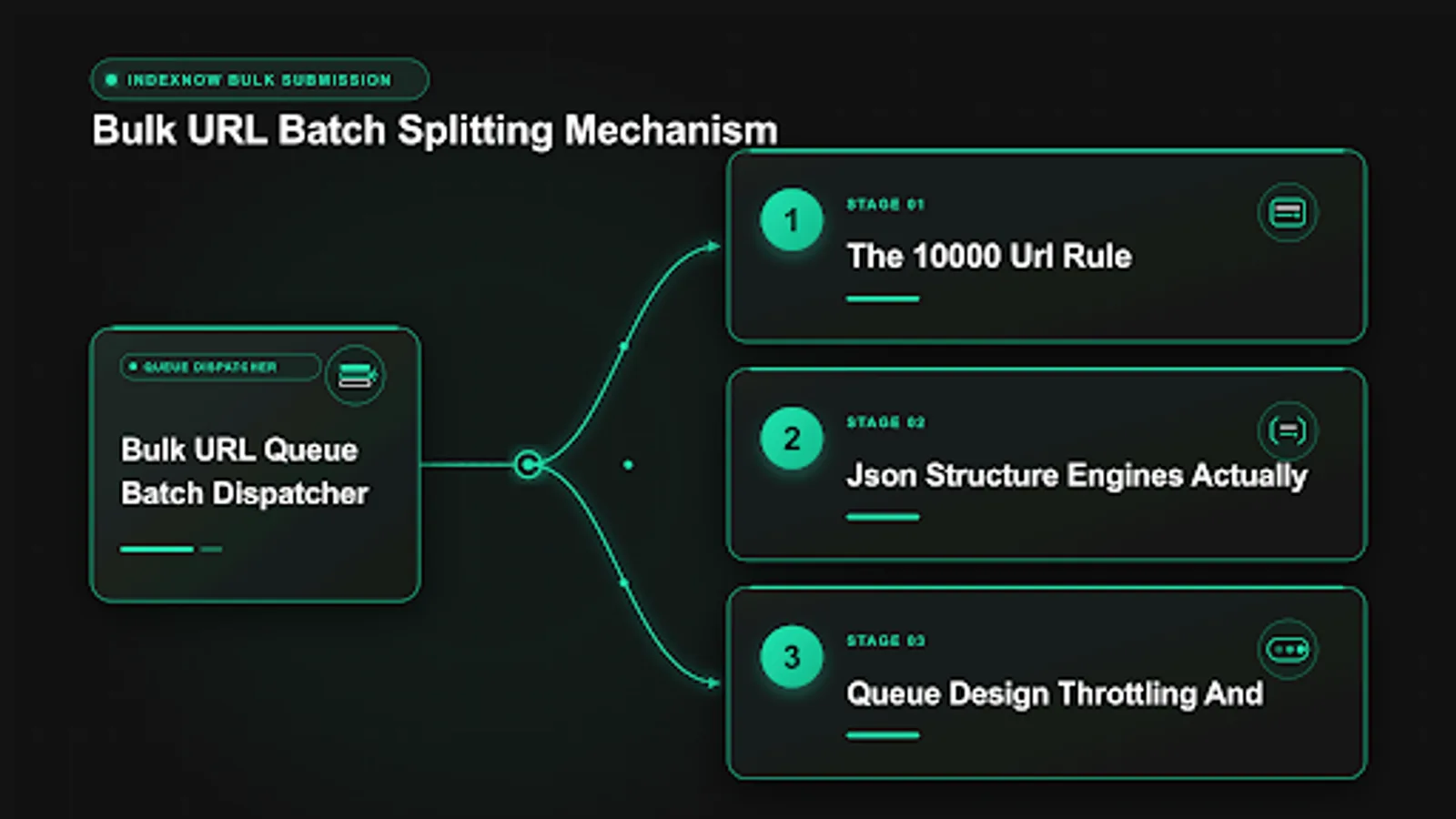
A catalog with 50,000 changed URLs should never be sent as five back to back 10,000 URL blasts. Split by priority first, then by host and template. Put new products, updated categories and corrected canonicals in early batches, move paginated archives and minor metadata tweaks to later batches, and exclude faceted filters, internal search and non canonical variants entirely. A practical split is 200 to 500 URLs per batch for large refreshes, spaced several minutes apart, with logs per batch and pauses to watch for 429 throttling. If a batch returns 429, honor Retry After, double the delay for the next attempt and reduce the following batch size. If a batch returns 400 or 422, quarantine it, validate entries, fix malformed or mismatched items and resubmit only corrected URLs. This paced approach respects quotas, makes failures isolable and shows engines a steady stream of meaningful changes rather than a flood that looks like spam.
IndexNow is an open protocol co-developed by Microsoft Bing and Yandex. Current supporters include Bing, Yandex, Naver, Seznam and other engines listed on the official IndexNow site, with DuckDuckGo routing through Bing for discovery. Always confirm the live list on the official documentation during planning, since partnerships evolve and no blog post should present a stale list as exhaustive. Google does not support IndexNow. Google relies on sitemaps, Search Console URL Inspection and Request Indexing, plus the Google Indexing API for JobPosting and BroadcastEvent pages only. Never claim an IndexNow ping reaches Google. Track IndexNow outcomes in Bing and Yandex portals and Google outcomes separately in Search Console. IndexNow complements sitemaps, internal linking, canonical tags, robots.txt and crawl budget work. It does not replace them.
- Generate a random key string with letters, numbers and dashes.
- Host the key text file at the root of your verified host with exact content.
- Fetch the key URL anonymously to confirm public access and correct content type.
- Submit one canonical URL and confirm a 200 or 202 response.
- Log URL, timestamp and response code before scaling to small batches.
Bulk discipline protects signal quality. IndexNow allows up to 10,000 URLs per POST, but practical use favors small batches of changed canonical URLs spaced minutes apart. Queue pending URLs, deduplicate repeats, throttle to a gentle pace, use exponential backoff on HTTP 429, honor any Retry After hint, and log request IDs with timestamps and response codes. Never hammer endpoints with parallel loops or resubmit unchanged URLs daily. Engines learn which senders provide fresh meaningful changes and which send noise. A clean queue with prioritization, validation and logging keeps acceptance high and makes debugging straightforward when a batch returns 400, 403, 422 or 429.
Measurement closes the loop between submission and outcome. Record every submitted URL with change type, submit time and response code, then check first crawl timestamps in Bing and Yandex Webmaster Tools and index status after seven days. Compare against your pre IndexNow baseline for similar launches. If discovery shortens from days to hours while quality and linking stay constant, the workflow is helping. If pings return success but crawls never arrive, look at content depth, internal link depth, canonical consistency, sitemap lastmod accuracy, server response times and robots rules before increasing volume. Keep Google metrics separate, since those engines follow independent scheduling and quality evaluation.
Queue design, throttling and backoff that respect quotas
A persistent queue is the difference between controlled bulk submission and accidental hammering. Store pending URLs with first seen time, change type, priority and retry count in a durable table or file. A worker pulls the next batch, validates entries, sends one POST, records response code and schedules retries with exponential backoff on 429. Start with one worker and one request every 10 to 30 seconds for bulk catch up, then slow to hourly or daily for steady state. Add jitter to avoid thundering herd after deploys, deduplicate URLs that appear multiple times, and cap daily volume to changed canonicals only. Never run parallel workers against the same host without coordination, never retry 400 or 422 without fixing payloads, and never resubmit success batches just to be safe. Good queue metrics include pending depth, success rate by code, median time from change to submit, and time from submit to first crawl observed in Webmaster Tools.
IndexNow is an open protocol co-developed by Microsoft Bing and Yandex. Current supporters include Bing, Yandex, Naver, Seznam and other engines listed on the official IndexNow site, with DuckDuckGo routing through Bing for discovery. Always confirm the live list on the official documentation during planning, since partnerships evolve and no blog post should present a stale list as exhaustive. Google does not support IndexNow. Google relies on sitemaps, Search Console URL Inspection and Request Indexing, plus the Google Indexing API for JobPosting and BroadcastEvent pages only. Never claim an IndexNow ping reaches Google. Track IndexNow outcomes in Bing and Yandex portals and Google outcomes separately in Search Console. IndexNow complements sitemaps, internal linking, canonical tags, robots.txt and crawl budget work. It does not replace them.
- Submit canonical https URLs only, without tracking parameters or variants.
- Deduplicate edits so one page updated five times pings once per cycle.
- Space batches minutes apart and watch for 429 throttling signals.
- Validate status, canonical and robots before every batch.
- Keep sitemap lastmod accurate so pings and sitemap tell the same story.
Bulk discipline protects signal quality. IndexNow allows up to 10,000 URLs per POST, but practical use favors small batches of changed canonical URLs spaced minutes apart. Queue pending URLs, deduplicate repeats, throttle to a gentle pace, use exponential backoff on HTTP 429, honor any Retry After hint, and log request IDs with timestamps and response codes. Never hammer endpoints with parallel loops or resubmit unchanged URLs daily. Engines learn which senders provide fresh meaningful changes and which send noise. A clean queue with prioritization, validation and logging keeps acceptance high and makes debugging straightforward when a batch returns 400, 403, 422 or 429.
Measurement closes the loop between submission and outcome. Record every submitted URL with change type, submit time and response code, then check first crawl timestamps in Bing and Yandex Webmaster Tools and index status after seven days. Compare against your pre IndexNow baseline for similar launches. If discovery shortens from days to hours while quality and linking stay constant, the workflow is helping. If pings return success but crawls never arrive, look at content depth, internal link depth, canonical consistency, sitemap lastmod accuracy, server response times and robots rules before increasing volume. Keep Google metrics separate, since those engines follow independent scheduling and quality evaluation.
Priority ordering so important URLs go first
When bulk volume exceeds what you should send in one day, ordering determines which pages benefit first. Rank candidates by business impact and freshness. New revenue pages, corrected titles and availability fixes outrank pagination tweaks and footer link changes. A simple scoring model adds points for new versus updated, for product versus filter, for internal link depth and for sitemap lastmod recency, then sorts descending and takes the top N for the next batch. Rebuild scores nightly from sitemap diffs, CMS change logs and crawl reports. Document exclusion rules explicitly so thin duplicates, staging URLs and parameter variants never enter the queue. Priority ordering also helps reporting. You can show stakeholders that top 500 revenue URLs were submitted within hours with 200 responses and first crawls within a day, while low priority batches followed over the week. That narrative beats raw counts of 10,000 pings with unknown outcomes.
IndexNow is an open protocol co-developed by Microsoft Bing and Yandex. Current supporters include Bing, Yandex, Naver, Seznam and other engines listed on the official IndexNow site, with DuckDuckGo routing through Bing for discovery. Always confirm the live list on the official documentation during planning, since partnerships evolve and no blog post should present a stale list as exhaustive. Google does not support IndexNow. Google relies on sitemaps, Search Console URL Inspection and Request Indexing, plus the Google Indexing API for JobPosting and BroadcastEvent pages only. Never claim an IndexNow ping reaches Google. Track IndexNow outcomes in Bing and Yandex portals and Google outcomes separately in Search Console. IndexNow complements sitemaps, internal linking, canonical tags, robots.txt and crawl budget work. It does not replace them.
- Generate a random key string with letters, numbers and dashes.
- Host the key text file at the root of your verified host with exact content.
- Fetch the key URL anonymously to confirm public access and correct content type.
- Submit one canonical URL and confirm a 200 or 202 response.
- Log URL, timestamp and response code before scaling to small batches.
Bulk discipline protects signal quality. IndexNow allows up to 10,000 URLs per POST, but practical use favors small batches of changed canonical URLs spaced minutes apart. Queue pending URLs, deduplicate repeats, throttle to a gentle pace, use exponential backoff on HTTP 429, honor any Retry After hint, and log request IDs with timestamps and response codes. Never hammer endpoints with parallel loops or resubmit unchanged URLs daily. Engines learn which senders provide fresh meaningful changes and which send noise. A clean queue with prioritization, validation and logging keeps acceptance high and makes debugging straightforward when a batch returns 400, 403, 422 or 429.
Measurement closes the loop between submission and outcome. Record every submitted URL with change type, submit time and response code, then check first crawl timestamps in Bing and Yandex Webmaster Tools and index status after seven days. Compare against your pre IndexNow baseline for similar launches. If discovery shortens from days to hours while quality and linking stay constant, the workflow is helping. If pings return success but crawls never arrive, look at content depth, internal link depth, canonical consistency, sitemap lastmod accuracy, server response times and robots rules before increasing volume. Keep Google metrics separate, since those engines follow independent scheduling and quality evaluation.
Deduplication and canonical filtering before you submit
Duplicates waste quota and teach engines to ignore your pings. Normalize every candidate before it enters urlList. Lowercase host, enforce https, strip tracking parameters, resolve trailing slash policy, collapse variant query strings to the canonical product URL and drop any URL whose canonical tag points elsewhere. Then deduplicate by canonical across sitemap, CMS feed and manual additions. Check status with a HEAD request, confirm robots allows crawling, confirm no noindex in meta or headers, and confirm the page renders meaningful content. Keep an allow list of templates that may be submitted and a deny list for cart, checkout, account, search and faceted routes. Log every filtered URL with reason so audits can explain why 50,000 changed rows became 1,200 submitted canonicals. That filtering story is exactly what experienced SEOs expect and what keeps IndexNow signals trusted over months.
IndexNow is an open protocol co-developed by Microsoft Bing and Yandex. Current supporters include Bing, Yandex, Naver, Seznam and other engines listed on the official IndexNow site, with DuckDuckGo routing through Bing for discovery. Always confirm the live list on the official documentation during planning, since partnerships evolve and no blog post should present a stale list as exhaustive. Google does not support IndexNow. Google relies on sitemaps, Search Console URL Inspection and Request Indexing, plus the Google Indexing API for JobPosting and BroadcastEvent pages only. Never claim an IndexNow ping reaches Google. Track IndexNow outcomes in Bing and Yandex portals and Google outcomes separately in Search Console. IndexNow complements sitemaps, internal linking, canonical tags, robots.txt and crawl budget work. It does not replace them.
| Check | What to confirm | How to verify |
|---|---|---|
| Host consistency | All URLs share one host per request | Normalize domain and split markets |
| Key accessibility | Key file returns exact string | Fetch key URL in browser and API client |
| Canonical form | Submit preferred URL only | Inspect canonical tag and status |
| Crawlability | Page returns 200 with content | Fetch as bot and review robots |
| Change reality | Content actually changed | Compare lastmod and page diff |
Bulk discipline protects signal quality. IndexNow allows up to 10,000 URLs per POST, but practical use favors small batches of changed canonical URLs spaced minutes apart. Queue pending URLs, deduplicate repeats, throttle to a gentle pace, use exponential backoff on HTTP 429, honor any Retry After hint, and log request IDs with timestamps and response codes. Never hammer endpoints with parallel loops or resubmit unchanged URLs daily. Engines learn which senders provide fresh meaningful changes and which send noise. A clean queue with prioritization, validation and logging keeps acceptance high and makes debugging straightforward when a batch returns 400, 403, 422 or 429.
Measurement closes the loop between submission and outcome. Record every submitted URL with change type, submit time and response code, then check first crawl timestamps in Bing and Yandex Webmaster Tools and index status after seven days. Compare against your pre IndexNow baseline for similar launches. If discovery shortens from days to hours while quality and linking stay constant, the workflow is helping. If pings return success but crawls never arrive, look at content depth, internal link depth, canonical consistency, sitemap lastmod accuracy, server response times and robots rules before increasing volume. Keep Google metrics separate, since those engines follow independent scheduling and quality evaluation.
 <!-- IMAGE-PROMPT workflow-02: 1600px max, DependsIt brand mint #22E3B0 on charcoal #121212, node-network line art, subject: validation to submission to log to crawl check workflow, flat vector, accessible, Clash Display headings General Sans labels feel, no em dash -->
Logging, request IDs and submission history
Every bulk POST should create a log entry with timestamp, host, batch size, key identifier, response code, response body snippet and a local batch ID. Store the exact urlList or a hash plus count so you can reconcile later crawls without storing massive files forever. Track per URL first submit time, last response code and first observed crawl from Bing and Yandex reports. Build a dashboard showing batches per day, success rate by code, 429 frequency, 422 quarantine depth and median submit to crawl latency. Retain logs for at least 90 days to support incident reviews and to prove prudent behavior if deliverability questions arise. Good logs turn vague complaints about indexing into answerable questions. You can point to batch 1842 with 340 URLs, all 202 accepted at 14:05, first crawls at 18:40, and only three thin pages still unindexed due to quality, not submission failure.
IndexNow is an open protocol co-developed by Microsoft Bing and Yandex. Current supporters include Bing, Yandex, Naver, Seznam and other engines listed on the official IndexNow site, with DuckDuckGo routing through Bing for discovery. Always confirm the live list on the official documentation during planning, since partnerships evolve and no blog post should present a stale list as exhaustive. Google does not support IndexNow. Google relies on sitemaps, Search Console URL Inspection and Request Indexing, plus the Google Indexing API for JobPosting and BroadcastEvent pages only. Never claim an IndexNow ping reaches Google. Track IndexNow outcomes in Bing and Yandex portals and Google outcomes separately in Search Console. IndexNow complements sitemaps, internal linking, canonical tags, robots.txt and crawl budget work. It does not replace them.
- Generate a random key string with letters, numbers and dashes.
- Host the key text file at the root of your verified host with exact content.
- Fetch the key URL anonymously to confirm public access and correct content type.
- Submit one canonical URL and confirm a 200 or 202 response.
- Log URL, timestamp and response code before scaling to small batches.
Bulk discipline protects signal quality. IndexNow allows up to 10,000 URLs per POST, but practical use favors small batches of changed canonical URLs spaced minutes apart. Queue pending URLs, deduplicate repeats, throttle to a gentle pace, use exponential backoff on HTTP 429, honor any Retry After hint, and log request IDs with timestamps and response codes. Never hammer endpoints with parallel loops or resubmit unchanged URLs daily. Engines learn which senders provide fresh meaningful changes and which send noise. A clean queue with prioritization, validation and logging keeps acceptance high and makes debugging straightforward when a batch returns 400, 403, 422 or 429.
Measurement closes the loop between submission and outcome. Record every submitted URL with change type, submit time and response code, then check first crawl timestamps in Bing and Yandex Webmaster Tools and index status after seven days. Compare against your pre IndexNow baseline for similar launches. If discovery shortens from days to hours while quality and linking stay constant, the workflow is helping. If pings return success but crawls never arrive, look at content depth, internal link depth, canonical consistency, sitemap lastmod accuracy, server response times and robots rules before increasing volume. Keep Google metrics separate, since those engines follow independent scheduling and quality evaluation.
Code patterns for bulk with cURL, Python, Node and PHP
Copy paste patterns speed adoption while keeping request shapes consistent. Use cURL for manual batch tests, Python for nightly sitemap diff jobs, Node for webhook driven queues and PHP for WordPress or custom CMS plugins. In every language, build the same flow. Load candidates, normalize and validate, split into batches of a few hundred, POST JSON to the IndexNow endpoint, check status codes, retry 429 with backoff and quarantine 400 and 422 for inspection. Set timeouts, set a descriptive User Agent, handle redirects for keyLocation fetches separately and never log secret keys in plain text. Keep batch size configurable so you can reduce from 500 to 100 without code changes when throttling appears. Version your submitter, record which version sent each batch and test payloads against a validator before enabling automation. Consistent patterns across languages reduce onboarding time and prevent one off scripts from drifting out of spec. See also the Bing submission guide for background that pairs with this step.
IndexNow is an open protocol co-developed by Microsoft Bing and Yandex. Current supporters include Bing, Yandex, Naver, Seznam and other engines listed on the official IndexNow site, with DuckDuckGo routing through Bing for discovery. Always confirm the live list on the official documentation during planning, since partnerships evolve and no blog post should present a stale list as exhaustive. Google does not support IndexNow. Google relies on sitemaps, Search Console URL Inspection and Request Indexing, plus the Google Indexing API for JobPosting and BroadcastEvent pages only. Never claim an IndexNow ping reaches Google. Track IndexNow outcomes in Bing and Yandex portals and Google outcomes separately in Search Console. IndexNow complements sitemaps, internal linking, canonical tags, robots.txt and crawl budget work. It does not replace them.
- Submit canonical https URLs only, without tracking parameters or variants.
- Deduplicate edits so one page updated five times pings once per cycle.
- Space batches minutes apart and watch for 429 throttling signals.
- Validate status, canonical and robots before every batch.
- Keep sitemap lastmod accurate so pings and sitemap tell the same story.
Bulk discipline protects signal quality. IndexNow allows up to 10,000 URLs per POST, but practical use favors small batches of changed canonical URLs spaced minutes apart. Queue pending URLs, deduplicate repeats, throttle to a gentle pace, use exponential backoff on HTTP 429, honor any Retry After hint, and log request IDs with timestamps and response codes. Never hammer endpoints with parallel loops or resubmit unchanged URLs daily. Engines learn which senders provide fresh meaningful changes and which send noise. A clean queue with prioritization, validation and logging keeps acceptance high and makes debugging straightforward when a batch returns 400, 403, 422 or 429.
Measurement closes the loop between submission and outcome. Record every submitted URL with change type, submit time and response code, then check first crawl timestamps in Bing and Yandex Webmaster Tools and index status after seven days. Compare against your pre IndexNow baseline for similar launches. If discovery shortens from days to hours while quality and linking stay constant, the workflow is helping. If pings return success but crawls never arrive, look at content depth, internal link depth, canonical consistency, sitemap lastmod accuracy, server response times and robots rules before increasing volume. Keep Google metrics separate, since those engines follow independent scheduling and quality evaluation.
curl -X POST "https://api.indexnow.org/indexnow" -H "Content-Type: application/json" -d '{"host":"www.example.com","key":"abc123def456","keyLocation":"https://www.example.com/abc123def456.txt","urlList":["https://www.example.com/products/blue-widget","https://www.example.com/products/red-widget","https://www.example.com/collections/widgets"]}'import requests
payload = {"host": "www.example.com", "key": "abc123def456", "keyLocation": "https://www.example.com/abc123def456.txt", "urlList": ["https://www.example.com/products/blue-widget"]}
r = requests.post("https://api.indexnow.org/indexnow", json=payload, timeout=20)
print(r.status_code)Monitoring crawl response after bulk pings
Acceptance codes only confirm receipt, so monitor what happens next. In Bing Webmaster Tools, watch crawl activity and index coverage for submitted directories. In Yandex Webmaster, review crawl statistics and indexed page trends for the same sets. Join submission logs to crawl logs by URL and compute time from submit to first crawl, share crawled within 24 and 72 hours, and share indexed after seven and 21 days. Segment by template to see whether products respond faster than blog archives. If crawls arrive but indexing lags, shift effort to content depth, internal linking, canonical clarity and page experience rather than more pings. If crawls never arrive despite 202 responses, check quality filters, robots, server errors and host mapping. Report bulk outcomes as funnel metrics, not vanity counts. Submitted, accepted, crawled and indexed tell a credible story that stakeholders can act on.
IndexNow is an open protocol co-developed by Microsoft Bing and Yandex. Current supporters include Bing, Yandex, Naver, Seznam and other engines listed on the official IndexNow site, with DuckDuckGo routing through Bing for discovery. Always confirm the live list on the official documentation during planning, since partnerships evolve and no blog post should present a stale list as exhaustive. Google does not support IndexNow. Google relies on sitemaps, Search Console URL Inspection and Request Indexing, plus the Google Indexing API for JobPosting and BroadcastEvent pages only. Never claim an IndexNow ping reaches Google. Track IndexNow outcomes in Bing and Yandex portals and Google outcomes separately in Search Console. IndexNow complements sitemaps, internal linking, canonical tags, robots.txt and crawl budget work. It does not replace them.
| Check | What to confirm | How to verify |
|---|---|---|
| Host consistency | All URLs share one host per request | Normalize domain and split markets |
| Key accessibility | Key file returns exact string | Fetch key URL in browser and API client |
| Canonical form | Submit preferred URL only | Inspect canonical tag and status |
| Crawlability | Page returns 200 with content | Fetch as bot and review robots |
| Change reality | Content actually changed | Compare lastmod and page diff |
Bulk discipline protects signal quality. IndexNow allows up to 10,000 URLs per POST, but practical use favors small batches of changed canonical URLs spaced minutes apart. Queue pending URLs, deduplicate repeats, throttle to a gentle pace, use exponential backoff on HTTP 429, honor any Retry After hint, and log request IDs with timestamps and response codes. Never hammer endpoints with parallel loops or resubmit unchanged URLs daily. Engines learn which senders provide fresh meaningful changes and which send noise. A clean queue with prioritization, validation and logging keeps acceptance high and makes debugging straightforward when a batch returns 400, 403, 422 or 429.
Measurement closes the loop between submission and outcome. Record every submitted URL with change type, submit time and response code, then check first crawl timestamps in Bing and Yandex Webmaster Tools and index status after seven days. Compare against your pre IndexNow baseline for similar launches. If discovery shortens from days to hours while quality and linking stay constant, the workflow is helping. If pings return success but crawls never arrive, look at content depth, internal link depth, canonical consistency, sitemap lastmod accuracy, server response times and robots rules before increasing volume. Keep Google metrics separate, since those engines follow independent scheduling and quality evaluation.
What not to do with indexnow bulk submission
Bulk power invites misuse that harms long term deliverability. Do not submit unchanged URLs daily to inflate activity, do not include parameter variants that canonicalize elsewhere, do not mix hosts or protocols in one payload, do not send deleted URLs as updated, and do not parallelize aggressive loops that trigger 429 storms. Avoid buying lists of URLs you do not control, avoid pinging staging or password protected pages, and avoid resubmitting quarantined batches without fixing root causes. Each of these patterns teaches engines that your notifications carry little new value, which can lead to slower crawling despite technically valid requests. The safer playbook is boring and effective. Submit changed canonicals, keep batches modest and spaced, validate before send, log everything, fix content and linking in parallel and reserve large 10,000 URL payloads for genuine large scale changes like migrations or major catalog refreshes with clean validation.
IndexNow is an open protocol co-developed by Microsoft Bing and Yandex. Current supporters include Bing, Yandex, Naver, Seznam and other engines listed on the official IndexNow site, with DuckDuckGo routing through Bing for discovery. Always confirm the live list on the official documentation during planning, since partnerships evolve and no blog post should present a stale list as exhaustive. Google does not support IndexNow. Google relies on sitemaps, Search Console URL Inspection and Request Indexing, plus the Google Indexing API for JobPosting and BroadcastEvent pages only. Never claim an IndexNow ping reaches Google. Track IndexNow outcomes in Bing and Yandex portals and Google outcomes separately in Search Console. IndexNow complements sitemaps, internal linking, canonical tags, robots.txt and crawl budget work. It does not replace them.
- Submit canonical https URLs only, without tracking parameters or variants.
- Deduplicate edits so one page updated five times pings once per cycle.
- Space batches minutes apart and watch for 429 throttling signals.
- Validate status, canonical and robots before every batch.
- Keep sitemap lastmod accurate so pings and sitemap tell the same story.
Bulk discipline protects signal quality. IndexNow allows up to 10,000 URLs per POST, but practical use favors small batches of changed canonical URLs spaced minutes apart. Queue pending URLs, deduplicate repeats, throttle to a gentle pace, use exponential backoff on HTTP 429, honor any Retry After hint, and log request IDs with timestamps and response codes. Never hammer endpoints with parallel loops or resubmit unchanged URLs daily. Engines learn which senders provide fresh meaningful changes and which send noise. A clean queue with prioritization, validation and logging keeps acceptance high and makes debugging straightforward when a batch returns 400, 403, 422 or 429.
Measurement closes the loop between submission and outcome. Record every submitted URL with change type, submit time and response code, then check first crawl timestamps in Bing and Yandex Webmaster Tools and index status after seven days. Compare against your pre IndexNow baseline for similar launches. If discovery shortens from days to hours while quality and linking stay constant, the workflow is helping. If pings return success but crawls never arrive, look at content depth, internal link depth, canonical consistency, sitemap lastmod accuracy, server response times and robots rules before increasing volume. Keep Google metrics separate, since those engines follow independent scheduling and quality evaluation.
Teams often ask what the practical indexnow limit means for daily operations. The specification allows indexnow 10000 urls in one POST, but that ceiling is not a daily target. Treat indexnow max urls as a safety valve for migrations, then run routine work in batches of 200 to 500 changed canonicals spaced minutes apart. This approach keeps logs readable, isolates failures and shows engines a steady stream of meaningful changes that build trust over time. Validate status, canonical and robots before send so bulk acceptance stays high.
When you submit multiple urls indexnow in one call, keep the indexnow post body strict with host, key, keyLocation and urlList and no trailing commas. Respect the indexnow array limit by validating host consistency and absolute https form before send. Each indexnow batch should share one host, contain only 200 status canonicals and carry a request ID in your logs so acceptance and later crawls can be joined in analysis. For indexnow large sites, split by template and priority for clearer reporting.
FAQ
Can I really send 10,000 URLs in one IndexNow request?
Yes, the specification allows up to 10,000 URLs in urlList per POST, but practical use should favor smaller batches of validated canonical URLs. Large payloads are best reserved for migrations or major refreshes where thousands of pages genuinely changed. For daily work, batches of 200 to 500 spaced minutes apart are easier to debug, gentler on throttling and clearer in logs. Always validate host consistency, key placement and URL quality before scaling to thousands. A clean bulk ping indexnow routine with deduplication and shared logging keeps success rates high across templates.
What happens if one URL in a bulk batch is invalid?
Depending on severity, the endpoint may return 400 for malformed JSON or host mismatch, or 422 when listed URLs fail validation. Quarantine the batch, inspect the response body, run each URL through status, canonical, robots and absolute form checks, remove or fix offenders and resubmit only corrected entries. A preflight validator that filters non canonical, non 200 and blocked URLs prevents most batch level rejections and keeps success rates high. For indexnow large sites, quarantine failures, fix offenders and resubmit only clean entries to protect sender trust.
How fast should I send bulk batches?
Start with one batch every few minutes and watch for 429 responses. If throttling appears, honor Retry After, increase delays with exponential backoff and reduce batch size. For steady state, hourly or daily flushes of changed URLs are usually enough. Avoid parallel workers hammering the same host. A single coordinated worker with deduplication and prioritization delivers predictable throughput without triggering rate limits. A steady bulk ping indexnow cadence with one worker and small indexnow batch sizes avoids throttling and keeps debugging simple.
Does bulk IndexNow submit to Google?
No. Google does not support IndexNow, so bulk pings reach Bing, Yandex, Naver, Seznam and other participating engines only. For Google coverage, maintain accurate sitemaps with correct lastmod, use Search Console inspection for critical URLs and improve quality and internal linking. Track Google outcomes separately from IndexNow outcomes to avoid misattributing results and to set correct stakeholder expectations. For indexnow large sites, keep sitemaps accurate and use bulk indexnow only for changed subsets so coverage stays trustworthy.
How do I prove bulk submissions worked?
Log every batch with timestamp, host, size, response code and batch ID, then join to crawl data from Bing and Yandex Webmaster Tools. Report submitted, accepted, crawled within 72 hours and indexed after seven days, segmented by template. That funnel shows real impact. Raw counts of URLs pinged without crawl and index follow up do not prove value and can hide quality problems that need content or linking fixes. Respect the indexnow limit, track indexnow max urls per batch and review time to first crawl to prove real impact.
Should large sites still use sitemaps with bulk IndexNow?
Yes. Keep sitemaps as the complete inventory for all engines including Google, and use IndexNow bulk as timely nudges for changed subsets. Accurate lastmod, clean splitting under size limits and prompt removal of dead URLs make sitemaps trustworthy. IndexNow then accelerates discovery of fresh changes on participating engines without replacing the comprehensive coverage that sitemaps provide. When you submit multiple urls indexnow, keep the indexnow post body valid and respect the indexnow array limit with preflight checks, even when sending indexnow 10000 urls in large refreshes.