IndexNow vs. Google Indexing API: Which Should You Use?

Choosing between IndexNow and the Google Indexing API is simpler once you see they cover different ground. IndexNow is an open protocol co-developed by Microsoft Bing and Yandex that pushes changed URLs to Bing, Yandex, Naver, Seznam, and related supporters. The Google Indexing API is a Google only endpoint that handles URL_UPDATED and URL_DELETED for JobPosting and BroadcastEvent pages. This guide compares coverage, authentication, quotas, speed, effort, cost, and risk, then shows how to run both together when your catalog needs it. The focus keyword for this guide is indexnow vs google indexing api.
Key takeaways
- IndexNow serves many supporters for general pages, while the Google API serves Google for jobs and livestreams only.
- Auth differs as root key file versus Cloud service account with OAuth, quotas, and permissions.
- Most general sites need IndexNow plus sitemaps, while job and livestream publishers add the Google API for eligible URLs.
- One CMS event can fan out to both tracks with dedup, pacing, and separate logs.
- Two tools with different jobs
- Coverage compared side by side
- Authentication compared key file versus service account
- Quotas and limits compared
- Speed and what each signal triggers
- Effort and maintenance compared
- When IndexNow is the right choice
- When the Google Indexing API is the right choice
- Using both together without double work
- Cost and risk comparison
- Decision checklist for indexnow vs google indexing api
 <!-- IMAGE-PROMPT cover: 1200x630, DependsIt brand, deep charcoal #121212 background with vibrant mint #22E3B0 accent glow, thin node-network line art comparing two API paths, Clash Display style bold heading space on left, General Sans clean labels, subject: IndexNow versus Google Indexing API comparison, flat vector, high contrast, accessible, no photorealistic faces, no text smaller than 24px, no em dash in rendered text, export PNG then cwebp -q 82 to WEBP -->
Two tools with different jobs
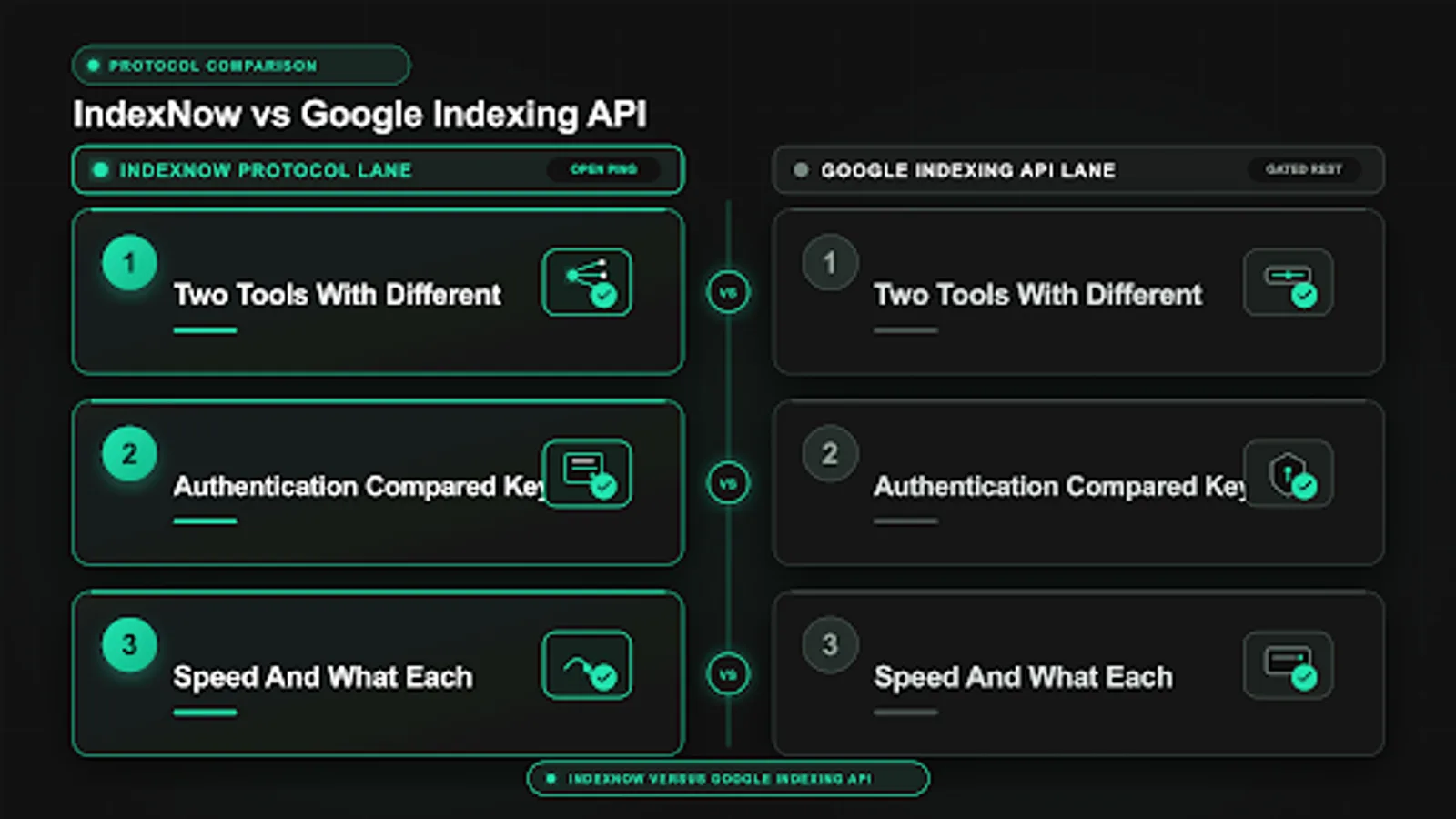
IndexNow and the Google Indexing API solve different problems. IndexNow is an open push protocol for Bing, Yandex, Naver, Seznam, and related supporters. The Google Indexing API is a Google only endpoint for JobPosting and BroadcastEvent pages. One is broad across supporters for many content types. The other is narrow and Google specific for eligible types. This guide compares them side by side so you can choose without overlap or gaps.
When teams ask indexnow or google api, start with this indexing protocol comparison to match tool to audience. The choice is rarely either or, since coverage and content type decide which track earns crawls.
IndexNow pushes changed URLs to participating supporters for faster discovery. Compare coverage first, since IndexNow serves Bing and partners while the Google API serves eligible Google types only. Teams that map audience by engine pick the right tool faster than teams chasing a single universal ping. Log each system separately, so you can see which one drives crawls for your content types. See the complete IndexNow protocol guide for background.
The Google API notifies Google of JobPosting and BroadcastEvent adds, updates, or deletes. Teams that map audience by engine pick the right tool faster than teams chasing a single universal ping. Log each system separately, so you can see which one drives crawls for your content types. Small sites often need IndexNow plus sitemaps, while larger teams add the Google API for eligible pages. See IndexNow documentation for the open spec.
One tool is open and multi engine, the other is Google only and type limited. Log each system separately, so you can see which one drives crawls for your content types. Small sites often need IndexNow plus sitemaps, while larger teams add the Google API for eligible pages. Test with a handful of URLs before automating, then scale once responses look stable.
Most sites need IndexNow plus Google sitemaps, some add the Google API for eligible pages. Small sites often need IndexNow plus sitemaps, while larger teams add the Google API for eligible pages. Test with a handful of URLs before automating, then scale once responses look stable. Steady, clean sends beat bursts, because both systems trust consistent signals over spikes.
Running both is normal when content spans general pages plus jobs or livestreams. Test with a handful of URLs before automating, then scale once responses look stable. Steady, clean sends beat bursts, because both systems trust consistent signals over spikes. Compare coverage first, since IndexNow serves Bing and partners while the Google API serves eligible Google types only.
Checklist for this section:
- IndexNow pushes changed URLs to participating supporters for faster discovery.
- The Google API notifies Google of JobPosting and BroadcastEvent adds, updates, or deletes.
- One tool is open and multi engine, the other is Google only and type limited.
- Most sites need IndexNow plus Google sitemaps, some add the Google API for eligible pages.
- Running both is normal when content spans general pages plus jobs or livestreams.
Work through the list and record dates. Compare coverage first, since IndexNow serves Bing and partners while the Google API serves eligible Google types only. IndexNow batches carry up to 10,000 URLs per request with simple key auth.
Coverage compared side by side
Coverage is the first decision filter. IndexNow covers Bing, Yandex, Naver, Seznam, and services routing via Bing, for many page types including posts, product pages, and docs. The Google API covers Google search for JobPosting and BroadcastEvent pages only. Normal blog posts and product pages fall outside its documented scope. If your catalog is mostly general pages, IndexNow plus sitemaps carries the load. If you publish jobs or livestreams, the Google API adds Google freshness for those types.
For Google vs Bing indexing weight, check where your traffic comes from before picking which indexing API gets priority. General catalogs lean to IndexNow, while job boards lean to both tracks.
IndexNow covers multiple supporters across many general content types. The Google Indexing API uses a Cloud service account with OAuth, which takes more setup. Keep credentials apart, with the key file public at root and the service JSON kept private. Rotate keys on schedule and monitor the key file with uptime checks.
The Google API covers Google for JobPosting and BroadcastEvent only. Keep credentials apart, with the key file public at root and the service JSON kept private. Rotate keys on schedule and monitor the key file with uptime checks. If auth fails, check file reachability for IndexNow and Search Console permissions for Google.
Normal posts and products rely on sitemaps and links for Google, not the Google API. Rotate keys on schedule and monitor the key file with uptime checks. If auth fails, check file reachability for IndexNow and Search Console permissions for Google. IndexNow uses a root key file for ownership, which is simple to host and verify.
Audience by engine decides which tool matters most for your traffic. If auth fails, check file reachability for IndexNow and Search Console permissions for Google. IndexNow uses a root key file for ownership, which is simple to host and verify. The Google Indexing API uses a Cloud service account with OAuth, which takes more setup.
Mixed catalogs often need both, each for the slice it actually serves. IndexNow uses a root key file for ownership, which is simple to host and verify. The Google Indexing API uses a Cloud service account with OAuth, which takes more setup. Keep credentials apart, with the key file public at root and the service JSON kept private.
| Aspect | IndexNow | Google Indexing API |
|---|---|---|
| Engines | Bing, Yandex, Naver, Seznam, Bing routed | Google only |
| Content scope | Many general types | JobPosting and BroadcastEvent only |
| Auth | Root key file | Cloud service account plus OAuth |
| Batch | Up to 10,000 URLs per request | One URL per publish call |
| Signal | Discovery hint for supporters | Crawl hint for Google eligible types |
Use the table during planning so each choice maps to an action. Teams that map audience by engine pick the right tool faster than teams chasing a single universal ping. The Google Indexing API uses a Cloud service account with OAuth, which takes more setup.
Authentication compared key file versus service account
Auth effort differs sharply. IndexNow needs a random key plus a matching text file at the site root, fetched by engines to prove ownership. Setup takes minutes and rotation is simple. The Google API needs a Cloud project, enabled API, service account, JSON key, OAuth tokens, and Search Console permissions. Setup takes longer and maintenance includes secret storage and rotation. Choose based on team capacity as well as coverage.
IndexNow auth is a public key file at root plus key in each request. Deduplicate queues on both tracks to avoid burning quota on repeats. On 429, back off exponentially with jitter and resume after the wait window. Never hammer endpoints, since aggressive retries delay real crawling. For key setup, see how to generate and host your IndexNow API key.
Google API auth is a private service account JSON plus OAuth access tokens. On 429, back off exponentially with jitter and resume after the wait window. Never hammer endpoints, since aggressive retries delay real crawling. IndexNow batches carry up to 10,000 URLs per request with simple key auth.
IndexNow rotation means publishing a new file, Google rotation means new keys and secrets. Never hammer endpoints, since aggressive retries delay real crawling. IndexNow batches carry up to 10,000 URLs per request with simple key auth. The Google API handles one URL per publish call with quota limits shown in Cloud console.
Store IndexNow keys openly at root, store Google JSON privately with limited access. IndexNow batches carry up to 10,000 URLs per request with simple key auth. The Google API handles one URL per publish call with quota limits shown in Cloud console. Deduplicate queues on both tracks to avoid burning quota on repeats.
Monitor IndexNow file uptime and Google token errors separately. The Google API handles one URL per publish call with quota limits shown in Cloud console. Deduplicate queues on both tracks to avoid burning quota on repeats. On 429, back off exponentially with jitter and resume after the wait window.
Checklist for this section:
- IndexNow auth is a public key file at root plus key in each request.
- Google API auth is a private service account JSON plus OAuth access tokens.
- IndexNow rotation means publishing a new file, Google rotation means new keys and secrets.
- Store IndexNow keys openly at root, store Google JSON privately with limited access.
- Monitor IndexNow file uptime and Google token errors separately.
Work through the list and record dates. Log each system separately, so you can see which one drives crawls for your content types. Deduplicate queues on both tracks to avoid burning quota on repeats.
Quotas and limits compared
Quota models differ. IndexNow allows large batches up to 10,000 URLs per request, with per engine throttles signaled by 429 when you push too fast. The Google API uses daily publish quotas shown in Cloud console, often around a few hundred per day for new projects, plus per minute throttles. Every publish and metadata call counts on the Google side. Design both queues with caps, pacing, and backoff so launches do not stall.
A clear two api strategy keeps IndexNow batches separate from Google publishes with own quotas and logs. Review indexing api differences in Cloud console versus IndexNow logs to decide which indexing API needs headroom first.
IndexNow batches scale to 10,000 URLs with throttle on abuse. Tighten structure first when lags grow, then revisit quotas and error handling. Use the two track workflow so no engine is left waiting for changes. Sitemaps, internal links, canonicals, and server health still shape whether pings turn into indexing.
The Google API uses daily and per minute quotas visible in Cloud console. Use the two track workflow so no engine is left waiting for changes. Sitemaps, internal links, canonicals, and server health still shape whether pings turn into indexing. Freshness signals help discovery, but quality and relevance decide ranking after the crawl.
Retries and duplicates burn quota on both systems. Sitemaps, internal links, canonicals, and server health still shape whether pings turn into indexing. Freshness signals help discovery, but quality and relevance decide ranking after the crawl. Review coverage and crawl stats monthly to confirm both tracks lead to visits.
Pace sends and cap daily totals to stay inside limits. Freshness signals help discovery, but quality and relevance decide ranking after the crawl. Review coverage and crawl stats monthly to confirm both tracks lead to visits. Tighten structure first when lags grow, then revisit quotas and error handling.
Alert at 70 and 90 percent so recovery starts before hard blocks. Review coverage and crawl stats monthly to confirm both tracks lead to visits. Tighten structure first when lags grow, then revisit quotas and error handling. Use the two track workflow so no engine is left waiting for changes.
| Limit signal | IndexNow action | Google API action |
|---|---|---|
| 200 or 202 | Continue steady pace | Continue steady pace |
| 400 or 422 | Fix JSON or URLs, then resend | Fix payload or scope, then resend |
| 403 | Fix key file name and content | Fix Search Console permissions and roles |
| 429 | Back off exponentially, resume later | Back off, check quota dashboard, resume next window |
| Repeats | Deduplicate before resend | Deduplicate before resend |
Use the table during planning so each choice maps to an action. Small sites often need IndexNow plus sitemaps, while larger teams add the Google API for eligible pages. Rotate keys on schedule and monitor the key file with uptime checks.
Speed and what each signal triggers
Both tools trigger discovery, not guaranteed indexing. IndexNow pings typically lead to supporter crawls within minutes to days depending on trust, load, and priority. The Google API can trigger fast Google crawls for eligible job and livestream pages, often within minutes when quotas allow. For ineligible types sent off label, timing varies and should not be relied on. Measure publish to first crawl per engine to set honest baselines.
Core IndexNow benefits show in faster supporter discovery for fresh posts and product updates. When indexing methods compared side by side, push beats polling for supporters while Google eligible types gain from direct API hints.
IndexNow shortens supporter discovery from days to minutes or hours. Test with a handful of URLs before automating, then scale once responses look stable. Steady, clean sends beat bursts, because both systems trust consistent signals over spikes. Compare coverage first, since IndexNow serves Bing and partners while the Google API serves eligible Google types only.
The Google API speeds Google crawls for eligible jobs and livestreams. Steady, clean sends beat bursts, because both systems trust consistent signals over spikes. Compare coverage first, since IndexNow serves Bing and partners while the Google API serves eligible Google types only. Teams that map audience by engine pick the right tool faster than teams chasing a single universal ping.
Off label Google sends for normal pages have inconsistent timing. Compare coverage first, since IndexNow serves Bing and partners while the Google API serves eligible Google types only. Teams that map audience by engine pick the right tool faster than teams chasing a single universal ping. Log each system separately, so you can see which one drives crawls for your content types.
Indexing still depends on quality, canonicals, and crawlability. Teams that map audience by engine pick the right tool faster than teams chasing a single universal ping. Log each system separately, so you can see which one drives crawls for your content types. Small sites often need IndexNow plus sitemaps, while larger teams add the Google API for eligible pages.
Track lag per track to avoid overpromising speed to stakeholders. Log each system separately, so you can see which one drives crawls for your content types. Small sites often need IndexNow plus sitemaps, while larger teams add the Google API for eligible pages. Test with a handful of URLs before automating, then scale once responses look stable.
Checklist for this section:
- IndexNow shortens supporter discovery from days to minutes or hours.
- The Google API speeds Google crawls for eligible jobs and livestreams.
- Off label Google sends for normal pages have inconsistent timing.
- Indexing still depends on quality, canonicals, and crawlability.
- Track lag per track to avoid overpromising speed to stakeholders.
Work through the list and record dates. Test with a handful of URLs before automating, then scale once responses look stable. Never hammer endpoints, since aggressive retries delay real crawling.
 <!-- IMAGE-PROMPT diagram-01: 1600px max, DependsIt brand mint #22E3B0 on charcoal #121212, node-network line art, subject: IndexNow versus Google Indexing API flow diagram, flat vector, accessible, Clash Display headings feel with General Sans labels, no em dash -->
Effort and maintenance compared
IndexNow is lighter to run. One key file, one JSON format, and one queue serve all supporters. Logs are simple and debugging centers on key reachability and URL validity. The Google API needs Cloud billing awareness, secret management, token refresh, permission reviews, and quota monitoring. Debugging spans 403 permission errors, JWT issues, and 429 throttles. Factor engineering time into cost, not just quota numbers.
IndexNow needs one file, one format, and one queue for all supporters. IndexNow uses a root key file for ownership, which is simple to host and verify. The Google Indexing API uses a Cloud service account with OAuth, which takes more setup. Keep credentials apart, with the key file public at root and the service JSON kept private.
The Google API needs Cloud setup, secrets, tokens, and permission upkeep. The Google Indexing API uses a Cloud service account with OAuth, which takes more setup. Keep credentials apart, with the key file public at root and the service JSON kept private. Rotate keys on schedule and monitor the key file with uptime checks.
IndexNow debugging is mostly key file and URL validity checks. Keep credentials apart, with the key file public at root and the service JSON kept private. Rotate keys on schedule and monitor the key file with uptime checks. If auth fails, check file reachability for IndexNow and Search Console permissions for Google.
Google debugging spans permissions, tokens, quotas, and payload scope. Rotate keys on schedule and monitor the key file with uptime checks. If auth fails, check file reachability for IndexNow and Search Console permissions for Google. IndexNow uses a root key file for ownership, which is simple to host and verify.
Total effort includes setup plus weekly monitoring and rotation. If auth fails, check file reachability for IndexNow and Search Console permissions for Google. IndexNow uses a root key file for ownership, which is simple to host and verify. The Google Indexing API uses a Cloud service account with OAuth, which takes more setup.
Checklist for this section:
- IndexNow needs one file, one format, and one queue for all supporters.
- The Google API needs Cloud setup, secrets, tokens, and permission upkeep.
- IndexNow debugging is mostly key file and URL validity checks.
- Google debugging spans permissions, tokens, quotas, and payload scope.
- Total effort includes setup plus weekly monitoring and rotation.
Work through the list and record dates. Steady, clean sends beat bursts, because both systems trust consistent signals over spikes. IndexNow batches carry up to 10,000 URLs per request with simple key auth.
When IndexNow is the right choice
Choose IndexNow when your content is general purpose and your audience includes Bing, Yandex, Naver, Seznam, or Bing routed services. Blogs, docs, product pages, and category pages fit well. It is also the right choice when you want one simple integration for many supporters without per engine work. Keep sitemaps clean alongside pings, since structure still helps supporters prioritize. Most sites start here before adding anything Google specific.
If you debate indexnow vs api for general pages, IndexNow usually wins for supporters while sitemaps cover Google. The best indexing api for blogs and stores is therefore IndexNow plus sitemaps, not the narrow Google endpoint.
General posts, docs, products, and categories fit IndexNow well. The Google API handles one URL per publish call with quota limits shown in Cloud console. Deduplicate queues on both tracks to avoid burning quota on repeats. On 429, back off exponentially with jitter and resume after the wait window.
Multi engine reach with one integration keeps ops simple. Deduplicate queues on both tracks to avoid burning quota on repeats. On 429, back off exponentially with jitter and resume after the wait window. Never hammer endpoints, since aggressive retries delay real crawling.
Frequent updates benefit most from push instead of waiting for recrawls. On 429, back off exponentially with jitter and resume after the wait window. Never hammer endpoints, since aggressive retries delay real crawling. IndexNow batches carry up to 10,000 URLs per request with simple key auth.
Sitemaps and internal links still support supporter crawling. Never hammer endpoints, since aggressive retries delay real crawling. IndexNow batches carry up to 10,000 URLs per request with simple key auth. The Google API handles one URL per publish call with quota limits shown in Cloud console.
Start with IndexNow when Google eligible types are not the focus. IndexNow batches carry up to 10,000 URLs per request with simple key auth. The Google API handles one URL per publish call with quota limits shown in Cloud console. Deduplicate queues on both tracks to avoid burning quota on repeats.
Checklist for this section:
- General posts, docs, products, and categories fit IndexNow well.
- Multi engine reach with one integration keeps ops simple.
- Frequent updates benefit most from push instead of waiting for recrawls.
- Sitemaps and internal links still support supporter crawling.
- Start with IndexNow when Google eligible types are not the focus.
Work through the list and record dates. Compare coverage first, since IndexNow serves Bing and partners while the Google API serves eligible Google types only. The Google API handles one URL per publish call with quota limits shown in Cloud console.
When the Google Indexing API is the right choice
Choose the Google Indexing API when you publish JobPosting or BroadcastEvent pages and need fast Google discovery for those types. Job boards, hiring sites, and livestream publishers gain the most. You still need Search Console verification, service account permissions, and quota headroom. Do not choose it as a general Google fast lane for normal pages, since that use sits outside documented scope and behaves inconsistently.
JobPosting pages for open roles fit documented scope. Review coverage and crawl stats monthly to confirm both tracks lead to visits. Tighten structure first when lags grow, then revisit quotas and error handling. Use the two track workflow so no engine is left waiting for changes. Scope details pair with URL updated versus URL deleted.
BroadcastEvent livestream pages fit documented scope. Tighten structure first when lags grow, then revisit quotas and error handling. Use the two track workflow so no engine is left waiting for changes. Sitemaps, internal links, canonicals, and server health still shape whether pings turn into indexing. Quota notes are in Google developer docs for sitemaps.
Google freshness for those types improves when quotas allow. Use the two track workflow so no engine is left waiting for changes. Sitemaps, internal links, canonicals, and server health still shape whether pings turn into indexing. Freshness signals help discovery, but quality and relevance decide ranking after the crawl.
Verification and permissions must be correct before sends work. Sitemaps, internal links, canonicals, and server health still shape whether pings turn into indexing. Freshness signals help discovery, but quality and relevance decide ranking after the crawl. Review coverage and crawl stats monthly to confirm both tracks lead to visits.
Normal pages should use sitemaps and links for Google instead. Freshness signals help discovery, but quality and relevance decide ranking after the crawl. Review coverage and crawl stats monthly to confirm both tracks lead to visits. Tighten structure first when lags grow, then revisit quotas and error handling.
Checklist for this section:
- JobPosting pages for open roles fit documented scope.
- BroadcastEvent livestream pages fit documented scope.
- Google freshness for those types improves when quotas allow.
- Verification and permissions must be correct before sends work.
- Normal pages should use sitemaps and links for Google instead.
Work through the list and record dates. Teams that map audience by engine pick the right tool faster than teams chasing a single universal ping. Deduplicate queues on both tracks to avoid burning quota on repeats.
Using both together without double work
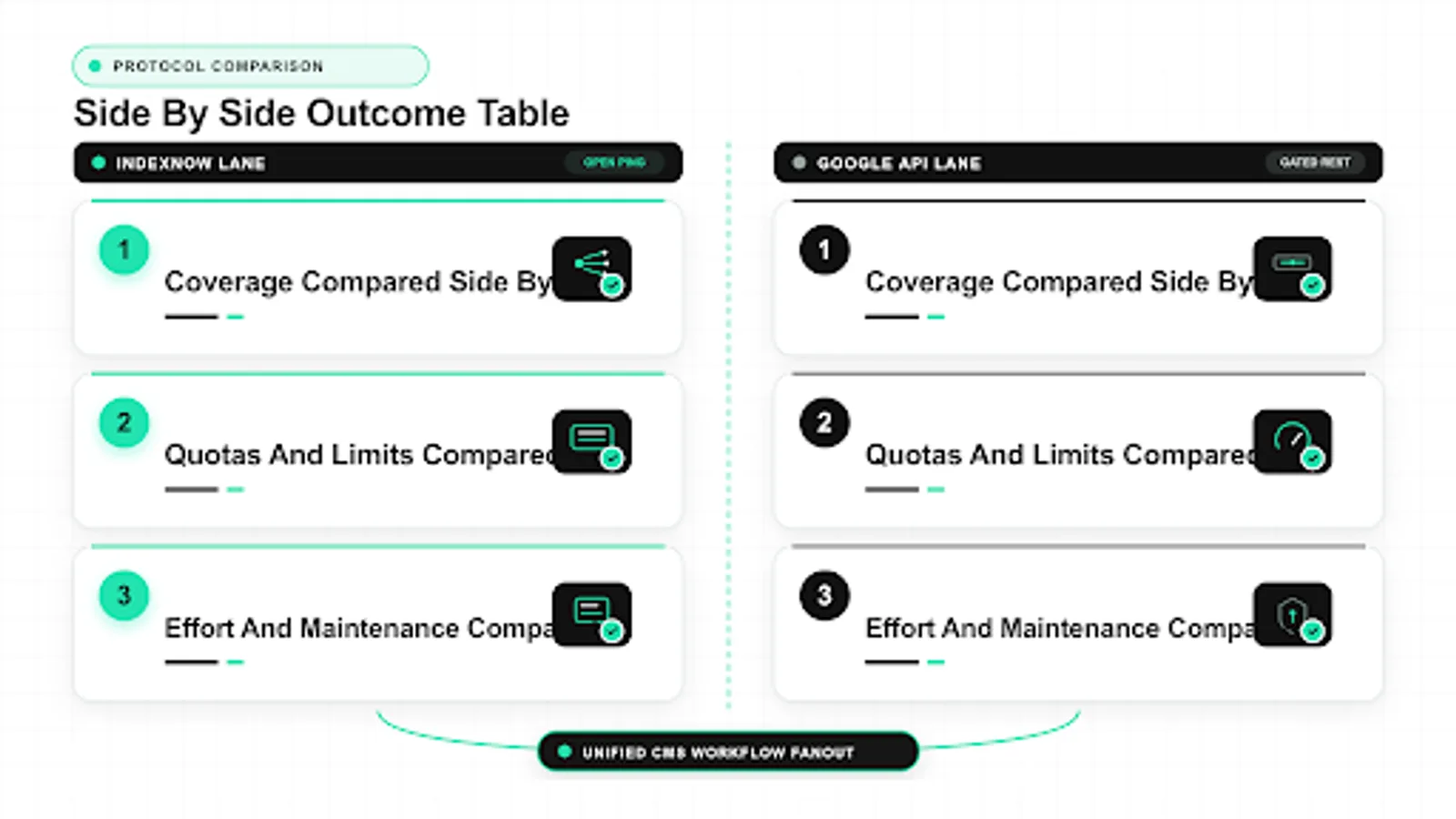
Many teams run both from one content event. On publish, update, or delete, the CMS queues the URL for IndexNow and, if eligible, for the Google API, while updating sitemaps and links. Shared deduplication prevents repeats. Separate workers handle each track with own auth, pacing, and logs. This fan out keeps code clean and avoids manual double submits across dashboards.
Trigger once on content events, then fan out to eligible tracks. Log each system separately, so you can see which one drives crawls for your content types. Small sites often need IndexNow plus sitemaps, while larger teams add the Google API for eligible pages. Test with a handful of URLs before automating, then scale once responses look stable.
Deduplicate shared queues so repeats do not burn quota twice. Small sites often need IndexNow plus sitemaps, while larger teams add the Google API for eligible pages. Test with a handful of URLs before automating, then scale once responses look stable. Steady, clean sends beat bursts, because both systems trust consistent signals over spikes.
Use separate workers with own auth, pacing, and error handling. Test with a handful of URLs before automating, then scale once responses look stable. Steady, clean sends beat bursts, because both systems trust consistent signals over spikes. Compare coverage first, since IndexNow serves Bing and partners while the Google API serves eligible Google types only.
Update sitemaps and hub links in the same deploy for Google general pages. Steady, clean sends beat bursts, because both systems trust consistent signals over spikes. Compare coverage first, since IndexNow serves Bing and partners while the Google API serves eligible Google types only. Teams that map audience by engine pick the right tool faster than teams chasing a single universal ping.
Review both logs weekly to confirm each track drives crawls. Compare coverage first, since IndexNow serves Bing and partners while the Google API serves eligible Google types only. Teams that map audience by engine pick the right tool faster than teams chasing a single universal ping. Log each system separately, so you can see which one drives crawls for your content types.
| Step | Shared action | Track specific note |
|---|---|---|
| 1. Event | CMS emits publish, update, or delete | Include URL, type, and timestamp |
| 2. Dedup | Drop repeats already queued | Keep per track dedup keys |
| 3. IndexNow | Batch POST with key auth | Up to 10,000 URLs, log codes |
| 4. Google API | Send only if JobPosting or BroadcastEvent | Check quota before send |
| 5. Sitemap | Update lastmod and index | Keep canonical 200 URLs only |
Use the table during planning so each choice maps to an action. Log each system separately, so you can see which one drives crawls for your content types. Rotate keys on schedule and monitor the key file with uptime checks.
 <!-- IMAGE-PROMPT workflow-02: 1600px max, DependsIt brand, mint #22E3B0 accents on charcoal #121212 or white, node-network line art, subject: unified CMS workflow fanning to IndexNow and Google API, flat vector, accessible, Clash Display and General Sans feel, no em dash -->
Example IndexNow batch:
{
  "host": "www.example.com",
  "key": "abc123def456abc123def456abc12345",
  "keyLocation": "https://www.example.com/abc123def456abc123def456abc12345.txt",
  "urlList": ["https://www.example.com/blog/fresh-post/", "https://www.example.com/jobs/senior-dev/"]
}
Example Google API publish for an eligible job page:
curl -X POST "https://indexing.googleapis.com/v3/urlNotifications:publish" \
  -H "Content-Type: application/json" \
  -H "Authorization: Bearer ya29.token" \
  -d '{"url":"https://www.example.com/jobs/senior-dev/","type":"URL_UPDATED"}'
Cost and risk comparison
Both protocols are free to call, but total cost includes engineering time and risk. IndexNow costs little beyond initial setup and monitoring, with low risk when batches stay clean and paced. The Google API adds setup, secret care, and quota planning, with risk if teams send ineligible types and expect guaranteed Google indexing. Off label use can waste effort and confuse reporting. Honest scope keeps cost and expectations aligned.
Protocol calls are free, engineering and monitoring are the real cost. If auth fails, check file reachability for IndexNow and Search Console permissions for Google. IndexNow uses a root key file for ownership, which is simple to host and verify. The Google Indexing API uses a Cloud service account with OAuth, which takes more setup.
IndexNow risk stays low with clean batches and backoff on 429. IndexNow uses a root key file for ownership, which is simple to host and verify. The Google Indexing API uses a Cloud service account with OAuth, which takes more setup. Keep credentials apart, with the key file public at root and the service JSON kept private.
Google API risk rises when used off label for normal pages. The Google Indexing API uses a Cloud service account with OAuth, which takes more setup. Keep credentials apart, with the key file public at root and the service JSON kept private. Rotate keys on schedule and monitor the key file with uptime checks.
Secret leaks and permission drift add maintenance cost on Google track. Keep credentials apart, with the key file public at root and the service JSON kept private. Rotate keys on schedule and monitor the key file with uptime checks. If auth fails, check file reachability for IndexNow and Search Console permissions for Google.
Document scope per track so stakeholders expect the right outcomes. Rotate keys on schedule and monitor the key file with uptime checks. If auth fails, check file reachability for IndexNow and Search Console permissions for Google. IndexNow uses a root key file for ownership, which is simple to host and verify.
Checklist for this section:
- Protocol calls are free, engineering and monitoring are the real cost.
- IndexNow risk stays low with clean batches and backoff on 429.
- Google API risk rises when used off label for normal pages.
- Secret leaks and permission drift add maintenance cost on Google track.
- Document scope per track so stakeholders expect the right outcomes.
Work through the list and record dates. Small sites often need IndexNow plus sitemaps, while larger teams add the Google API for eligible pages. Never hammer endpoints, since aggressive retries delay real crawling.
Decision checklist for indexnow vs google indexing api
Decide by content type and audience. If you publish general pages, set up IndexNow plus clean sitemaps and hub links. If you publish jobs or livestreams, add the Google API for those types with proper Cloud setup and quotas. Automate both from CMS events, monitor key file uptime and quota use, and measure publish to crawl lag per engine. Revisit quarterly as content mix and limits change.
When deciding which indexing API to prioritize, list content types first, then map engines to traffic. This keeps the two api strategy grounded in real coverage needs.
List content types and mark JobPosting or BroadcastEvent versus general pages. IndexNow batches carry up to 10,000 URLs per request with simple key auth. The Google API handles one URL per publish call with quota limits shown in Cloud console. Deduplicate queues on both tracks to avoid burning quota on repeats.
Map audience engines to decide weight for each track. The Google API handles one URL per publish call with quota limits shown in Cloud console. Deduplicate queues on both tracks to avoid burning quota on repeats. On 429, back off exponentially with jitter and resume after the wait window.
Set up IndexNow first, then add Google API only for eligible types. Deduplicate queues on both tracks to avoid burning quota on repeats. On 429, back off exponentially with jitter and resume after the wait window. Never hammer endpoints, since aggressive retries delay real crawling.
Automate from CMS events with dedup, pacing, and per track logs. On 429, back off exponentially with jitter and resume after the wait window. Never hammer endpoints, since aggressive retries delay real crawling. IndexNow batches carry up to 10,000 URLs per request with simple key auth.
Recheck quotas and supporter lists quarterly and before launches. Never hammer endpoints, since aggressive retries delay real crawling. IndexNow batches carry up to 10,000 URLs per request with simple key auth. The Google API handles one URL per publish call with quota limits shown in Cloud console.
Checklist for this section:
- List content types and mark JobPosting or BroadcastEvent versus general pages.
- Map audience engines to decide weight for each track.
- Set up IndexNow first, then add Google API only for eligible types.
- Automate from CMS events with dedup, pacing, and per track logs.
- Recheck quotas and supporter lists quarterly and before launches.
Work through the list and record dates. Test with a handful of URLs before automating, then scale once responses look stable. IndexNow batches carry up to 10,000 URLs per request with simple key auth.
FAQ
Should I use IndexNow or the Google Indexing API?
Use IndexNow for general pages across Bing, Yandex, Naver, Seznam, and related supporters when you debate indexnow or google api for your catalog. Add the Google Indexing API only for JobPosting and BroadcastEvent pages that need Google freshness. Most general catalogs need IndexNow plus sitemaps and links, while job boards and livestream sites benefit from a two api strategy. Map audience by engine first, then decide which indexing API gets priority for each content type and review quarterly with crawl data.
Does IndexNow submit to Google?
No. Google does not support IndexNow, so IndexNow pings do not place URLs into Google search results at all. For Google general pages, use sitemaps, internal links, and Search Console requests within limits for steady discovery every week. For eligible job and livestream pages, use the Google Indexing API within quota and documented scope. This indexing protocol comparison shows Google vs Bing indexing needs differ clearly, so keep IndexNow for supporters and sitemaps plus API for Google where documented scope applies.
Can the Google API replace IndexNow?
No, because scope differs across this indexing protocol comparison for site owners planning full coverage today. The Google API is Google only and type limited, while IndexNow is multi engine for many general types including posts and products. Replacing IndexNow with Google API sends would leave Bing and other supporters waiting for discovery. Replacing Google sitemaps with IndexNow would leave Google waiting. IndexNow benefits come from broad supporter reach, so run each tool where it actually works without overlap or gaps.
What does setup effort look like?
IndexNow setup is light, with one key file and batched POST sends that show clear IndexNow benefits for small teams and busy publishers every day. Google API setup is heavier, with a Cloud project, service account, OAuth tokens, and Search Console permissions to maintain. Budget time for secrets, rotation, quota monitoring, and error handling on the Google track every month. These indexing api differences explain why teams start with IndexNow first, then add Google only for eligible types with engineering support.
How do quotas compare?
IndexNow allows up to 10,000 URLs per request with throttles on abuse, which shapes any two api strategy for large catalogs and frequent updates. The Google API uses daily and per minute quotas shown in Cloud console, with every publish counting against strict limits. Deduplicate both queues, pace sends, back off on 429 with jitter, and alert at 70 and 90 percent on the Google side. When indexing methods compared over time, clean paced sends beat bursts on both systems for stable discovery.
What is the simplest dual setup?
Emit one CMS event on publish, update, or delete to run the best indexing api setup for your content mix and team size. Queue the URL for IndexNow always, queue for the Google API only if JobPosting or BroadcastEvent, and update sitemaps plus links in the same deploy. Use separate workers, auth, pacing, and logs per track when you choose indexnow or google api per URL, then review publish to crawl lag weekly. This keeps indexnow vs api work clean without double sends or quota waste.
Sources
- https://www.indexnow.org/documentation
- https://developers.google.com/search/apis/indexing-api/v3/prereqs
- https://developers.google.com/search/docs/crawling-indexing/sitemaps-overview
- https://www.bing.com/webmasters/help/indexnow
- https://yandex.com/support/webmaster/indexnow/indexnow.html