How to Submit URLs to Bing with IndexNow

Bing rewards fresh signals when they are clean and consistent, and IndexNow is the fastest way to provide them. Instead of waiting for sitemap polls, you can notify Bing the moment products, articles or categories change, then watch crawl activity respond. This guide walks through submitting URLs to Bing with IndexNow from first principles, including key generation, root hosting, manual tests, bulk batches, Webmaster Tools setup and automation from your CMS or deploy pipeline. You will also learn quotas, troubleshooting and how to pair IndexNow with sitemaps and quality fixes. This bing indexnow workflow respects validation, throttling and logging so Bing learns to prioritize your fresh pages quickly.
Key takeaways
- IndexNow notifies Bing instantly, but crawl and index still depend on quality and linking.
- Host a key file at root, submit canonical https URLs and start with single URL tests.
- Use bulk POST for changed sets, throttle gently and back off on 429.
- Track submissions against Bing Webmaster Tools crawl and index reports.
- Why Bing values fresh signals and IndexNow
- Bing versus Google coverage set expectations correctly
- Prerequisites verification Webmaster Tools and crawl health
- Generate and host your IndexNow key file step by step
- Submit your first URL manually and confirm acceptance
- Bulk submission and daily rhythm for bing indexnow success
- Pair IndexNow with Bing Webmaster URL Submission API
- Automate from CMS and deploy pipeline without spam
- Track indexing in Bing Webmaster Tools reports
- Troubleshooting key not found 403 422 and ignored pings
- Keep sitemaps and quality signals aligned with pings
- FAQ
- Sources
- Further reading
 <!-- IMAGE-PROMPT cover: 1200x630, DependsIt brand, deep charcoal #121212 background, vibrant mint #22E3B0 accent glow, thin node-network line art, Clash Display style bold heading space on left, General Sans clean labels, subject: bing indexnow concept art for search discovery, flat vector, high contrast, accessible, no photorealistic faces, no text smaller than 24px, no em dash in rendered text, export PNG then cwebp -q 82 to WEBP -->
Why Bing values fresh signals and IndexNow
Bing operates a large crawl schedule across diverse sites and markets, and fresh signals help it allocate fetches to pages that actually changed. Sitemaps provide the full inventory with lastmod hints, but polling intervals mean new products or articles can wait days for discovery. IndexNow lets owners notify Bing directly when URLs are added, updated or deleted, so the scheduler can prioritize those fetches sooner when quality and linking support it. The benefit compounds for sites with frequent updates, seasonal catalogs and news like content. Instead of hoping the next crawl aligns with a launch, you provide a timestamped nudge tied to a verified host and key. Bing still applies its own quality, spam and crawl budget judgments, so notifications accelerate discovery rather than guaranteeing indexing. Treat IndexNow as a way to earn faster consideration through clean signals.
IndexNow is an open protocol co-developed by Microsoft Bing and Yandex. Current supporters include Bing, Yandex, Naver, Seznam and other engines listed on the official IndexNow site, with DuckDuckGo routing through Bing for discovery. Always confirm the live list on the official documentation during planning, since partnerships evolve and no blog post should present a stale list as exhaustive. Google does not support IndexNow. Google relies on sitemaps, Search Console URL Inspection and Request Indexing, plus the Google Indexing API for JobPosting and BroadcastEvent pages only. Never claim an IndexNow ping reaches Google. Track IndexNow outcomes in Bing and Yandex portals and Google outcomes separately in Search Console. IndexNow complements sitemaps, internal linking, canonical tags, robots.txt and crawl budget work. It does not replace them.
- Submit canonical https URLs only, without tracking parameters or variants.
- Deduplicate edits so one page updated five times pings once per cycle.
- Space batches minutes apart and watch for 429 throttling signals.
- Validate status, canonical and robots before every batch.
- Keep sitemap lastmod accurate so pings and sitemap tell the same story.
Bulk discipline protects signal quality. IndexNow allows up to 10,000 URLs per POST, but practical use favors small batches of changed canonical URLs spaced minutes apart. Queue pending URLs, deduplicate repeats, throttle to a gentle pace, use exponential backoff on HTTP 429, honor any Retry After hint, and log request IDs with timestamps and response codes. Never hammer endpoints with parallel loops or resubmit unchanged URLs daily. Engines learn which senders provide fresh meaningful changes and which send noise. A clean queue with prioritization, validation and logging keeps acceptance high and makes debugging straightforward when a batch returns 400, 403, 422 or 429.
Measurement closes the loop between submission and outcome. Record every submitted URL with change type, submit time and response code, then check first crawl timestamps in Bing and Yandex Webmaster Tools and index status after seven days. Compare against your pre IndexNow baseline for similar launches. If discovery shortens from days to hours while quality and linking stay constant, the workflow is helping. If pings return success but crawls never arrive, look at content depth, internal link depth, canonical consistency, sitemap lastmod accuracy, server response times and robots rules before increasing volume. Keep Google metrics separate, since those engines follow independent scheduling and quality evaluation.
Bing versus Google coverage set expectations correctly
Bing and Google run independent crawlers, indexes and ranking systems with different schedules and preferences. An IndexNow ping reaches participating engines including Bing, Yandex, Naver and Seznam, while Google does not support IndexNow and follows sitemaps, Search Console inspection and its Indexing API for JobPosting and BroadcastEvent pages only. For site owners this means two funnels to track. Bing outcomes are measured in Bing Webmaster Tools through URL Submission, crawl activity and index coverage reports. Google outcomes are measured separately in Search Console. A launch can appear in Bing within hours while Google takes days, or vice versa, without either result indicating a bug. Reporting should keep these tracks distinct, with IndexNow success tied to Bing discovery latency and Google progress tied to sitemap accuracy, internal linking and content quality. Clear expectations prevent misattribution and guide budget to the right fixes. See also the IndexNow complete guide for background that pairs with this step.
IndexNow is an open protocol co-developed by Microsoft Bing and Yandex. Current supporters include Bing, Yandex, Naver, Seznam and other engines listed on the official IndexNow site, with DuckDuckGo routing through Bing for discovery. Always confirm the live list on the official documentation during planning, since partnerships evolve and no blog post should present a stale list as exhaustive. Google does not support IndexNow. Google relies on sitemaps, Search Console URL Inspection and Request Indexing, plus the Google Indexing API for JobPosting and BroadcastEvent pages only. Never claim an IndexNow ping reaches Google. Track IndexNow outcomes in Bing and Yandex portals and Google outcomes separately in Search Console. IndexNow complements sitemaps, internal linking, canonical tags, robots.txt and crawl budget work. It does not replace them.
| Check | What to confirm | How to verify |
|---|---|---|
| Host consistency | All URLs share one host per request | Normalize domain and split markets |
| Key accessibility | Key file returns exact string | Fetch key URL in browser and API client |
| Canonical form | Submit preferred URL only | Inspect canonical tag and status |
| Crawlability | Page returns 200 with content | Fetch as bot and review robots |
| Change reality | Content actually changed | Compare lastmod and page diff |
Bulk discipline protects signal quality. IndexNow allows up to 10,000 URLs per POST, but practical use favors small batches of changed canonical URLs spaced minutes apart. Queue pending URLs, deduplicate repeats, throttle to a gentle pace, use exponential backoff on HTTP 429, honor any Retry After hint, and log request IDs with timestamps and response codes. Never hammer endpoints with parallel loops or resubmit unchanged URLs daily. Engines learn which senders provide fresh meaningful changes and which send noise. A clean queue with prioritization, validation and logging keeps acceptance high and makes debugging straightforward when a batch returns 400, 403, 422 or 429.
Measurement closes the loop between submission and outcome. Record every submitted URL with change type, submit time and response code, then check first crawl timestamps in Bing and Yandex Webmaster Tools and index status after seven days. Compare against your pre IndexNow baseline for similar launches. If discovery shortens from days to hours while quality and linking stay constant, the workflow is helping. If pings return success but crawls never arrive, look at content depth, internal link depth, canonical consistency, sitemap lastmod accuracy, server response times and robots rules before increasing volume. Keep Google metrics separate, since those engines follow independent scheduling and quality evaluation.
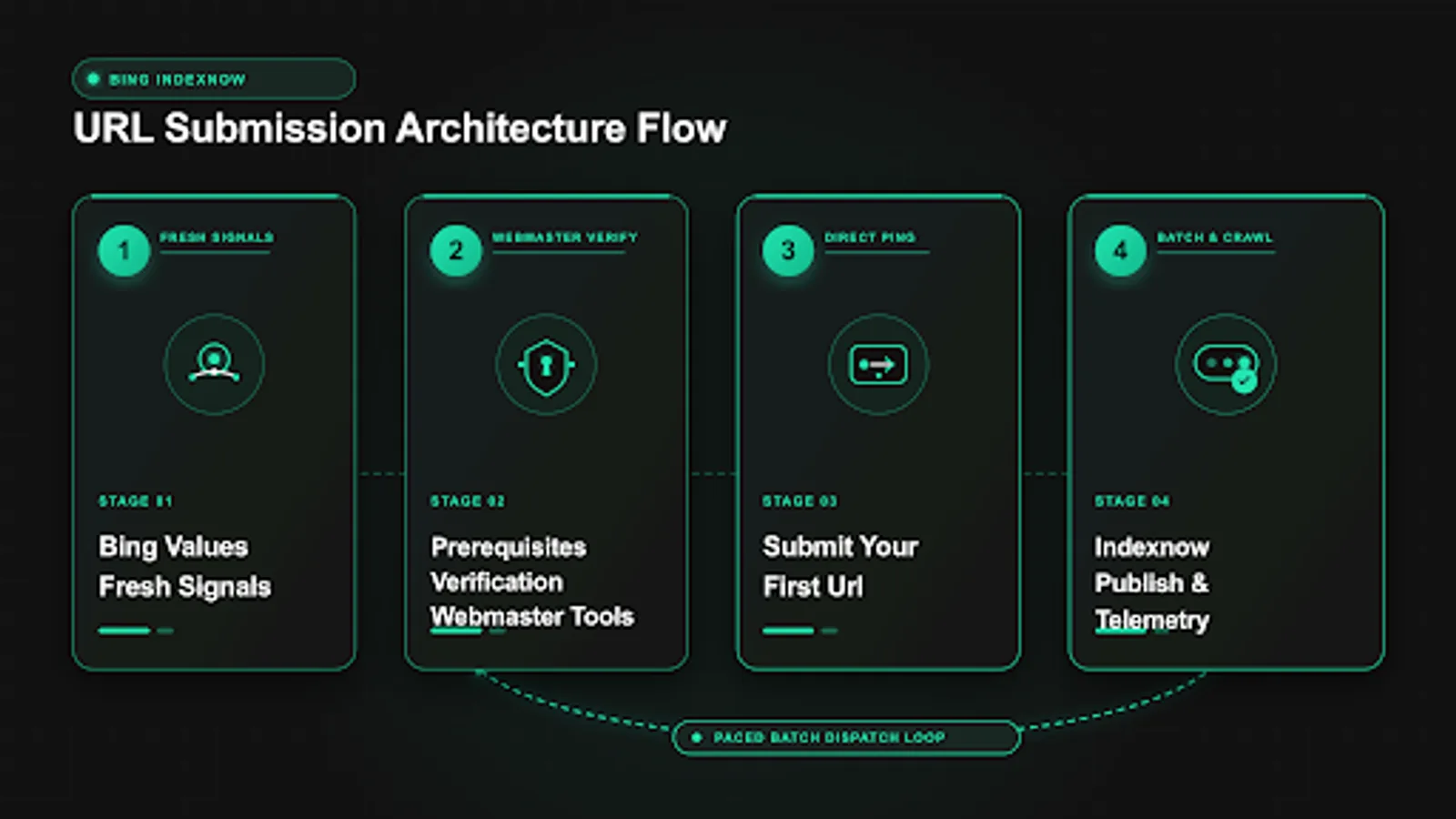 <!-- IMAGE-PROMPT diagram-01: 1600px max, DependsIt brand mint #22E3B0 on charcoal #121212, node-network line art, subject: bulk URL queue splitting into paced IndexNow batches diagram, flat vector, accessible, Clash Display headings General Sans labels feel, no em dash -->
Prerequisites verification Webmaster Tools and crawl health
Before submitting to Bing, confirm ownership and baseline health so results are interpretable. Verify the site in Bing Webmaster Tools using DNS, file or meta tag methods and confirm the primary domain, subdomains and protocols you will submit. Export current sitemaps and check that new URLs appear with accurate lastmod, that paginated and faceted routes are controlled, and that robots.txt allows important templates. Audit canonical tags for self reference on preferred URLs, remove stray noindex from production templates and confirm key pages return 200 with meaningful content and reasonable speed. Note recent crawl frequency for product and article directories to establish a baseline. With verification and health in place, IndexNow tests produce clear signals. Failures point to key or payload issues, while slow crawling after acceptance points to quality or linking gaps rather than submission errors.
IndexNow is an open protocol co-developed by Microsoft Bing and Yandex. Current supporters include Bing, Yandex, Naver, Seznam and other engines listed on the official IndexNow site, with DuckDuckGo routing through Bing for discovery. Always confirm the live list on the official documentation during planning, since partnerships evolve and no blog post should present a stale list as exhaustive. Google does not support IndexNow. Google relies on sitemaps, Search Console URL Inspection and Request Indexing, plus the Google Indexing API for JobPosting and BroadcastEvent pages only. Never claim an IndexNow ping reaches Google. Track IndexNow outcomes in Bing and Yandex portals and Google outcomes separately in Search Console. IndexNow complements sitemaps, internal linking, canonical tags, robots.txt and crawl budget work. It does not replace them.
- Submit canonical https URLs only, without tracking parameters or variants.
- Deduplicate edits so one page updated five times pings once per cycle.
- Space batches minutes apart and watch for 429 throttling signals.
- Validate status, canonical and robots before every batch.
- Keep sitemap lastmod accurate so pings and sitemap tell the same story.
Bulk discipline protects signal quality. IndexNow allows up to 10,000 URLs per POST, but practical use favors small batches of changed canonical URLs spaced minutes apart. Queue pending URLs, deduplicate repeats, throttle to a gentle pace, use exponential backoff on HTTP 429, honor any Retry After hint, and log request IDs with timestamps and response codes. Never hammer endpoints with parallel loops or resubmit unchanged URLs daily. Engines learn which senders provide fresh meaningful changes and which send noise. A clean queue with prioritization, validation and logging keeps acceptance high and makes debugging straightforward when a batch returns 400, 403, 422 or 429.
Measurement closes the loop between submission and outcome. Record every submitted URL with change type, submit time and response code, then check first crawl timestamps in Bing and Yandex Webmaster Tools and index status after seven days. Compare against your pre IndexNow baseline for similar launches. If discovery shortens from days to hours while quality and linking stay constant, the workflow is helping. If pings return success but crawls never arrive, look at content depth, internal link depth, canonical consistency, sitemap lastmod accuracy, server response times and robots rules before increasing volume. Keep Google metrics separate, since those engines follow independent scheduling and quality evaluation.
Generate and host your IndexNow key file step by step
Key setup proves you control the host you are notifying about. Generate a random key string between 8 and 128 characters using lowercase letters, numbers and dashes. Create a text file named after the key with a dot txt extension, containing only the key string with no HTML, whitespace padding or extra lines. Upload it to the site root so it loads over https at slash key dot txt with HTTP 200 and plain text content type. Fetch it anonymously in a browser and with curl to confirm public access, stable content and no redirect chains that alter the path. Record the key and keyLocation URL in a secure vault with version history. Test with a single URL submission before automating. If hosting on a complex stack with edge redirects, verify the final fetch still returns the exact string, since subtle rewrites are a common source of 403 responses. See also the key hosting walkthrough for background that pairs with this step.
IndexNow is an open protocol co-developed by Microsoft Bing and Yandex. Current supporters include Bing, Yandex, Naver, Seznam and other engines listed on the official IndexNow site, with DuckDuckGo routing through Bing for discovery. Always confirm the live list on the official documentation during planning, since partnerships evolve and no blog post should present a stale list as exhaustive. Google does not support IndexNow. Google relies on sitemaps, Search Console URL Inspection and Request Indexing, plus the Google Indexing API for JobPosting and BroadcastEvent pages only. Never claim an IndexNow ping reaches Google. Track IndexNow outcomes in Bing and Yandex portals and Google outcomes separately in Search Console. IndexNow complements sitemaps, internal linking, canonical tags, robots.txt and crawl budget work. It does not replace them.
- Generate a random key string with letters, numbers and dashes.
- Host the key text file at the root of your verified host with exact content.
- Fetch the key URL anonymously to confirm public access and correct content type.
- Submit one canonical URL and confirm a 200 or 202 response.
- Log URL, timestamp and response code before scaling to small batches.
Bulk discipline protects signal quality. IndexNow allows up to 10,000 URLs per POST, but practical use favors small batches of changed canonical URLs spaced minutes apart. Queue pending URLs, deduplicate repeats, throttle to a gentle pace, use exponential backoff on HTTP 429, honor any Retry After hint, and log request IDs with timestamps and response codes. Never hammer endpoints with parallel loops or resubmit unchanged URLs daily. Engines learn which senders provide fresh meaningful changes and which send noise. A clean queue with prioritization, validation and logging keeps acceptance high and makes debugging straightforward when a batch returns 400, 403, 422 or 429.
Measurement closes the loop between submission and outcome. Record every submitted URL with change type, submit time and response code, then check first crawl timestamps in Bing and Yandex Webmaster Tools and index status after seven days. Compare against your pre IndexNow baseline for similar launches. If discovery shortens from days to hours while quality and linking stay constant, the workflow is helping. If pings return success but crawls never arrive, look at content depth, internal link depth, canonical consistency, sitemap lastmod accuracy, server response times and robots rules before increasing volume. Keep Google metrics separate, since those engines follow independent scheduling and quality evaluation.
Submit your first URL manually and confirm acceptance
Manual submission validates the full chain with minimal risk. Build a GET request to the IndexNow endpoint with host, url, key and keyLocation parameters pointing to one canonical https page that returns 200. Send it from a browser or API client and inspect the status code. A 200 or 202 means acceptance for processing, not immediate indexing. Log URL, timestamp and code, then check Bing Webmaster Tools over the next hours for crawl activity on that path. If you receive 400, check JSON encoding and host consistency even for GET parameters. If 403, recheck key file accessibility and exact match. If 422, validate that the URL is absolute, canonical, indexable and on the declared host. One clean manual success proves key hosting, host mapping and request shape before you scale to batches or automation.
IndexNow is an open protocol co-developed by Microsoft Bing and Yandex. Current supporters include Bing, Yandex, Naver, Seznam and other engines listed on the official IndexNow site, with DuckDuckGo routing through Bing for discovery. Always confirm the live list on the official documentation during planning, since partnerships evolve and no blog post should present a stale list as exhaustive. Google does not support IndexNow. Google relies on sitemaps, Search Console URL Inspection and Request Indexing, plus the Google Indexing API for JobPosting and BroadcastEvent pages only. Never claim an IndexNow ping reaches Google. Track IndexNow outcomes in Bing and Yandex portals and Google outcomes separately in Search Console. IndexNow complements sitemaps, internal linking, canonical tags, robots.txt and crawl budget work. It does not replace them.
- Submit canonical https URLs only, without tracking parameters or variants.
- Deduplicate edits so one page updated five times pings once per cycle.
- Space batches minutes apart and watch for 429 throttling signals.
- Validate status, canonical and robots before every batch.
- Keep sitemap lastmod accurate so pings and sitemap tell the same story.
Bulk discipline protects signal quality. IndexNow allows up to 10,000 URLs per POST, but practical use favors small batches of changed canonical URLs spaced minutes apart. Queue pending URLs, deduplicate repeats, throttle to a gentle pace, use exponential backoff on HTTP 429, honor any Retry After hint, and log request IDs with timestamps and response codes. Never hammer endpoints with parallel loops or resubmit unchanged URLs daily. Engines learn which senders provide fresh meaningful changes and which send noise. A clean queue with prioritization, validation and logging keeps acceptance high and makes debugging straightforward when a batch returns 400, 403, 422 or 429.
Measurement closes the loop between submission and outcome. Record every submitted URL with change type, submit time and response code, then check first crawl timestamps in Bing and Yandex Webmaster Tools and index status after seven days. Compare against your pre IndexNow baseline for similar launches. If discovery shortens from days to hours while quality and linking stay constant, the workflow is helping. If pings return success but crawls never arrive, look at content depth, internal link depth, canonical consistency, sitemap lastmod accuracy, server response times and robots rules before increasing volume. Keep Google metrics separate, since those engines follow independent scheduling and quality evaluation.
curl "https://api.indexnow.org/indexnow?host=www.example.com&url=https://www.example.com/products/fresh-lamp&key=abc123def456&keyLocation=https://www.example.com/abc123def456.txt"Bulk submission and daily rhythm for bing indexnow success
Daily operations should favor small batches of changed canonical URLs over occasional massive blasts. Group new and materially updated products, categories and articles into POST payloads of a few hundred URLs, spaced minutes apart, with host, key, keyLocation and urlList fields per the specification. Deduplicate edits so a product saved five times pings once, prioritize revenue and freshness over pagination tweaks and exclude parameter variants, search pages and non canonical duplicates. Log every batch with response codes and watch for 429 throttling that signals a need for longer gaps. A steady rhythm of meaningful changes teaches Bing to treat your notifications as reliable. Erratic floods of unchanged URLs have the opposite effect, consuming attention without providing new value and making future pings less effective for launches that truly matter.
IndexNow is an open protocol co-developed by Microsoft Bing and Yandex. Current supporters include Bing, Yandex, Naver, Seznam and other engines listed on the official IndexNow site, with DuckDuckGo routing through Bing for discovery. Always confirm the live list on the official documentation during planning, since partnerships evolve and no blog post should present a stale list as exhaustive. Google does not support IndexNow. Google relies on sitemaps, Search Console URL Inspection and Request Indexing, plus the Google Indexing API for JobPosting and BroadcastEvent pages only. Never claim an IndexNow ping reaches Google. Track IndexNow outcomes in Bing and Yandex portals and Google outcomes separately in Search Console. IndexNow complements sitemaps, internal linking, canonical tags, robots.txt and crawl budget work. It does not replace them.
- Generate a random key string with letters, numbers and dashes.
- Host the key text file at the root of your verified host with exact content.
- Fetch the key URL anonymously to confirm public access and correct content type.
- Submit one canonical URL and confirm a 200 or 202 response.
- Log URL, timestamp and response code before scaling to small batches.
Bulk discipline protects signal quality. IndexNow allows up to 10,000 URLs per POST, but practical use favors small batches of changed canonical URLs spaced minutes apart. Queue pending URLs, deduplicate repeats, throttle to a gentle pace, use exponential backoff on HTTP 429, honor any Retry After hint, and log request IDs with timestamps and response codes. Never hammer endpoints with parallel loops or resubmit unchanged URLs daily. Engines learn which senders provide fresh meaningful changes and which send noise. A clean queue with prioritization, validation and logging keeps acceptance high and makes debugging straightforward when a batch returns 400, 403, 422 or 429.
Measurement closes the loop between submission and outcome. Record every submitted URL with change type, submit time and response code, then check first crawl timestamps in Bing and Yandex Webmaster Tools and index status after seven days. Compare against your pre IndexNow baseline for similar launches. If discovery shortens from days to hours while quality and linking stay constant, the workflow is helping. If pings return success but crawls never arrive, look at content depth, internal link depth, canonical consistency, sitemap lastmod accuracy, server response times and robots rules before increasing volume. Keep Google metrics separate, since those engines follow independent scheduling and quality evaluation.
Pair IndexNow with Bing Webmaster URL Submission API
IndexNow and the Bing Webmaster URL Submission API serve complementary roles and can coexist in one workflow. IndexNow provides lightweight instant notifications with key file auth and broad engine fan out to participants beyond Bing. The Bing API provides authenticated quota managed submission directly tied to your Webmaster Tools property with detailed feedback. Many teams use IndexNow for real time nudges on every meaningful change and the Bing API for high priority URLs that deserve explicit tracking, such as homepage features, seasonal collections and corrected canonicals. Keep both paths feeding from the same validated queue so deduplication and logging stay consistent. Monitor quotas separately, since limits and Retry After behavior differ. Document which path each job uses and reconcile outcomes in Bing Webmaster Tools to see which channel drives faster first crawls per template.
IndexNow is an open protocol co-developed by Microsoft Bing and Yandex. Current supporters include Bing, Yandex, Naver, Seznam and other engines listed on the official IndexNow site, with DuckDuckGo routing through Bing for discovery. Always confirm the live list on the official documentation during planning, since partnerships evolve and no blog post should present a stale list as exhaustive. Google does not support IndexNow. Google relies on sitemaps, Search Console URL Inspection and Request Indexing, plus the Google Indexing API for JobPosting and BroadcastEvent pages only. Never claim an IndexNow ping reaches Google. Track IndexNow outcomes in Bing and Yandex portals and Google outcomes separately in Search Console. IndexNow complements sitemaps, internal linking, canonical tags, robots.txt and crawl budget work. It does not replace them.
| Check | What to confirm | How to verify |
|---|---|---|
| Host consistency | All URLs share one host per request | Normalize domain and split markets |
| Key accessibility | Key file returns exact string | Fetch key URL in browser and API client |
| Canonical form | Submit preferred URL only | Inspect canonical tag and status |
| Crawlability | Page returns 200 with content | Fetch as bot and review robots |
| Change reality | Content actually changed | Compare lastmod and page diff |
Bulk discipline protects signal quality. IndexNow allows up to 10,000 URLs per POST, but practical use favors small batches of changed canonical URLs spaced minutes apart. Queue pending URLs, deduplicate repeats, throttle to a gentle pace, use exponential backoff on HTTP 429, honor any Retry After hint, and log request IDs with timestamps and response codes. Never hammer endpoints with parallel loops or resubmit unchanged URLs daily. Engines learn which senders provide fresh meaningful changes and which send noise. A clean queue with prioritization, validation and logging keeps acceptance high and makes debugging straightforward when a batch returns 400, 403, 422 or 429.
Measurement closes the loop between submission and outcome. Record every submitted URL with change type, submit time and response code, then check first crawl timestamps in Bing and Yandex Webmaster Tools and index status after seven days. Compare against your pre IndexNow baseline for similar launches. If discovery shortens from days to hours while quality and linking stay constant, the workflow is helping. If pings return success but crawls never arrive, look at content depth, internal link depth, canonical consistency, sitemap lastmod accuracy, server response times and robots rules before increasing volume. Keep Google metrics separate, since those engines follow independent scheduling and quality evaluation.
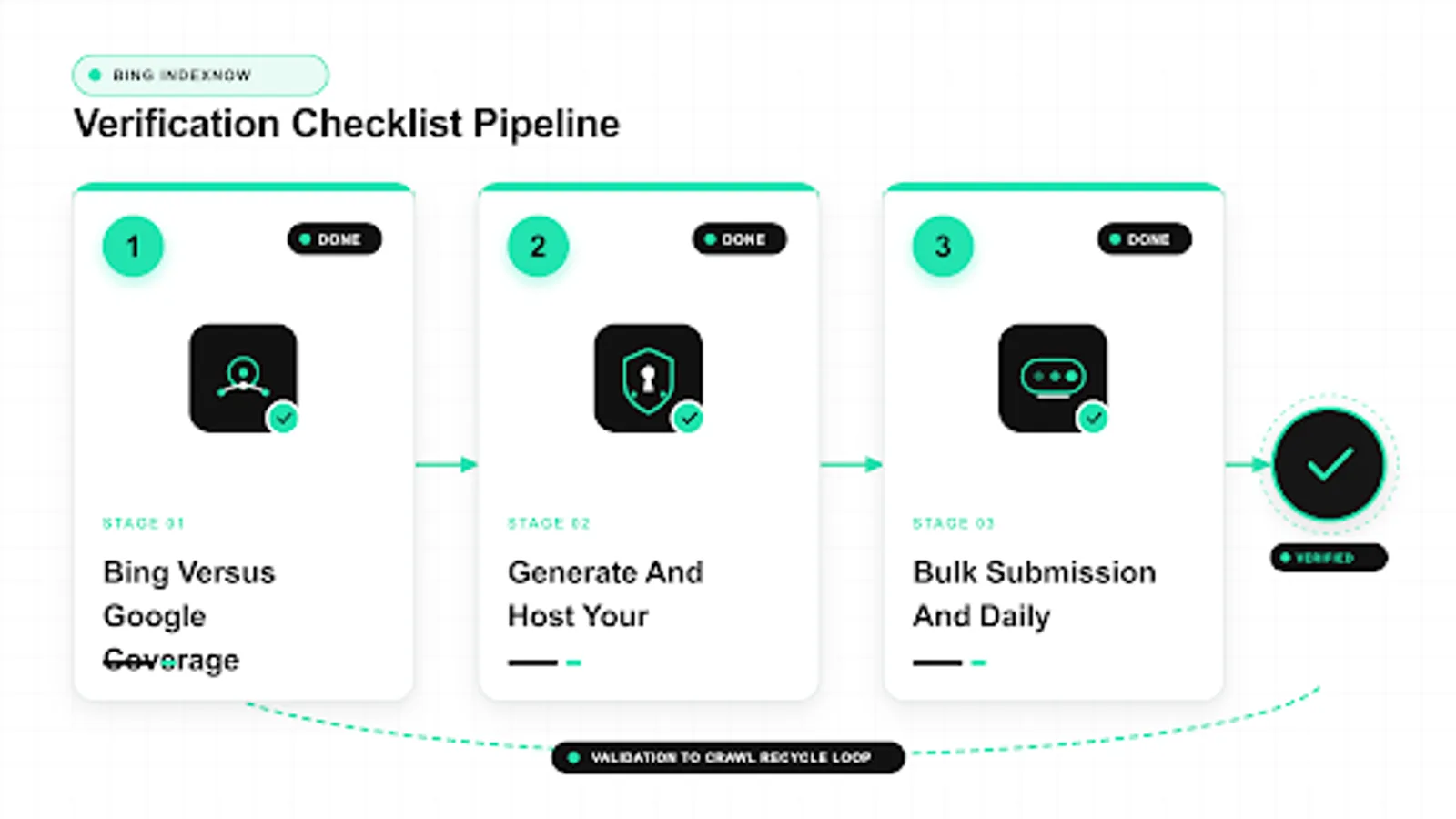 <!-- IMAGE-PROMPT workflow-02: 1600px max, DependsIt brand mint #22E3B0 on charcoal #121212, node-network line art, subject: validation to submission to log to crawl check workflow, flat vector, accessible, Clash Display headings General Sans labels feel, no em dash -->
Automate from CMS and deploy pipeline without spam
Automation should trigger on genuine content events, not on every save. Connect CMS publish webhooks, sitemap diff jobs or deploy pipeline hooks to a queue that validates, deduplicates and flushes on a schedule. A product publish event enqueues its canonical URL with change type added, a sitemap diff adds URLs whose lastmod advanced since the last run, and a deploy hook adds only templates that changed materially. The worker sends paced POST batches, handles 429 with exponential backoff, quarantines 400 and 422 for inspection and logs per URL outcomes. Add guards that drop cart, checkout, account, search and faceted URLs, enforce https and single host per batch and cap daily volume to changed canonicals. Review queue depth and error shares weekly. Automation done this way removes manual toil while preserving the signal quality that earns faster Bing crawls.
IndexNow is an open protocol co-developed by Microsoft Bing and Yandex. Current supporters include Bing, Yandex, Naver, Seznam and other engines listed on the official IndexNow site, with DuckDuckGo routing through Bing for discovery. Always confirm the live list on the official documentation during planning, since partnerships evolve and no blog post should present a stale list as exhaustive. Google does not support IndexNow. Google relies on sitemaps, Search Console URL Inspection and Request Indexing, plus the Google Indexing API for JobPosting and BroadcastEvent pages only. Never claim an IndexNow ping reaches Google. Track IndexNow outcomes in Bing and Yandex portals and Google outcomes separately in Search Console. IndexNow complements sitemaps, internal linking, canonical tags, robots.txt and crawl budget work. It does not replace them.
- Generate a random key string with letters, numbers and dashes.
- Host the key text file at the root of your verified host with exact content.
- Fetch the key URL anonymously to confirm public access and correct content type.
- Submit one canonical URL and confirm a 200 or 202 response.
- Log URL, timestamp and response code before scaling to small batches.
Bulk discipline protects signal quality. IndexNow allows up to 10,000 URLs per POST, but practical use favors small batches of changed canonical URLs spaced minutes apart. Queue pending URLs, deduplicate repeats, throttle to a gentle pace, use exponential backoff on HTTP 429, honor any Retry After hint, and log request IDs with timestamps and response codes. Never hammer endpoints with parallel loops or resubmit unchanged URLs daily. Engines learn which senders provide fresh meaningful changes and which send noise. A clean queue with prioritization, validation and logging keeps acceptance high and makes debugging straightforward when a batch returns 400, 403, 422 or 429.
Measurement closes the loop between submission and outcome. Record every submitted URL with change type, submit time and response code, then check first crawl timestamps in Bing and Yandex Webmaster Tools and index status after seven days. Compare against your pre IndexNow baseline for similar launches. If discovery shortens from days to hours while quality and linking stay constant, the workflow is helping. If pings return success but crawls never arrive, look at content depth, internal link depth, canonical consistency, sitemap lastmod accuracy, server response times and robots rules before increasing volume. Keep Google metrics separate, since those engines follow independent scheduling and quality evaluation.
import requests
payload = {"host": "www.example.com", "key": "abc123def456", "keyLocation": "https://www.example.com/abc123def456.txt", "urlList": ["https://www.example.com/blog/bing-indexing-tips"]}
print(requests.post("https://api.indexnow.org/indexnow", json=payload, timeout=20).status_code)
Track indexing in Bing Webmaster Tools reports
Measurement links submissions to crawl and index outcomes. In Bing Webmaster Tools, verify ownership, review URL Submission and IndexNow sections where available, monitor crawl activity by directory and check index coverage trends for submitted sets. Build a sheet that joins submission logs with first crawl timestamps and index status after seven and 21 days. Segment by template to learn whether products, categories or articles respond fastest. Report funnel metrics of submitted, accepted, crawled within 72 hours and indexed, rather than raw ping counts. If acceptance is high but crawls lag, prioritize content depth, internal linking, page speed and sitemap accuracy over higher ping volume. If crawls arrive but indexing lags, focus on uniqueness, intent match and site reputation. Consistent reporting turns IndexNow from a fire and forget ping into a managed discovery channel.
IndexNow is an open protocol co-developed by Microsoft Bing and Yandex. Current supporters include Bing, Yandex, Naver, Seznam and other engines listed on the official IndexNow site, with DuckDuckGo routing through Bing for discovery. Always confirm the live list on the official documentation during planning, since partnerships evolve and no blog post should present a stale list as exhaustive. Google does not support IndexNow. Google relies on sitemaps, Search Console URL Inspection and Request Indexing, plus the Google Indexing API for JobPosting and BroadcastEvent pages only. Never claim an IndexNow ping reaches Google. Track IndexNow outcomes in Bing and Yandex portals and Google outcomes separately in Search Console. IndexNow complements sitemaps, internal linking, canonical tags, robots.txt and crawl budget work. It does not replace them.
- Submit canonical https URLs only, without tracking parameters or variants.
- Deduplicate edits so one page updated five times pings once per cycle.
- Space batches minutes apart and watch for 429 throttling signals.
- Validate status, canonical and robots before every batch.
- Keep sitemap lastmod accurate so pings and sitemap tell the same story.
Bulk discipline protects signal quality. IndexNow allows up to 10,000 URLs per POST, but practical use favors small batches of changed canonical URLs spaced minutes apart. Queue pending URLs, deduplicate repeats, throttle to a gentle pace, use exponential backoff on HTTP 429, honor any Retry After hint, and log request IDs with timestamps and response codes. Never hammer endpoints with parallel loops or resubmit unchanged URLs daily. Engines learn which senders provide fresh meaningful changes and which send noise. A clean queue with prioritization, validation and logging keeps acceptance high and makes debugging straightforward when a batch returns 400, 403, 422 or 429.
Measurement closes the loop between submission and outcome. Record every submitted URL with change type, submit time and response code, then check first crawl timestamps in Bing and Yandex Webmaster Tools and index status after seven days. Compare against your pre IndexNow baseline for similar launches. If discovery shortens from days to hours while quality and linking stay constant, the workflow is helping. If pings return success but crawls never arrive, look at content depth, internal link depth, canonical consistency, sitemap lastmod accuracy, server response times and robots rules before increasing volume. Keep Google metrics separate, since those engines follow independent scheduling and quality evaluation.
Troubleshooting key not found 403 422 and ignored pings
Most Bing IndexNow failures map to a short list with clear fixes. Key not found means the keyLocation URL does not return the exact string publicly, so check hosting, https, redirects, content type and whitespace. Host mismatch means urlList mixes domains or protocols, so normalize to one host per request and split locales. Invalid entries trigger 422 when lists contain relative paths, tracking parameters, non canonical variants or non 200 targets, so validate status, canonical, robots and absolute form before send. Throttling appears as 429 when batches are too large or frequent, so add delays, honor Retry After and reduce batch size. Silent ignores after 200 or 202 usually reflect thin, duplicate or orphaned pages, so improve descriptions, link from collections, fix canonicals and confirm sitemap inclusion. Keep a runbook with symptom, code and exact check for fast resolution.
IndexNow is an open protocol co-developed by Microsoft Bing and Yandex. Current supporters include Bing, Yandex, Naver, Seznam and other engines listed on the official IndexNow site, with DuckDuckGo routing through Bing for discovery. Always confirm the live list on the official documentation during planning, since partnerships evolve and no blog post should present a stale list as exhaustive. Google does not support IndexNow. Google relies on sitemaps, Search Console URL Inspection and Request Indexing, plus the Google Indexing API for JobPosting and BroadcastEvent pages only. Never claim an IndexNow ping reaches Google. Track IndexNow outcomes in Bing and Yandex portals and Google outcomes separately in Search Console. IndexNow complements sitemaps, internal linking, canonical tags, robots.txt and crawl budget work. It does not replace them.
| Check | What to confirm | How to verify |
|---|---|---|
| Host consistency | All URLs share one host per request | Normalize domain and split markets |
| Key accessibility | Key file returns exact string | Fetch key URL in browser and API client |
| Canonical form | Submit preferred URL only | Inspect canonical tag and status |
| Crawlability | Page returns 200 with content | Fetch as bot and review robots |
| Change reality | Content actually changed | Compare lastmod and page diff |
Bulk discipline protects signal quality. IndexNow allows up to 10,000 URLs per POST, but practical use favors small batches of changed canonical URLs spaced minutes apart. Queue pending URLs, deduplicate repeats, throttle to a gentle pace, use exponential backoff on HTTP 429, honor any Retry After hint, and log request IDs with timestamps and response codes. Never hammer endpoints with parallel loops or resubmit unchanged URLs daily. Engines learn which senders provide fresh meaningful changes and which send noise. A clean queue with prioritization, validation and logging keeps acceptance high and makes debugging straightforward when a batch returns 400, 403, 422 or 429.
Measurement closes the loop between submission and outcome. Record every submitted URL with change type, submit time and response code, then check first crawl timestamps in Bing and Yandex Webmaster Tools and index status after seven days. Compare against your pre IndexNow baseline for similar launches. If discovery shortens from days to hours while quality and linking stay constant, the workflow is helping. If pings return success but crawls never arrive, look at content depth, internal link depth, canonical consistency, sitemap lastmod accuracy, server response times and robots rules before increasing volume. Keep Google metrics separate, since those engines follow independent scheduling and quality evaluation.
Keep sitemaps and quality signals aligned with pings
IndexNow performs best when sitemaps, linking and quality tell the same story as your notifications. Keep sitemaps complete with accurate lastmod, prompt removal of dead URLs and clean splitting for large catalogs. Ensure canonical tags consolidate variants to preferred URLs and that pings always use those canonical forms. Review robots.txt for overbroad blocks, confirm staging noindex never leaks to production and strengthen internal linking so every submitted page sits within a few clicks of the homepage or primary hubs. Improve page experience through fast loads, stable layouts and useful images, and deepen thin product descriptions with specifics that help Bing assess relevance. When foundational signals agree, each IndexNow notification reinforces a coherent case for prompt crawling and durable indexing rather than compensating for conflicting cues.
IndexNow is an open protocol co-developed by Microsoft Bing and Yandex. Current supporters include Bing, Yandex, Naver, Seznam and other engines listed on the official IndexNow site, with DuckDuckGo routing through Bing for discovery. Always confirm the live list on the official documentation during planning, since partnerships evolve and no blog post should present a stale list as exhaustive. Google does not support IndexNow. Google relies on sitemaps, Search Console URL Inspection and Request Indexing, plus the Google Indexing API for JobPosting and BroadcastEvent pages only. Never claim an IndexNow ping reaches Google. Track IndexNow outcomes in Bing and Yandex portals and Google outcomes separately in Search Console. IndexNow complements sitemaps, internal linking, canonical tags, robots.txt and crawl budget work. It does not replace them.
- Submit canonical https URLs only, without tracking parameters or variants.
- Deduplicate edits so one page updated five times pings once per cycle.
- Space batches minutes apart and watch for 429 throttling signals.
- Validate status, canonical and robots before every batch.
- Keep sitemap lastmod accurate so pings and sitemap tell the same story.
Bulk discipline protects signal quality. IndexNow allows up to 10,000 URLs per POST, but practical use favors small batches of changed canonical URLs spaced minutes apart. Queue pending URLs, deduplicate repeats, throttle to a gentle pace, use exponential backoff on HTTP 429, honor any Retry After hint, and log request IDs with timestamps and response codes. Never hammer endpoints with parallel loops or resubmit unchanged URLs daily. Engines learn which senders provide fresh meaningful changes and which send noise. A clean queue with prioritization, validation and logging keeps acceptance high and makes debugging straightforward when a batch returns 400, 403, 422 or 429.
Measurement closes the loop between submission and outcome. Record every submitted URL with change type, submit time and response code, then check first crawl timestamps in Bing and Yandex Webmaster Tools and index status after seven days. Compare against your pre IndexNow baseline for similar launches. If discovery shortens from days to hours while quality and linking stay constant, the workflow is helping. If pings return success but crawls never arrive, look at content depth, internal link depth, canonical consistency, sitemap lastmod accuracy, server response times and robots rules before increasing volume. Keep Google metrics separate, since those engines follow independent scheduling and quality evaluation.
To submit url to bing reliably, start with one canonical page and confirm 200 or 202 before scaling to batches. Connect each ping to bing webmaster indexnow reporting by verifying the property and watching crawl activity for submitted paths. When quality and linking are solid, teams often see bing index faster for fresh products and articles, with discovery compressing from days to hours on crawlable templates that meet guidelines and load quickly. Log response codes, join to crawl data and keep sitemaps accurate so pings and inventory tell the same story.
Many teams pair IndexNow with the official bing indexing api for high priority URLs that need explicit tracking. In practice, bing seo tools in Webmaster Tools show whether notifications lead to fetches, while a manual bing crawl me now style test with one URL validates key hosting before automation. Keep your indexnow bing setup simple with one queue, host consistent batches and shared logging so both channels stay coordinated and auditable across launches. Log response codes, join to crawl data and keep sitemaps accurate so pings and inventory tell the same story.
FAQ
Does IndexNow get pages into Bing immediately?
IndexNow notifies Bing instantly and often shortens discovery from days to hours for crawlable canonical pages, but crawling and indexing still depend on quality, linking and crawl budget. A 200 or 202 response means acceptance for processing, not a guarantee. Track first crawl timestamps in Bing Webmaster Tools and index status after seven days to judge real impact, and improve content and internal links in parallel with submission. Each bing url submission should target changed canonicals, since focused pings help bing index faster without wasting trust.
Do I need Bing Webmaster Tools to use IndexNow?
You can send IndexNow pings with only a hosted key file, but Webmaster Tools verification is strongly recommended for measurement and for pairing with the Bing submission API. Verification unlocks crawl activity, index coverage and URL performance reports that prove whether pings lead to fetches. It also helps diagnose host mapping and quota issues with authoritative data instead of guesswork. Pair bing webmaster indexnow data with the official bing indexing api for priority URLs that need explicit tracking and feedback.
Can I submit the same URLs to Bing daily?
Only resubmit URLs that actually changed. Daily resubmission of unchanged pages wastes attention and can reduce trust in your signals. Deduplicate edits, rely on sitemap diffs and CMS change logs to detect real updates, and reserve bulk capacity for fresh or materially improved canonicals. Log change types so audits can explain why each batch was sent. To submit url to bing safely, deduplicate edits and confirm bing site indexing improvements through crawl and coverage reports.
What is the difference between IndexNow and Bing URL Submission API?
IndexNow is a lightweight open notification with key file auth that fans out to multiple participating engines. The Bing URL Submission API is an authenticated Bing specific channel tied to Webmaster Tools with its own quotas and feedback. Many teams use both from one validated queue, with IndexNow for broad real time nudges and the Bing API for high priority URLs that need explicit tracking. Many teams use bing seo tools alongside the bing indexing api, keeping one validated queue for both IndexNow and direct submission.
Why do my Bing pings succeed but pages stay unindexed?
Acceptance confirms key, host and request validity, while indexing requires quality, uniqueness, intent match and sufficient site reputation. Check for thin or duplicate descriptions, weak internal links, canonicals pointing elsewhere, slow pages and low priority for new sections. Improve those factors, ensure sitemap accuracy and resubmit once after material change rather than pinging daily without improvement. Weak bing site indexing often traces to thin content, so test with a bing crawl me now style single URL check before scaling batches.
Should I still maintain sitemaps for Bing?
Yes. Keep sitemaps as the complete inventory with accurate lastmod and clean structure for all engines, and use IndexNow for timely nudges about recent changes. Sitemaps provide fallback discovery, support scheduling and help Bing reconcile notifications with site structure. Submit sitemaps in Webmaster Tools and keep them consistent with every IndexNow batch. For bing for seo planning, keep an indexnow bing setup checklist with sitemaps, lastmod accuracy and consistent bing url submission hygiene.