Which Search Engines Support IndexNow? The Full List

If you publish content and wonder which search engines hear about it through IndexNow, this guide gives you the current picture in plain terms. IndexNow is an open protocol co-developed by Microsoft Bing and Yandex that lets site owners push lists of changed URLs to participating engines. Instead of waiting for scheduled recrawls, you notify once and supporters prioritize those URLs for discovery. You will learn which engines support IndexNow, what each one does with your submissions, how to verify the list without relying on stale posts, and how to set up one workflow that reaches every supporter while handling Google separately. The focus keyword for this guide is indexnow supported search engines, and every section ties back to practical setup, verification, and measurement.
Key takeaways
- IndexNow is supported by Bing, Yandex, Naver, Seznam, and others listed in official docs, while Google does not support it.
- One key file at the root plus batched POST submissions can serve all supporters without per engine integrations.
- A 200 or 202 response means received for consideration, not guaranteed indexing, while quality and crawlability still decide outcomes.
- Verify the supporter list against primary sources before you cite it, and plan a separate Google track with sitemaps and Search Console.
- What IndexNow is and why engine support matters
- How IndexNow started with Bing and Yandex
- Bing and IndexNow today
- Yandex and IndexNow today
- Naver support and what it covers
- Seznam support and what it covers
- Other engines and services that accept IndexNow
- Where Google stands and why it matters
- How to check the current list without relying on stale posts
- What happens after you submit to each engine
- Practical setup so one submission reaches all indexnow supported search engines
 <!-- IMAGE-PROMPT cover: 1200x630, DependsIt brand, deep charcoal #121212 background with vibrant mint #22E3B0 accent glow, thin node-network line art connecting search engine nodes, Clash Display style bold heading space on left, General Sans clean labels, subject: IndexNow supported search engines map, flat vector, high contrast, accessible, no photorealistic faces, no text smaller than 24px, no em dash in rendered text, export PNG then cwebp -q 82 to WEBP -->
What IndexNow is and why engine support matters
IndexNow is an open protocol that lets site owners ping search engines the moment URLs are added, updated, or removed. Instead of waiting for the next crawl cycle, you send a direct notice with the changed URLs, your host, and your key. Engines that support the protocol then prioritize those URLs for discovery. This article maps which engines support IndexNow today, what each one does with your pings, and where Google stands, so you can plan coverage without guessing.
A ping lists changed URLs so engines can discover fresh content in minutes instead of days. That check takes seconds, yet it prevents hours of debugging when submissions seem to vanish. Site owners who log every submission spot patterns faster and fix root causes instead of guessing. Small teams benefit most from this habit, since one clear log replaces several scattered guesses.
Support varies by engine, so one submission does not guarantee identical handling everywhere. Site owners who log every submission spot patterns faster and fix root causes instead of guessing. Small teams benefit most from this habit, since one clear log replaces several scattered guesses. Keep notes on what changed before each submission, so you can link causes to crawl results.
Coverage planning starts by listing where your audience searches, then matching engines to that list. Small teams benefit most from this habit, since one clear log replaces several scattered guesses. Keep notes on what changed before each submission, so you can link causes to crawl results. Consistent process beats bursts of effort, because search engines trust steady, clean signals.
Verification with a root key file proves ownership before any engine accepts your pings. Keep notes on what changed before each submission, so you can link causes to crawl results. Consistent process beats bursts of effort, because search engines trust steady, clean signals. When in doubt, test with a single URL first, confirm the response, then scale to batches.
Logs and Webmaster Tools show whether pings turn into crawls for each supporter. Consistent process beats bursts of effort, because search engines trust steady, clean signals. When in doubt, test with a single URL first, confirm the response, then scale to batches. That check takes seconds, yet it prevents hours of debugging when submissions seem to vanish.
| Question | Answer |
|---|---|
| What is IndexNow | A push protocol where owners notify engines of added, updated, or deleted URLs |
| Who consumes it | Bing, Yandex, Naver, Seznam, and others listed in official docs |
| Does it cover Google | No, Google does not support IndexNow, plan a separate track |
| How is ownership proven | With a key text file hosted at the site root |
| What does a ping trigger | Prioritized discovery and crawling, not guaranteed indexing |
Read the table row by row before you change code, since each row maps to a check you can run today. Confirm the key file is reachable, confirm batches use canonical URLs, and confirm logs show 200 or 202 for recent sends. XML sitemaps give structure and lastmod hints, while IndexNow gives freshness the moment URLs change.
How IndexNow started with Bing and Yandex
IndexNow was co-developed by Microsoft Bing and Yandex as a shared way to reduce wasteful crawling. Before the protocol, engines had to recrawl sites on schedules to find changes. That meant extra load for servers and slower discovery for owners. The shared protocol replaced polling with push, where owners notify engines once and all supporters can act. Knowing this origin helps you understand why Bing and Yandex remain core supporters.
Bing and Yandex launched IndexNow to replace scheduled recrawls with direct change notices. The file name matches your key, for example abc123def456.txt, and it holds the same key as plain text. Search engines fetch this file once to confirm control of the domain, then they accept submissions. Keep the file reachable with a 200 status, plain text type, and no login wall or bot block. See the complete IndexNow protocol guide for endpoint and key details, plus IndexNow documentation for the current spec.
Push reduces server load, since engines crawl what changed instead of everything on timer. Search engines fetch this file once to confirm control of the domain, then they accept submissions. Keep the file reachable with a 200 status, plain text type, and no login wall or bot block. If the key file returns 404 or blocks crawlers, verification fails and submissions are ignored.
A shared key file and endpoint format keeps implementation simple across supporters. Keep the file reachable with a 200 status, plain text type, and no login wall or bot block. If the key file returns 404 or blocks crawlers, verification fails and submissions are ignored. Ownership in IndexNow is proven with a key file that lives at the root of your site.
Early docs and case notes came from Bing and Yandex Webmaster portals. If the key file returns 404 or blocks crawlers, verification fails and submissions are ignored. Ownership in IndexNow is proven with a key file that lives at the root of your site. The file name matches your key, for example abc123def456.txt, and it holds the same key as plain text.
Core design choices still shape quotas, response codes, and key handling today. Ownership in IndexNow is proven with a key file that lives at the root of your site. The file name matches your key, for example abc123def456.txt, and it holds the same key as plain text. Search engines fetch this file once to confirm control of the domain, then they accept submissions.
Checklist for this section:
- Bing and Yandex launched IndexNow to replace scheduled recrawls with direct change notices.
- Push reduces server load, since engines crawl what changed instead of everything on timer.
- A shared key file and endpoint format keeps implementation simple across supporters.
- Early docs and case notes came from Bing and Yandex Webmaster portals.
- Core design choices still shape quotas, response codes, and key handling today.
Work through the checklist in order and note the date you verified each item. Site owners who log every submission spot patterns faster and fix root causes instead of guessing. Always log response codes, batch sizes, and timestamps so you can audit what was sent and when.
Bing and IndexNow today
Bing remains the primary IndexNow supporter for most English language sites. When Bing accepts your ping, the URLs enter discovery and join normal ranking pipelines based on quality and relevance. Submission does not guarantee indexing, but it shortens the wait between publish and first crawl. Bing Webmaster Tools gives visibility into submitted URLs, crawl activity, and index coverage. For sites that depend on Bing traffic or DuckDuckGo routing via Bing, this path matters.
For Bing IndexNow verification, check the official indexnow engines list first, then confirm the host in Bing Webmaster Tools before sending batches. This avoids stale lists and proves which search engines IndexNow submissions actually reach today.
Bing accepts IndexNow pings and prioritizes listed URLs for crawling. Separate IndexNow queues from Google Indexing API queues, since auth and quotas differ. Pace batches to a few requests per minute at first, then scale after watching 200 and 202 responses. On 429, pause and retry with exponential backoff instead of hammering the endpoint in a tight loop.
IndexNow complements Bing Webmaster URL submission, which has separate flows and quotas. Pace batches to a few requests per minute at first, then scale after watching 200 and 202 responses. On 429, pause and retry with exponential backoff instead of hammering the endpoint in a tight loop. The endpoint accepts GET for quick tests and POST with JSON for batches up to 10,000 URLs. For key hosting steps, see how to generate and host your IndexNow API key and Bing Webmaster IndexNow help for engine side notes.
Webmaster Tools helps confirm whether pings lead to crawls and indexed pages. On 429, pause and retry with exponential backoff instead of hammering the endpoint in a tight loop. The endpoint accepts GET for quick tests and POST with JSON for batches up to 10,000 URLs. Always log response codes, batch sizes, and timestamps so you can audit what was sent and when.
Quality and relevance still decide ranking after discovery, pings only speed the first step. The endpoint accepts GET for quick tests and POST with JSON for batches up to 10,000 URLs. Always log response codes, batch sizes, and timestamps so you can audit what was sent and when. Separate IndexNow queues from Google Indexing API queues, since auth and quotas differ.
Sites with news, jobs, products, or frequent updates gain the most from faster Bing discovery. Always log response codes, batch sizes, and timestamps so you can audit what was sent and when. Separate IndexNow queues from Google Indexing API queues, since auth and quotas differ. Pace batches to a few requests per minute at first, then scale after watching 200 and 202 responses.
Checklist for this section:
- Bing accepts IndexNow pings and prioritizes listed URLs for crawling.
- IndexNow complements Bing Webmaster URL submission, which has separate flows and quotas.
- Webmaster Tools helps confirm whether pings lead to crawls and indexed pages.
- Quality and relevance still decide ranking after discovery, pings only speed the first step.
- Sites with news, jobs, products, or frequent updates gain the most from faster Bing discovery.
Work through the checklist in order and note the date you verified each item. Small teams benefit most from this habit, since one clear log replaces several scattered guesses. Separate IndexNow queues from Google Indexing API queues, since auth and quotas differ.
Yandex and IndexNow today
Yandex co-developed IndexNow and continues to support it for its index. Sites with Russian language content, regional audiences, or Eastern European traffic often see the clearest benefit here. Yandex uses pings as discovery hints alongside its normal crawling, sitemaps, and Webmaster signals. Setup mirrors Bing, with the same key file and endpoint pattern, so one batch can serve both engines. Yandex Webmaster provides crawl and indexing feedback to close the loop.
For Yandex IndexNow handling, use the same key file as Bing and watch Yandex Webmaster for crawl pickup within days. Regional sites often see faster discovery here than on global engines when language match is strong.
Yandex supports IndexNow as a discovery hint alongside normal crawl signals. Use canonical tags to concentrate signals on one preferred URL instead of splitting across variants. Review crawl stats monthly to confirm pings lead to visits, then adjust priority and frequency. XML sitemaps give structure and lastmod hints, while IndexNow gives freshness the moment URLs change.
Regional and Russian language sites often see the fastest practical gains. Review crawl stats monthly to confirm pings lead to visits, then adjust priority and frequency. XML sitemaps give structure and lastmod hints, while IndexNow gives freshness the moment URLs change. Keep sitemaps clean with canonical 200 URLs only, correct lastmod dates, and no 404s or redirects.
The same key file and JSON format work for Yandex and Bing, which simplifies ops. XML sitemaps give structure and lastmod hints, while IndexNow gives freshness the moment URLs change. Keep sitemaps clean with canonical 200 URLs only, correct lastmod dates, and no 404s or redirects. Tighten internal links and fix redirect chains so crawlers spend budget on important pages.
Yandex Webmaster shows crawl and coverage data to validate that pings work. Keep sitemaps clean with canonical 200 URLs only, correct lastmod dates, and no 404s or redirects. Tighten internal links and fix redirect chains so crawlers spend budget on important pages. Use canonical tags to concentrate signals on one preferred URL instead of splitting across variants.
Keep content reachable and fast, since server errors reduce crawl rate even with pings. Tighten internal links and fix redirect chains so crawlers spend budget on important pages. Use canonical tags to concentrate signals on one preferred URL instead of splitting across variants. Review crawl stats monthly to confirm pings lead to visits, then adjust priority and frequency.
| Bing item | What to do |
|---|---|
| Key file | Host <key>.txt at root with 200 status and plain text type |
| Submission | POST JSON with host, key, keyLocation, and urlList |
| Batch size | Up to 10,000 URLs per request, keep lists clean |
| Tools | Use Bing Webmaster Tools to confirm crawls and coverage |
| Failures | Fix 403 key mismatch, 422 bad URLs, 429 slow down with backoff |
Read the table row by row before you change code, since each row maps to a check you can run today. Confirm the key file is reachable, confirm batches use canonical URLs, and confirm logs show 200 or 202 for recent sends. Use canonical tags to concentrate signals on one preferred URL instead of splitting across variants.
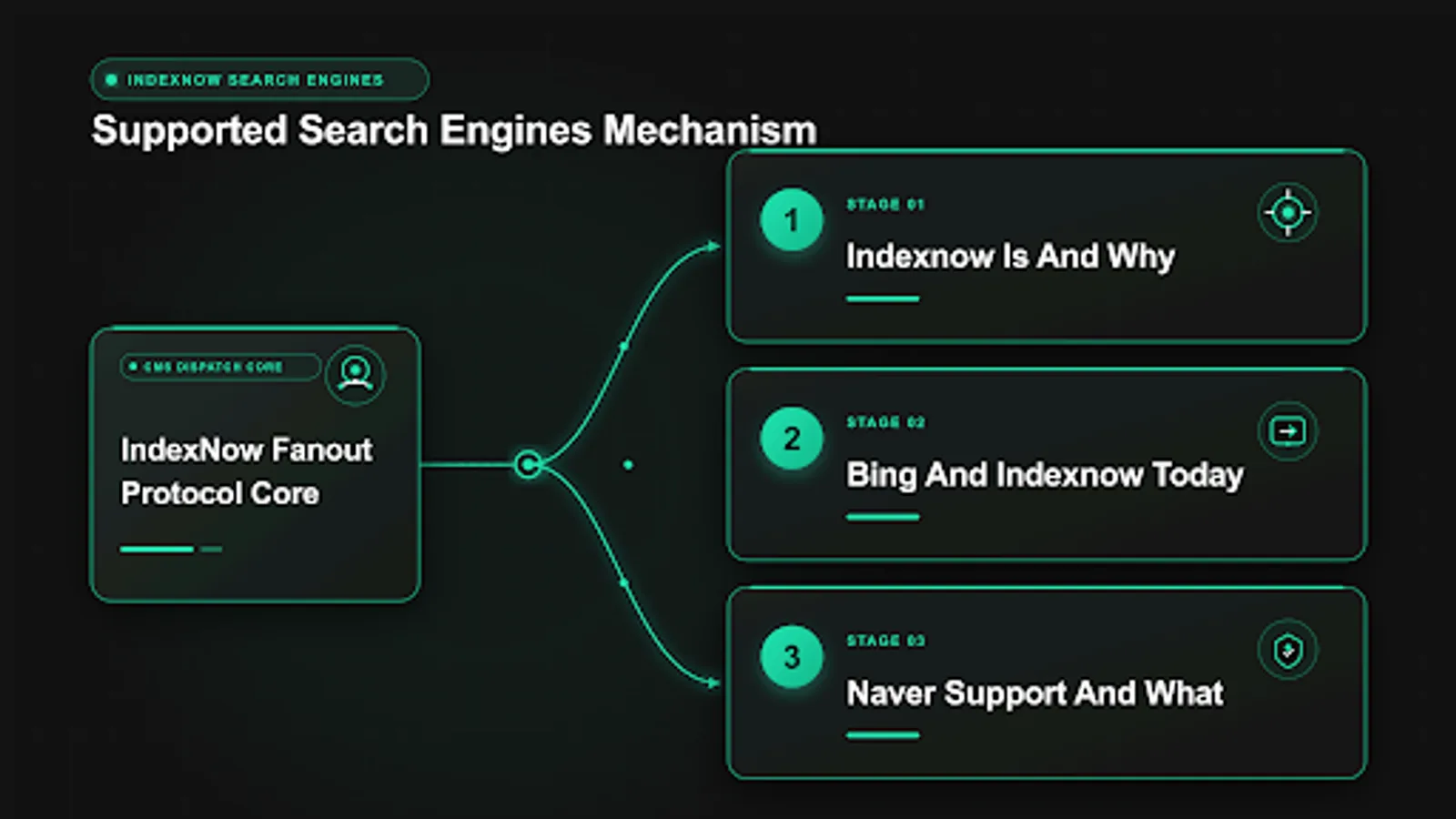 <!-- IMAGE-PROMPT diagram-01: 1600px max, DependsIt brand mint #22E3B0 on charcoal #121212, node-network line art, subject: IndexNow submission flow from CMS to Bing Yandex Naver Seznam diagram, flat vector, accessible, Clash Display headings feel with General Sans labels, no em dash -->
Naver support and what it covers
Naver joined the IndexNow supporter list as the protocol expanded beyond its founders. For sites targeting Korean audiences or Korean language queries, Naver coverage adds meaningful reach. Naver consumes the same IndexNow submissions, using your key file for ownership and your urlList for discovery. Practical impact depends on content relevance, language match, and site quality. Owners should still follow Naver Webmaster guidance for verification and sitemaps where available.
For Naver IndexNow results, publish Korean language URLs with clean canonicals and track Naver referrals separately. Language match plus steady submits helps Naver prioritize recrawls without extra integration work.
Naver accepts IndexNow submissions using the shared key and endpoint format. Consistent process beats bursts of effort, because search engines trust steady, clean signals. When in doubt, test with a single URL first, confirm the response, then scale to batches. That check takes seconds, yet it prevents hours of debugging when submissions seem to vanish.
Korean language and Korea focused sites gain the most added reach. When in doubt, test with a single URL first, confirm the response, then scale to batches. That check takes seconds, yet it prevents hours of debugging when submissions seem to vanish. Site owners who log every submission spot patterns faster and fix root causes instead of guessing.
One submission can serve Naver plus Bing, Yandex, and other supporters. That check takes seconds, yet it prevents hours of debugging when submissions seem to vanish. Site owners who log every submission spot patterns faster and fix root causes instead of guessing. Small teams benefit most from this habit, since one clear log replaces several scattered guesses.
Language match and content quality decide whether discovered URLs get indexed. Site owners who log every submission spot patterns faster and fix root causes instead of guessing. Small teams benefit most from this habit, since one clear log replaces several scattered guesses. Keep notes on what changed before each submission, so you can link causes to crawl results.
Track Naver referrals and crawl hits separately to judge real impact. Small teams benefit most from this habit, since one clear log replaces several scattered guesses. Keep notes on what changed before each submission, so you can link causes to crawl results. Consistent process beats bursts of effort, because search engines trust steady, clean signals.
Checklist for this section:
- Naver accepts IndexNow submissions using the shared key and endpoint format.
- Korean language and Korea focused sites gain the most added reach.
- One submission can serve Naver plus Bing, Yandex, and other supporters.
- Language match and content quality decide whether discovered URLs get indexed.
- Track Naver referrals and crawl hits separately to judge real impact.
Work through the checklist in order and note the date you verified each item. Consistent process beats bursts of effort, because search engines trust steady, clean signals. On 429, pause and retry with exponential backoff instead of hammering the endpoint in a tight loop.
Seznam support and what it covers
Seznam, the Czech search engine, supports IndexNow for its index. Sites with Czech content or Central European audiences pick up extra discovery through this channel. The mechanics are the same, with a root key file and batched urlList payloads. Seznam uses pings to prioritize recrawls of changed pages. As with other supporters, pings help discovery but do not override quality checks.
For Seznam IndexNow pickup, keep batches clean and watch server logs for Seznam bot visits after each send. Czech regional pages with clear internal links tend to get recrawled fastest through this channel.
Seznam supports IndexNow and uses pings to prioritize changed URLs. Ownership in IndexNow is proven with a key file that lives at the root of your site. The file name matches your key, for example abc123def456.txt, and it holds the same key as plain text. Search engines fetch this file once to confirm control of the domain, then they accept submissions.
Czech language and regional sites see the most direct benefit. The file name matches your key, for example abc123def456.txt, and it holds the same key as plain text. Search engines fetch this file once to confirm control of the domain, then they accept submissions. Keep the file reachable with a 200 status, plain text type, and no login wall or bot block.
Shared format means no extra code path, just include URLs in normal batches. Search engines fetch this file once to confirm control of the domain, then they accept submissions. Keep the file reachable with a 200 status, plain text type, and no login wall or bot block. If the key file returns 404 or blocks crawlers, verification fails and submissions are ignored.
Discovery is faster, while indexing still depends on quality and crawlability. Keep the file reachable with a 200 status, plain text type, and no login wall or bot block. If the key file returns 404 or blocks crawlers, verification fails and submissions are ignored. Ownership in IndexNow is proven with a key file that lives at the root of your site.
Monitor server logs for Seznam bot visits after batches to confirm pickup. If the key file returns 404 or blocks crawlers, verification fails and submissions are ignored. Ownership in IndexNow is proven with a key file that lives at the root of your site. The file name matches your key, for example abc123def456.txt, and it holds the same key as plain text.
Checklist for this section:
- Seznam supports IndexNow and uses pings to prioritize changed URLs.
- Czech language and regional sites see the most direct benefit.
- Shared format means no extra code path, just include URLs in normal batches.
- Discovery is faster, while indexing still depends on quality and crawlability.
- Monitor server logs for Seznam bot visits after batches to confirm pickup.
Work through the checklist in order and note the date you verified each item. When in doubt, test with a single URL first, confirm the response, then scale to batches. The endpoint accepts GET for quick tests and POST with JSON for batches up to 10,000 URLs.
Other engines and services that accept IndexNow
Beyond the named supporters, IndexNow has been adopted by additional engines and services that route through Bing or consume the feed directly. DuckDuckGo, for example, sources results in part via Bing, so faster Bing discovery can improve freshness downstream. Other niche engines and SEO platforms have announced compatibility at different times. The safest approach is to treat the official documentation as the source of truth and recheck it before publishing a fixed list.
To answer who uses IndexNow today, review IndexNow partners linked from official docs and track IndexNow adoption notes by date. New IndexNow partners often route via Bing at first, so Bing pickup is a useful early signal while direct support matures.
DuckDuckGo routes in part via Bing, so Bing freshness can help downstream. Always log response codes, batch sizes, and timestamps so you can audit what was sent and when. Separate IndexNow queues from Google Indexing API queues, since auth and quotas differ. Pace batches to a few requests per minute at first, then scale after watching 200 and 202 responses.
Niche and regional engines adopt at different times, so lists go stale quickly. Separate IndexNow queues from Google Indexing API queues, since auth and quotas differ. Pace batches to a few requests per minute at first, then scale after watching 200 and 202 responses. On 429, pause and retry with exponential backoff instead of hammering the endpoint in a tight loop.
SEO tools and CDNs may offer IndexNow relays that forward to supporters. Pace batches to a few requests per minute at first, then scale after watching 200 and 202 responses. On 429, pause and retry with exponential backoff instead of hammering the endpoint in a tight loop. The endpoint accepts GET for quick tests and POST with JSON for batches up to 10,000 URLs.
Always verify against official docs instead of copying a static list from a post. On 429, pause and retry with exponential backoff instead of hammering the endpoint in a tight loop. The endpoint accepts GET for quick tests and POST with JSON for batches up to 10,000 URLs. Always log response codes, batch sizes, and timestamps so you can audit what was sent and when.
Design your submitter to ping the shared endpoint once, not per engine hacks. The endpoint accepts GET for quick tests and POST with JSON for batches up to 10,000 URLs. Always log response codes, batch sizes, and timestamps so you can audit what was sent and when. Separate IndexNow queues from Google Indexing API queues, since auth and quotas differ.
Checklist for this section:
- DuckDuckGo routes in part via Bing, so Bing freshness can help downstream.
- Niche and regional engines adopt at different times, so lists go stale quickly.
- SEO tools and CDNs may offer IndexNow relays that forward to supporters.
- Always verify against official docs instead of copying a static list from a post.
- Design your submitter to ping the shared endpoint once, not per engine hacks.
Work through the checklist in order and note the date you verified each item. That check takes seconds, yet it prevents hours of debugging when submissions seem to vanish. Always log response codes, batch sizes, and timestamps so you can audit what was sent and when.
Where Google stands and why it matters
Google does not support IndexNow. IndexNow pings do not place URLs into Google search results. For Google, use XML sitemaps, Search Console URL Inspection, internal linking, and content that earns crawls. The Google Indexing API is separate and limited to JobPosting and BroadcastEvent pages, not normal posts or product pages. Planning for Google separately avoids the costly mistake of assuming one ping covers every engine.
The current Google IndexNow support position is no support, so keep Google on sitemaps and Search Console while IndexNow serves other search engines IndexNow partners support. This split keeps launches clean across both ecosystems.
Google does not consume IndexNow, so plan a separate Google track. Tighten internal links and fix redirect chains so crawlers spend budget on important pages. Use canonical tags to concentrate signals on one preferred URL instead of splitting across variants. Review crawl stats monthly to confirm pings lead to visits, then adjust priority and frequency. Background on alternatives is in Google Indexing API alternatives.
Sitemaps, Search Console, and internal links remain the Google discovery path. Use canonical tags to concentrate signals on one preferred URL instead of splitting across variants. Review crawl stats monthly to confirm pings lead to visits, then adjust priority and frequency. XML sitemaps give structure and lastmod hints, while IndexNow gives freshness the moment URLs change.
The Google Indexing API covers JobPosting and BroadcastEvent only. Review crawl stats monthly to confirm pings lead to visits, then adjust priority and frequency. XML sitemaps give structure and lastmod hints, while IndexNow gives freshness the moment URLs change. Keep sitemaps clean with canonical 200 URLs only, correct lastmod dates, and no 404s or redirects.
Off label use for normal pages has mixed results and should be stated honestly. XML sitemaps give structure and lastmod hints, while IndexNow gives freshness the moment URLs change. Keep sitemaps clean with canonical 200 URLs only, correct lastmod dates, and no 404s or redirects. Tighten internal links and fix redirect chains so crawlers spend budget on important pages.
A two track workflow covers IndexNow supporters plus Google without gaps. Keep sitemaps clean with canonical 200 URLs only, correct lastmod dates, and no 404s or redirects. Tighten internal links and fix redirect chains so crawlers spend budget on important pages. Use canonical tags to concentrate signals on one preferred URL instead of splitting across variants.
| Google path | Action |
|---|---|
| Sitemaps | Keep clean, canonical, with correct lastmod dates |
| Search Console | Use URL Inspection for important URLs, respect limits |
| Indexing API | JobPosting and BroadcastEvent only, not normal pages |
| Internal links | Link new pages from relevant hubs to earn crawls |
| Measurement | Track Google crawls separately from IndexNow supporters |
Read the table row by row before you change code, since each row maps to a check you can run today. Confirm the key file is reachable, confirm batches use canonical URLs, and confirm logs show 200 or 202 for recent sends. Tighten internal links and fix redirect chains so crawlers spend budget on important pages.
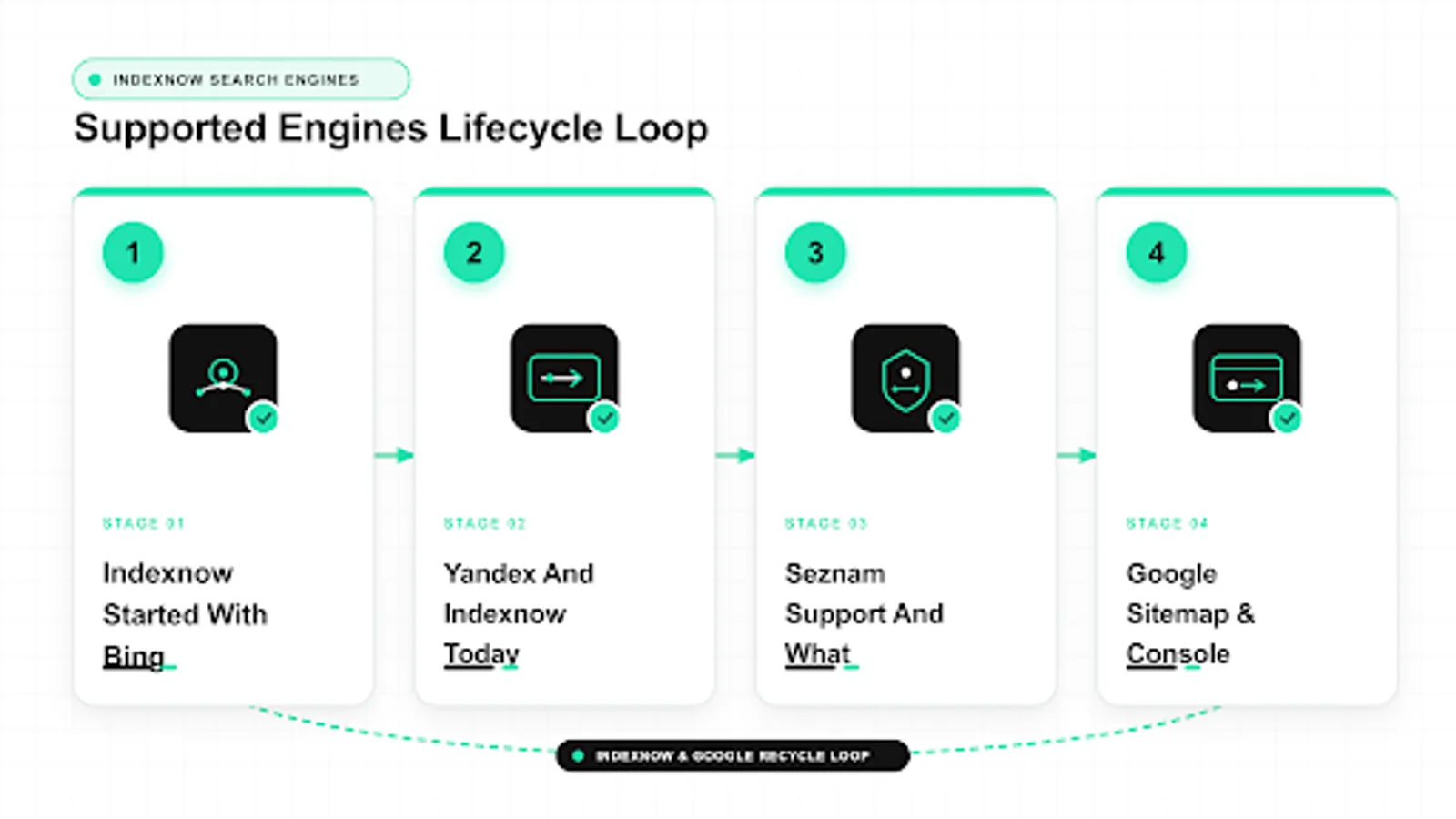 <!-- IMAGE-PROMPT workflow-02: 1600px max, DependsIt brand, mint #22E3B0 accents on charcoal #121212 or white, node-network line art, subject: two track workflow covering IndexNow engines and Google sitemap Search Console, flat vector, accessible, Clash Display and General Sans feel, no em dash -->
How to check the current list without relying on stale posts
Supporter lists change, so build a habit of verifying before you cite or commit. Start with the official documentation, then cross check Bing Webmaster announcements and Yandex Webmaster docs for your region. Look for dates on any list you find, and prefer primary sources over roundups. Keep a short note in your runbook with the date you last verified, the URLs you checked, and what each source said. That note saves debates later.
Start with official docs as the primary source for supporter lists. Small teams benefit most from this habit, since one clear log replaces several scattered guesses. Keep notes on what changed before each submission, so you can link causes to crawl results. Consistent process beats bursts of effort, because search engines trust steady, clean signals.
Cross check Bing and Yandex Webmaster announcements for updates. Keep notes on what changed before each submission, so you can link causes to crawl results. Consistent process beats bursts of effort, because search engines trust steady, clean signals. When in doubt, test with a single URL first, confirm the response, then scale to batches.
Prefer dated primary sources over undated roundups and social posts. Consistent process beats bursts of effort, because search engines trust steady, clean signals. When in doubt, test with a single URL first, confirm the response, then scale to batches. That check takes seconds, yet it prevents hours of debugging when submissions seem to vanish.
Record verification date and source URLs in your runbook. When in doubt, test with a single URL first, confirm the response, then scale to batches. That check takes seconds, yet it prevents hours of debugging when submissions seem to vanish. Site owners who log every submission spot patterns faster and fix root causes instead of guessing.
Revisit the list quarterly or before large migrations and launches. That check takes seconds, yet it prevents hours of debugging when submissions seem to vanish. Site owners who log every submission spot patterns faster and fix root causes instead of guessing. Small teams benefit most from this habit, since one clear log replaces several scattered guesses.
Checklist for this section:
- Start with official docs as the primary source for supporter lists.
- Cross check Bing and Yandex Webmaster announcements for updates.
- Prefer dated primary sources over undated roundups and social posts.
- Record verification date and source URLs in your runbook.
- Revisit the list quarterly or before large migrations and launches.
Work through the checklist in order and note the date you verified each item. Small teams benefit most from this habit, since one clear log replaces several scattered guesses. Pace batches to a few requests per minute at first, then scale after watching 200 and 202 responses.
What happens after you submit to each engine
After you submit, each supporter decides when to crawl based on its own load, trust in your site, and URL priority. A 200 or 202 response means the batch was received, not that every URL will be indexed. Engines may crawl within minutes, hours, or days depending on freshness signals and site history. New domains often see slower pickup until trust builds. Deleted URLs are treated as removal hints, not instant purges, and still pass through normal validation.
200 means received for consideration, 202 means accepted for processing. If the key file returns 404 or blocks crawlers, verification fails and submissions are ignored. Ownership in IndexNow is proven with a key file that lives at the root of your site. The file name matches your key, for example abc123def456.txt, and it holds the same key as plain text.
Crawl timing varies by engine load, site trust, and URL priority. Ownership in IndexNow is proven with a key file that lives at the root of your site. The file name matches your key, for example abc123def456.txt, and it holds the same key as plain text. Search engines fetch this file once to confirm control of the domain, then they accept submissions.
Indexing still depends on quality, canonicals, and crawlability after discovery. The file name matches your key, for example abc123def456.txt, and it holds the same key as plain text. Search engines fetch this file once to confirm control of the domain, then they accept submissions. Keep the file reachable with a 200 status, plain text type, and no login wall or bot block.
URL deletions are hints that go through validation, not instant purges. Search engines fetch this file once to confirm control of the domain, then they accept submissions. Keep the file reachable with a 200 status, plain text type, and no login wall or bot block. If the key file returns 404 or blocks crawlers, verification fails and submissions are ignored.
Track per engine crawl hits to learn normal lag for your site. Keep the file reachable with a 200 status, plain text type, and no login wall or bot block. If the key file returns 404 or blocks crawlers, verification fails and submissions are ignored. Ownership in IndexNow is proven with a key file that lives at the root of your site.
Checklist for this section:
- 200 means received for consideration, 202 means accepted for processing.
- Crawl timing varies by engine load, site trust, and URL priority.
- Indexing still depends on quality, canonicals, and crawlability after discovery.
- URL deletions are hints that go through validation, not instant purges.
- Track per engine crawl hits to learn normal lag for your site.
Work through the checklist in order and note the date you verified each item. Keep notes on what changed before each submission, so you can link causes to crawl results. On 429, pause and retry with exponential backoff instead of hammering the endpoint in a tight loop.
Practical setup so one submission reaches all indexnow supported search engines
You do not need a separate integration per engine. Host one key file at the root, generate a strong random key, and submit batches to the shared endpoint. Include full canonical URLs, keep batches clean, and log responses. Automate submission on publish, update, and delete events from your CMS or deploy pipeline. Monitor key file availability with uptime checks, since an unreachable key file silently disables verification.
Host one key file at root and keep it reachable with 200 status. The endpoint accepts GET for quick tests and POST with JSON for batches up to 10,000 URLs. Always log response codes, batch sizes, and timestamps so you can audit what was sent and when. Separate IndexNow queues from Google Indexing API queues, since auth and quotas differ.
Submit canonical absolute URLs in POST JSON batches up to 10,000. Always log response codes, batch sizes, and timestamps so you can audit what was sent and when. Separate IndexNow queues from Google Indexing API queues, since auth and quotas differ. Pace batches to a few requests per minute at first, then scale after watching 200 and 202 responses.
Automate on publish, update, and delete so no change is missed. Separate IndexNow queues from Google Indexing API queues, since auth and quotas differ. Pace batches to a few requests per minute at first, then scale after watching 200 and 202 responses. On 429, pause and retry with exponential backoff instead of hammering the endpoint in a tight loop.
Log codes and batch sizes, and alert on repeated 403, 422, or 429. Pace batches to a few requests per minute at first, then scale after watching 200 and 202 responses. On 429, pause and retry with exponential backoff instead of hammering the endpoint in a tight loop. The endpoint accepts GET for quick tests and POST with JSON for batches up to 10,000 URLs.
Monitor key file uptime so verification never silently breaks. On 429, pause and retry with exponential backoff instead of hammering the endpoint in a tight loop. The endpoint accepts GET for quick tests and POST with JSON for batches up to 10,000 URLs. Always log response codes, batch sizes, and timestamps so you can audit what was sent and when.
Checklist for this section:
- Host one key file at root and keep it reachable with 200 status.
- Submit canonical absolute URLs in POST JSON batches up to 10,000.
- Automate on publish, update, and delete so no change is missed.
- Log codes and batch sizes, and alert on repeated 403, 422, or 429.
- Monitor key file uptime so verification never silently breaks.
Work through the checklist in order and note the date you verified each item. Consistent process beats bursts of effort, because search engines trust steady, clean signals. The endpoint accepts GET for quick tests and POST with JSON for batches up to 10,000 URLs.
Example POST batch for IndexNow supporters:
{
  "host": "www.example.com",
  "key": "abc123def456abc123def456abc12345",
  "keyLocation": "https://www.example.com/abc123def456abc123def456abc12345.txt",
  "urlList": [
    "https://www.example.com/new-post/",
    "https://www.example.com/updated-guide/",
    "https://www.example.com/products/widget/"
  ]
}
Example cURL for a quick single batch test:
curl -X POST "https://www.bing.com/indexnow" \
  -H "Content-Type: application/json" \
  -d '{"host":"www.example.com","key":"abc123def456abc123def456abc12345","keyLocation":"https://www.example.com/abc123def456abc123def456abc12345.txt","urlList":["https://www.example.com/new-post/"]}'
FAQ
Does Google support IndexNow?
No. Google does not support IndexNow, so pings do not reach Google search. The Google IndexNow support status has been consistent across official docs, with Google recommending sitemaps, Search Console URL Inspection, internal linking, and steady publishing for discovery. Keep IndexNow for Bing, Yandex, Naver, Seznam, and other supporters, and track Google crawls separately in server logs and Search Console. Check coverage monthly, keep sitemaps clean with canonical URLs, and request recrawls only for priority pages. This split avoids the common mistake of assuming one submission covers every engine.
Which engines should I list as IndexNow supporters?
List Bing and Yandex as core supporters, plus Naver and Seznam, then note additional services that route via Bing or consume the feed. The official indexnow engines list is the source of truth, so recheck it before you publish a fixed list since IndexNow adoption changes over time. For Bing IndexNow and Yandex IndexNow, one key file serves both. For Naver IndexNow and Seznam IndexNow, the same batch applies. Record the verification date, link your runbook to primary sources, and note who uses IndexNow today instead of copying a stale roundup.
Do I need a separate integration for each engine?
No. Host one key file at the root and submit batches to the shared endpoint for all indexnow supported search engines. The same host, key, keyLocation, and urlList format serves Bing, Yandex, Naver, Seznam, and other IndexNow partners. This single pipe design keeps code simple and avoids per engine hacks. Monitor the key file with uptime checks, log response codes per batch, deduplicate repeats before sending, and pace requests to avoid 429 responses. When search engines IndexNow systems fetch your key, they all validate against the same file.
Does a 200 response mean my URLs are indexed?
No. A 200 means received for consideration and a 202 means accepted for processing across indexnow supported search engines. Each engine still decides when to crawl based on load, trust, and priority, and indexing still depends on quality, canonicals, and crawlability. Use Bing Webmaster Tools, Yandex Webmaster, and server logs to confirm pings turn into crawls, then into indexed pages. Track batch time, URL count, response code, and first crawl hit per engine. Review weekly to learn normal lag and spot gaps early.
How many URLs can I send at once?
A single IndexNow request can carry up to 10,000 URLs for all indexnow supported search engines. Use POST with JSON for batches and GET for quick single URL tests. Keep lists to canonical absolute URLs, deduplicate repeats, and pace requests instead of hammering. On 429, back off exponentially and resume after the wait window. Log batch size and response codes, split very large catalogs into dated chunks, and keep sitemaps in sync so supporters see consistent signals. Clean batches get prioritized faster than noisy ones.
How do I prove IndexNow is working?
Submit a small test batch with fresh URLs, log the response codes, then watch server logs for Bingbot, Yandex, and other supporter visits. Cross check Webmaster Tools for crawl and coverage changes within days. Keep a simple sheet with batch time, URL count, response code, and first crawl hit per engine, then review weekly. Compare Bing IndexNow pickup against Yandex IndexNow, Naver IndexNow, and Seznam IndexNow to see which search engines IndexNow activity drives crawls fastest. Stable short lags confirm the workflow is healthy.
Sources
- https://www.indexnow.org/documentation
- https://www.bing.com/webmasters/help/indexnow
- https://yandex.com/support/webmaster/indexnow/indexnow.html
- https://developers.google.com/search/docs/crawling-indexing/sitemaps-overview
- https://developers.google.com/search/docs/monitor-debug/search-console-start