Free Ways to Index Backlinks Without a Service

Paid indexer subscriptions promise speed, but most of what moves the needle for backlinks is already free when you use official channels and clean site hygiene. You can inspect and request fetching for your own pages without paying, notify Bing side engines through IndexNow with a simple key file, keep sitemaps and feeds accurate from your CMS, build internal pathways from live content, and ask publishers for precise markup fixes that cost nothing but care. This guide shows you how to combine those free levers into a routine that rivals many paid packages for the links that actually matter.
The focus keyword is free backlink indexer, interpreted as free methods rather than a free trial of a closed network. The distinction matters for policy and durability. Free official methods submit only URLs you own, create pathways that serve readers as well as crawlers, and leave behind logs you can audit. They never ask you to hand target lists to an opaque third party or to place links on thin pages you do not control. That ownership aware stance keeps quota clean and results explainable to clients or managers.
You will learn native Search Console and Bing Webmaster workflows for your own hubs, self run IndexNow submission with your own key, sitemap plus RSS plus internal linking hygiene, content hubs and secondary pages that attract follows, publisher outreach templates for markup repairs, and a tracking plus retry schedule that prevents duplicate work. Each method lists prerequisites, steps, and stop rules so a solo owner can run the full system in a few hours per month without writing a large codebase.
Key takeaways
- Free methods cover the useful core: owned hub submission, IndexNow with your own key, sitemaps, feeds, internal links, and publisher outreach.
- Submit only URLs you own through free official channels. Use hubs and context pages to create followable paths toward third party mentions.
- Publisher markup fixes cost nothing and often outperform paid pings. Prioritize server rendered anchors with clean href values.
- A simple sheet with live dates, check dates, actions, and response codes replaces most dashboard fees for small teams.
- Reserve paid help for unusual launch spikes after a month of free baseline data proves where the gaps actually sit.
- Why a free backlink indexer routine matches paid services
- Native Search Console and Bing workflows
- Self run IndexNow with your own key
- Sitemaps, RSS, and internal links done right
- Hubs and secondary pages that earn crawls
- Outreach fixes that cost nothing
- Tracking and retry without paid dashboards
 <!-- IMAGE-PROMPT cover: 1200x630, DependsIt brand, deep charcoal #121212 or clean white background, vibrant mint #22E3B0 accent glow, thin node-network line art, Clash Display style bold heading space on left, General Sans clean labels, subject: free ways to index backlinks without service, flat vector, high contrast, accessible, no photorealistic faces, no text smaller than 24px, no em dash in rendered text, export PNG then cwebp -q 82 to WEBP -->
Why a free backlink indexer routine matches paid services
Free methods match paid services for most routine backlinks because the underlying actions are identical at the protocol level. A paid submitter that uses your own keys sends the same hub notification you can send manually through native inspection or a ten line script. A paid feed helper generates the same RSS and sitemap entries your CMS can generate on publish. A paid hub product hosts a roundup page that you could publish on your own domain with better topical fit and persistent value. What fees buy in these cases is convenience and interface polish, not access to a secret endpoint that free users lack.
Triage explains why blanket paid coverage rarely pays. Most new mentions fall into two buckets that need no paid help. Strong editorial placements on healthy publications are found through normal polling within a normal cycle, so extra submission duplicates work polling already handles. Thin profiles and ephemeral bookmarks lack the substance to pass value even after perfect discovery, so accelerating them spends money without changing outcomes. Only a narrow middle tier of valuable but poorly connected pages benefits from active help, and that tier is small enough to handle manually with free channels plus occasional outreach. Paying per link across all tiers therefore subsidizes work that was either unnecessary or futile.
Log transparency further favors free owned routines for small teams. When you submit hubs yourself, receipts live in your own consoles and server logs with timestamps you control. When you rely on aggregate vendor dashboards, you must reconstruct per URL history from screenshots and support tickets. That detective work often costs more in labor than the subscription saves in clicks. Free methods keep evidence local and grepable, which speeds weekly reviews and makes real failures obvious. Over a quarter, the labor savings from clean local logs frequently outweigh the convenience of a polished but opaque dashboard.
Content assets tip lifetime value decisively toward free methods. A mentions hub you publish on your domain serves readers, accumulates internal links, and can rank for brand plus coverage queries long after any campaign ends. A vendor hosted pathway vanishes at cancellation, leaving no residual equity for your site. The same holds for data supplements, methods notes, and campaign diaries that support outreach. Those pages attract citations and secondary links that compound, while rented network pages contribute nothing durable. When you compare total return over twelve months rather than speed screenshots from week one, owned free content wins for nearly every small team profile.
The practical rule is to earn the right to pay through baseline data. Run free methods for a month with disciplined tracking of hub fetch times and report appearance by tier. This free link indexing baseline covers core free indexing methods well, and it suits budget link indexing plans that need proof before any spend. If data shows a specific gap, such as launch weeks with dozens of simultaneous mentions overwhelming manual batches, then consider a modest transparent tool for that narrow peak rather than a blanket subscription. That evidence based escalation keeps budgets aligned with measured lift, and it preserves the free routine as a control set for judging any future vendor trial fairly. For paid comparisons, see how to index backlinks fast before spending.
A simple tracking sheet turns backlink indexing from guesswork into a repeatable operation that any content team can run. Columns should include the referring URL, the target URL on your site, the date the link went live, the linking page index status, the discovery method used, the submission date, the response code, and the date the link first appeared in Search Console or server referral logs. Review the sheet weekly rather than hourly, because index systems need time to process queues. Prioritize rows by business impact. A guest post on a real publication with traffic deserves manual verification and outreach for fixes. A low quality profile link with no traffic deserves no action beyond a single passive discovery trigger. This triage keeps effort aligned with expected return.
Spam style tactics for forcing link discovery create footprint and policy risks that outweigh any short term crawl spike. Mass pinging unrelated endpoints, building tiers of thin doorway pages whose only purpose is to redirect crawler attention, stuffing links into auto generated comments, and submitting third party URLs to endpoints scoped for your own verified property all fall into this category. Engines have years of experience discounting such signals, and site owners inherit the cleanup cost when doorway hubs get deindexed or when a vendor network is flagged. The safer path uses only URLs you control for direct submission, accurate sitemaps and feeds, genuine internal links from real hub content, and polite outreach to publishers when markup needs a fix. Those methods are slower per URL but they compound without creating liability.
Native Search Console and Bing workflows
Native webmaster workflows handle Google side and Bing side hub coverage without extra software, provided you keep verification and hygiene current. In Search Console, confirm that the property owning your hub host remains verified, then use URL inspection to check crawl, index, and canonical state for each new or updated hub. Where inspection offers a request for fetching of your own URL, use it sparingly for campaign hubs rather than for every archive tweak, and record the outcome with timestamps. Pair inspection with sitemap management in the same console, submitting updated sitemap sections after hub publishes so declaration and request stay consistent.
Bing Webmaster Tools mirrors this pattern with Bing specific options for URL submission and sitemap declaration. Register and verify the same hub hosts you use on the Google side, submit updated sitemap locations after structural changes, and use native URL submission for priority hubs within documented limits. Because IndexNow and Bing submission have separate quotas and flows, track them as distinct channels in your sheet rather than blending them into one column. That separation clarifies which channel preceded any observed Bingbot fetch in server logs, which improves future pacing decisions during launches with many simultaneous hub updates.
Verification maintenance prevents the most common native workflow failures. After domain moves, HTTPS migrations, CDN changes, or CMS replatforms, recheck property verification, sitemap reachability, and canonical host consistency before assuming engine neglect. Typical breakage includes delegation records dropped during DNS edits, sitemap URLs still pointing to old hosts after a migration, and inspection requests sent for staging hosts that were never verified. A five minute checklist after every infrastructure change, verification intact, sitemaps fetchable, canonicals self consistent, preserves the reliability of all free submission that follows.
Pacing and prioritization apply even to free native actions. Reserve manual requests for hubs with genuine content changes and business impact, such as new campaign sections with multiple fresh outbound references. Allow routine archive updates to be found through sitemaps and internal links without manual requests. Space launch requests across hours rather than minutes when many hubs publish together, so each request gets clean log attribution and throttling stays unlikely. Log every native action with hub URL, channel, timestamp, and observed response or confirmation message. That discipline keeps free workflows credible when stakeholders ask what was done for each link.
Measurement for native workflows should focus on hub fetch evidence rather than instant link counting. Filter server logs by crawler family for hub URLs in the days after each action, note inspection state transitions for Google side hubs, and record Bing side feedback separately. These free url submission steps plus simple free index tools for log filtering give small teams enough evidence without a dashboard. Compare time to hub fetch against prior polling baselines for similar hubs to estimate lift. Link report appearance follows later through normal following and evaluation, often days or weeks after the hub fetch that enabled it. Reporting hub fetch lift honestly prevents the common error of judging native submission by same day report movement that no free or paid method can guarantee. Native limits are documented in IndexNow documentation and related webmaster docs.
A bring your own key workflow gives small teams the transparency of direct API submission without building a full backend from scratch. In this pattern you create your own keys and service accounts in your own cloud project or webmaster account, then you paste those credentials into a lightweight tool or script that runs under your control. Quota consumption appears in your own console, logs stay in your own storage, and revoking access is a single key rotation rather than a support ticket. For backlink work this pattern fits hub page submission. You submit your own roundup, press, and resource pages through your own keys, which indirectly helps engines discover the outbound referring URLs those hubs point to. You never submit third party domains through your Google property scope, because verification and ownership rules still apply.
Google discovers backlinks in stages, and each stage has a different meaning for rankings. First comes discovery, where a crawler finds a URL or a link on a page it already visits. Next comes crawling, where the engine fetches the linking page, parses the HTML, and extracts the anchor and href attributes. Only after that comes indexing, where the linking page enters the index and its links become eligible to pass signals. Many site owners collapse these stages into one word, indexing, which creates confusion when a link is found but not yet counted. A practical workflow therefore tracks each stage separately. Discovery can be checked in server logs and crawl reports. Crawling can be confirmed with URL inspection and fetch tools. Indexing requires a check of the linking page status in the index. When you separate the stages, you stop chasing the wrong fix and you focus on the actual bottleneck.
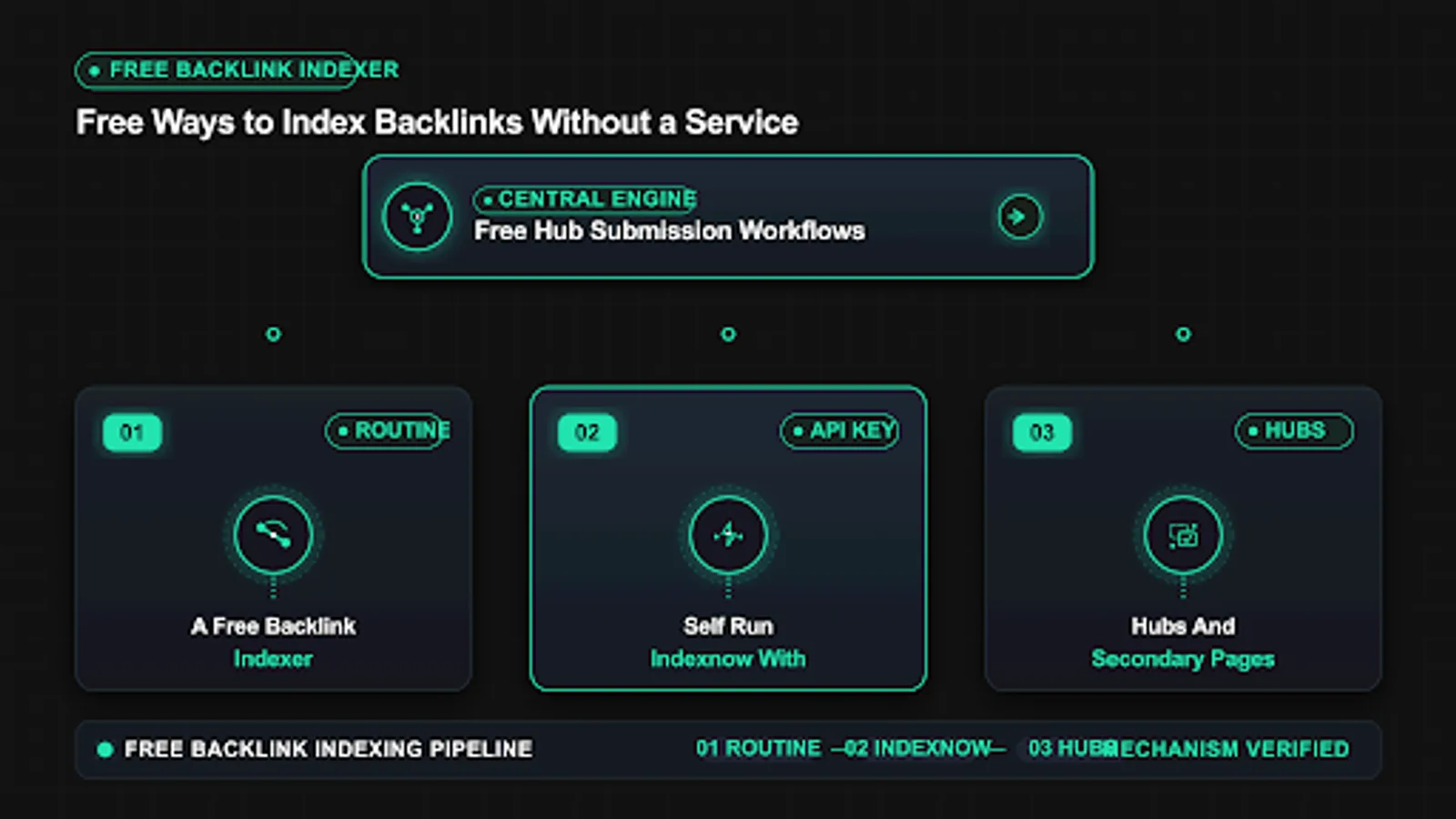 <!-- IMAGE-PROMPT diagram-01: 1600px max, DependsIt brand mint #22E3B0 on charcoal #121212 or white, node-network line art, Clash Display headings feel, General Sans clean labels, subject: free hub submission workflows diagram diagram, flat vector, accessible, no em dash -->
Self run IndexNow with your own key
Self run IndexNow submission is one of the highest return free actions for Bing side discovery, because setup takes minutes and each batch costs nothing beyond log review. Start by generating a random key with sufficient entropy from your local machine, then save it as a plain text file at the site root using the exact filename the protocol expects. Verify that the file returns over HTTP with the key as the body and a plain text content type. Keep that file deployed permanently across all environments, because engines revalidate ownership on later batches and a missing file converts accepts into validation failures that look like service outages.
Sending a batch requires only a standard HTTP POST with a JSON body containing the host, the key, the key location URL, and a list of changed URLs on that host. Use any scripting language you already run, from Python with requests to Node with fetch to PHP with curl bindings, and keep batch sizes within documented limits for large hub updates. Submit only URLs on the matching host that changed meaningfully, such as a mentions hub with new campaign context and outbound references. Avoid including thousands of unchanged URLs or third party publisher URLs under your own key, both of which fail validation logic or dilute signal trust without helping any backlink.
A minimal script plus a small queue turns one off batches into a reliable routine. Store pending hub URLs with change reasons in a text file or sheet, send one batch per hub update, then append the timestamp, included URLs, endpoint, response code, and message to a log file you can review weekly. Handle throttling with backoff and smaller batches rather than immediate full resends. Handle validation errors by fixing the key file or host mismatch first, then resending once with confirmation. That tiny system handles dozens of hubs per month without a subscription, and every step remains inspectable when results need explanation.
Common failure modes are inexpensive to prevent with a preflight checklist. Confirm key reachability from the public internet rather than only from localhost, because edge rules sometimes serve different content externally. Confirm that robots allows the key path and that caching layers do not serve stale key content after rotation. Confirm host spelling including www versus apex consistency between key location and submitted URLs, because mismatches are a frequent source of rejected batches after migrations. Run this checklist before launch week batches when many mentions arrive together, since that is exactly when a stale key file causes the most visible delay.
Judge self run IndexNow on Bing side hub movement alone, using server logs filtered for Bingbot plus Bing Webmaster feedback for submitted hubs. Do not expect Google report movement from these pings, because Google does not participate in the protocol. When teams keep engine families separate, self run batches often show clear hub fetch lift within days, which justifies keeping the step as a standing action after every hub update. That scoped win compounds across quarters into faster Bing side discovery for all owned content, with backlink hubs riding the same reliable channel at zero marginal cost. Protocol background appears in IndexNow complete guide with setup details.
IndexNow is an open protocol co developed by Microsoft Bing and Yandex that lets site owners notify participating engines about new, updated, or deleted URLs. The current participant list is maintained on the official documentation site and includes Bing, Yandex, Naver, Seznam, and other engines that ingest the shared feed. Google does not support IndexNow, so an IndexNow ping never submits a URL directly to Google. That fact shapes every serious backlink workflow. You use IndexNow to cover Bing side discovery for linking pages and for your own hub pages, while you use separate Google side methods for Googlebot discovery. Setup uses a plain text key file hosted at the site root for ownership verification, plus simple HTTP POST requests with JSON bodies that list changed URLs.
The Google Indexing API runs at a dedicated endpoint for URL notifications and it supports two notification types, URL_UPDATED and URL_DELETED. Official documentation scopes the API to JobPosting pages and BroadcastEvent pages for livestreams, which are short lived content types where fast discovery has clear user value. The API is not documented for normal blog posts, product pages, or third party backlink URLs that you do not control. Many SEO teams still test off label use, and results vary by site, quota, and content type. Honest guidance therefore states the documented scope first, then explains the observed behavior, then lists the risks. Those risks include wasted quota, inconsistent processing, and no guarantee that a notification leads to a crawl or to index entry. For backlinks, the API only makes sense for URLs you own, such as hub pages that list or link toward your new referring pages.
Sitemaps, RSS, and internal links done right
Free discovery foundations outperform sporadic manual pushes when they are kept accurate, and every component already exists in most stacks at no extra cost. Build an XML sitemap that lists only indexable URLs you own, each returning 200 with substantive content and a self referencing canonical. Derive lastmod from genuine content edits rather than deploy times, so crawlers learn that your dates predict real changes. Organize large sites with a sitemap index segmented by content type, and include mentions hubs in the appropriate child sitemap immediately on publish. Validate syntax and reachability after every CMS update, because one malformed file can stall declaration for all hubs until fixed.
Feeds provide the freshness layer that sitemaps alone sometimes miss. Expose RSS or Atom with stable hub links, accurate publish and update timestamps, and meaningful summaries that help downstream pollers understand what changed. Keep feed cache lifetimes short enough for timely propagation after hub updates, but long enough to avoid origin strain during traffic peaks. After template changes, validate feed parsing and confirm that hub updates actually appear as new or updated entries rather than being filtered by category rules. Many teams discover that hubs were silently excluded from feeds for months, which explains slow polling more convincingly than any engine theory.
Internal linking distributes the crawl attention that sitemaps and feeds declare. Place each mentions hub within two clicks of a high traffic parent, add contextual links from related articles when new coverage arrives, and keep those links stable rather than rotating them away after a week. Use descriptive anchors that name the campaign or topic, and keep hub URLs persistent so links accumulate instead of resetting after every redesign. Monthly, scan for orphaned hubs with zero or one internal referrer and either link them from a relevant parent or consolidate them into a stronger hub. That scan takes minutes with a site crawl and it prevents silent priority drops that undermine all other free work.
Hygiene checks tie the three foundations into a monthly routine that fits inside an hour. Weekly, fetch sitemap indexes and sample child files for status, content type, and absence of 404 entries. Weekly, confirm that recent hub updates appear in feeds with correct dates. Monthly, compare sitemap inventory against CMS inventory to catch template exclusions where new hubs publish without declaration. Quarterly, sample lastmod accuracy by verifying that meaningful edits moved dates while trivial tweaks did not. Log each check with a date so gaps become visible as patterns rather than anecdotes. Clean foundations make every later free action more effective while reducing how often manual pushes are even needed.
For backlink support specifically, treat hub inclusion across all three channels as the definition of done for every campaign. A hub that appears in sitemaps, in feeds, and from contextual internal parents gets multiple independent chances for timely fetching on both engine families. A hub that misses any of the three depends on a single pathway that may be slow for reasons outside your control. When postmortems blame endpoints for slow campaigns, the root cause is often a missing feed entry or an orphaned hub rather than a protocol failure. Fixing those basics costs nothing and it improves all future campaigns simultaneously.
Sitemaps, RSS feeds, and internal linking still do most of the heavy lifting for durable discovery, and notification protocols only complement them. A clean XML sitemap gives crawlers a canonical list of your own URLs with accurate lastmod dates, while an RSS or Atom feed surfaces fresh content in chronological order for feed readers and crawlers that poll it. Internal links then distribute crawl attention from high authority hub pages toward new or updated targets, which reduces crawl depth and shortens time to first fetch. This foundation matters for backlink indexing because you rarely control the linking domain. What you do control is your own site architecture. When you publish a research hub, a press page, or a links roundup that references your new mentions, and you include those hub URLs in sitemaps and feeds, you create crawler pathways that help engines find the referring pages sooner.
Quotas, throttling, and retry logic separate reliable indexing workflows from scripts that burn through limits in an hour. Every submission endpoint enforces some form of rate control, and HTTP 429 remains the standard signal for too many requests. A sound queue therefore paces submissions, respects Retry After headers where present, and applies exponential backoff with jitter before retrying failed items. Logging matters as much as pacing. Each submission should record the target URL, the endpoint used, the timestamp, the response code, and any message body or request identifier returned by the server. With that log you can distinguish a key validation failure from a quota pause, and you can prove whether a batch was accepted or ignored. Never advise hammering endpoints. Steady pacing plus clear logs produces faster net indexing than bursts that trigger blocks.
Hubs and secondary pages that earn crawls
Hubs earn crawls when they serve readers first, which is why the best free backlink support doubles as useful content rather than bot fodder. A monthly mentions roundup with short summaries, accurate dates, and grouping by topic helps visitors catch up on coverage while giving crawlers a stable page that updates on a predictable cadence. A campaign resource index that links to data supplements, methods notes, and press assets serves journalists and partners while creating natural internal links toward new mentions. A research diary that narrates outreach progress with lessons learned serves peers while justifying frequent hub updates with genuine content changes. Each format qualifies for sitemap and feed inclusion on merit, not merely as a submission vehicle.
Structure determines whether hubs accumulate authority or fragment it across disposable URLs. Prefer one persistent hub per theme or quarter with stable URLs and paginated archives, rather than a new thin page for every single mention. Link each new mention into the persistent hub with context that explains why the coverage matters, and link outward to the referring page with a clean href plus a short quote or paraphrase that respects copyright. Cross link related hubs so crawlers and readers can traverse campaigns without returning to navigation on every step. That consolidation focuses internal attention and external citations onto fewer stronger pages, which shortens revisit intervals over time.
Secondary pages extend reach without creating doorway risk when they add distinct value. A data supplement with downloadable tables and chart explanations supports the main study and attracts its own citations. A methods note with sampling and analysis details serves technical readers and earns links from writers who need rigor. A short launch retrospective with metrics and mistakes serves operators and gets shared in communities that rarely link to pure press pages. Each secondary page should link contextually to the mentions hub and to the most relevant referring coverage, and each should appear in sitemaps and feeds with honest dates. Those genuine connections create multiple crawl entry points that all reinforce the same hub.
Quality bars keep hubs and supplements from decaying into thin lists that crawlers learn to ignore. Require a minimum of original summary per mention rather than bare link dumps, keep dates and attributions accurate, prune or update broken outbound references monthly, and remove or consolidate sections with no traffic and no new mentions after a quarter. Avoid auto generating location or keyword variations of the same hub to chase long tail queries, because that pattern dilutes attention and risks thin content evaluation. A smaller set of well maintained hubs with real readership outperforms a large set of auto generated pages on every discovery metric that matters for backlinks.
Promote hubs through normal editorial channels rather than leaving them isolated. Feature new hub updates in newsletters, link them from relevant evergreen guides, and share them on social profiles that point to your domain rather than directly to third party threads. Those reader driven visits generate usage signals and secondary links that further justify crawl attention, creating a virtuous cycle where useful hubs get found faster precisely because they are useful. Track hub traffic alongside bot fetch intervals to confirm the correlation for your own site. Over two quarters you will see which hub formats earn both audiences, and those formats become your standard template for every future outreach cycle at zero incremental tooling cost.
Search Console data about links always lags behind the live web, and that lag explains many false alarms about missing backlinks. The Links report shows referring pages that Google has already crawled and associated with your site, not every link that exists on the internet today. A new guest post, directory listing, or forum mention can take days or weeks to appear there, even when the linking page is perfectly crawlable. Third party link indexes have their own crawl schedules and coverage gaps, so disagreement between tools is normal rather than proof of a penalty. The right response is a calm verification sequence. Check whether the linking page is indexed. Check whether the link markup is present in rendered HTML. Check crawl access for the linking page. Then decide whether any action is needed at all.
Crawl budget shapes how quickly new referring pages get processed, especially when those pages live on large, slow, or low authority domains. Budget is not a single number in a dashboard. It reflects host load limits, crawl demand signals, and the engine side scheduling that balances freshness against server cost. A small blog with clean architecture can see new posts crawled within hours, while a large forum with millions of thin threads may wait weeks for deep pages to be revisited. You cannot control another site crawl budget directly, but you can influence discovery signals around your links. Links placed on freshly updated hub pages, category pages with steady traffic, and sitemap listed archive pages tend to be found sooner than links buried in paginated thread page 40. When you evaluate a new backlink, look at the linking page crawl context, not just domain authority.
 <!-- IMAGE-PROMPT workflow-02: 1600px max, DependsIt brand mint #22E3B0 on charcoal #121212, node-network line art, Clash Display style headings, General Sans labels, subject: free hub building workflow, flat vector, accessible, no em dash -->
Outreach fixes that cost nothing
Outreach for markup fixes costs nothing but attention, yet it often delivers more countable value than any submission campaign because it removes the barrier that prevents counting after discovery. The highest return requests are specific and technical. They name the live referring URL, quote the observed anchor and href, identify the exact issue such as JavaScript only rendering or a redirect chain with a broken hop, and propose corrected markup with an example. Publishers and developers act faster on such notes than on generic requests for better SEO, because the fix improves reader experience and page performance at the same time.
Prioritize outreach where expected value justifies human time. Editorial guest posts on active publications, partner integration pages with steady traffic, and maintained resource guides with real curation all warrant a ten minute audit plus a polite technical note when issues appear. Thin profiles, auto generated bookmarks, and login walled threads do not, because even perfect markup leaves minimal weight to gain. That triage keeps weekly outreach inside an hour while focusing effort on placements where a single edit converts directly into durable link equity. Log every candidate with tier, issue type, and contact date so follow ups stay organized without daily rechecking.
Templates should be short enough to forward to a developer without editing. Open with thanks for the mention and the live URL. Describe the observation in one sentence with a timestamped snippet. Propose the fix with a concrete anchor example and the final target URL. Offer to supply replacement copy or an updated link if content moved. Close with a single sentence on reader benefit, such as faster loading or clearer attribution. Attach no large files and make no demands about follow versus nofollow beyond accurately describing commercial relationships. Where disclosure rules require sponsored or ugc annotations, keep them accurate and negotiate placement prominence or context depth instead of asking for mislabeling that puts the publisher at risk.
Cadence and tracking separate professional outreach from spam. Allow at least a week between messages, reference the original technical note with any updated observations, and stop after two unanswered attempts on any single placement unless new information changes the request. Record every send, reply, claimed fix, and verification recheck with dates in the same sheet that tracks index state. Recheck markup after any reply that claims deployment, because CMS caching and template inheritance sometimes delay the visible change. When outreach stalls on a critical placement, consider contributing a fresh piece to a healthier section of the same publication rather than continuing to chase a problematic template.
Measure outreach by fix rate and downstream counting rather than email volume. Track what share of tier one requests produce a markup change within a month, and what share of fixed pages progress to index confirmation and report appearance in the following cycle. Share those win rates with writers and outreach staff as placement guidelines, highlighting templates and outlets with proven responsiveness. Over time this feedback loop shifts prospecting toward publishers that maintain clean server rendered markup and healthy crawl contexts, which reduces the need for fixes in the first place. That compounding improvement is free, durable, and entirely under your control. Engine side guidance is summarized in Bing Webmaster help for submission workflows.
Link markup details decide whether a discovered backlink can pass signals once the linking page is crawled. A standard anchor with an href to your absolute URL in server rendered HTML remains the most reliably processed format. JavaScript injected links, links inside shadow DOM, links that require login or interaction, and links with restrictive rel attributes all add processing steps that delay or reduce value transfer. Rel sponsored and rel ugc do not block discovery, but they annotate the link relationship for the engine, which affects how the signal is weighted. Rel nofollow similarly preserves discovery while instructing the engine not to pass ranking signals in the classic PageRank sense. Before you push for faster indexing of a backlink, view the rendered source of the linking page and confirm the link exists in a crawlable format with the intended attributes.
Robots directives, canonical tags, and HTTP status codes on the linking page can silently prevent a backlink from ever counting, no matter how many pings you send. If the linking page is blocked by robots.txt, served with a noindex header, canonicalized to a different URL, or returning soft 404 or 5xx errors, the engine will deprioritize or drop it during indexing. The link on that page then remains invisible for ranking purposes. This is why a pre submission audit of each high value referring URL pays for itself. Fetch the headers, read the robots rules for the path, check the rendered canonical, and confirm a 200 status with substantive content. Fixing a single noindex or canonical mismatch on the linking domain often does more than a month of repeated submissions through third party networks.
Tracking and retry without paid dashboards
A free tracking sheet replaces most paid dashboard value for small teams by recording exactly what matters for decisions and nothing more. Create one row per referring page with columns for target URL on your site, link live date, tier, markup snapshot reference, status and directive notes, index check dates with outcomes, associated hub URL, actions taken with timestamps and channels, response codes or confirmations, and first appearance in link reports or referral logs. Review tier one rows weekly during campaigns and monthly otherwise, advancing rows only when evidence changes. That evidence rule prevents daily reprocessing of unchanged URLs that clutters logs and consumes attention new placements need.
Retry logic stays simple when it distinguishes delivery failures from processing waits. This no cost backlink indexing discipline helps you index links without paying for retries that add no new information. Retry promptly after fixing clear failures such as missing key files, host mismatches in IndexNow batches, lapsed property verification, malformed sitemap entries, or explicit throttling signals with backoff. Confirm the new receipt and log it alongside the original attempt for a complete history. Do not retry merely because a link report has not refreshed within days of a successful hub submission. Reports batch behind the scenes, and repeated sends during normal lag add no new information for engines while obscuring genuine failures in your history. Patience here is operational efficiency rather than neglect.
Stop rules keep free routines sustainable across quarters. Define them before each campaign so decisions stay objective when stakeholders press for more activity. A practical default is two full publisher cycles with clean markup, verified hub pathways across sitemaps feeds and internal links, and still no movement, after which low tier rows move to quarterly monitoring and tier one rows get one placement improvement attempt before the same fate. Redirect saved hours toward new outreach on domains with proven counting behavior, where identical effort has higher probability of producing durable links. Document each stop decision with a date and reason so future audits do not reopen settled rows without new evidence.
Free data sources already provide the signals needed for these decisions without subscriptions. Server logs show bot fetches for hubs you control when filtered by crawler family and URL. Native consoles show hub crawl and index state plus sitemap health for your verified properties. Rendered source checks with browser dev tools confirm anchors and attributes as bots see them. Referral analytics reveal user clicks that prove a mention is live even before any link report updates. Corroborate important rows with at least two independent sources before labeling them indexed or stalled, because any single source can mislead through sampling or delay.
Reporting closes the loop with pipeline metrics that stakeholders understand. Show median days from link live to hub fetch, to observable linking page crawl signals, and to report appearance, segmented by tier and by engine family. Annotate which movements followed publisher fixes versus hub updates versus passive waiting, so the team learns what correlates with progress. Revisit cycle time targets quarterly and publish placement guidelines that reflect the data, such as preferring server rendered editorial templates with sitemap inclusion. That learning system turns free tracking from overhead into a competitive advantage, because each cycle makes the next round of link building faster without spending more.
A simple tracking sheet turns backlink indexing from guesswork into a repeatable operation that any content team can run. Columns should include the referring URL, the target URL on your site, the date the link went live, the linking page index status, the discovery method used, the submission date, the response code, and the date the link first appeared in Search Console or server referral logs. Review the sheet weekly rather than hourly, because index systems need time to process queues. Prioritize rows by business impact. A guest post on a real publication with traffic deserves manual verification and outreach for fixes. A low quality profile link with no traffic deserves no action beyond a single passive discovery trigger. This triage keeps effort aligned with expected return.
Spam style tactics for forcing link discovery create footprint and policy risks that outweigh any short term crawl spike. Mass pinging unrelated endpoints, building tiers of thin doorway pages whose only purpose is to redirect crawler attention, stuffing links into auto generated comments, and submitting third party URLs to endpoints scoped for your own verified property all fall into this category. Engines have years of experience discounting such signals, and site owners inherit the cleanup cost when doorway hubs get deindexed or when a vendor network is flagged. The safer path uses only URLs you control for direct submission, accurate sitemaps and feeds, genuine internal links from real hub content, and polite outreach to publishers when markup needs a fix. Those methods are slower per URL but they compound without creating liability.
FAQ
Do I need to pay to index backlinks?
No for most routine work. Free official channels plus clean hygiene cover hub submission, IndexNow with your own key, sitemaps, feeds, internal linking, and publisher outreach for markup fixes. You can index backlinks free with these steps, and they match the useful core of many paid products at zero subscription cost. Consider paid help only for unusual launch spikes after baseline data proves a specific capacity gap, and keep free indexing options as the control set for judging any trial.
What is the best free first step for a new backlink?
Audit the referring page once for status, markup, and directives, then ensure your own mentions hub references the coverage with context and appears in sitemaps, feeds, and internal links. Submit the hub through native inspection on Google side and IndexNow on Bing side, log both actions, then monitor for one full publisher cycle. That single sequence resolves most cases without further intervention or spend.
Can I run IndexNow for free without a developer?
Yes. Generate a key file, host it at your site root, then send batches with any HTTP client using the documented JSON format. Many teams run manual batches after each hub update with no custom backend, logging timestamps and response codes in a sheet. This free backlink crawl trigger costs nothing beyond log review and works well for low volume sites. A ten line script with pacing and logging becomes worthwhile once launch volume makes manual sends tedious, but it remains optional for low volume sites.
How do free sitemaps help backlinks on other domains?
They accelerate fetching of your own hubs, which then point outward toward referring pages with context. Among free indexing options, accurate sitemaps with honest lastmod dates teach crawlers to trust your hub cadence, which shortens time to hub fetch after each campaign. Faster hub fetches lead to sooner following of outbound references through normal processing. Sitemaps never submit publisher URLs directly, yet they shorten the path in a durable, policy aligned way.
What should I ask publishers to fix for free?
Request server rendered placement with a stable href and descriptive anchor, removal of broken redirect hops, and correction of accidental robots blocks, noindex tags, or canonical mismatches on the linking page. Provide the live URL, a timestamped snippet, and a concrete suggested fix that improves reader experience. Keep disclosure annotations accurate and negotiate prominence or context rather than mislabeling relationships.
When should free methods give way to paid tools?
When a month of tracked baseline data shows a specific capacity or convenience gap, such as launch weeks with dozens of simultaneous hub updates overwhelming manual batches, and a scoped trial of a transparent bring your own key tool beats the baseline on hub fetch time for your tier mix. Renew only while measured lift persists beyond total cost including review labor. Otherwise stay with free routines and invest saved budget in hub quality and outreach.
Sources
- https://www.indexnow.org/documentation
- https://www.bing.com/webmasters/help
- https://support.google.com/webmasters/answer/7440203
- https://developers.google.com/search/docs/crawling-indexing/overview-google-crawlers
- https://developer.mozilla.org/en-US/docs/Web/HTTP/Status/429