Tier 2 Links: How to Power Up and Index Them

Tiered link building promises leverage. Instead of pointing every new link directly at your money page, you point tier 2 backlinks at your best tier 1 placements, so those placements gain authority and pass more value upward. That leverage only works if search engines actually discover, crawl, and index both layers. An unindexed tier 2 link is a vote cast in an empty room. No one counts it.
The focus keyword for this guide is tier 2 backlinks. You will learn what tier 2 links are and when they help, how to choose which tier 1 pages deserve support, how to build second tier links that look natural, how to get both layers indexed without creating obvious patterns, and how to measure whether the tier is adding strength or just adding noise. The approach here is conservative: fewer, cleaner tier 2 links with patient indexing beat large blasts that spike and fade.
Think of tiers as plumbing. Tier 1 links flow directly to your site. Tier 2 links flow into tier 1 pages, raising the pressure in those pipes. If the pipes leak because tier 1 pages are thin, blocked, or ignored, extra pressure does not help. Fix the tier 1 destination first, then add tier 2 support gradually, and give crawlers ordinary paths to find every new link.
Key takeaways
- Tier 2 links amplify tier 1 authority only when both layers are indexed and crawlable.
- Support only strong tier 1 placements with real content, not every link you have ever built.
- Build varied tier 2 sources with natural anchors and staggered timing to avoid star patterns.
- Index tier 2 through sitemaps, internal links, and paced pings, not bulk blasts.
- Track tier 1 crawl rate and referral impact, and prune tier 2 sources that never index.
- What tier 2 links are and when they actually help
- Choosing which tier 1 pages deserve tier 2 support
- Building tier 2 links that look natural and last
- Powering up tier 1 without over optimization
- How to index tier 2 backlinks with patient methods
- Common tiering mistakes that waste budget
- Measuring tier impact and pruning what does not work
- FAQ
 <!-- IMAGE-PROMPT cover: 1200x630, DependsIt brand, deep charcoal #121212 or clean white background, vibrant mint #22E3B0 accent glow, thin node-network line art, Clash Display style bold heading space on left, General Sans clean labels, subject: tiered link pyramid with tier 2 nodes feeding tier 1 then money site, flat vector, high contrast, accessible, no photorealistic faces, no text smaller than 24px, no em dash in rendered text, export PNG then cwebp -q 82 to WEBP -->
What tier 2 links are and when they actually help
Tier 2 links are backlinks that point to your backlinks. Suppose a niche blog publishes a guest post that links to your site. That guest post is tier 1. If you then earn or build links from other pages to that guest post, those are tier 2. The theory is that authority flows upward: tier 2 raises the strength of the tier 1 page, which then passes more value to your money page. In practice, the gain is real but modest, and it depends entirely on whether search engines trust and index each layer.
Tier 2 helps most in three situations. First, when you have a small number of excellent tier 1 placements on real sites that are already indexed but could use more crawl attention. A thoughtful second layer can increase recrawl frequency for those pages. Second, when tier 1 sits on a mid authority site that rarely earns its own inbound links. A few relevant tier 2 mentions can keep that page from going stale. Third, when you want to diversify risk by strengthening intermediaries instead of adding more direct links to the money page in a short window. Spreading growth across layers can look more gradual than stacking direct links.
Tier 2 helps least when tier 1 itself is weak. If tier 1 is a thin profile, an auto generated bookmark, or a spun article that search engines ignore, tier 2 support rarely rescues it. You end up spending to prop up pages that never enter the index. The same applies when tier 1 is blocked by robots, tagged noindex, or buried with no internal links on its own domain. No amount of tier 2 will fix a destination that crawlers cannot fetch or choose not to store. Audit tier 1 first, support second.
There is also a relevance factor. Links pass more useful signals when the topical connection makes sense at each hop. A tier 2 page about outdoor gear pointing to a tier 1 guest post about hiking boots, which points to your store category for hiking boots, forms a coherent chain. A random tier 2 page about casino bonuses pointing to that same hiking post breaks the theme and adds little beyond a raw crawl path. You do not need perfect topical matches for every tier 2 link, but the overall mix should look like normal web referencing, not a scattershot blast.
Timing shapes outcomes as well. Natural link growth is uneven. A tier 1 guest post might earn one or two organic mentions over several months. If you add twenty tier 2 links in the first 48 hours after publishing, the velocity looks artificial even if each source looks okay alone. Stagger tier 2 over weeks, vary source types, and let some tier 1 pages earn support while others sit. That uneven rhythm mirrors how real content accumulates references and it keeps link graphs from showing synchronized spikes centered on your targets.
For grounding on whether links need indexing to matter, read do backlinks need to be indexed to count. For a broader toolkit of discovery methods you can apply to either layer, see how to index backlinks fast with 7 methods that work. Those basics prevent the most common tiering error: building a large second layer before confirming the first layer is healthy and indexed.
A quick suitability test before you build any tier 2:
- Is the tier 1 page indexed today and recrawled in the last 30 days.
- Does tier 1 have real content of at least 700 words with a clear topic.
- Is tier 1 reachable from its own domain navigation or sitemap.
- Does tier 1 link out sparingly, with your link in relevant context.
- Would you still want that tier 1 link even without tier 2 support.
If you answer yes to four or five, tier 2 support is worth testing. If you answer yes to two or fewer, improve or replace tier 1 first. Tier 2 is an amplifier. It makes strong placements stronger and weak placements more obviously weak. Choose destinations that deserve amplification and your budget will go much further.
Choosing which tier 1 pages deserve tier 2 support
Not every tier 1 link deserves a second layer. Supporting everything spreads budget thin and creates sprawling patterns that are easy to spot. Supporting a focused shortlist concentrates crawl and authority where they can actually move results. Start by exporting all referring pages from the last six months, then score each on indexing, content, placement, and domain health. Promote only the top 10 to 20 percent to tier 2 candidacy.
Indexing comes first. A tier 1 page that is not indexed cannot reliably pass value upward, so it should not receive tier 2 until it indexes on its own merits. Check status through Search Console link reports where possible, through site queries as rough hints, and through server logs if you control the linking domain. Prioritize pages that are indexed and have a recent last crawl date. Deprioritize pages stuck in Discovered but not indexed or Crawled but not indexed. Those need content or connectivity fixes, not more inbound links.
Content quality is next. Favor tier 1 articles with original depth, clear headings, at least one custom image or table, and contextual relevance to your target. A 1,200 word guest post that thoroughly covers a narrow question is a far better candidate than a 400 word generic post with three unrelated outbound links. Read the surrounding paragraph that holds your link. Does it explain why your page is a useful next step. Would a neutral reader trust that recommendation. If the context feels forced, tier 2 will only amplify an awkward placement.
Placement and attributes matter as much as words. Prefer in content contextual links over author bio, footer, or sidebar links. Confirm the anchor is a normal link without nofollow, sponsored, or ugc attributes unless those attributes fit the disclosure context. Vary anchors across your shortlist so the supported set does not share identical commercial phrases. Check that the tier 1 page links out to a small number of relevant sources, not dozens of unrelated money pages. A clean outbound profile helps your link stand out and helps crawlers interpret the page as editorial rather than templated.
Domain health rounds out the score. Look at whether the linking domain itself is indexed broadly, whether its homepage and category pages are recrawled regularly, and whether it publishes fresh content beyond link placements. A healthy niche blog that posts weekly is a better host for tier 2 support than a dormant directory with no new content in a year. You do not need high authority scores alone. Consistent crawl activity and genuine content rhythm predict tier 2 success better than a single metric.
Build a simple scoring sheet you can reuse:
| Factor | Strong candidate | Weak candidate |
|---|---|---|
| Index status | Indexed, crawled in last 30 days | Not indexed or stale over 60 days |
| Content | 800 plus original words, custom element | Thin, spun, or duplicated |
| Placement | Contextual, relevant paragraph | Bio, footer, or forced insert |
| Outbound count | 1 to 4 relevant links | 10 plus unrelated links |
| Host activity | Publishes regularly, sitemap clean | Dormant, sitemap full of errors |
Select five to ten tier 1 pages that score strong on at least four factors. Those become your tier 2 targets for the next quarter. Document why each was chosen so future reviews can compare expectations to outcomes. Resist pressure to support every new placement immediately. Let new tier 1 pages age two to four weeks, confirm stable indexing, then add them to the candidate pool. That delay filters out placements that were never going to hold value and it keeps your tiering rhythm natural.
Building tier 2 links that look natural and last
Good tier 2 links look like ordinary web mentions that happen to point at a useful tier 1 article. They come from varied source types, use varied anchors, appear on varied schedules, and sit inside relevant context. Bad tier 2 links look like a purchased blast: dozens of identical profiles or comments appearing in one week, all with exact match anchors, all pointing to the same tier 1 URLs. Search engines may crawl the blast quickly, but they rarely reward it durably.
Vary source types intentionally. A natural mix might include one relevant blog comment that adds to the discussion, one niche forum post that cites the tier 1 article as a resource, one social bookmark with a human caption, one small directory listing where the tier 1 site genuinely belongs, and one mention in your own supporting content where it fits. No single type should dominate. If 90 percent of tier 2 comes from one bookmark platform, the pattern is obvious even if each bookmark looks okay alone. Aim for at least four distinct source types per tier 1 target over a quarter.
Vary anchors and surrounding text. Use brand mentions, URL mentions, topical phrases, and occasional exact phrases in a restrained ratio. For example, for a tier 1 guest post about budget hiking boots, tier 2 anchors could include the article title, the author name plus site, a generic phrase like this breakdown, and only one keyword leaning phrase. Write unique one to two sentence contexts for each tier 2 link that explain why the tier 1 article is worth reading. Duplicate captions across many tier 2 sources are a classic footprint.
Control velocity with a simple calendar. For each tier 1 target, plan three to six tier 2 links spread across six to eight weeks, not all in week one. Start with the most natural source first, such as a relevant comment or community mention, then add slower sources like directories or resource lists. Space actions by several days and vary weekdays. If you manage multiple tier 1 targets, offset their calendars so the whole program never spikes on one day. That staggering is one of the cheapest safety tools you have.
Prioritize durability over raw count. A tier 2 link on a page that stays live and indexed for a year beats ten links on pages that vanish in a month. Favor sources with stable histories: established forums with moderated threads, directories that actually review submissions, blogs that keep comments open long term, and social profiles you control and maintain. Avoid auto generated pages that rotate out quickly, expired shorteners, and throwaway profiles with no activity. Check back after 30 days and replace tier 2 sources that disappeared with steadier alternatives rather than simply adding more.
Keep quality bars for tier 2 content itself. Even short tier 2 mentions should be readable, relevant, and free of spun grammar. A two sentence forum post that summarizes the tier 1 article and asks a follow up question looks far more natural than a keyword stuffed paragraph with three links. One link per tier 2 source is usually enough. If a source allows a bio plus a contextual link, choose one, not both. Restraint at tier 2 keeps the chain clean and reduces the chance that tier 2 pages themselves get flagged as spam.
Document every tier 2 placement with source URL, date, anchor, context snippet, and login used. That log prevents duplicate submissions, reveals overuse of any single platform, and makes pruning possible later. It also helps you measure which source types actually get indexed and which never move. Over two quarters, most teams find that a handful of steady source types drive nearly all durable tier 2 indexing. Double down on those and retire the rest instead of chasing ever larger blasts.
A steady tier 2 link building calendar works best when second tier backlinks are added slowly to power up tier 1 pages that are already indexed. Plan three to six placements over six to eight weeks rather than a day one blast.
 <!-- IMAGE-PROMPT diagram-01: 1600px max, DependsIt brand mint #22E3B0 on charcoal #121212 or white, node-network line art, subject: tier 2 source variety diagram with blogs forums bookmarks pointing to tier 1 articles, flat vector, accessible, no em dash, Clash Display headings feel and General Sans labels feel -->
Powering up tier 1 without over optimization
Powering up tier 1 is about increasing crawl frequency and perceived usefulness without tripping over optimization filters. The safest lever is improving the tier 1 page itself where you have influence. Suggest a content refresh to the host where appropriate: a clearer intro, an updated data point, a small FAQ addition, or a custom image. Refreshes give crawlers a reason to return and they improve the page for every reader, not just for link value. Even minor updates paired with a correct lastmod change can restart recrawl on dormant pages.
Internal links on the linking domain are the next best lever. If the host blog has related indexed posts, a single contextual link from one of those posts to your tier 1 article can do more than five external tier 2 bookmarks. Site owners often welcome such suggestions when they improve navigation. Propose one relevant internal link with natural anchor, not a sitewide sidebar addition. Sitewide links create their own footprint and dilute relevance. One thoughtful in content link beats a template change every time.
Anchor discipline across the whole chain prevents over optimization. If tier 1 already uses an exact match commercial anchor to your money page, tier 2 should not repeat that same phrase. Use neutral anchors at tier 2 that describe the tier 1 article, not your money keywords. For example, if tier 1 links to you as best budget hiking boots, tier 2 should link to tier 1 as this hiking boot comparison or by article title. That layering keeps commercial density low while still moving crawl and authority upward. Track anchor distribution per money page so commercial ratios stay conservative.
Watch outbound dilution on tier 1. Some hosts add more outbound links over time, which spreads the page limited value across more targets. If a once clean guest post now links to fifteen unrelated sites, its ability to lift your page has faded even if it stays indexed. Periodically review your top tier 1 pages for new outbound additions, broken links, or template changes that added sitewide links. Where you have a relationship with the host, ask for cleanup of unrelated links or for consolidation of thin sections. Where you lack influence, factor dilution into expectations and shift tier 2 support to cleaner placements.
Avoid aggressive power up tactics that promise fast lifts. Examples include pointing hundreds of tier 2 links at one tier 1 page in days, adding hidden links or keyword stuffed blocks to tier 1, building private redirect chains that all resolve to the same tier 1, or repeatedly resubmitting tier 1 through every available console and ping service at once. Those moves spike activity metrics while adding pattern risk. They can also trigger closer review of the tier 1 page, which may lead to discounting rather than strengthening. Steady, explainable improvements beat bursts.
Coordinate tier 2 with broader SEO work so gains compound. If you refresh the money page, improve its internal links, and fix technical errors in the same quarter you add tier 2, you will see clearer movement and you will avoid attributing all change to tiering alone. Google documentation on crawling and indexing frames discovery as only the first step toward possible indexing (Google documentation on crawling and indexing). That principle applies at both tiers. Crawling without quality and relevance rarely moves rankings, no matter how many tier 2 links you add.
How to index tier 2 backlinks with patient methods
Indexing tier 2 follows the same patient logic as indexing any backlink, with one extra constraint: you often control tier 2 sources less than you control your own site, so you must rely on clean basics and time rather than force. Start by ensuring each tier 2 page is itself live, reachable, and indexable. Check status codes, meta robots, and canonicals where you can. Many tier 2 failures trace to simple issues like a forum post stuck in moderation, a bookmark set to private, or a profile blocked by robots. No submission method fixes a page that is not publicly available.
Next, give each tier 2 page at least one ordinary crawl path beyond its own existence. For tier 2 on platforms you control, such as your own supporting blogs or maintained social accounts, link the new tier 2 mention from an indexed hub page or include it in a clean feed. For tier 2 on third party sites, rely on that site normal navigation, category pages, and sitemaps. Avoid manufacturing dozens of tier 3 links to force tier 2 crawling. Adding a third artificial layer to support a second artificial layer multiplies patterns without reliably improving durability.
Use official pings only where they fit. For tier 2 content hosted on your own domains, IndexNow can notify participating engines like Bing and Yandex about new URLs through your own key, which often speeds discovery on that side. The IndexNow spec defines the key file and payload format (IndexNow documentation). For Google, there is no general ping for normal tier 2 pages. Rely on sitemaps, internal links, and natural recrawl instead of repeated manual submits for pages you do not own. Respect quotas, pace batches, and log responses so you can distinguish accepted pings from ignored quality judgments.
Pace tier 2 indexing actions with the same calendar you used for building. If you added three tier 2 links in week one and three more in week four, check index status at week three and week six, not daily. Many tier 2 pages index within two to four weeks when sources are stable, while weak sources linger. Resist resubmitting the same stubborn tier 2 URLs every day. After two clean cycles with no movement, treat the source as low value and replace it rather than pushing harder. Your time is better spent earning one steady tier 2 mention than re pinging ten dead profiles.
Keep tier 2 sitemaps and feeds clean where you control them. If you host tier 2 on your own supporting sites, include new tier 2 URLs with accurate lastmod dates, remove 404s promptly, and keep feeds enabled. If tier 2 lives on third party platforms, you cannot fix their sitemaps, but you can choose platforms with healthy crawl behavior in the first place. Prefer communities and directories that are themselves well indexed and recrawled. A tier 2 link on a vibrant indexed thread beats a tier 2 link on a ghost town profile, even if the ghost town was easier to automate.
Track tier 2 indexing separately from tier 1 movement. A useful weekly sheet records tier 2 URL, source type, date built, first crawler hit where visible, index status at day 14 and day 30, and whether the parent tier 1 showed fresh crawl activity afterward. Over time you will see which source types reliably index and which rarely do. Most teams find that a small set of community and editorial style sources drive nearly all durable tier 2 indexing. Reallocate effort toward those and stop funding source types that never clear 20 percent indexing after 30 days.
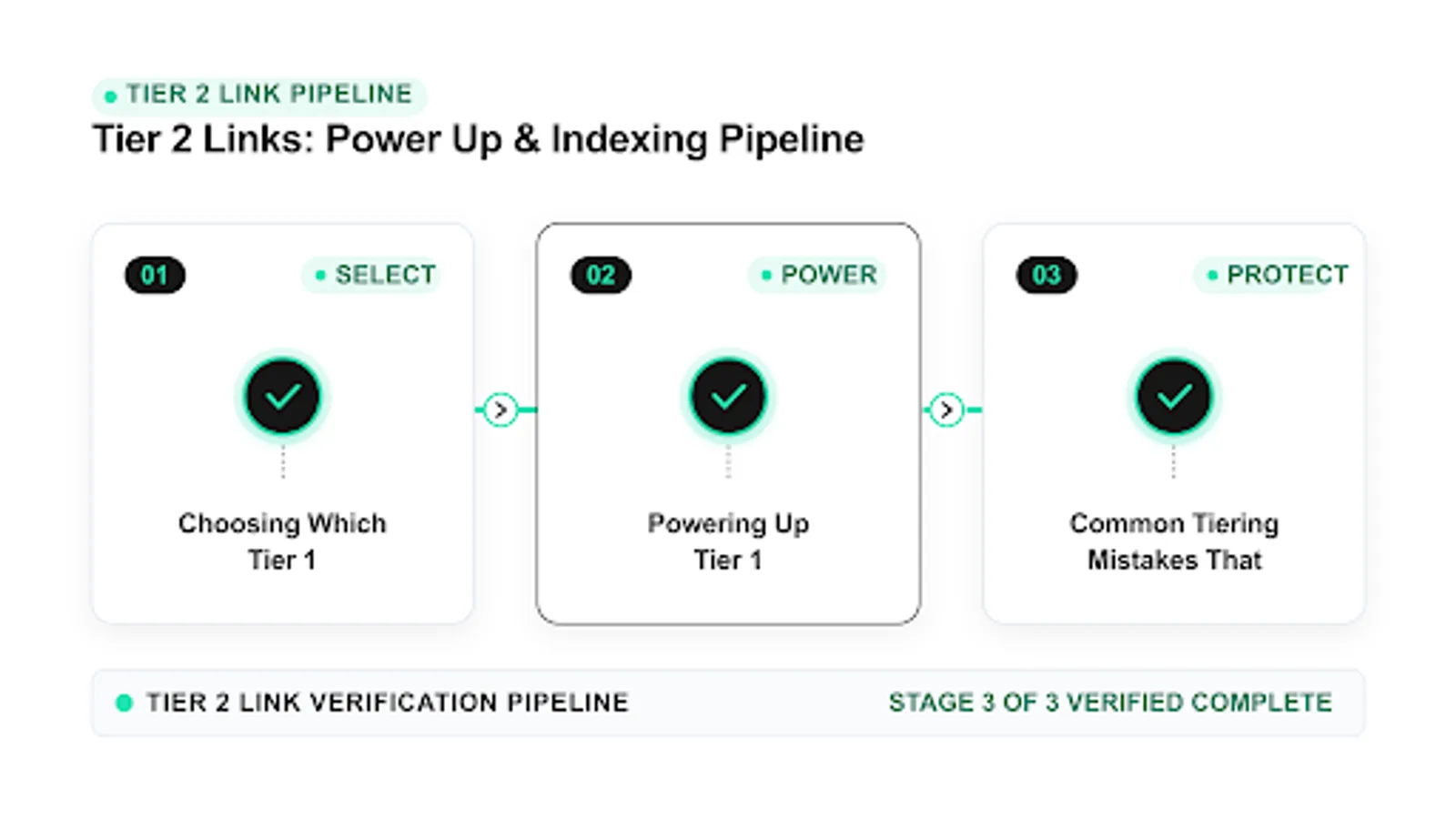 <!-- IMAGE-PROMPT workflow-02: 1600px max, DependsIt brand, deep charcoal #121212 background with mint #22E3B0 node-network line art, subject: staggered tier 2 calendar with building then patient indexing checks and pruning, flat vector, accessible, no em dash, Clash Display headings feel and General Sans labels feel -->
Common tiering mistakes that waste budget
The most expensive mistake is building tier 2 before confirming tier 1 health. Teams sometimes order hundreds of tier 2 links the same week new guest posts go live, before those posts are even indexed. When half the tier 1 pages never index, the tier 2 spend attached to them is wasted. Always confirm tier 1 indexing and stability for two to four weeks before adding support. That single delay saves more budget than any vendor discount.
The second mistake is over concentration. Pointing 80 percent of tier 2 at one favorite guest post creates a star pattern where many unrelated sources all converge on one URL in a short window. Even if each source looks okay alone, the aggregate graph is conspicuous. Spread support across five to ten tier 1 targets, vary timing, and leave some strong tier 1 pages with little or no tier 2. Natural portfolios are uneven. Some good pages earn mentions, others sit quietly. Mimic that unevenness deliberately.
The third mistake is anchor repetition across layers. Using the same commercial anchor at tier 1 and tier 2 doubles commercial density along the chain and invites filters. If your money keywords already appear at tier 1, keep tier 2 neutral and descriptive. Audit anchors per money page quarterly, including both layers. When commercial ratios creep up, pause exact anchors and add brand, URL, and generic mentions until balance returns. Anchor hygiene is free and it prevents many over optimization slowdowns.
The fourth mistake is chasing count over durability. Dashboards that celebrate 1,000 tier 2 links built obscure the fact that 800 live on pages that vanish or never index. A smaller program with 60 tier 2 links on stable indexed pages will outperform a large blast on throwaways. Measure cost per durably indexed tier 2 page at day 30, not cost per built link. Retire source types with low durability even if they are cheap to produce. Cheap links that never index are the most expensive kind because they consume management attention while adding nothing.
The fifth mistake is ignoring tier 1 decay. Guest posts get edited, hosts add more outbound links, templates change, and some blogs go dormant. A tier 1 page that was strong in January may be diluted by June. Without periodic reviews, tier 2 keeps flowing into a weakening destination. Re score top tier 1 pages quarterly for index status, outbound count, and host activity. Pause tier 2 for pages that slipped, fix what you can through outreach, and shift support to healthier placements. Tiering is maintenance, not a one time build.
The sixth mistake is adding a frantic tier 3 to rescue failing tier 2. When tier 2 does not index, some teams build hundreds of tier 3 links to force it. That adds another artificial layer with its own patterns and rarely improves durable indexing. If tier 2 sources consistently fail to index, the problem is source quality or page availability, not lack of tier 3 pressure. Replace the sources instead of stacking more layers. Two clean layers beat three noisy ones in both safety and cost.
Measuring tier impact and pruning what does not work
Measurement needs to separate activity from impact. Activity metrics include tier 2 links built, tier 2 pages crawled, and tier 2 pages indexed. Impact metrics include tier 1 recrawl frequency, tier 1 stability in the index, appearance of tier 1 in link reports, and movement in money page impressions for relevant queries. Activity without impact is a signal to change sources or destinations, not to build more of the same.
Set a simple quarterly scoreboard. For each supported tier 1 page, record tier 2 links added, tier 2 indexed rate at day 30, tier 1 last crawl date, tier 1 index status, and money page impression trend for the targeted topic cluster. Review it as a group, not link by link. You are looking for patterns: which tier 1 types respond, which tier 2 source types index, and which combinations correlate with stable gains. Small samples can still guide decisions when you track consistently across two quarters.
Review your tier 2 strategy quarterly by checking tier 2 links value through recrawl rates and impression stability. When you index tier 2 links from stable sources, keep those that hold indexing above 50 percent at day 30 and retire tactics that never clear 20 percent. In tiered seo, focus effort where evidence shows durability.
Prune with clear rules. If a tier 2 source type shows under 20 percent indexing after 30 days across two batches, retire it. If a specific tier 1 page shows no fresh crawl activity after 60 days despite clean tier 2 support, pause further support and investigate the destination. If a money page shows no impression movement after a full quarter of steady tiering while technical health is clean, reconsider whether tiering is the constraint or whether content relevance and intent match need work first. Pruning is not failure. It is how you concentrate budget where evidence says it works.
Keep reporting honest about attribution. Rankings move for many reasons: content refreshes, internal link changes, competitor shifts, and seasonality. Avoid crediting every gain to tier 2 alone. Note concurrent changes alongside tiering in your log so reviews can weigh them. When gains coincide with both a money page refresh and new tier 2, acknowledge both. That honesty builds better strategy over time because it prevents over investment in whichever tactic happened to be newest.
Finally, plan maintenance, not just campaigns. Tiered structures decay as sources vanish, hosts edit pages, and engines re evaluate quality. Schedule monthly link health checks for top tier 1 and tier 2 URLs, quarterly anchor audits, and semiannual source type reviews. Replace dead tier 2 with steadier alternatives, refresh aging tier 1 where hosts allow, and retire destinations that no longer hold index status. A small, tended tiered footprint that stays indexed and relevant will quietly support results for a year. A large, untended blast will spike in logs and then fade from reports.
FAQ
How many tier 2 links should point to one tier 1 page?
Start small with three to six tier 2 links spread across six to eight weeks for each priority tier 1 page. That range is enough to test response without creating a star pattern. Add more only if the tier 1 page is indexed, recrawled regularly, and shows stable value. Most pages never need dozens of tier 2 links to benefit.
Do tier 2 links need to be indexed to help?
Yes, in practical terms. A tier 2 link on a page that is never indexed rarely passes meaningful upward value, though it may provide a brief crawl path. Track tier 2 index rates at day 14 and day 30. Keep source types that clear reasonable rates and retire those that consistently stay unindexed.
How does tier 2 link building differ from direct outreach?
Tier 2 link building focuses on strengthening existing tier 1 pages rather than earning new direct links to your money site. Use it when tier 1 is already indexed and relevant but needs more crawl frequency. Keep placements varied, staggered, and neutral in anchor to avoid star patterns.
Can second tier backlinks help new tier 1 pages?
Second tier backlinks help most when tier 1 is already indexed and stable for two to four weeks. If tier 1 is still unindexed, fix its content and connectivity first rather than adding support. Once stable, three to six slow placements can improve recrawl without looking coordinated.
How do I use tier 2 to power up tier 1 safely?
To power up tier 1 safely, improve the tier 1 page itself first with a refresh or an internal link from its own domain, then add a few neutral tier 2 mentions over weeks. Keep commercial anchors at tier 1 only and use descriptive anchors at tier 2 so the chain stays balanced.
What makes a good tier 2 strategy for small teams?
A good tier 2 strategy for small teams supports only five to ten strong tier 1 pages per quarter, with clear stop rules and monthly index checks. Track indexed rates at day 30, prune sources under 20 percent, and reinvest time in steady community and editorial style placements that hold.
Sources
- https://developers.google.com/search/docs/crawling-indexing/overview
- https://www.indexnow.org/documentation
- https://support.google.com/webmasters/answer/744020
- https://developer.mozilla.org/en-US/docs/Web/HTTP/Status/404
- https://schema.org/Article