Do Backlinks Need to Be Indexed to Count?

If a backlink never appears in a links report, does it still help your rankings. That question drives a large share of indexer spending, and the honest answer is more careful than yes or no. A backlink can only pass full value after the linking page is crawled, rendered, indexed, and evaluated for quality and relevance. Before that point it may be discovered without being counted, which looks identical to doing nothing in most dashboards. This guide explains the mechanics in plain terms for site owners who want to know which links deserve attention and which can be left alone.
The focus keyword here is do backlinks need to be indexed, and the short version is that the linking page generally needs to reach the index before the link carries weight. Discovery alone is not enough. A crawler must fetch the page, parse the anchor, confirm the target, and store the relationship alongside quality signals. Unindexed pages therefore pass little to no ranking value in the classic sense, although they can still send referral traffic and help crawlers find other pages through normal following.
You will learn how Google finds links, what Search Console shows and what it hides, how to test whether a referring page is indexed, what to do when it is not, and a priority framework that keeps effort aligned with likely return. The tone stays practical throughout. No scare tactics, no guarantees, only checks you can run with free tools and a spreadsheet.
Key takeaways
- The linking page usually must be indexed before its backlinks pass ranking value. Discovery without index entry rarely moves results.
- Google finds links by crawling the linking page, rendering HTML, and associating anchors with targets. Each step can fail independently.
- Search Console links data lags behind the live web by days or weeks. Absence from the report does not always mean absence from processing.
- Check index state, markup, status codes, and crawl access before assuming a link is lost. Many gaps resolve with a publisher fix.
- Prioritize editorial placements on real sites for active help. Leave thin profiles and ephemeral bookmarks in a passive bucket.
- Discovery, crawling, and indexing for links
- How Google actually finds your backlinks
- Do backlinks need to be indexed to pass value
- Why Search Console lags behind the live web
- How to check if a referring page is indexed
- What to do when referring pages are not indexed
- A priority framework for link owners
 <!-- IMAGE-PROMPT cover: 1200x630, DependsIt brand, deep charcoal #121212 or clean white background, vibrant mint #22E3B0 accent glow, thin node-network line art, Clash Display style bold heading space on left, General Sans clean labels, subject: whether backlinks must be indexed to count, flat vector, high contrast, accessible, no photorealistic faces, no text smaller than 24px, no em dash in rendered text, export PNG then cwebp -q 82 to WEBP -->
Discovery, crawling, and indexing for links
Discovery, crawling, and indexing describe three gates that every backlink passes in order. Discovery means the engine knows the linking URL exists. That knowledge can come from a sitemap entry, an RSS item, an internal link from a known page, or a prior crawl frontier record. Discovery alone creates no ranking effect. It only places the URL into a queue for future fetching, and low priority URLs can wait there for a long time when host resources are constrained.
Crawling is the fetch and parse step. The engine requests the linking page, reads headers and status codes, downloads HTML, renders scripts where needed, and extracts anchors with href targets. Failures here are common and specific. A robots block stops the fetch. A 5xx error aborts the attempt. A login wall returnsusable content with no links. Client side rendering that never completes for bots leaves anchors invisible. Each failure preserves discovery while preventing any downstream counting, which is why log evidence of a fetch matters more than assumptions.
Indexing is the admission step for the linking page itself. After crawling and rendering, the engine decides whether the page merits index entry based on content substance, uniqueness, crawl access, canonical signals, and site level quality patterns. Only indexed linking pages become eligible to pass link signals in the normal ranking flow. A page that is crawled but excluded by noindex, canonicalized elsewhere, or judged thin remains outside the index, and its outbound links stay uncounted for ranking purposes even though referral clicks may still work for users.
For reporting, keep the three gates separate in your tracker. Mark each referring URL as discovered, crawled, or indexed with a date and a method of confirmation. That habit prevents the common error of resubmitting discovered URLs as if they were blocked, when they simply await their turn in a busy queue. It also clarifies outreach. A discovered page needs pathways. A crawled but excluded page needs quality or directive fixes on the publisher side. An indexed page with no visible effect needs markup and attribute review rather than more submission. Teams that review backlink crawling logs alongside a clear backlink discovered vs indexed label spend less time chasing report lag and more time fixing real blocks.
Time windows differ by gate and by page type. Discovery can happen within hours when a publisher includes new posts in sitemaps and feeds. Crawling follows publisher cadence, from same day on daily outlets to weeks on quiet archives. Indexing adds evaluation time after the fetch, plus report lag before the relationship surfaces in interfaces. When you promise internal timelines, give ranges by linking page tier instead of a single global deadline. Editorial posts move fast. Profiles and bookmarks move slowly or never. That segmentation keeps stakeholder trust intact while work continues in the background.
Sitemaps, RSS feeds, and internal linking still do most of the heavy lifting for durable discovery, and notification protocols only complement them. A clean XML sitemap gives crawlers a canonical list of your own URLs with accurate lastmod dates, while an RSS or Atom feed surfaces fresh content in chronological order for feed readers and crawlers that poll it. Internal links then distribute crawl attention from high authority hub pages toward new or updated targets, which reduces crawl depth and shortens time to first fetch. This foundation matters for backlink indexing because you rarely control the linking domain. What you do control is your own site architecture. When you publish a research hub, a press page, or a links roundup that references your new mentions, and you include those hub URLs in sitemaps and feeds, you create crawler pathways that help engines find the referring pages sooner.
Quotas, throttling, and retry logic separate reliable indexing workflows from scripts that burn through limits in an hour. Every submission endpoint enforces some form of rate control, and HTTP 429 remains the standard signal for too many requests. A sound queue therefore paces submissions, respects Retry After headers where present, and applies exponential backoff with jitter before retrying failed items. Logging matters as much as pacing. Each submission should record the target URL, the endpoint used, the timestamp, the response code, and any message body or request identifier returned by the server. With that log you can distinguish a key validation failure from a quota pause, and you can prove whether a batch was accepted or ignored. Never advise hammering endpoints. Steady pacing plus clear logs produces faster net indexing than bursts that trigger blocks.
How Google actually finds your backlinks
Google finds backlinks by crawling the web and following links, not by receiving a feed of your link building activity. The process starts from known URLs in its frontier, which includes sitemap listed pages, previously crawled hubs, and URLs found during prior fetches. From there Googlebot requests pages, parses anchors, queues newly found URLs, and repeats the cycle under host load limits. Your new backlink enters this system only when a crawler fetches the specific linking page and extracts your anchor, which explains why placement context matters as much as domain strength.
Placement determines how soon that fetch happens. A link in a new article that appears on the homepage, in a category hub, in XML sitemaps, and in RSS will be found quickly because multiple pathways point to the same fresh URL. A link on page forty of a paginated forum, with no sitemap entry and no internal links from fresh hubs, may wait a long time because few pathways lead there. Publishers with clean architecture therefore deliver faster link discovery as a side effect of good hygiene, while sprawling user generated sites impose longer waits even for legitimate mentions.
Rendering adds a second layer that many audits miss. Google processes server rendered HTML immediately during the initial fetch, while JavaScript dependent content waits for a rendering pass that consumes more resources. Links injected after interaction, links inside closed shadow roots, and links that require scrolling or login often miss the extraction window. The fix is to view the rendered source as a crawler would, confirm that your anchor appears with a stable href, and ask the publisher for server rendered placement when the current implementation hides the link from bots. That single check resolves many mysteries where a link exists for users but not for engines.
Signals around the linking page influence scheduling as well. Fresh hub pages with steady traffic attract revisits, which propagate attention toward their outbound links. Stale archives with thin content and high error rates attract fewer revisits, which delays even valid new links placed there. You cannot control publisher scheduling directly, but you can choose outreach targets with healthy crawl contexts and you can create your own hubs that point toward important mentions. Those owned hubs do not replace publisher crawling, yet they add legitimate pathways that shorten the wait when the publisher side is slow.
Measurement should follow the crawler rather than the dashboard. Server logs on properties you control show when bots fetch your hubs. Publisher sitemap timestamps show when new linking pages were declared. Render checks show whether anchors are visible to bots. Link reports show associations only after processing completes. When you align these sources in chronological order, you see the true pipeline from placement to counting, and you stop mistaking report lag for crawl failure. That clarity also helps you explain timelines to clients without resorting to vague claims about algorithm delays. For background on tool categories, see backlink indexers explained before choosing any service.
Search Console data about links always lags behind the live web, and that lag explains many false alarms about missing backlinks. The Links report shows referring pages that Google has already crawled and associated with your site, not every link that exists on the internet today. A new guest post, directory listing, or forum mention can take days or weeks to appear there, even when the linking page is perfectly crawlable. Third party link indexes have their own crawl schedules and coverage gaps, so disagreement between tools is normal rather than proof of a penalty. The right response is a calm verification sequence. Check whether the linking page is indexed. Check whether the link markup is present in rendered HTML. Check crawl access for the linking page. Then decide whether any action is needed at all.
Crawl budget shapes how quickly new referring pages get processed, especially when those pages live on large, slow, or low authority domains. Budget is not a single number in a dashboard. It reflects host load limits, crawl demand signals, and the engine side scheduling that balances freshness against server cost. A small blog with clean architecture can see new posts crawled within hours, while a large forum with millions of thin threads may wait weeks for deep pages to be revisited. You cannot control another site crawl budget directly, but you can influence discovery signals around your links. Links placed on freshly updated hub pages, category pages with steady traffic, and sitemap listed archive pages tend to be found sooner than links buried in paginated thread page 40. When you evaluate a new backlink, look at the linking page crawl context, not just domain authority.
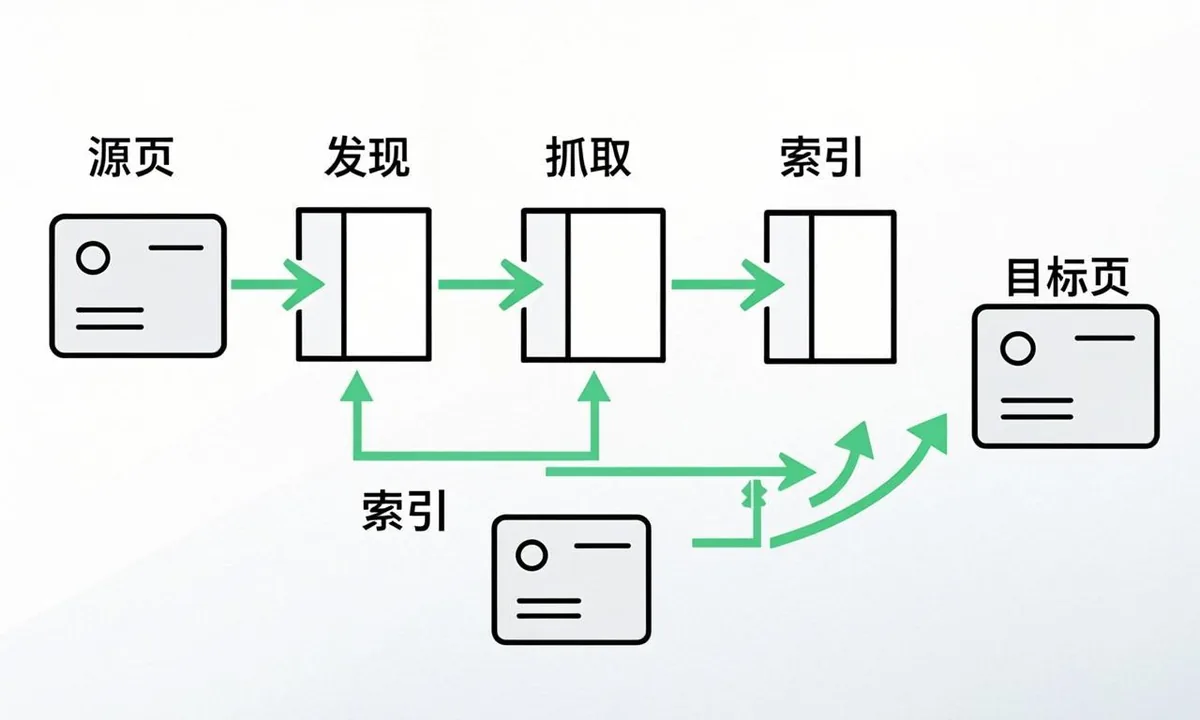 <!-- IMAGE-PROMPT diagram-01: 1600px max, DependsIt brand mint #22E3B0 on charcoal #121212 or white, node-network line art, Clash Display headings feel, General Sans clean labels, subject: Google backlink discovery pipeline diagram, flat vector, accessible, no em dash -->
Do backlinks need to be indexed to pass value
The practical rule is that backlinks from unindexed pages pass little to no ranking value, with narrow exceptions that do not justify broad spending. For a link to influence rankings through the standard flow, the linking page must be crawled, rendered, admitted to the index, and evaluated as a legitimate source. An unindexed page has failed or not yet completed that sequence, so its outbound anchors remain outside the scoring graph. When you debate unindexed backlinks value, remember that backlink value without index remains minimal, while indexed link power only builds after the container page is admitted and evaluated. Teams sometimes hope that discovery alone confers partial credit, but logs and report behavior consistently show that counting follows index entry rather than preceding it.
Exceptions exist but they are limited and often temporary. A freshly crawled page awaiting index evaluation may contribute to discovery of your own URLs when crawlers follow its outbound links, even before it appears in link reports. That discovery help can speed up fetching of your target page without passing anchor weight in the ranking sense. Referral traffic is a second benefit that needs no index entry at all. A mention on a busy community thread can send qualified visitors from day one while remaining invisible in search link graphs. Treat these as useful side effects rather than proof that unindexed links carry full ranking power.
Attribute and markup factors further separate discovery from value. A link with rel nofollow, sponsored, or ugc on an indexed page is discovered normally but annotated to limit or redirect signal flow. A followed link in server rendered HTML on an indexed, topically relevant page represents the strongest standard case. An unindexed page with followed markup still waits at the gate, because the container page has not been admitted. Before debating attributes, confirm the container state. Index first, then markup, then relevance. That order prevents wasted negotiation over rel values on pages that cannot yet pass anything.
Quality evaluation after index entry adds another filter that teams underestimate. Engines assess the linking page for substance, uniqueness, and purpose, plus site level patterns such as scaled thin content or aggressive monetization. A thin auto generated profile that somehow reaches the index may still be discounted during scoring, which produces the familiar pattern of an indexed link with no visible movement. This is why placement quality predicts outcomes better than raw link counts. One editorial citation in a substantive article routinely outweighs dozens of thin profile mentions, even when all of them eventually reach the index.
The action rule follows directly. Do not pay to force discovery for pages that cannot pass value after discovery. Audit the linking page for index eligibility, markup, and relevance first. If the page is thin, blocked, or mismatched to your topic, reallocate effort toward better placements or request improvements from the publisher. If the page is strong but simply new and poorly connected, light pathway support is rational. That triage keeps budgets focused on links where index entry will actually translate into weight, rather than spreading spend across inventory that stays weak even when counted. Protocol scope is defined in IndexNow documentation, which clarifies which engines receive pings.
Link markup details decide whether a discovered backlink can pass signals once the linking page is crawled. A standard anchor with an href to your absolute URL in server rendered HTML remains the most reliably processed format. JavaScript injected links, links inside shadow DOM, links that require login or interaction, and links with restrictive rel attributes all add processing steps that delay or reduce value transfer. Rel sponsored and rel ugc do not block discovery, but they annotate the link relationship for the engine, which affects how the signal is weighted. Rel nofollow similarly preserves discovery while instructing the engine not to pass ranking signals in the classic PageRank sense. Before you push for faster indexing of a backlink, view the rendered source of the linking page and confirm the link exists in a crawlable format with the intended attributes.
Robots directives, canonical tags, and HTTP status codes on the linking page can silently prevent a backlink from ever counting, no matter how many pings you send. If the linking page is blocked by robots.txt, served with a noindex header, canonicalized to a different URL, or returning soft 404 or 5xx errors, the engine will deprioritize or drop it during indexing. The link on that page then remains invisible for ranking purposes. This is why a pre submission audit of each high value referring URL pays for itself. Fetch the headers, read the robots rules for the path, check the rendered canonical, and confirm a 200 status with substantive content. Fixing a single noindex or canonical mismatch on the linking domain often does more than a month of repeated submissions through third party networks.
Why Search Console lags behind the live web
Search Console shows processed link associations, not a live feed of crawler fetches, and that design creates inevitable lag. After Googlebot crawls a linking page, the engine must render content, resolve canonicals, evaluate quality, update link graphs, and propagate those updates through data pipelines before the Links report reflects the change. Each stage batches work for efficiency, so new mentions routinely take days or weeks to surface even when the underlying crawl happened quickly. Expecting same day report updates for normal editorial links misunderstands the reporting architecture.
Coverage differences between tools add to the confusion. Third party link indexes operate their own crawl fleets with distinct priorities, budgets, and refresh cycles. One provider may discover a forum mention quickly while another misses it for a month, and neither fleet matches Google scheduling exactly. Disagreement between providers therefore signals different crawl frontiers rather than proof that a link is invalid. The same holds for referral analytics, which record user clicks without any indexing requirement. A link can drive traffic on day one while remaining absent from every link report for weeks, and both observations can be true at once.
Sampling and thresholds further shape what you see. Reports emphasize referring pages that meet quality and stability bars, which means transient or low value mentions may never appear even after being fetched. Pagination, filtering, and export limits obscure the long tail of minor links that contribute little individually. For client communication, explain that the visible report is a curated subset optimized for action, not a complete ledger of every anchor on the web. That framing reduces panic when a new batch of minor mentions fails to appear immediately.
Seasonality and site level events also affect refresh speed. Large migrations, prolonged outages, or sharp publishing spikes can delay processing across many URLs at once, which looks like a sudden link loss when it is actually a pipeline backlog. During such periods, resist the urge to resubmit everything daily. Confirm that your own property remains verified, that sitemaps are reachable, and that server error rates are normal, then allow the backlog to clear. Repeated bulk actions during a backlog add noise to logs without accelerating the underlying queues.
A calm verification sequence beats reactive resubmission. Note the link live date, confirm markup and status on the linking page, check publisher sitemap and feed inclusion, then set a review date one full crawl cycle out based on publisher cadence. Only when that date passes with no fetch evidence and no report movement should you escalate to pathway support or publisher outreach. This cadence respects how batch processing actually works, and it preserves clean logs that make real failures easy to spot when they occur. Crawler behavior context appears in Google search indexing guidance, useful when explaining lag to stakeholders.
A simple tracking sheet turns backlink indexing from guesswork into a repeatable operation that any content team can run. Columns should include the referring URL, the target URL on your site, the date the link went live, the linking page index status, the discovery method used, the submission date, the response code, and the date the link first appeared in Search Console or server referral logs. Review the sheet weekly rather than hourly, because index systems need time to process queues. Prioritize rows by business impact. A guest post on a real publication with traffic deserves manual verification and outreach for fixes. A low quality profile link with no traffic deserves no action beyond a single passive discovery trigger. This triage keeps effort aligned with expected return.
Spam style tactics for forcing link discovery create footprint and policy risks that outweigh any short term crawl spike. Mass pinging unrelated endpoints, building tiers of thin doorway pages whose only purpose is to redirect crawler attention, stuffing links into auto generated comments, and submitting third party URLs to endpoints scoped for your own verified property all fall into this category. Engines have years of experience discounting such signals, and site owners inherit the cleanup cost when doorway hubs get deindexed or when a vendor network is flagged. The safer path uses only URLs you control for direct submission, accurate sitemaps and feeds, genuine internal links from real hub content, and polite outreach to publishers when markup needs a fix. Those methods are slower per URL but they compound without creating liability.
How to check if a referring page is indexed
Start with the simplest checks that take under a minute per URL and require no special access. Search the exact referring URL in quotes to see whether the engine returns the page itself. Follow with a site scoped query for a unique phrase from the linking page to confirm whether the host path is represented in the index. Compare results across Google and Bing side engines separately, because coverage differs and IndexNow activity only affects the Bing family. Record the date and the outcome for each check so later reviews can distinguish new movement from stale memory.
Next, verify the technical preconditions that index entry depends on. Fetch response headers for the referring URL and confirm a 200 status with substantive HTML rather than a soft 404 or an error page masquerading as content. Read robots directives for the path, including wildcard rules that sometimes block entire sections by accident. Inspect the rendered canonical tag and confirm it points to the referring URL itself rather than to a different consolidation target. Check for meta robots or header based noindex that would explicitly exclude the page. Any failure here explains non indexation without needing further theory.
Markup review comes third and it is often decisive. View rendered source and locate your anchor, the href value, and rel attributes. Confirm that the href resolves to your intended target without broken redirect chains, that the anchor appears without login or interaction, and that JavaScript rendering completes for bots. Note whether the link carries sponsored, ugc, or nofollow annotations that affect weight even after index entry. Screenshot or save the relevant snippet with a timestamp, because publisher templates change and you will want proof of what the crawler saw on a given date.
Where you have access, use authoritative consoles instead of guessing. For your own hub pages that reference new mentions, URL inspection shows crawl, index, and canonical state directly. For publisher pages you do not control, rely on publisher sitemaps, feed inclusion, and internal link placement as proxies for crawl priority, plus server logs for your own outbound hub fetches. Avoid third party index status badges as sole evidence, since their fleets differ from engine scheduling. Corroborate any single signal with at least one independent check before you label a page indexed or missing.
Document everything in a sheet that survives staff changes. Columns for referring URL, target URL, live date, markup snapshot, status code, robots and canonical notes, index check dates, and report appearance dates turn scattered checks into an auditable history. Review weekly for high priority rows and monthly for the full list. Over time the sheet reveals which publishers index reliably, which templates hide links from bots, and where outreach actually changes outcomes. That institutional memory is more valuable than any one time bulk submission, because it guides future placement choices toward inventory that counts.
A bring your own key workflow gives small teams the transparency of direct API submission without building a full backend from scratch. In this pattern you create your own keys and service accounts in your own cloud project or webmaster account, then you paste those credentials into a lightweight tool or script that runs under your control. Quota consumption appears in your own console, logs stay in your own storage, and revoking access is a single key rotation rather than a support ticket. For backlink work this pattern fits hub page submission. You submit your own roundup, press, and resource pages through your own keys, which indirectly helps engines discover the outbound referring URLs those hubs point to. You never submit third party domains through your Google property scope, because verification and ownership rules still apply.
Google discovers backlinks in stages, and each stage has a different meaning for rankings. First comes discovery, where a crawler finds a URL or a link on a page it already visits. Next comes crawling, where the engine fetches the linking page, parses the HTML, and extracts the anchor and href attributes. Only after that comes indexing, where the linking page enters the index and its links become eligible to pass signals. Many site owners collapse these stages into one word, indexing, which creates confusion when a link is found but not yet counted. A practical workflow therefore tracks each stage separately. Discovery can be checked in server logs and crawl reports. Crawling can be confirmed with URL inspection and fetch tools. Indexing requires a check of the linking page status in the index. When you separate the stages, you stop chasing the wrong fix and you focus on the actual bottleneck.
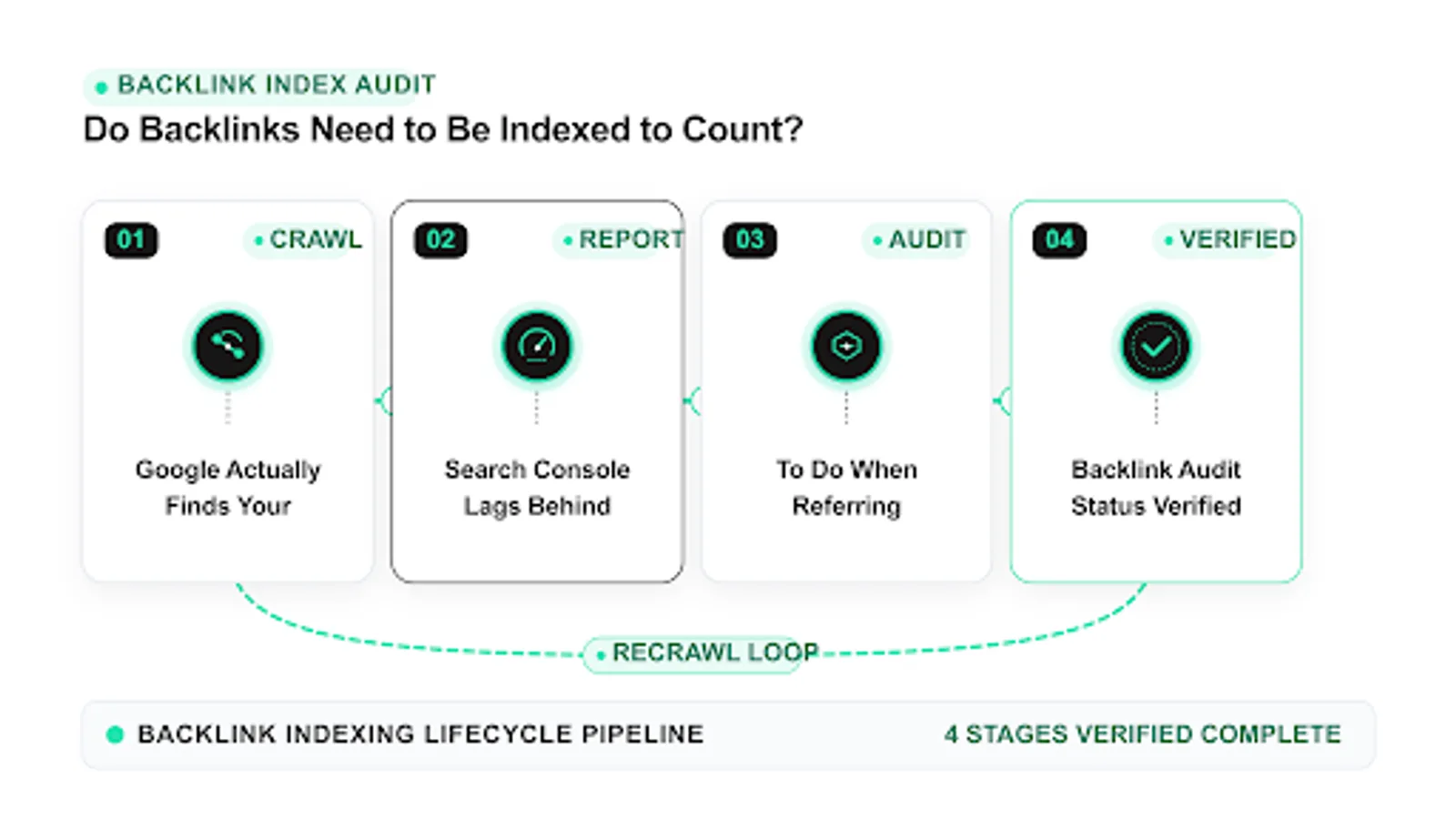 <!-- IMAGE-PROMPT workflow-02: 1600px max, DependsIt brand mint #22E3B0 on charcoal #121212, node-network line art, Clash Display style headings, General Sans labels, subject: referring page index verification workflow, flat vector, accessible, no em dash -->
What to do when referring pages are not indexed
When a valuable referring page remains outside the index after a full crawl cycle, work through fixes in order of leverage rather than trying everything at once. Start with access and directives on the linking page itself. Confirm that robots allows the path, that no noindex header or tag excludes it, that the canonical is self referencing, and that the status is a clean 200 with real content. Many publisher templates apply broad rules that accidentally exclude new sections, and a precise note to the publisher with paths and line references resolves those blocks faster than repeated pings from your side.
Next, address markup and placement quality. Ask whether the link can move into server rendered body content with a stable href and descriptive anchor, rather than remaining in a JavaScript widget, a login walled area, or an infinite scroll container that bots rarely expand. Request removal of unnecessary redirect hops between the anchor and your target, because each hop adds failure points and dilutes crawl efficiency. Where commercial relationships require disclosure, keep sponsored or ugc annotations accurate and focus negotiation on placement prominence and context rather than on mislabeling the relationship. Honest markup on an indexed page outperforms manipulated markup on an excluded page every time.
Then strengthen legitimate pathways without misrepresenting ownership. Publish a context rich hub on your own site that references the mention, include that hub in sitemaps and feeds with accurate dates, and link to the hub from relevant internal pages. Use IndexNow for the hub URL on Bing side channels where appropriate, and use normal inspection workflows for the hub on Google side channels. You are accelerating discovery of your own hub and creating followable paths outward, not submitting publisher URLs through property scoped endpoints. That distinction keeps the workflow policy aligned while still shortening waits.
Outreach deserves a clear template and a polite cadence. Write to the publisher with the live URL, a short description of the issue, the exact markup or directive you observed, and a concrete suggested fix with an example. Offer to provide a replacement paragraph or an updated URL if content moved. Space follow ups by at least a week and keep every message concise enough to forward to a developer. Track responses alongside technical rechecks, because some fixes deploy silently without a reply. When outreach stalls after two attempts on a high value page, consider whether a second placement on a healthier section of the same publication would outperform continued chasing of a problematic template.
Know when to stop and reallocate. Ephemeral bookmarks, auto generated profiles with no traffic, and login walled threads rarely justify more than passive support, because even perfect index entry leaves minimal weight. Set a stop rule in advance, for example two full publisher cycles with clean markup and no movement, then move the row to a monitoring tab with quarterly checks. Redirect saved hours toward outreach for new editorial placements on sites with proven index behavior. That discipline compounds over quarters into a portfolio of links that actually count, rather than a long list of forced fetches with no durable effect. For the discovery pipeline behind these checks, review how Google discovers backlinks alongside your logs.
IndexNow is an open protocol co developed by Microsoft Bing and Yandex that lets site owners notify participating engines about new, updated, or deleted URLs. The current participant list is maintained on the official documentation site and includes Bing, Yandex, Naver, Seznam, and other engines that ingest the shared feed. Google does not support IndexNow, so an IndexNow ping never submits a URL directly to Google. That fact shapes every serious backlink workflow. You use IndexNow to cover Bing side discovery for linking pages and for your own hub pages, while you use separate Google side methods for Googlebot discovery. Setup uses a plain text key file hosted at the site root for ownership verification, plus simple HTTP POST requests with JSON bodies that list changed URLs.
The Google Indexing API runs at a dedicated endpoint for URL notifications and it supports two notification types, URL_UPDATED and URL_DELETED. Official documentation scopes the API to JobPosting pages and BroadcastEvent pages for livestreams, which are short lived content types where fast discovery has clear user value. The API is not documented for normal blog posts, product pages, or third party backlink URLs that you do not control. Many SEO teams still test off label use, and results vary by site, quota, and content type. Honest guidance therefore states the documented scope first, then explains the observed behavior, then lists the risks. Those risks include wasted quota, inconsistent processing, and no guarantee that a notification leads to a crawl or to index entry. For backlinks, the API only makes sense for URLs you own, such as hub pages that list or link toward your new referring pages.
A priority framework for link owners
A priority framework turns a growing backlink list into a weekly routine that fits inside an hour. Start by importing new referring pages from link monitors, Search Console, and referral logs, then deduplicate by linking page URL so one page with three anchors counts once. Score each page on four factors with simple high medium low grades. Traffic potential reflects whether the page serves real readers. Topical fit reflects whether the mention context matches your target intent. Markup quality reflects server rendered placement with a clean href. Index likelihood reflects publisher cadence, sitemap inclusion, and current status checks. Combine the grades into tiers rather than precise scores to keep the process fast.
Tier one holds editorial mentions on active publications with clean markup and clear relevance. These rows get the full workflow. Ten minute audit, markup snapshot, publisher outreach when needed, inclusion in your mentions hub, sitemap and feed hygiene for that hub, and dated log entries for every action. Tier two holds partner pages, resource lists, and directories with real curation but slower cadence. These rows get audit plus hub inclusion without custom outreach unless the link is especially valuable. Tier three holds profiles, bookmarks, and auto generated mentions with minimal content. These rows get passive treatment only, meaning they may be referenced by a general hub but never trigger manual submission or outreach.
Cadence matters as much as tiering. Review tier one weekly during active campaigns and monthly otherwise. Review tier two monthly. Review tier three quarterly or not at all beyond automated collection. For each review, advance rows only when evidence changes, such as a new fetch in logs, a markup fix by the publisher, or appearance in a link report. Avoid reprocessing the same unchanged rows every day, because that creates log noise and consumes attention that new placements need. A steady rhythm with clear exit criteria outperforms bursts of resubmission followed by neglect.
Reporting should show pipeline movement rather than raw counts. Track median days from link live date to first observed crawl signal, to index confirmation, and to report appearance, segmented by tier and by engine family. Note separately which actions preceded movement, such as publisher fixes versus hub updates, so the team learns what actually correlates with progress. Over two quarters this report answers the core business question behind indexing work. It shows which publishers and formats deliver countable links, what cycle times to promise, and whether any paid acceleration adds lift beyond the owned baseline.
Finally, connect indexing triage to future link building choices. When data shows that guest posts on publications with clean sitemaps and server rendered templates count within two weeks, prioritize those outlets for the next quarter. When data shows that certain forum profiles never progress past discovery, stop pursuing them regardless of vanity metrics. Share the findings with writers and outreach staff as placement guidelines, not just as SEO trivia. That feedback loop gradually shifts effort toward inventory that counts, which reduces the need for indexing interventions in the first place and makes each remaining intervention more likely to succeed.
Sitemaps, RSS feeds, and internal linking still do most of the heavy lifting for durable discovery, and notification protocols only complement them. A clean XML sitemap gives crawlers a canonical list of your own URLs with accurate lastmod dates, while an RSS or Atom feed surfaces fresh content in chronological order for feed readers and crawlers that poll it. Internal links then distribute crawl attention from high authority hub pages toward new or updated targets, which reduces crawl depth and shortens time to first fetch. This foundation matters for backlink indexing because you rarely control the linking domain. What you do control is your own site architecture. When you publish a research hub, a press page, or a links roundup that references your new mentions, and you include those hub URLs in sitemaps and feeds, you create crawler pathways that help engines find the referring pages sooner.
Quotas, throttling, and retry logic separate reliable indexing workflows from scripts that burn through limits in an hour. Every submission endpoint enforces some form of rate control, and HTTP 429 remains the standard signal for too many requests. A sound queue therefore paces submissions, respects Retry After headers where present, and applies exponential backoff with jitter before retrying failed items. Logging matters as much as pacing. Each submission should record the target URL, the endpoint used, the timestamp, the response code, and any message body or request identifier returned by the server. With that log you can distinguish a key validation failure from a quota pause, and you can prove whether a batch was accepted or ignored. Never advise hammering endpoints. Steady pacing plus clear logs produces faster net indexing than bursts that trigger blocks.
FAQ
Do backlinks need to be indexed to pass ranking value?
In the standard flow, yes. The linking page should be crawled, rendered, and admitted to the index before its outbound links carry ranking weight. Discovery without index entry may help crawlers find URLs but it rarely moves rankings on its own. This distinction explains backlink discovered vs indexed reporting gaps and why link credit google systems only assign weight after index entry. Confirm index state of the referring page before debating other factors, because no markup tweak compensates for a container page that remains outside the index.
Can an unindexed link still help in any way?
It can send referral traffic from day one and it can aid discovery when crawlers follow its outbound targets, even before any ranking signal transfers. When teams ask do links count without index, the honest answer is that discovery help and visits do not equal full equity. Those side benefits matter for launches and community mentions. Treat traffic and discovery as useful extras while you work toward index entry, and judge unindexed link worth by referral value rather than ranking impact.
How long should I wait before acting on a missing backlink?
Allow at least one full crawl cycle for the linking domain, which ranges from days on daily publications to weeks on quiet archives and forums. During that window verify markup, status, and sitemap inclusion once, then monitor. Escalate to pathway support or outreach only after the window passes with no fetch evidence and no report movement. Premature daily resubmission adds noise without changing scheduling.
Why does Search Console not show a link I can see in a browser?
The Links report shows processed associations after crawling, rendering, quality evaluation, and pipeline refresh, not live fetches. New mentions need time to move through those stages, and low value or transient mentions may never meet display thresholds. Confirm the link in rendered HTML, check the linking page index state, then allow time for refresh before assuming a problem exists.
What is the most common reason a good link stays unindexed?
Access or template issues on the linking page, such as robots blocks, noindex directives, canonical mismatches, thin content, or JavaScript only placement that bots never render. A quick look at google finds backlinks data will not explain the gap alone, so pair it with a backlink crawling check of headers, directives and rendered markup. These barriers prevent index entry regardless of submission volume. A ten minute audit of headers, directives, canonicals, and rendered markup identifies most cases, and a precise publisher request often resolves them faster than any service.
When should I stop chasing a specific backlink?
Stop active work when the linking page lacks traffic potential, topical fit, or substantive content, or when two full publisher cycles pass with clean markup and still no movement. Move such rows to quarterly monitoring and reallocate hours toward editorial placements with proven index behavior. A portfolio built from countable placements outperforms a long list of forced fetches on inventory that stays weak.
Sources
- https://www.indexnow.org/documentation
- https://developers.google.com/search/docs/crawling-indexing/overview-google-crawlers
- https://support.google.com/webmasters/answer/7440203
- https://www.bing.com/webmasters/help
- https://developer.mozilla.org/en-US/docs/Web/HTTP/Status/429