How to Index Backlinks Fast: 7 Methods That Work

New backlinks often sit in limbo for weeks. The mention is live, referral clicks may arrive, yet link reports show nothing and rankings do not move. That gap usually reflects discovery and processing delays rather than a penalty, and a structured routine shortens it without resorting to spam networks. This guide gives you seven methods that work for the links that actually deserve help, ordered from most controllable to most situational. It is written for owners and small SEO teams who manage outreach, publish content, and need a repeatable workflow.
The focus keyword is how to index backlinks, and the approach stays ownership aware throughout. You submit and improve only URLs you control, such as hubs, press pages, and feeds on your own domain. For third party referring pages you create legitimate pathways and request publisher fixes, rather than pretending to submit someone else property through your own accounts. That distinction keeps quota clean, logs honest, and results durable across algorithm updates.
You will learn direct hub submission for Google side fetching, IndexNow for Bing side coverage, sitemap and RSS hygiene, internal linking from live hubs, secondary crawl triggers that still work, publisher outreach for markup fixes, and a monitoring plus retry system that prevents duplicate work. Each method includes when to use it, what to log, and when to stop. Combined, they form a weekly routine that fits inside a few hours and compounds as your hub library grows.
Key takeaways
- Index only what you own directly. Use hubs, feeds, and sitemaps on your domain to create followable paths toward new mentions.
- Use IndexNow for Bing side hub acceleration and Google side hub hygiene separately. The two engine families need separate tracking.
- Publisher markup fixes outperform repeated submission. A server rendered anchor with a clean href beats any ping campaign.
- Seven methods cover submission, feeds, internal links, secondary triggers, outreach, and monitoring. Apply them by tier, not to every link.
- Log every action with timestamps and response codes. Retry only on clear delivery failures, not on report lag.
- Method 1: How to index backlinks with owned hubs
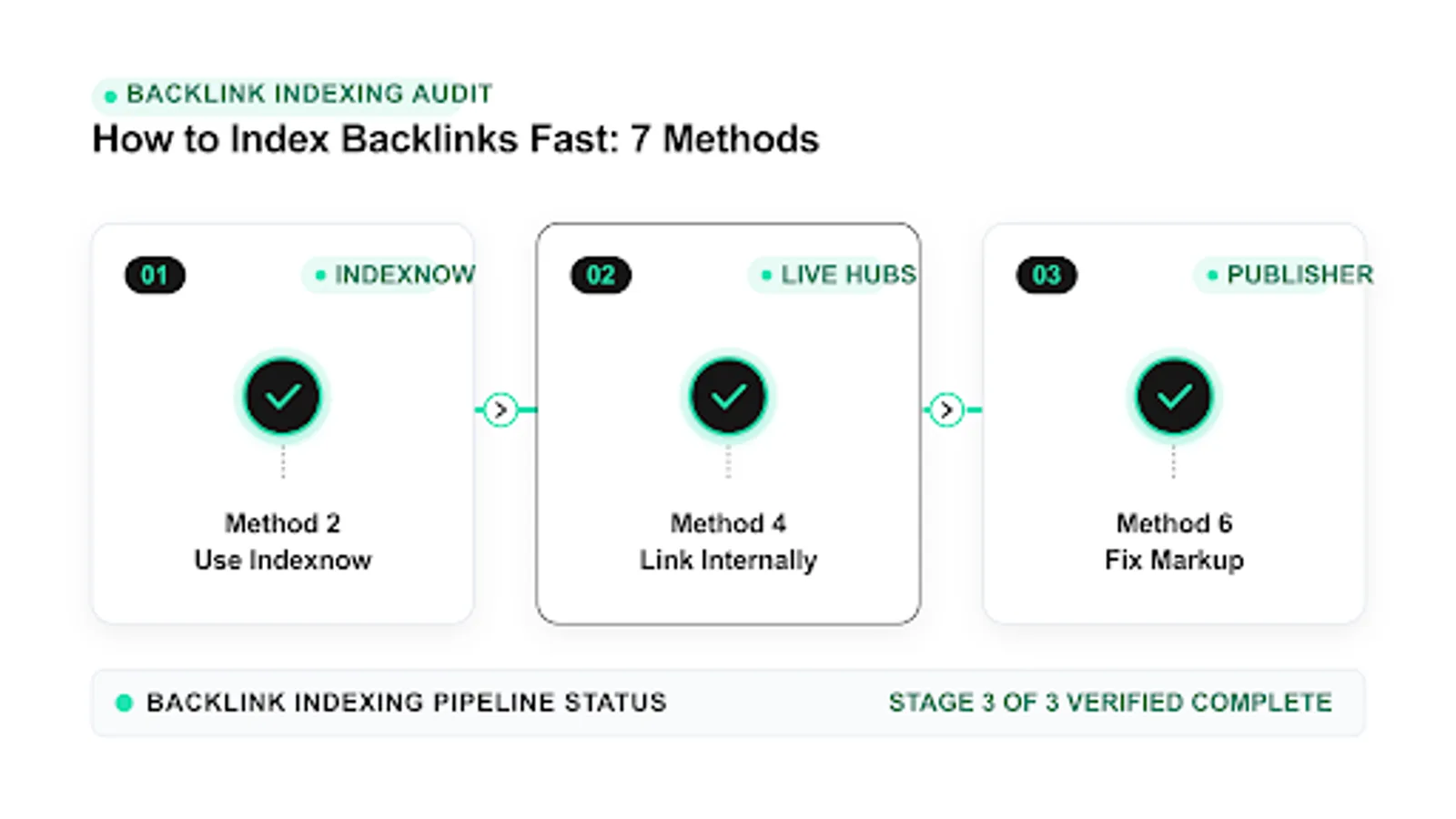
- Method 2: Use IndexNow for Bing side hub coverage
- Method 3: Keep sitemaps and RSS accurate
- Method 4: Link internally from live hub pages
- Method 5: Add honest secondary crawl triggers
- Method 6: Fix markup with the publisher
- Method 7: Monitor, retry, and stop on schedule
 <!-- IMAGE-PROMPT cover: 1200x630, DependsIt brand, deep charcoal #121212 or clean white background, vibrant mint #22E3B0 accent glow, thin node-network line art, Clash Display style bold heading space on left, General Sans clean labels, subject: seven methods to index backlinks fast, flat vector, high contrast, accessible, no photorealistic faces, no text smaller than 24px, no em dash in rendered text, export PNG then cwebp -q 82 to WEBP -->
Method 1: How to index backlinks with owned hubs
Direct submission works best when it targets URLs you own and control, especially hubs that reference new backlinks with context. Build a mentions or press hub on your domain that summarizes recent coverage, links outward to each referring page, and adds enough editorial context to serve readers on its own. After publishing or meaningfully updating that hub, submit the hub URL through the normal inspection workflow for your verified property and confirm acceptance in logs. You are asking for a faster fetch of your own page, which then creates a legitimate crawl path toward the referring pages it cites.
Queue design keeps this method sustainable during launches with many mentions at once. Store each hub URL with its change reason, submission timestamp, response message, and next review date. Prioritize campaign hubs over routine archive refreshes so quota and attention flow to money content first. Space routine submissions to avoid hammering, and pause low priority jobs when a launch needs every slot. For most small sites a weekly hub update during active outreach and a monthly update otherwise provides steady coverage without training crawlers to ignore the hub through over submission of trivial changes.
Verification and ownership must be current before you rely on submission. Confirm that the property for the hub host remains verified in Search Console, that DNS and domain moves have not broken delegation, and that service account access uses the correct scope with securely stored keys where APIs are involved. Common failures include permission denied when delegation lapsed, token errors when keys expired, and host mismatches after a migration changed canonical hosts. A short preflight check of verification, headers, and canonicals before each batch prevents confusing failures that look like engine neglect.
Measure hub fetching rather than chasing per link guarantees. Review server logs for bot fetches of the hub URL within days of submission, check inspection state for crawl and index confirmation, and note when outbound referring pages show first crawl signals in available data. Keep Google side and Bing side observations in separate columns, because submission channels differ by engine family. Over a month this view shows whether hub submission shortens time to first hub fetch compared with polling alone, which is the correct success metric for method one. Link counting follows later through normal following and evaluation, not instantly at submission time.
Stop rules prevent overuse. If a hub is already crawled frequently through feeds and internal links, additional manual submission adds little and clutters history. If a hub is thin and exists only for bots, submission may produce a fetch without durable following, which signals a content problem rather than a submission problem. Invest the saved time in hub quality, with real summaries, accurate dates, and useful grouping by topic or campaign. Many teams ask for the fastest way to index backlinks during launches, and the durable answer is to get links indexed quickly through stronger hubs rather than repeated manual pings. Strong hubs earn revisits on their own merit, which makes each future submission more effective while reducing how often you need to submit at all. For category context, start with backlink indexers explained before selecting tools.
Search Console data about links always lags behind the live web, and that lag explains many false alarms about missing backlinks. The Links report shows referring pages that Google has already crawled and associated with your site, not every link that exists on the internet today. A new guest post, directory listing, or forum mention can take days or weeks to appear there, even when the linking page is perfectly crawlable. Third party link indexes have their own crawl schedules and coverage gaps, so disagreement between tools is normal rather than proof of a penalty. The right response is a calm verification sequence. Check whether the linking page is indexed. Check whether the link markup is present in rendered HTML. Check crawl access for the linking page. Then decide whether any action is needed at all.
Crawl budget shapes how quickly new referring pages get processed, especially when those pages live on large, slow, or low authority domains. Budget is not a single number in a dashboard. It reflects host load limits, crawl demand signals, and the engine side scheduling that balances freshness against server cost. A small blog with clean architecture can see new posts crawled within hours, while a large forum with millions of thin threads may wait weeks for deep pages to be revisited. You cannot control another site crawl budget directly, but you can influence discovery signals around your links. Links placed on freshly updated hub pages, category pages with steady traffic, and sitemap listed archive pages tend to be found sooner than links buried in paginated thread page 40. When you evaluate a new backlink, look at the linking page crawl context, not just domain authority.
Method 2: Use IndexNow for Bing side hub coverage
IndexNow gives you a lightweight notification channel for Bing side engines, and backlink workflows use it to accelerate their own hubs rather than publisher URLs. After you update your mentions hub, send a POST with the host, key, key location, and the list of changed hub URLs on that host. Participating engines can then prioritize those hubs for fetching, and crawlers following outbound links may discover fresh referring pages sooner than polling schedules would. The effect remains indirect, because the referring page still needs its own fetch and evaluation, but the trigger is fully under your control and fully loggable.
Key hosting must be permanent and precise. Generate a random key, save it as a text file at the site root with the exact expected filename, and ensure it returns over HTTP with readable plain text. Keep the file deployed across all deploys and environment promotions, because a missing file turns later submissions into validation failures that mimic engine outages. Confirm that robots rules allow the key path and that edge caching does not serve stale content for that file. A one minute check of the key URL before each batch saves hours of debugging after a failed campaign push.
Batch discipline protects the trust your domain builds with the channel. Include only hub URLs on the matching host that changed in a meaningful way, such as a new campaign section or several new outbound references with context. Avoid resending thousands of unchanged URLs in every request, and avoid submitting third party publisher URLs under your own key, which fails host validation by design. A practical rhythm is one batch per hub update, with the hub URL plus any paginated hub pages that actually changed. That restraint keeps signals sharp for launch weeks when many mentions arrive together.
Logging for IndexNow should mirror your Google side logs with engine specific fields. Record the batch timestamp, the hub URLs included, the endpoint used, the response code and message, and the key location verified at send time. Common responses include accepted for well formed batches, validation errors for host or key mismatches, and throttling signals when pacing is too aggressive. Retry validation errors only after fixing the underlying file or host issue. Retry throttling with backoff and reduced batch sizes rather than immediate full resends. Clean receipts make weekly reviews fast and they prove whether a hub was announced or merely assumed to be found.
Judge this method on Bing side movement alone. Track hub fetch evidence in server logs filtered by Bingbot, Bing Webmaster feedback for submitted URLs, and Bing index checks for hub pages over the following days. Do not judge IndexNow by Google report movement, because Google does not ingest these pings. When teams keep separate columns per engine family, IndexNow often shows clear hub fetch lift within its scope, which justifies keeping it as a standing step after every hub update. That scoped win compounds across quarters into reliably faster Bing side discovery for all owned content, backlink hubs included. Protocol details are defined in IndexNow documentation, the authoritative reference for keys and batches.
Link markup details decide whether a discovered backlink can pass signals once the linking page is crawled. A standard anchor with an href to your absolute URL in server rendered HTML remains the most reliably processed format. JavaScript injected links, links inside shadow DOM, links that require login or interaction, and links with restrictive rel attributes all add processing steps that delay or reduce value transfer. Rel sponsored and rel ugc do not block discovery, but they annotate the link relationship for the engine, which affects how the signal is weighted. Rel nofollow similarly preserves discovery while instructing the engine not to pass ranking signals in the classic PageRank sense. Before you push for faster indexing of a backlink, view the rendered source of the linking page and confirm the link exists in a crawlable format with the intended attributes.
Robots directives, canonical tags, and HTTP status codes on the linking page can silently prevent a backlink from ever counting, no matter how many pings you send. If the linking page is blocked by robots.txt, served with a noindex header, canonicalized to a different URL, or returning soft 404 or 5xx errors, the engine will deprioritize or drop it during indexing. The link on that page then remains invisible for ranking purposes. This is why a pre submission audit of each high value referring URL pays for itself. Fetch the headers, read the robots rules for the path, check the rendered canonical, and confirm a 200 status with substantive content. Fixing a single noindex or canonical mismatch on the linking domain often does more than a month of repeated submissions through third party networks.
 <!-- IMAGE-PROMPT diagram-01: 1600px max, DependsIt brand mint #22E3B0 on charcoal #121212 or white, node-network line art, Clash Display headings feel, General Sans clean labels, subject: seven backlink indexing methods diagram diagram, flat vector, accessible, no em dash -->
Method 3: Keep sitemaps and RSS accurate
Accurate sitemaps and feeds remain the most durable discovery foundation, because they work for every crawler without per URL manual effort. Maintain an XML sitemap that lists only indexable URLs you own, each returning 200 with substantive content and a self referencing canonical. Set lastmod dates from real content change events rather than deploy timestamps, so engines learn that your dates predict genuine updates. Split large sites into logical sitemap sections by content type, with a sitemap index that stays under documented URL and size limits. Include your mentions hubs in the appropriate section the moment they publish.
RSS or Atom feeds complement sitemaps by surfacing freshness in chronological order. Many crawlers and downstream tools poll feeds aggressively for new items, which makes feed inclusion a fast path for hub discovery after each update. Ensure that hub updates appear as feed entries with stable links, accurate publish dates, and full or meaningful summaries rather than empty stubs. Keep feed caching short enough that new items propagate quickly, but long enough to avoid origin overload during traffic spikes. Validate feed syntax after template changes, because a single malformed tag can stall parsing for all items until fixed.
Hygiene checks prevent silent rot that undermines all other methods. Weekly, fetch your sitemap index and a sample of child sitemaps to confirm 200 responses, correct content types, and no 404 entries for removed hubs. Remove or redirect deleted hub URLs promptly rather than leaving them listed indefinitely. Monthly, compare sitemap listed URLs against actual indexable inventory from your CMS to catch template exclusions where new hubs publish without being added to any sitemap. Quarterly, review lastmod accuracy by sampling updated pages and confirming that meaningful edits moved the date while trivial header tweaks did not. These checks take minutes with simple scripts and they protect every downstream acceleration attempt.
For backlink support specifically, treat hub sitemap inclusion as non negotiable. A hub that is omitted from sitemaps and feeds depends entirely on internal link crawling, which may be slow if the hub sits deep in navigation. A hub that appears in both sitemaps and feeds gets multiple independent chances for timely fetching, which shortens the path toward outbound referring pages. When you audit why a campaign was slow, check hub sitemap presence before blaming endpoints. In many postmortems the hub simply never entered the canonical URL list that crawlers consult first.
Common mistakes are easy to avoid once named. Listing non indexable URLs with noindex or canonical elsewhere teaches crawlers to distrust the file. Faking lastmod to now on every deploy has the same effect at larger scale. Stuffing sitemaps with paginated filter combinations dilutes attention away from hubs that matter. Among practical backlink indexing tips, protecting backlink index speed means keeping sitemaps honest and feeds valid so each hub update earns trust. Splitting feeds by accident during a CMS migration hides new hubs from pollers without any visible error on the site. A short checklist after every CMS or hosting change, sitemaps reachable, counts stable, lastmod honest, feeds valid, hub included, keeps the foundation solid while you layer faster methods on top. If budget is tight, compare these steps with free ways to index backlinks to stay on free channels.
A simple tracking sheet turns backlink indexing from guesswork into a repeatable operation that any content team can run. Columns should include the referring URL, the target URL on your site, the date the link went live, the linking page index status, the discovery method used, the submission date, the response code, and the date the link first appeared in Search Console or server referral logs. Review the sheet weekly rather than hourly, because index systems need time to process queues. Prioritize rows by business impact. A guest post on a real publication with traffic deserves manual verification and outreach for fixes. A low quality profile link with no traffic deserves no action beyond a single passive discovery trigger. This triage keeps effort aligned with expected return.
Spam style tactics for forcing link discovery create footprint and policy risks that outweigh any short term crawl spike. Mass pinging unrelated endpoints, building tiers of thin doorway pages whose only purpose is to redirect crawler attention, stuffing links into auto generated comments, and submitting third party URLs to endpoints scoped for your own verified property all fall into this category. Engines have years of experience discounting such signals, and site owners inherit the cleanup cost when doorway hubs get deindexed or when a vendor network is flagged. The safer path uses only URLs you control for direct submission, accurate sitemaps and feeds, genuine internal links from real hub content, and polite outreach to publishers when markup needs a fix. Those methods are slower per URL but they compound without creating liability.
Method 4: Link internally from live hub pages
Internal linking controls how crawl attention flows across your own site, and it directly affects how quickly hubs that cite backlinks get revisited. Pages buried five clicks deep with no inbound links from fresh content wait longer for every fetch, while pages linked from the homepage, primary resource indexes, and recent posts ride existing crawl frequency. The fix is architectural rather than tactical. Place your mentions hub within two clicks of a high traffic section, link to it contextually from related articles when new coverage arrives, and keep those contextual links stable instead of rotating them away after a week.
Context quality matters as much as link count. A single paragraph in a relevant article that explains why new coverage matters and links to the hub with descriptive anchor text outperforms a dozen footer links with generic labels. Readers follow the former, and crawlers treat sustained contextual links as stronger freshness signals than template boilerplate. When you add hub links, update the surrounding paragraph to reflect the campaign so the linking page itself qualifies as meaningfully changed. That pairing gives you two fresh URLs for the price of one edit, the article and the hub, both of which can appear in sitemaps and feeds with honest dates.
Orphan prevention deserves a monthly scan. Export all hub and campaign URLs, crawl inbound link counts from your own site graph, and flag any hub with zero or one internal referrer. Either link those orphans from a relevant parent or consolidate them into a stronger parent hub rather than leaving them isolated. Pay special attention after redesigns, where navigation pruning often orphans resource sections without anyone noticing. A hub that loses its parents silently drops in crawl priority, and backlink support fades with it even though the hub content never changed.
Anchor and hub structure should stay descriptive and stable. Use anchors that name the campaign or topic rather than generic phrases, and keep hub URLs persistent across quarters so external references and internal links accumulate rather than resetting. Avoid chaining hubs through multiple redirects after URL scheme changes. Each redirect hop costs crawl efficiency and risks signal loss when chains grow or break. Where a URL must change, implement a single direct redirect, update internal links to the final destination, and refresh sitemap entries immediately so crawlers learn the new canonical without detour.
Measure internal impact through crawl frequency and depth rather than vanity link counts. Compare server log fetch intervals for hubs before and after adding contextual parents, track clicks from parent to hub in analytics as a proxy for user value, and confirm that hub lastmod updates propagate to sitemap fetch behavior. Over time you will see which parents actually move the needle. Those parents become your standard launch checklist for every future campaign, which turns internal linking from ad hoc edits into a repeatable accelerator for all backlink related hubs.
A bring your own key workflow gives small teams the transparency of direct API submission without building a full backend from scratch. In this pattern you create your own keys and service accounts in your own cloud project or webmaster account, then you paste those credentials into a lightweight tool or script that runs under your control. Quota consumption appears in your own console, logs stay in your own storage, and revoking access is a single key rotation rather than a support ticket. For backlink work this pattern fits hub page submission. You submit your own roundup, press, and resource pages through your own keys, which indirectly helps engines discover the outbound referring URLs those hubs point to. You never submit third party domains through your Google property scope, because verification and ownership rules still apply.
Google discovers backlinks in stages, and each stage has a different meaning for rankings. First comes discovery, where a crawler finds a URL or a link on a page it already visits. Next comes crawling, where the engine fetches the linking page, parses the HTML, and extracts the anchor and href attributes. Only after that comes indexing, where the linking page enters the index and its links become eligible to pass signals. Many site owners collapse these stages into one word, indexing, which creates confusion when a link is found but not yet counted. A practical workflow therefore tracks each stage separately. Discovery can be checked in server logs and crawl reports. Crawling can be confirmed with URL inspection and fetch tools. Indexing requires a check of the linking page status in the index. When you separate the stages, you stop chasing the wrong fix and you focus on the actual bottleneck.
Method 5: Add honest secondary crawl triggers
Secondary crawl triggers are legitimate pages and signals that attract crawlers toward your hubs without misrepresentation. Examples include a short campaign diary post that narrates outreach progress and links to the hub, a data supplement with charts that journalists cite, and a social profile post that links to the hub rather than directly to third party URLs. Each trigger serves readers first and crawlers second, which is the test that separates honest pathways from doorway spam. If you would keep the page even with no SEO benefit, it qualifies. If it exists only to be fetched, it will fade and may harm trust.
Content supplements work especially well for research driven link building. When you publish original data, add a methods note, a CSV download, and a chart pack on your own domain alongside the main study. Those assets attract citations, they give you more owned URLs to include in sitemaps, and they create natural internal links toward your mentions hub as coverage arrives. Social posts and community updates then point to those owned assets rather than scattering attention across third party threads. The result is a small content cluster where every new mention strengthens the hub through additional context, and every hub update gives secondary pages a reason to link inward.
Syndication and partnerships need careful canonical handling to help rather than dilute discovery. When a partner republishes your campaign summary, agree on canonical direction toward your original hub or ensure the syndicated copy links back clearly to your canonical with context. Without that clarity, engines may consolidate signals onto the copy rather than your hub, which weakens the pathway you are trying to build. The same care applies to press release mirrors. Use them for announcement reach, but keep the durable hub on your domain as the canonical record that accumulates links and updates over time.
Avoid triggers that create footprint risk. Do not mass generate thin pages that differ only by city or keyword and all point to the same hub. Do not buy bulk social signals that link directly to third party referring pages through redirect chains you do not control. Do not place links in auto generated comments or forum signatures at scale to force fetches. Those patterns produce short spikes in fetch charts followed by discounting, and cleanup costs fall on your domain when doorway pages get excluded. Honest triggers grow more slowly per week but they compound without liability, which wins over any quarter longer than a single campaign.
Track each trigger as its own row linked to the parent hub. Note the trigger URL, its publish date, its sitemap and feed inclusion, its internal parents, and its first observed bot fetch. Honest supplements help make google crawl links toward new coverage and help index new backlinks without resorting to doorway pages. After a month, compare hubs with and without secondary triggers on time to first hub fetch and on downstream referring page movement. Most teams find that one or two genuine supplements per campaign outperform a dozen thin triggers, which simplifies planning. Standardize the winners into templates, such as a campaign diary plus a data supplement, and reuse them for every major outreach cycle. Crawler background appears in Google search indexing guidance, useful when explaining timing to stakeholders.
IndexNow is an open protocol co developed by Microsoft Bing and Yandex that lets site owners notify participating engines about new, updated, or deleted URLs. The current participant list is maintained on the official documentation site and includes Bing, Yandex, Naver, Seznam, and other engines that ingest the shared feed. Google does not support IndexNow, so an IndexNow ping never submits a URL directly to Google. That fact shapes every serious backlink workflow. You use IndexNow to cover Bing side discovery for linking pages and for your own hub pages, while you use separate Google side methods for Googlebot discovery. Setup uses a plain text key file hosted at the site root for ownership verification, plus simple HTTP POST requests with JSON bodies that list changed URLs.
The Google Indexing API runs at a dedicated endpoint for URL notifications and it supports two notification types, URL_UPDATED and URL_DELETED. Official documentation scopes the API to JobPosting pages and BroadcastEvent pages for livestreams, which are short lived content types where fast discovery has clear user value. The API is not documented for normal blog posts, product pages, or third party backlink URLs that you do not control. Many SEO teams still test off label use, and results vary by site, quota, and content type. Honest guidance therefore states the documented scope first, then explains the observed behavior, then lists the risks. Those risks include wasted quota, inconsistent processing, and no guarantee that a notification leads to a crawl or to index entry. For backlinks, the API only makes sense for URLs you own, such as hub pages that list or link toward your new referring pages.
 <!-- IMAGE-PROMPT workflow-02: 1600px max, DependsIt brand mint #22E3B0 on charcoal #121212, node-network line art, Clash Display style headings, General Sans labels, subject: backlink indexing monitoring workflow, flat vector, accessible, no em dash -->
Method 6: Fix markup with the publisher
Publisher side markup fixes deliver more durable lift than any submission trick, because they remove the barrier that prevents counting even after discovery. The most common issues are links rendered only after interaction, links inside widgets that bots never expand, href values that pass through broken redirect chains, and rel attributes that limit signal flow beyond what the relationship requires. A precise audit of rendered HTML identifies which of these applies to each high value mention, so outreach can request a specific change rather than a vague favor.
Build the audit into a ten minute routine per priority link. Confirm the status code and content substance of the linking page, locate your anchor in rendered source, record the href and rel values, and test the href path for redirect hops and final destination accuracy. Screenshot the snippet with a timestamp and save the headers alongside it. Note whether the page appears in the publisher sitemap or feed and how many clicks it sits from a fresh hub on that domain. That packet gives the publisher everything needed to act without back and forth, and it proves due diligence if stakeholders question why a link remains uncounted.
Outreach wording should be short, technical, and easy to forward to a developer. State the live URL, describe the observed markup in one sentence, propose the corrected markup with an example anchor, and explain the reader benefit such as faster loading or clearer disclosure. Where commercial disclosure applies, keep sponsored or ugc annotations accurate and negotiate placement prominence, context depth, or a second mention instead of asking for mislabeled attribution. Publishers respond faster to requests that respect their policy constraints while improving reader experience, and those fixes persist long after any campaign ends.
Follow up with discipline rather than pressure. Allow at least a week between messages, reference the original technical note with updated observations, and offer to supply replacement copy or an updated target URL if content moved. Log every attempt with dates and outcomes, and recheck markup after any reply that claims a fix deployed. Some templates deploy silently through CMS updates, so verification matters more than email confirmation. When two polite attempts produce no movement on a critical placement, evaluate whether a fresh contribution to a healthier section of the same publication would outperform continued chasing of a problematic template.
Prioritize this method for tier one placements where expected value justifies human time. A guest post on a respected industry site, a partner integration page with steady traffic, and a resource citation in a maintained guide all warrant audit plus outreach. Thin profiles and ephemeral bookmarks do not, because even perfect markup leaves minimal weight to gain. That triage keeps outreach hours focused where fixes convert directly into countable, relevant links, which is the highest return activity in the entire seven method set.
Sitemaps, RSS feeds, and internal linking still do most of the heavy lifting for durable discovery, and notification protocols only complement them. A clean XML sitemap gives crawlers a canonical list of your own URLs with accurate lastmod dates, while an RSS or Atom feed surfaces fresh content in chronological order for feed readers and crawlers that poll it. Internal links then distribute crawl attention from high authority hub pages toward new or updated targets, which reduces crawl depth and shortens time to first fetch. This foundation matters for backlink indexing because you rarely control the linking domain. What you do control is your own site architecture. When you publish a research hub, a press page, or a links roundup that references your new mentions, and you include those hub URLs in sitemaps and feeds, you create crawler pathways that help engines find the referring pages sooner.
Quotas, throttling, and retry logic separate reliable indexing workflows from scripts that burn through limits in an hour. Every submission endpoint enforces some form of rate control, and HTTP 429 remains the standard signal for too many requests. A sound queue therefore paces submissions, respects Retry After headers where present, and applies exponential backoff with jitter before retrying failed items. Logging matters as much as pacing. Each submission should record the target URL, the endpoint used, the timestamp, the response code, and any message body or request identifier returned by the server. With that log you can distinguish a key validation failure from a quota pause, and you can prove whether a batch was accepted or ignored. Never advise hammering endpoints. Steady pacing plus clear logs produces faster net indexing than bursts that trigger blocks.
Method 7: Monitor, retry, and stop on schedule
Monitoring turns seven methods into a system by showing what moved, what stalled, and what deserves a retry. Build a single sheet where each row is a referring page and columns capture the target URL on your site, the link live date, markup notes, index state with check dates, hub association, actions taken with timestamps, response codes, and first appearance in link reports or referral logs. Review tier one rows weekly during campaigns and monthly otherwise. Advance rows only when evidence changes, not on elapsed time alone. That evidence rule stops daily resubmission of unchanged URLs that only pollutes logs.
Retry logic should distinguish delivery failures from processing waits. Retry promptly when logs show a clear failure such as key validation errors, permission denied for a hub submission, malformed batches, or quota pauses with explicit throttling signals. Fix the underlying cause first, then resend once and confirm the new receipt. Do not retry merely because a report has not refreshed within days of a successful submission. Reports batch process behind the scenes, and repeated sends during normal lag add no new information for engines while obscuring real failures in your history. Patience here is operational efficiency, not passivity.
Stop rules protect budgets and attention. Define them before a campaign starts so decisions stay objective under pressure. A practical default is to keep active work to two full publisher cycles with clean markup and verified hub pathways, then move stalled low tier rows to quarterly monitoring. For tier one rows that stall despite clean technicals, escalate once to a placement improvement request or a second contribution, then accept the outcome if movement still fails. Redirect saved hours toward new outreach on domains with proven index behavior, where the same effort has higher probability of producing countable links.
Reporting should separate engine families and method contributions. Show median days from link live to hub fetch, to linking page crawl signals where observable, and to report appearance, segmented by linking page tier. Annotate which movements followed publisher fixes versus hub updates versus passive waiting, so the team learns what correlates with progress rather than assuming every movement proves the last action worked. Over two or three cycles this report reveals true cycle times to promise, publishers worth prioritizing, and whether any paid tool adds lift beyond your owned baseline. Many teams find owned methods plus selective outreach match subscription networks at lower cost.
Finally, feed lessons back into link building choices. When data shows that server rendered editorial placements with sitemap inclusion count within two weeks, brief writers and outreach staff to target those templates explicitly. When data shows that certain profile networks never progress past discovery, remove them from prospect lists regardless of vanity authority scores. Publish the resulting placement guidelines as a one page checklist for future campaigns. That loop gradually reduces the need for indexing interventions at all, because each new batch of links starts from inventory that history proves will count.
Search Console data about links always lags behind the live web, and that lag explains many false alarms about missing backlinks. The Links report shows referring pages that Google has already crawled and associated with your site, not every link that exists on the internet today. A new guest post, directory listing, or forum mention can take days or weeks to appear there, even when the linking page is perfectly crawlable. Third party link indexes have their own crawl schedules and coverage gaps, so disagreement between tools is normal rather than proof of a penalty. The right response is a calm verification sequence. Check whether the linking page is indexed. Check whether the link markup is present in rendered HTML. Check crawl access for the linking page. Then decide whether any action is needed at all.
Crawl budget shapes how quickly new referring pages get processed, especially when those pages live on large, slow, or low authority domains. Budget is not a single number in a dashboard. It reflects host load limits, crawl demand signals, and the engine side scheduling that balances freshness against server cost. A small blog with clean architecture can see new posts crawled within hours, while a large forum with millions of thin threads may wait weeks for deep pages to be revisited. You cannot control another site crawl budget directly, but you can influence discovery signals around your links. Links placed on freshly updated hub pages, category pages with steady traffic, and sitemap listed archive pages tend to be found sooner than links buried in paginated thread page 40. When you evaluate a new backlink, look at the linking page crawl context, not just domain authority.
FAQ
What is the fastest legitimate way to index backlinks?
Submit an owned hub that references the new mentions, keep that hub in accurate sitemaps and feeds, link to it internally, and send an IndexNow ping for the hub on Bing side channels. For quick backlink indexing without spend, you can index backlinks free through native inspection and manual IndexNow batches before buying any tool. Then verify markup on the referring pages and request publisher fixes where needed. This combination shortens hub fetch time and creates followable paths without misrepresenting ownership. Expect days to weeks depending on publisher cadence, not minutes.
Should I submit third party backlink URLs directly to Google?
No. Submit only URLs on properties you control through your verified accounts. For third party mentions, improve owned pathways and request publisher side fixes for markup, status, or directives. Direct submission of publisher URLs through your own property scope fails validation and wastes quota while obscuring real hub issues in logs. Ownership aware workflows stay policy aligned and produce cleaner evidence.
Does IndexNow index backlinks in Google?
No. IndexNow notifies participating engines such as Bing, Yandex, Naver, and Seznam. Google does not participate. Use IndexNow to accelerate your own hubs for Bing side discovery, and use sitemaps, feeds, internal linking, and normal inspection workflows for Google side hub coverage. Track each engine family separately to judge each method fairly.
How do sitemaps help backlink indexing if links live elsewhere?
Sitemaps accelerate fetching of your own hubs, which then point outward toward referring pages with context. They do not directly submit publisher URLs. One of the most durable backlink indexing tips is to keep lastmod honest, since accurate dates teach crawlers to trust your hub cadence, which shortens time to hub fetch after each campaign. That faster hub fetch leads to sooner following of outbound references through normal link processing.
When is publisher outreach better than more submission?
When audits show markup, status, or directive barriers on the linking page, such as JavaScript only anchors, broken redirect chains, noindex tags, canonical mismatches, or login walls. No amount of hub submission overcomes those blocks. A precise technical request to the publisher often resolves the root cause in one edit, after which normal discovery completes without further intervention.
How do I know when to stop trying?
Set stop rules before the campaign, such as two full publisher cycles with clean markup and verified hub pathways and still no movement. Move stalled low tier rows to quarterly monitoring and reallocate hours toward new editorial placements with proven index behavior. Reporting median cycle times by tier keeps future promises realistic and focuses spend where counting is likely.
Sources
- https://www.indexnow.org/documentation
- https://developers.google.com/search/docs/crawling-indexing/overview-google-crawlers
- https://www.bing.com/webmasters/help
- https://support.google.com/webmasters/answer/7440203
- https://developer.mozilla.org/en-US/docs/Web/HTTP/Status/429