Indexing for AI Agents: Preparing for Agentic Search

Agentic search optimization decides whether AI agents can find, read, and act on your pages when users ask them to complete tasks. This guide is for site owners, SEOs, and developers who already manage classic indexing and who now need a clear plan for agent ready content. You will learn how agents discover URLs, what technical setup keeps pages readable, how to structure facts and actions so agents can use them, and how to track whether agents cite and visit your site. The focus is practical: small structural fixes that help both classic crawlers and new agent systems without rebuilding your stack.
Key takeaways
- Use agentic search optimization with clean inclusion rules so only live canonical 200 pages consume crawl attention.
- Keep files small, fast, and honest with accurate dates and aligned canonical and robots signals.
- Validate output before submission and review search and assistant visibility on a monthly cadence.
- Pair indexing with internal links and clear structure so new URLs gain discovery paths beyond the file.
- Agentic search optimization: what changes for site owners
- How AI agents discover and read pages
- Technical requirements for agent ready pages
- Structuring content so agents can act on it
- Sitemaps feeds and update signals for agents
- Trust identity and permission controls
- A practical checklist to prepare this quarter
- FAQ
- Sources
- Further reading
 <!-- IMAGE-PROMPT cover: 1200x630, DependsIt brand, deep charcoal #121212 background, vibrant mint #22E3B0 accent glow, thin node-network line art, Clash Display style bold heading space on left, General Sans clean labels, subject: AI agents reading structured website pages for agentic search tasks cover, flat vector, high contrast, accessible, no photorealistic faces, no text smaller than 24px, no em dash in rendered text, export PNG then cwebp -q 82 to WEBP -->
Agentic search optimization: what changes for site owners
Agentic search moves the unit of work from a ranked list to a completed task. Instead of showing ten links, an agent reads several pages, compares options, fills forms, checks prices, and summarizes next steps. That shift rewards pages that state facts directly, keep actions simple, and expose stable identifiers such as SKUs, dates, and policy text. Sites that hide key details behind interactions, that split one task across many thin pages, or that change URLs often force agents to guess. Agents prefer sources that reduce uncertainty and that show consistent data across visits. Planning for the agentic search future does not require rebuilding your stack; it requires making every key page fast, factual, and fetchable so agents can complete tasks without guessing.
In practical terms, this relates directly to agentic search optimization. Site owners often treat each URL in isolation, but assistants and search engines evaluate patterns across templates, link graphs, and quality thresholds. Understanding the pattern saves time because one template fix can move hundreds of URLs at once. Export up to 1,000 sample URLs and add columns for template, word count, internal inlinks, canonical target, status code, and sitemap presence. That sheet reveals whether issues cluster on one template or spread across the site. Template clusters point to code or settings. Spread points to broader quality or linking weakness. Use that grouping before editing single pages.
For what agentic search changes for site owners, Start with three checks that catch most issues. First, verify technical eligibility. Confirm the URL returns 200, allows crawling in robots.txt, has no noindex in meta or headers, and declares a clean absolute canonical. Use view source, dev tools network headers, and a header fetch. Second, verify discovery signals. Check which sitemaps list the URL, how many internal links point to it, and whether those links use descriptive anchors from relevant hubs. Pages with zero referring internal links rely solely on sitemaps, which weakens demand. Third, verify value signals. Compare title, headings, intro, and main content against cited competitors and document gaps with dates.
Key checks for this stage:
- Audit templates first because agentic search optimization issues rarely affect random singletons. One header, plugin, or filter rule often explains hundreds of rows.
- Compare rendered HTML to raw HTML. Script delayed content can make a page look thin to assistants even when browsers show full text.
- Review canonical chains. A canonical that points to a redirect, a 404, or a noindexed page confuses consolidation and delays indexing.
- Clean sitemap signals. List only canonical 200 URLs with accurate lastmod. Remove variants, redirects, and excluded pages that dilute attention.
- Strengthen internal context. Add specific links from indexed hubs with natural anchors. Avoid sitewide boilerplate links that carry little topical weight.
Apply fixes in priority order. Address eligibility blockers first because no content improvement can overcome a noindex or crawl block. Then fix canonical and duplicate clarity so systems know which URL should accumulate signals. Then improve content differentiation with steps, examples, data points, FAQs, and original observations that separate the page from near duplicates. Then improve internal linking so the page sits fewer clicks from the homepage and receives topical context. Finally, stabilize freshness and maintenance by updating dates only when content truly changes, fixing broken outbound links, compressing images, and keeping server response times steady.
| Check | What to confirm | Tool |
|---|---|---|
| Status code and robots | 200 response, allowed by robots, no noindex in meta or headers | View source, headers, live inspection |
| Canonical intent | Single absolute canonical to preferred 200 URL, matching sitemap | Crawl export, inspection |
| Discovery path | Sitemap inclusion plus at least one contextual internal link | Sitemap index, crawl inlinks |
| Uniqueness | Specific details that differ from site siblings and search competitors | Manual comparison, similarity check |
| Stability | Fast responses, no 5xx spikes, consistent rendering | Crawl stats, server logs |
Measurement closes the loop. Record baseline counts for indexed pages, cited prompts, referral sessions, and error rates. After changes, inspect live samples to confirm eligibility, check selected canonical where relevant, and confirm referring sitemap correctness. Test a fixed set of prompts rather than ad hoc queries. Watch crawl stats for increased fetching without server errors. Expect gradual movement across one to two crawl cycles. Keep a simple log with change date, template, action, sample URLs, and before and after counts.
To finish this stage, pick one cluster related to agentic search optimization, apply the checks above for what agentic search changes for site owners, and document the result before expanding to the next cluster. Small batches reduce risk and make cause and effect visible.
How AI agents discover and read pages
Agents discover pages through a mix of classic indexes, live search calls, sitemaps, feeds, and links followed during a task. An agent may start from a web index, fetch your page HTML, extract headings and tables, and then follow internal links to related steps. If your pages allow crawling, return 200 quickly, and render core text in HTML, discovery works. If pages require login, block automation with aggressive rules, or render text only after long script runs, agents skip them. Clean discovery plus fast readable HTML remains the entry ticket for agentic search optimization.
In practical terms, this relates directly to agentic search optimization. Site owners often treat each URL in isolation, but assistants and search engines evaluate patterns across templates, link graphs, and quality thresholds. Understanding the pattern saves time because one template fix can move hundreds of URLs at once. Export up to 1,000 sample URLs and add columns for template, word count, internal inlinks, canonical target, status code, and sitemap presence. That sheet reveals whether issues cluster on one template or spread across the site. Template clusters point to code or settings. Spread points to broader quality or linking weakness. Use that grouping before editing single pages.
For how ai agents discover and read pages, Start with three checks that catch most issues. First, verify technical eligibility. Confirm the URL returns 200, allows crawling in robots.txt, has no noindex in meta or headers, and declares a clean absolute canonical. Use view source, dev tools network headers, and a header fetch. Second, verify discovery signals. Check which sitemaps list the URL, how many internal links point to it, and whether those links use descriptive anchors from relevant hubs. Pages with zero referring internal links rely solely on sitemaps, which weakens demand. Third, verify value signals. Compare title, headings, intro, and main content against cited competitors and document gaps with dates.
Key checks for this stage:
- Audit templates first because agentic search optimization issues rarely affect random singletons. One header, plugin, or filter rule often explains hundreds of rows.
- Compare rendered HTML to raw HTML. Script delayed content can make a page look thin to assistants even when browsers show full text.
- Review canonical chains. A canonical that points to a redirect, a 404, or a noindexed page confuses consolidation and delays indexing.
- Clean sitemap signals. List only canonical 200 URLs with accurate lastmod. Remove variants, redirects, and excluded pages that dilute attention.
- Strengthen internal context. Add specific links from indexed hubs with natural anchors. Avoid sitewide boilerplate links that carry little topical weight.
Apply fixes in priority order. Address eligibility blockers first because no content improvement can overcome a noindex or crawl block. Then fix canonical and duplicate clarity so systems know which URL should accumulate signals. Then improve content differentiation with steps, examples, data points, FAQs, and original observations that separate the page from near duplicates. Then improve internal linking so the page sits fewer clicks from the homepage and receives topical context. Finally, stabilize freshness and maintenance by updating dates only when content truly changes, fixing broken outbound links, compressing images, and keeping server response times steady.
| Check | What to confirm | Tool |
|---|---|---|
| Status code and robots | 200 response, allowed by robots, no noindex in meta or headers | View source, headers, live inspection |
| Canonical intent | Single absolute canonical to preferred 200 URL, matching sitemap | Crawl export, inspection |
| Discovery path | Sitemap inclusion plus at least one contextual internal link | Sitemap index, crawl inlinks |
| Uniqueness | Specific details that differ from site siblings and search competitors | Manual comparison, similarity check |
| Stability | Fast responses, no 5xx spikes, consistent rendering | Crawl stats, server logs |
Measurement closes the loop. Record baseline counts for indexed pages, cited prompts, referral sessions, and error rates. After changes, inspect live samples to confirm eligibility, check selected canonical where relevant, and confirm referring sitemap correctness. Test a fixed set of prompts rather than ad hoc queries. Watch crawl stats for increased fetching without server errors. Expect gradual movement across one to two crawl cycles. Keep a simple log with change date, template, action, sample URLs, and before and after counts.
To finish this stage, pick one cluster related to agentic search optimization, apply the checks above for how ai agents discover and read pages, and document the result before expanding to the next cluster. Small batches reduce risk and make cause and effect visible.
For background on related setup, see complete list of AI crawlers and what they do.
Technical requirements for agent ready pages
Agent ready pages share the same foundation as indexable pages. They return 200 to unauthenticated fetchers, load main content without clicks, declare a self referencing canonical, avoid conflicting noindex, and use semantic HTML with one H1 and clear H2s. Response time matters because agents work under time limits and will abandon slow pages. Keep total weight modest, keep critical CSS inline where practical, and avoid interstitials that push content down. Test with a text only fetch and with mobile emulation to confirm the task answer appears without scrolling through popups.
In practical terms, this relates directly to agentic search optimization. Site owners often treat each URL in isolation, but assistants and search engines evaluate patterns across templates, link graphs, and quality thresholds. Understanding the pattern saves time because one template fix can move hundreds of URLs at once. Export up to 1,000 sample URLs and add columns for template, word count, internal inlinks, canonical target, status code, and sitemap presence. That sheet reveals whether issues cluster on one template or spread across the site. Template clusters point to code or settings. Spread points to broader quality or linking weakness. Use that grouping before editing single pages.
For technical requirements for agent ready pages, Start with three checks that catch most issues. First, verify technical eligibility. Confirm the URL returns 200, allows crawling in robots.txt, has no noindex in meta or headers, and declares a clean absolute canonical. Use view source, dev tools network headers, and a header fetch. Second, verify discovery signals. Check which sitemaps list the URL, how many internal links point to it, and whether those links use descriptive anchors from relevant hubs. Pages with zero referring internal links rely solely on sitemaps, which weakens demand. Third, verify value signals. Compare title, headings, intro, and main content against cited competitors and document gaps with dates.
Key checks for this stage:
- Audit templates first because agentic search optimization issues rarely affect random singletons. One header, plugin, or filter rule often explains hundreds of rows.
- Compare rendered HTML to raw HTML. Script delayed content can make a page look thin to assistants even when browsers show full text.
- Review canonical chains. A canonical that points to a redirect, a 404, or a noindexed page confuses consolidation and delays indexing.
- Clean sitemap signals. List only canonical 200 URLs with accurate lastmod. Remove variants, redirects, and excluded pages that dilute attention.
- Strengthen internal context. Add specific links from indexed hubs with natural anchors. Avoid sitewide boilerplate links that carry little topical weight.
Apply fixes in priority order. Address eligibility blockers first because no content improvement can overcome a noindex or crawl block. Then fix canonical and duplicate clarity so systems know which URL should accumulate signals. Then improve content differentiation with steps, examples, data points, FAQs, and original observations that separate the page from near duplicates. Then improve internal linking so the page sits fewer clicks from the homepage and receives topical context. Finally, stabilize freshness and maintenance by updating dates only when content truly changes, fixing broken outbound links, compressing images, and keeping server response times steady.
| Check | What to confirm | Tool |
|---|---|---|
| Status code and robots | 200 response, allowed by robots, no noindex in meta or headers | View source, headers, live inspection |
| Canonical intent | Single absolute canonical to preferred 200 URL, matching sitemap | Crawl export, inspection |
| Discovery path | Sitemap inclusion plus at least one contextual internal link | Sitemap index, crawl inlinks |
| Uniqueness | Specific details that differ from site siblings and search competitors | Manual comparison, similarity check |
| Stability | Fast responses, no 5xx spikes, consistent rendering | Crawl stats, server logs |
Measurement closes the loop. Record baseline counts for indexed pages, cited prompts, referral sessions, and error rates. After changes, inspect live samples to confirm eligibility, check selected canonical where relevant, and confirm referring sitemap correctness. Test a fixed set of prompts rather than ad hoc queries. Watch crawl stats for increased fetching without server errors. Expect gradual movement across one to two crawl cycles. Keep a simple log with change date, template, action, sample URLs, and before and after counts.
To finish this stage, pick one cluster related to agentic search optimization, apply the checks above for technical requirements for agent ready pages, and document the result before expanding to the next cluster. Small batches reduce risk and make cause and effect visible.
 <!-- IMAGE-PROMPT diagram-01: 1600px max, DependsIt brand mint #22E3B0 on charcoal #121212, node-network line art, Clash Display style headings, General Sans clean labels, subject: agentic search flow diagram from page fetch through passage retrieval to task completion, flat vector, accessible, no em dash in rendered text -->
Structuring content so agents can act on it
Agents act when facts sit next to their context and when steps include preconditions and outcomes. Place the price next to what it includes, the date next to what happened, and the requirement next to the step that needs it. Use short paragraphs of 40 to 70 words, each making one claim. Use tables for comparisons and limits, lists for steps and checks, and definition blocks for terms. Keep each URL focused on one task so the agent can cite one page for one action. This structure also helps human readers who scan before they commit.
In practical terms, this relates directly to agentic search optimization. Site owners often treat each URL in isolation, but assistants and search engines evaluate patterns across templates, link graphs, and quality thresholds. Understanding the pattern saves time because one template fix can move hundreds of URLs at once. Export up to 1,000 sample URLs and add columns for template, word count, internal inlinks, canonical target, status code, and sitemap presence. That sheet reveals whether issues cluster on one template or spread across the site. Template clusters point to code or settings. Spread points to broader quality or linking weakness. Use that grouping before editing single pages.
For structuring content so agents can act on it, Start with three checks that catch most issues. First, verify technical eligibility. Confirm the URL returns 200, allows crawling in robots.txt, has no noindex in meta or headers, and declares a clean absolute canonical. Use view source, dev tools network headers, and a header fetch. Second, verify discovery signals. Check which sitemaps list the URL, how many internal links point to it, and whether those links use descriptive anchors from relevant hubs. Pages with zero referring internal links rely solely on sitemaps, which weakens demand. Third, verify value signals. Compare title, headings, intro, and main content against cited competitors and document gaps with dates.
Key checks for this stage:
- Audit templates first because agentic search optimization issues rarely affect random singletons. One header, plugin, or filter rule often explains hundreds of rows.
- Compare rendered HTML to raw HTML. Script delayed content can make a page look thin to assistants even when browsers show full text.
- Review canonical chains. A canonical that points to a redirect, a 404, or a noindexed page confuses consolidation and delays indexing.
- Clean sitemap signals. List only canonical 200 URLs with accurate lastmod. Remove variants, redirects, and excluded pages that dilute attention.
- Strengthen internal context. Add specific links from indexed hubs with natural anchors. Avoid sitewide boilerplate links that carry little topical weight.
Apply fixes in priority order. Address eligibility blockers first because no content improvement can overcome a noindex or crawl block. Then fix canonical and duplicate clarity so systems know which URL should accumulate signals. Then improve content differentiation with steps, examples, data points, FAQs, and original observations that separate the page from near duplicates. Then improve internal linking so the page sits fewer clicks from the homepage and receives topical context. Finally, stabilize freshness and maintenance by updating dates only when content truly changes, fixing broken outbound links, compressing images, and keeping server response times steady.
| Check | What to confirm | Tool |
|---|---|---|
| Status code and robots | 200 response, allowed by robots, no noindex in meta or headers | View source, headers, live inspection |
| Canonical intent | Single absolute canonical to preferred 200 URL, matching sitemap | Crawl export, inspection |
| Discovery path | Sitemap inclusion plus at least one contextual internal link | Sitemap index, crawl inlinks |
| Uniqueness | Specific details that differ from site siblings and search competitors | Manual comparison, similarity check |
| Stability | Fast responses, no 5xx spikes, consistent rendering | Crawl stats, server logs |
Measurement closes the loop. Record baseline counts for indexed pages, cited prompts, referral sessions, and error rates. After changes, inspect live samples to confirm eligibility, check selected canonical where relevant, and confirm referring sitemap correctness. Test a fixed set of prompts rather than ad hoc queries. Watch crawl stats for increased fetching without server errors. Expect gradual movement across one to two crawl cycles. Keep a simple log with change date, template, action, sample URLs, and before and after counts.
To finish this stage, pick one cluster related to agentic search optimization, apply the checks above for structuring content so agents can act on it, and document the result before expanding to the next cluster. Small batches reduce risk and make cause and effect visible.
Sitemaps feeds and update signals for agents
Sitemaps, RSS, and product feeds still guide agents to new and changed URLs. Keep your XML sitemap clean with canonical 200 URLs, honest lastmod from true edit time, and children paginated for fast fetching. Maintain RSS or Atom for blogs and docs so agents can poll recent changes without scanning the whole site. For catalogs, keep a structured feed with IDs, availability, and price that matches on page text. Consistent signals across sitemap, feed, and page reduce the chance an agent quotes stale details.
In practical terms, this relates directly to agentic search optimization. Site owners often treat each URL in isolation, but assistants and search engines evaluate patterns across templates, link graphs, and quality thresholds. Understanding the pattern saves time because one template fix can move hundreds of URLs at once. Export up to 1,000 sample URLs and add columns for template, word count, internal inlinks, canonical target, status code, and sitemap presence. That sheet reveals whether issues cluster on one template or spread across the site. Template clusters point to code or settings. Spread points to broader quality or linking weakness. Use that grouping before editing single pages.
For sitemaps feeds and update signals for agents, Start with three checks that catch most issues. First, verify technical eligibility. Confirm the URL returns 200, allows crawling in robots.txt, has no noindex in meta or headers, and declares a clean absolute canonical. Use view source, dev tools network headers, and a header fetch. Second, verify discovery signals. Check which sitemaps list the URL, how many internal links point to it, and whether those links use descriptive anchors from relevant hubs. Pages with zero referring internal links rely solely on sitemaps, which weakens demand. Third, verify value signals. Compare title, headings, intro, and main content against cited competitors and document gaps with dates.
Key checks for this stage:
- Audit templates first because agentic search optimization issues rarely affect random singletons. One header, plugin, or filter rule often explains hundreds of rows.
- Compare rendered HTML to raw HTML. Script delayed content can make a page look thin to assistants even when browsers show full text.
- Review canonical chains. A canonical that points to a redirect, a 404, or a noindexed page confuses consolidation and delays indexing.
- Clean sitemap signals. List only canonical 200 URLs with accurate lastmod. Remove variants, redirects, and excluded pages that dilute attention.
- Strengthen internal context. Add specific links from indexed hubs with natural anchors. Avoid sitewide boilerplate links that carry little topical weight.
Apply fixes in priority order. Address eligibility blockers first because no content improvement can overcome a noindex or crawl block. Then fix canonical and duplicate clarity so systems know which URL should accumulate signals. Then improve content differentiation with steps, examples, data points, FAQs, and original observations that separate the page from near duplicates. Then improve internal linking so the page sits fewer clicks from the homepage and receives topical context. Finally, stabilize freshness and maintenance by updating dates only when content truly changes, fixing broken outbound links, compressing images, and keeping server response times steady.
| Check | What to confirm | Tool |
|---|---|---|
| Status code and robots | 200 response, allowed by robots, no noindex in meta or headers | View source, headers, live inspection |
| Canonical intent | Single absolute canonical to preferred 200 URL, matching sitemap | Crawl export, inspection |
| Discovery path | Sitemap inclusion plus at least one contextual internal link | Sitemap index, crawl inlinks |
| Uniqueness | Specific details that differ from site siblings and search competitors | Manual comparison, similarity check |
| Stability | Fast responses, no 5xx spikes, consistent rendering | Crawl stats, server logs |
Measurement closes the loop. Record baseline counts for indexed pages, cited prompts, referral sessions, and error rates. After changes, inspect live samples to confirm eligibility, check selected canonical where relevant, and confirm referring sitemap correctness. Test a fixed set of prompts rather than ad hoc queries. Watch crawl stats for increased fetching without server errors. Expect gradual movement across one to two crawl cycles. Keep a simple log with change date, template, action, sample URLs, and before and after counts.
To finish this stage, pick one cluster related to agentic search optimization, apply the checks above for sitemaps feeds and update signals for agents, and document the result before expanding to the next cluster. Small batches reduce risk and make cause and effect visible.
For related troubleshooting, see robots.txt rules for AI bots.
Trust identity and permission controls
Agents weigh identity and permission before quoting or acting. Show visible author or team names, publication and update dates, contact details, and a short about page that explains who maintains the content. Use structured data for Organization, Product, FAQ, and HowTo where it matches visible text. For crawler permissions, allow useful agent and search fetchers on public content while blocking scrapers that ignore limits. Document which user agents you allow and review quarterly so marketing, legal, and engineering stay aligned on agentic search optimization policy.
In practical terms, this relates directly to agentic search optimization. Site owners often treat each URL in isolation, but assistants and search engines evaluate patterns across templates, link graphs, and quality thresholds. Understanding the pattern saves time because one template fix can move hundreds of URLs at once. Export up to 1,000 sample URLs and add columns for template, word count, internal inlinks, canonical target, status code, and sitemap presence. That sheet reveals whether issues cluster on one template or spread across the site. Template clusters point to code or settings. Spread points to broader quality or linking weakness. Use that grouping before editing single pages.
For trust identity and permission controls, Start with three checks that catch most issues. First, verify technical eligibility. Confirm the URL returns 200, allows crawling in robots.txt, has no noindex in meta or headers, and declares a clean absolute canonical. Use view source, dev tools network headers, and a header fetch. Second, verify discovery signals. Check which sitemaps list the URL, how many internal links point to it, and whether those links use descriptive anchors from relevant hubs. Pages with zero referring internal links rely solely on sitemaps, which weakens demand. Third, verify value signals. Compare title, headings, intro, and main content against cited competitors and document gaps with dates.
Key checks for this stage:
- Audit templates first because agentic search optimization issues rarely affect random singletons. One header, plugin, or filter rule often explains hundreds of rows.
- Compare rendered HTML to raw HTML. Script delayed content can make a page look thin to assistants even when browsers show full text.
- Review canonical chains. A canonical that points to a redirect, a 404, or a noindexed page confuses consolidation and delays indexing.
- Clean sitemap signals. List only canonical 200 URLs with accurate lastmod. Remove variants, redirects, and excluded pages that dilute attention.
- Strengthen internal context. Add specific links from indexed hubs with natural anchors. Avoid sitewide boilerplate links that carry little topical weight.
Apply fixes in priority order. Address eligibility blockers first because no content improvement can overcome a noindex or crawl block. Then fix canonical and duplicate clarity so systems know which URL should accumulate signals. Then improve content differentiation with steps, examples, data points, FAQs, and original observations that separate the page from near duplicates. Then improve internal linking so the page sits fewer clicks from the homepage and receives topical context. Finally, stabilize freshness and maintenance by updating dates only when content truly changes, fixing broken outbound links, compressing images, and keeping server response times steady.
| Check | What to confirm | Tool |
|---|---|---|
| Status code and robots | 200 response, allowed by robots, no noindex in meta or headers | View source, headers, live inspection |
| Canonical intent | Single absolute canonical to preferred 200 URL, matching sitemap | Crawl export, inspection |
| Discovery path | Sitemap inclusion plus at least one contextual internal link | Sitemap index, crawl inlinks |
| Uniqueness | Specific details that differ from site siblings and search competitors | Manual comparison, similarity check |
| Stability | Fast responses, no 5xx spikes, consistent rendering | Crawl stats, server logs |
Measurement closes the loop. Record baseline counts for indexed pages, cited prompts, referral sessions, and error rates. After changes, inspect live samples to confirm eligibility, check selected canonical where relevant, and confirm referring sitemap correctness. Test a fixed set of prompts rather than ad hoc queries. Watch crawl stats for increased fetching without server errors. Expect gradual movement across one to two crawl cycles. Keep a simple log with change date, template, action, sample URLs, and before and after counts.
To finish this stage, pick one cluster related to agentic search optimization, apply the checks above for trust identity and permission controls, and document the result before expanding to the next cluster. Small batches reduce risk and make cause and effect visible.
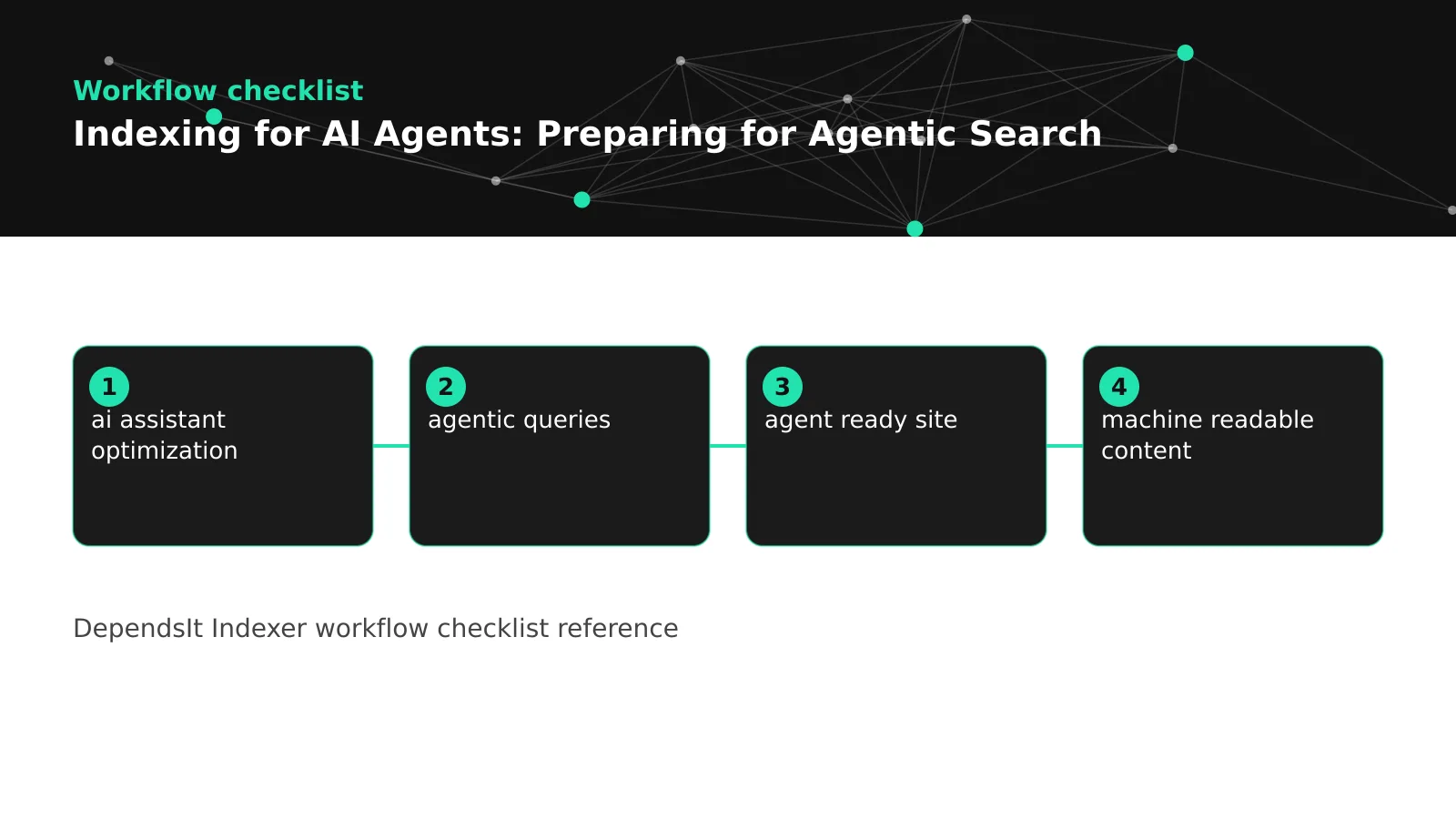 <!-- IMAGE-PROMPT workflow-02: 1600px max, DependsIt brand mint #22E3B0 on charcoal #121212 or white, node-network line art, Clash Display style headings, General Sans clean labels, subject: agent readiness workflow from audit to structured rewrite to monitoring, flat vector, accessible, no em dash in rendered text -->
A practical checklist to prepare this quarter
Preparation works best as a short quarterly checklist with owners and dates. Pick ten money pages and run eligibility, readability, and action tests on each. Fix blocks, rewrite thin answers, add missing tables, and align feeds and sitemaps. Then run a fixed set of task prompts against two assistants and record whether your pages appear and whether facts match. Repeat monthly and track citation rate, correction rate, and referral sessions. Small steady cycles beat a one time audit that goes stale after one CMS update.
In practical terms, this relates directly to agentic search optimization. Site owners often treat each URL in isolation, but assistants and search engines evaluate patterns across templates, link graphs, and quality thresholds. Understanding the pattern saves time because one template fix can move hundreds of URLs at once. Export up to 1,000 sample URLs and add columns for template, word count, internal inlinks, canonical target, status code, and sitemap presence. That sheet reveals whether issues cluster on one template or spread across the site. Template clusters point to code or settings. Spread points to broader quality or linking weakness. Use that grouping before editing single pages.
For a practical checklist to prepare this quarter, Start with three checks that catch most issues. First, verify technical eligibility. Confirm the URL returns 200, allows crawling in robots.txt, has no noindex in meta or headers, and declares a clean absolute canonical. Use view source, dev tools network headers, and a header fetch. Second, verify discovery signals. Check which sitemaps list the URL, how many internal links point to it, and whether those links use descriptive anchors from relevant hubs. Pages with zero referring internal links rely solely on sitemaps, which weakens demand. Third, verify value signals. Compare title, headings, intro, and main content against cited competitors and document gaps with dates.
Key checks for this stage:
- Audit templates first because agentic search optimization issues rarely affect random singletons. One header, plugin, or filter rule often explains hundreds of rows.
- Compare rendered HTML to raw HTML. Script delayed content can make a page look thin to assistants even when browsers show full text.
- Review canonical chains. A canonical that points to a redirect, a 404, or a noindexed page confuses consolidation and delays indexing.
- Clean sitemap signals. List only canonical 200 URLs with accurate lastmod. Remove variants, redirects, and excluded pages that dilute attention.
- Strengthen internal context. Add specific links from indexed hubs with natural anchors. Avoid sitewide boilerplate links that carry little topical weight.
Apply fixes in priority order. Address eligibility blockers first because no content improvement can overcome a noindex or crawl block. Then fix canonical and duplicate clarity so systems know which URL should accumulate signals. Then improve content differentiation with steps, examples, data points, FAQs, and original observations that separate the page from near duplicates. Then improve internal linking so the page sits fewer clicks from the homepage and receives topical context. Finally, stabilize freshness and maintenance by updating dates only when content truly changes, fixing broken outbound links, compressing images, and keeping server response times steady.
| Check | What to confirm | Tool |
|---|---|---|
| Status code and robots | 200 response, allowed by robots, no noindex in meta or headers | View source, headers, live inspection |
| Canonical intent | Single absolute canonical to preferred 200 URL, matching sitemap | Crawl export, inspection |
| Discovery path | Sitemap inclusion plus at least one contextual internal link | Sitemap index, crawl inlinks |
| Uniqueness | Specific details that differ from site siblings and search competitors | Manual comparison, similarity check |
| Stability | Fast responses, no 5xx spikes, consistent rendering | Crawl stats, server logs |
Measurement closes the loop. Record baseline counts for indexed pages, cited prompts, referral sessions, and error rates. After changes, inspect live samples to confirm eligibility, check selected canonical where relevant, and confirm referring sitemap correctness. Test a fixed set of prompts rather than ad hoc queries. Watch crawl stats for increased fetching without server errors. Expect gradual movement across one to two crawl cycles. Keep a simple log with change date, template, action, sample URLs, and before and after counts.
To finish this stage, pick one cluster related to agentic search optimization, apply the checks above for a practical checklist to prepare this quarter, and document the result before expanding to the next cluster. Small batches reduce risk and make cause and effect visible.
FAQ
What is agentic search in simple terms?
Agentic search means an AI assistant reads several pages, compares facts, and completes steps toward a goal instead of only listing links. When ai agents search on a user's behalf, they break the request into agentic queries, fetch candidate pages, and keep the facts that survive comparison. It still depends on crawled pages, but it rewards clear structure, stable URLs, and machine readable facts. Think of it as classic indexing plus task completion, where pages that state answers directly get quoted and vague ones get skipped.
Do I need a new sitemap for AI agents?
No. Keep your existing XML sitemap clean and add RSS or product feeds where they fit. Agents reuse classic discovery signals, so accurate lastmod, fast fetching, and canonical 200 URLs matter more than a new file format. Treat ai agent discovery as an extension of crawl hygiene: if crawlers can fetch a fresh accurate list of canonical URLs quickly, agents inherit that freshness. Focus on accuracy before adding new endpoints, and validate feeds with the same monitoring you use for search consoles.
Should I allow all AI bots for agentic visibility?
Allow search and answer fetchers on public content you want cited, and decide separately about training crawlers based on your licensing view. Blocking everything removes you from answers, while allowing everything raises load and reuse questions. A documented allowlist reviewed quarterly is the balanced path. Because agent browsing sessions open several pages per task, keep response times low and rate limits generous for verified fetchers, and log which agents visit so access policy stays evidence based rather than guesswork. Revisit the allowlist after every major site release.
How is agentic SEO different from classic SEO?
Classic SEO ranks whole pages for queries, while agentic work retrieves short passages and acts on structured facts. That is why machine readable content wins twice: headings phrased as tasks, tables with defined criteria, and steps with preconditions do well in both, but they matter more when an agent must quote one paragraph and then take the next step. Write each section so it answers one question completely, label dates and units explicitly, and keep claims close to the evidence that supports them.
How long until agent readiness shows results?
Technical fixes often reflect in crawl logs within days, while citations and task success usually shift over several weeks as assistants refetch and retest pages. To optimize for ai agents steadily, ship the agent ready site basics first: fast server responses, clean canonicals, accurate feeds, and direct factual pages. Then track a fixed prompt set weekly and compare citation rate and fact accuracy rather than judging single anecdotes. Progress looks like fewer failed fetches first, then more citations, then better task completion.
What is the most common blocker for agents?
JavaScript hidden content, login walls on public information, slow pages, and vague answers buried under background text. A text only fetch test finds most of these in minutes. Fixing readability and directness usually lifts both human conversion and agent citation, which is the cheapest form of ai assistant optimization available: no new files, no new endpoints, just pages that say the answer plainly. Re-test after each template change, because one CMS update can reintroduce the same blockers across thousands of URLs.