IndexNow Best Practices for Large Sites

Indexnow best practices for large sites start from one constraint: engines grant fast crawling to hosts that send meaningful change notices, not to hosts that dump entire catalogs on repeat. IndexNow is an open protocol co-developed by Microsoft Bing and Yandex that lets sites notify Bing, Yandex, Naver, Seznam, and related supporters about added, updated, or deleted URLs. Large catalogs can use it well when prioritization, batching, pacing, and monitoring stay disciplined. This guide shows that operating model.
In this guide you will learn what to submit and skip, how to tier URLs by value, how to batch correctly, how to pace sends, and how to monitor without spam. It is written for SEO leads, developers, and content ops teams who run stores, marketplaces, publishers, or docs with thousands to millions of URLs. You will finish with tier definitions, batch rules, a monitoring rhythm, and a rollout checklist for large properties.
Key takeaways
- Large sites should ping changed canonicals in priority tiers, not entire catalogs on a loop.
- Batches up to 10000 need pacing, dedup, and backoff to stay inside per engine limits.
- Sitemaps carry inventory while IndexNow carries fresh changes, with canonical hygiene tying both.
- Weekly log and crawl reviews keep trust high and catch drift before launches stall.
- Why large sites need rules instead of bulk dumps
- What to submit and what to skip
- IndexNow Best Practices: Prioritization Tiers Engines Can Feel
- Batching up to 10000 correctly
- Pacing and per engine throttles
- Sitemaps plus IndexNow division of labor
- Canonical duplicates and parameter hygiene
- Automation from CMS and pipelines without storms
- Monitoring logs and crawl stats that prove value
- Spam lines you must not cross
- Rollout checklist for large catalogs
 <!-- IMAGE-PROMPT cover: 1200x630, DependsIt brand, deep charcoal #121212 background with vibrant mint #22E3B0 accent glow, thin node-network line art, Clash Display style bold heading space on left, General Sans clean labels, subject: large site IndexNow batching and priority workflow with network nodes, flat vector, high contrast, accessible, no photorealistic faces, no text smaller than 24px, no em dash in rendered text, export PNG then cwebp -q 82 to WEBP -->
Why large sites need rules instead of bulk dumps
Large sites generate constant URL churn from price edits, stock flags, faceted filters, and CMS re saves, which can look like millions of changes when only hundreds matter. Pinging everything trains engines to discount the feed and can trigger 429 throttles that delay the important pages. Rules separate meaningful content changes from template noise before anything reaches the queue. That filter is the core practice for scale.
Trust compounds at volume. A host that sends steady batches of changed canonicals earns quicker revisits for priority pages, while a host that blasts unchanged URLs earns slower treatment. Logs make the difference visible within weeks through time to crawl per tier. Write the rules down, assign an owner, and review exceptions weekly so growth does not quietly turn the feed into spam.
For teams tracking indexnow best practices, the practical link to why large sites need rules instead of bulk dumps is discovery speed, not a direct position change. When a changed URL is pinged cleanly, participating engines can fetch it sooner, which shortens the wait between publish and crawl. That earlier crawl still passes through the normal quality checks, so relevance, intent match, and page experience decide where the page can rank. Treat why large sites need rules instead of bulk dumps as a way to remove delay, then let content quality do the ranking work.
A common mistake around why large sites need rules instead of bulk dumps is sending noisy signals and then reading the noise as a ranking effect. Repeated pings for unchanged URLs, pings for non canonical variants, and pings for thin pages all waste attention and can slow trust. Deduplicate the queue, ping only canonical URLs that actually changed, and space batches so engines see a steady pattern. Clean sends make crawl logs easier to read and keep indexnow best practices work credible with stakeholders.
Stakeholder reporting on why large sites need rules instead of bulk dumps should separate three clocks: time to ping, time to crawl, and time to rank. The first two often improve with indexnow best practices because engines learn about changes sooner. The third depends on competition, query intent, and page quality, which pings cannot change. Report all three side by side so faster discovery is visible even when positions move slowly. That honest split builds trust in the indexing work.
When you review why large sites need rules instead of bulk dumps, keep sitemaps, internal links, canonical tags, and server health in the same picture. IndexNow complements these foundations, it does not replace them. A clean XML sitemap still lists the canonical set, internal links still pass context, and a stable server still lets crawlers finish the job. If any of those basics are broken, faster pings cannot fix the outcome. Fix structure first, then use indexnow best practices pings to surface fresh URLs sooner.
Checklist for this section:
- Filter template noise before enqueue.
- Protect sender trust with steady clean batches.
- Track time to crawl per tier.
- Review exceptions weekly.
Work through this part before moving on, and record the date and result so later reviews have facts to use.
What to submit and what to skip
Submit canonical URLs that gained, lost, or meaningfully changed indexable content, such as new products, updated guides, price or availability changes, and removed pages with delete intent. Skip faceted filter variants, session URLs, internal search pages, paginated duplicates beyond the canonical series, and non canonical language or currency variants. When in doubt, check the canonical tag that a crawler would see, not the link the CMS emitted.
Deletes deserve the same care as updates. Send delete notices only for URLs that return 404 or 410 or that carry a proper noindex after removal, and keep them out of sitemaps at the same time. Never ping URLs blocked by robots rules, since that asks engines to fetch what policy forbids. A short allow and deny list in config prevents most large site mistakes.
When you review what to submit and what to skip, keep sitemaps, internal links, canonical tags, and server health in the same picture. IndexNow complements these foundations, it does not replace them. A clean XML sitemap still lists the canonical set, internal links still pass context, and a stable server still lets crawlers finish the job. If any of those basics are broken, faster pings cannot fix the outcome. Fix structure first, then use indexnow best practices pings to surface fresh URLs sooner.
From an operations view, what to submit and what to skip needs a short checklist and one owner. Confirm the key file is reachable, confirm each batch used valid JSON with host and key fields, confirm response codes were logged, and confirm the crawl followed within the expected window. When a step fails, fix that step before resending the same URLs. This keeps indexnow best practices effort tied to verifiable actions instead of guesses about ranking moves.
When what to submit and what to skip involves Bing or Yandex, remember that each supporter applies its own crawl and quality filters after the ping. A 200 or 202 response means the submission was accepted, not that the URL will be indexed or ranked. Watch bot hits in server logs, then check index coverage in the relevant webmaster tools. Use that chain as proof that indexnow best practices did its part, and treat ranking separately as a content and relevance task.
Measurement for what to submit and what to skip works best with dates and server logs rather than rank snapshots alone. Record when each URL was published, when it was pinged, when the engine fetched it, and when it first appeared in results. Compare pinged URLs against a small control set that was left to natural discovery. This shows whether indexnow best practices shortened time to crawl without confusing crawl speed with ranking strength. Keep the test window to a few weeks so seasonal moves do not blur the read.
| Send | Skip |
|---|---|
| New canonical product or post | Facet and filter variants |
| Meaningful content update | Session and tracking URLs |
| Price or availability change | Internal search pages |
| True removals with 404 or 410 | Non canonical variants |
Checklist for this section:
- Ping changed canonicals with indexable updates.
- Skip facets, session IDs, and search pages.
- Handle deletes with matching status and sitemap removal.
- Never ping robots blocked URLs.
Work through this part before moving on, and record the date and result so later reviews have facts to use.
IndexNow Best Practices: Prioritization Tiers Engines Can Feel
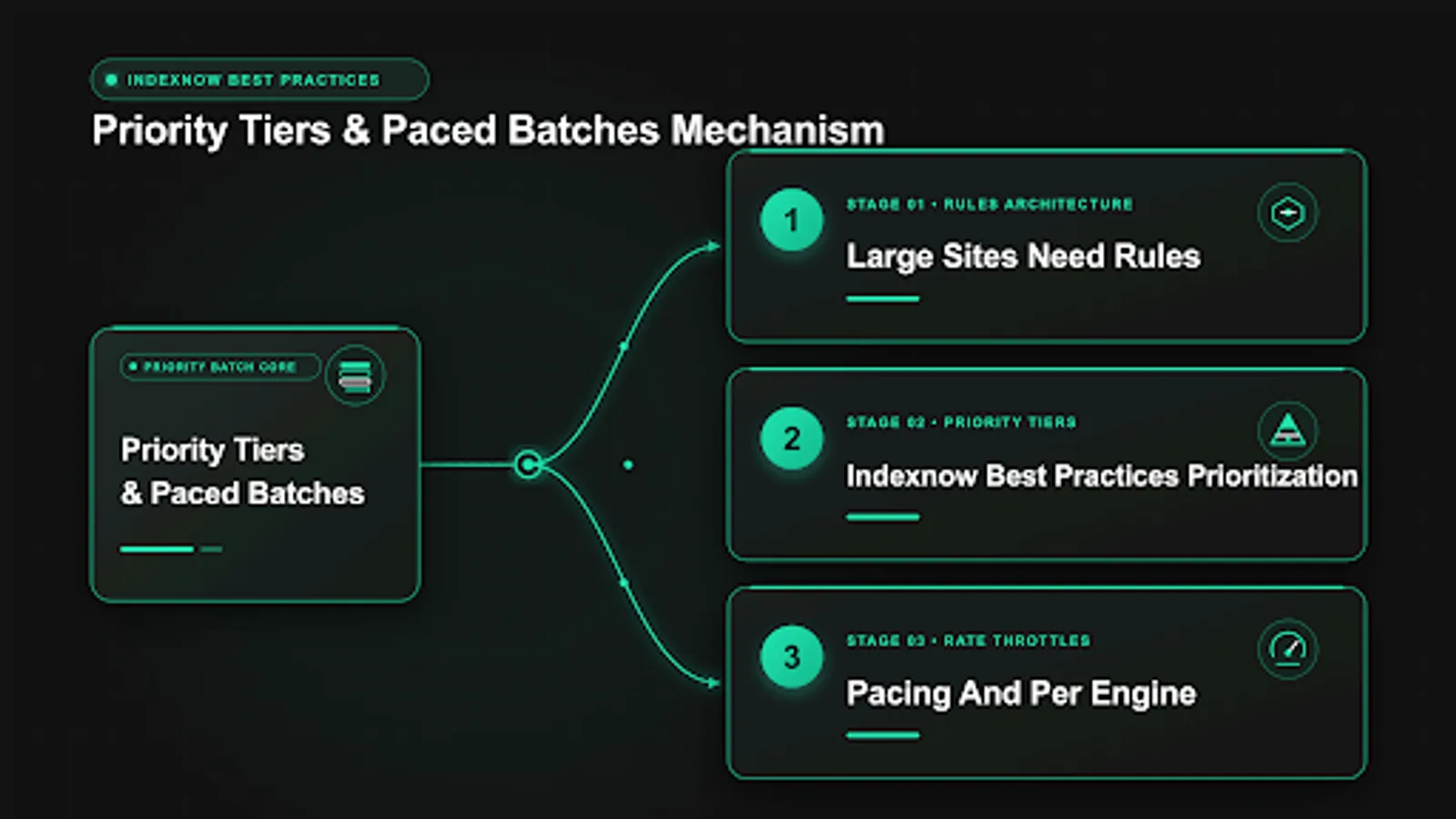
Tiers turn a flat catalog into an ordered feed. A clear indexnow strategy puts revenue and news shaped pages in tier one, supporting guides in tier two, and evergreen pages in tier three. Tier one holds revenue and news shaped pages that change often and must be recrawled fast, such as top products, breaking stories, and key categories. Tier two holds supporting content with weekly change rhythms, such as guides and subcategories. Tier three holds evergreen pages that rarely change and can rely on sitemaps plus natural recrawl. Each tier gets its own batch budget and latency target.
Sizes keep tiers honest. Cap tier one to a small share of the catalog so its batches stay fast even during launches. Review tier membership monthly against traffic and revenue data, and promote pages that earn attention while demoting stale ones. Log tier per URL so crawl reviews show whether priority pages actually get faster fetches than the long tail.
Measurement for prioritization tiers that engines can feel works best with dates and server logs rather than rank snapshots alone. Record when each URL was published, when it was pinged, when the engine fetched it, and when it first appeared in results. Compare pinged URLs against a small control set that was left to natural discovery. This shows whether indexnow best practices shortened time to crawl without confusing crawl speed with ranking strength. Keep the test window to a few weeks so seasonal moves do not blur the read.
For prioritization tiers that engines can feel, think in terms of crawl budget and priority rather than positions. Engines allocate fetch capacity based on site trust, change rate, and URL value. A focused set of changed canonical URLs earns faster revisits than a bulk dump of everything. Prioritize updated posts, changed product pages, and corrected canonicals, and leave evergreen URLs to sitemaps and natural recrawl. This is how indexnow best practices helps important pages get seen sooner without spamming.
For teams tracking indexnow best practices, the practical link to prioritization tiers that engines can feel is discovery speed, not a direct position change. When a changed URL is pinged cleanly, participating engines can fetch it sooner, which shortens the wait between publish and crawl. That earlier crawl still passes through the normal quality checks, so relevance, intent match, and page experience decide where the page can rank. Treat prioritization tiers that engines can feel as a way to remove delay, then let content quality do the ranking work.
A common mistake around prioritization tiers that engines can feel is sending noisy signals and then reading the noise as a ranking effect. Repeated pings for unchanged URLs, pings for non canonical variants, and pings for thin pages all waste attention and can slow trust. Deduplicate the queue, ping only canonical URLs that actually changed, and space batches so engines see a steady pattern. Clean sends make crawl logs easier to read and keep indexnow best practices work credible with stakeholders.
Checklist for this section:
- Tier one is small, fast, and revenue shaped.
- Tier two follows weekly rhythms.
- Tier three relies on sitemaps.
- Log tier per URL for review.
Tier thinking pairs well with batch rules in IndexNow bulk submissions and the 10000 URL rule before you size tier budgets.
Work through this part before moving on, and record the date and result so later reviews have facts to use.
 <!-- IMAGE-PROMPT diagram-01: 1600px max, DependsIt brand mint #22E3B0 on charcoal #121212, node-network line art, Clash Display style headings, General Sans clean labels, subject: priority tiers to paced IndexNow batches diagram, flat vector, accessible, high contrast, no em dash in rendered text -->
Batching up to 10000 correctly
IndexNow accepts up to 10000 URLs per request, but large sites should treat that ceiling as capacity rather than a target. Solid indexnow batching builds batches by tier and change window, validates every URL as absolute and canonical, and includes correct host and key fields. One clean batch of five hundred beats five messy batches of ten thousand, and practical indexnow tips always favor smaller validated sends. Split larger change sets into sequential batches with pauses between sends so engines absorb them calmly. One clean batch of five hundred beats five messy batches of ten thousand.
Validation before send saves most debugging time. Check scheme, host match, trailing slash policy, length limits, and duplicate entries inside the batch. Reject the whole batch to a review queue when validation fails rather than sending a partial set with guessed fixes. Record batch ID, URL count, tier mix, and response code for every send so later audits can trace any URL to its batch.
A common mistake around batching up to 10000 correctly is sending noisy signals and then reading the noise as a ranking effect. Repeated pings for unchanged URLs, pings for non canonical variants, and pings for thin pages all waste attention and can slow trust. Deduplicate the queue, ping only canonical URLs that actually changed, and space batches so engines see a steady pattern. Clean sends make crawl logs easier to read and keep indexnow best practices work credible with stakeholders.
Stakeholder reporting on batching up to 10000 correctly should separate three clocks: time to ping, time to crawl, and time to rank. The first two often improve with indexnow best practices because engines learn about changes sooner. The third depends on competition, query intent, and page quality, which pings cannot change. Report all three side by side so faster discovery is visible even when positions move slowly. That honest split builds trust in the indexing work.
When you review batching up to 10000 correctly, keep sitemaps, internal links, canonical tags, and server health in the same picture. IndexNow complements these foundations, it does not replace them. A clean XML sitemap still lists the canonical set, internal links still pass context, and a stable server still lets crawlers finish the job. If any of those basics are broken, faster pings cannot fix the outcome. Fix structure first, then use indexnow best practices pings to surface fresh URLs sooner.
From an operations view, batching up to 10000 correctly needs a short checklist and one owner. Confirm the key file is reachable, confirm each batch used valid JSON with host and key fields, confirm response codes were logged, and confirm the crawl followed within the expected window. When a step fails, fix that step before resending the same URLs. This keeps indexnow best practices effort tied to verifiable actions instead of guesses about ranking moves.
Checklist for this section:
- Batch by tier and time window.
- Validate canonical and host match.
- Split large sets with pauses.
- Record batch ID and codes.
{
  "host": "www.example.com",
  "key": "c7d2e5a14b8f4c9d9e1a23456789abcd",
  "keyLocation": "https://www.example.com/c7d2e5a14b8f4c9d9e1a23456789abcd.txt",
  "urlList": [
    "https://www.example.com/products/alpha/",
    "https://www.example.com/products/beta/"
  ]
}
Work through this part before moving on, and record the date and result so later reviews have facts to use.
Pacing and per engine throttles
Pacing protects both tracks when change volume spikes during migrations, sales, or deploys. Space batches with fixed delays plus small jitter, cap sends per minute and per day per engine, and slow down as soon as 429 appears. Queue priority pages first so throttles delay the long tail rather than tier one. Calm pacing signals operational maturity that engines reward with steadier crawl rates.
Alert thresholds turn pacing into teamwork. Warn ops at 70 percent of daily caps, pause non urgent tiers at 90 percent, and resume automatically in the next window with smaller batches. Document the wait and resume in logs so stakeholders see control rather than failure. After any throttle incident, review what caused the spike and tighten change detection before raising caps.
From an operations view, pacing and per engine throttles needs a short checklist and one owner. Confirm the key file is reachable, confirm each batch used valid JSON with host and key fields, confirm response codes were logged, and confirm the crawl followed within the expected window. When a step fails, fix that step before resending the same URLs. This keeps indexnow best practices effort tied to verifiable actions instead of guesses about ranking moves.
When pacing and per engine throttles involves Bing or Yandex, remember that each supporter applies its own crawl and quality filters after the ping. A 200 or 202 response means the submission was accepted, not that the URL will be indexed or ranked. Watch bot hits in server logs, then check index coverage in the relevant webmaster tools. Use that chain as proof that indexnow best practices did its part, and treat ranking separately as a content and relevance task.
Measurement for pacing and per engine throttles works best with dates and server logs rather than rank snapshots alone. Record when each URL was published, when it was pinged, when the engine fetched it, and when it first appeared in results. Compare pinged URLs against a small control set that was left to natural discovery. This shows whether indexnow best practices shortened time to crawl without confusing crawl speed with ranking strength. Keep the test window to a few weeks so seasonal moves do not blur the read.
For pacing and per engine throttles, think in terms of crawl budget and priority rather than positions. Engines allocate fetch capacity based on site trust, change rate, and URL value. A focused set of changed canonical URLs earns faster revisits than a bulk dump of everything. Prioritize updated posts, changed product pages, and corrected canonicals, and leave evergreen URLs to sitemaps and natural recrawl. This is how indexnow best practices helps important pages get seen sooner without spamming.
Checklist for this section:
- Space batches with delay plus jitter.
- Cap per minute and per day.
- Prioritize tier one during throttles.
- Warn at 70 percent, pause at 90 percent.
Work through this part before moving on, and record the date and result so later reviews have facts to use.
Sitemaps plus IndexNow division of labor
Sitemaps remain the inventory of record for large sites, listing the canonical set with last modified dates that engines can poll. IndexNow adds fast notice for the small slice that just changed, which keeps engines from reprocessing the whole inventory to find fresh pages. Keep sitemaps split by section with clean last modified values, and keep pings limited to URLs that also belong in those sitemaps unless they are true deletes. The two systems agree when both point at the same canonicals.
Hygiene decides whether the pair works. Remove 404s, redirects, and non canonicals from sitemaps promptly, and fix last modified logic so it reflects content edits rather than template deploys. Ping only after sitemaps and internal links reflect the same change, so the early fetch meets a consistent site. Monthly sitemap audits keep the base trustworthy enough for fast pings to matter.
For sitemaps plus indexnow division of labor, think in terms of crawl budget and priority rather than positions. Engines allocate fetch capacity based on site trust, change rate, and URL value. A focused set of changed canonical URLs earns faster revisits than a bulk dump of everything. Prioritize updated posts, changed product pages, and corrected canonicals, and leave evergreen URLs to sitemaps and natural recrawl. This is how indexnow best practices helps important pages get seen sooner without spamming.
For teams tracking indexnow best practices, the practical link to sitemaps plus indexnow division of labor is discovery speed, not a direct position change. When a changed URL is pinged cleanly, participating engines can fetch it sooner, which shortens the wait between publish and crawl. That earlier crawl still passes through the normal quality checks, so relevance, intent match, and page experience decide where the page can rank. Treat sitemaps plus indexnow division of labor as a way to remove delay, then let content quality do the ranking work.
A common mistake around sitemaps plus indexnow division of labor is sending noisy signals and then reading the noise as a ranking effect. Repeated pings for unchanged URLs, pings for non canonical variants, and pings for thin pages all waste attention and can slow trust. Deduplicate the queue, ping only canonical URLs that actually changed, and space batches so engines see a steady pattern. Clean sends make crawl logs easier to read and keep indexnow best practices work credible with stakeholders.
Stakeholder reporting on sitemaps plus indexnow division of labor should separate three clocks: time to ping, time to crawl, and time to rank. The first two often improve with indexnow best practices because engines learn about changes sooner. The third depends on competition, query intent, and page quality, which pings cannot change. Report all three side by side so faster discovery is visible even when positions move slowly. That honest split builds trust in the indexing work.
Checklist for this section:
- Sitemaps list inventory, pings flag fresh changes.
- Split sitemaps by section with real dates.
- Ping what sitemaps also show, except deletes.
- Audit sitemaps monthly.
Keep inventory thinking straight with IndexNow versus XML sitemaps so pings and sitemaps agree on canonicals.
Batch shapes follow IndexNow documentation for host, key, and URL list fields.
Work through this part before moving on, and record the date and result so later reviews have facts to use.
Canonical duplicates and parameter hygiene
Large catalogs multiply duplicates through facets, sorting, tracking, currency, and language variants, and every duplicate ping wastes trust. Standardize one canonical per content unit, self reference it consistently, and strip non canonical parameters before enqueue. Block crawl of facet and search spaces that should never be indexed, and keep hreflang or variant logic separate from ping logic. The queue should only ever see the canonical survivor of each duplicate set.
Verification belongs in the pipeline rather than in memory. Add an automated check that fetches the canonical tag for sampled URLs before batching, and quarantine mismatches for review. Track duplicate rate per batch as a quality metric alongside response codes. When duplicate rate rises after a template release, pause new tiers until the template fix ships.
Stakeholder reporting on canonical duplicates and parameter hygiene should separate three clocks: time to ping, time to crawl, and time to rank. The first two often improve with indexnow best practices because engines learn about changes sooner. The third depends on competition, query intent, and page quality, which pings cannot change. Report all three side by side so faster discovery is visible even when positions move slowly. That honest split builds trust in the indexing work.
When you review canonical duplicates and parameter hygiene, keep sitemaps, internal links, canonical tags, and server health in the same picture. IndexNow complements these foundations, it does not replace them. A clean XML sitemap still lists the canonical set, internal links still pass context, and a stable server still lets crawlers finish the job. If any of those basics are broken, faster pings cannot fix the outcome. Fix structure first, then use indexnow best practices pings to surface fresh URLs sooner.
From an operations view, canonical duplicates and parameter hygiene needs a short checklist and one owner. Confirm the key file is reachable, confirm each batch used valid JSON with host and key fields, confirm response codes were logged, and confirm the crawl followed within the expected window. When a step fails, fix that step before resending the same URLs. This keeps indexnow best practices effort tied to verifiable actions instead of guesses about ranking moves.
When canonical duplicates and parameter hygiene involves Bing or Yandex, remember that each supporter applies its own crawl and quality filters after the ping. A 200 or 202 response means the submission was accepted, not that the URL will be indexed or ranked. Watch bot hits in server logs, then check index coverage in the relevant webmaster tools. Use that chain as proof that indexnow best practices did its part, and treat ranking separately as a content and relevance task.
Checklist for this section:
- One canonical per content unit.
- Strip parameters before enqueue.
- Block facet and search spaces.
- Sample canonical tags automatically.
Work through this part before moving on, and record the date and result so later reviews have facts to use.
 <!-- IMAGE-PROMPT workflow-02: 1600px max, DependsIt brand mint #22E3B0 on charcoal #121212, node-network line art, Clash Display style headings, General Sans clean labels, subject: large site submission monitoring workflow, flat vector, accessible, high contrast, no em dash in rendered text -->
Automation from CMS and pipelines without storms
Automation should detect real content changes rather than every save event. Compare rendered content hashes or meaningful fields such as price, stock, title, and body text before enqueue, and ignore timestamp only saves. For static builds, diff sitemap outputs between deploys and enqueue only added, changed, or removed canonicals. Add a global rate limiter so a bad deploy cannot enqueue millions of rows in minutes.
Safety valves matter as much as triggers. Require a dry run mode that lists what would be sent, add a kill switch per tier, and cap new tier onboarding to small cohorts first. Review automation diffs weekly to catch drift such as new parameter pollution or template wide canonical breaks. Calm automation earns faster crawls, while hair trigger automation earns throttles.
When automation from cms and pipelines without storms involves Bing or Yandex, remember that each supporter applies its own crawl and quality filters after the ping. A 200 or 202 response means the submission was accepted, not that the URL will be indexed or ranked. Watch bot hits in server logs, then check index coverage in the relevant webmaster tools. Use that chain as proof that indexnow best practices did its part, and treat ranking separately as a content and relevance task.
Measurement for automation from cms and pipelines without storms works best with dates and server logs rather than rank snapshots alone. Record when each URL was published, when it was pinged, when the engine fetched it, and when it first appeared in results. Compare pinged URLs against a small control set that was left to natural discovery. This shows whether indexnow best practices shortened time to crawl without confusing crawl speed with ranking strength. Keep the test window to a few weeks so seasonal moves do not blur the read.
For automation from cms and pipelines without storms, think in terms of crawl budget and priority rather than positions. Engines allocate fetch capacity based on site trust, change rate, and URL value. A focused set of changed canonical URLs earns faster revisits than a bulk dump of everything. Prioritize updated posts, changed product pages, and corrected canonicals, and leave evergreen URLs to sitemaps and natural recrawl. This is how indexnow best practices helps important pages get seen sooner without spamming.
For teams tracking indexnow best practices, the practical link to automation from cms and pipelines without storms is discovery speed, not a direct position change. When a changed URL is pinged cleanly, participating engines can fetch it sooner, which shortens the wait between publish and crawl. That earlier crawl still passes through the normal quality checks, so relevance, intent match, and page experience decide where the page can rank. Treat automation from cms and pipelines without storms as a way to remove delay, then let content quality do the ranking work.
Checklist for this section:
- Hash content, not just save events.
- Diff sitemaps on static deploys.
- Add rate limits and kill switches.
- Dry run before new tiers.
Change detection patterns from automating IndexNow pings from CMS or deploy pipeline help prevent storm sends.
Work through this part before moving on, and record the date and result so later reviews have facts to use.
Monitoring logs and crawl stats that prove value
Monitoring ties sends to outcomes through three data sources: submission logs with codes, server logs with bot fetches, and webmaster coverage with index states. Join them by URL and tier to report time to ping, time to crawl, and time to index for priority sets versus control sets. Dashboards should show batch counts, accept rates, 429 waits, fetch lag, and coverage movement side by side. That chain replaces opinions with dates.
Cadence keeps large programs honest. Review tier one daily during launches and weekly otherwise, review tiers two and three weekly, and run a monthly coverage audit that ties crawl gains to business pages. When fetches lag after clean accepts, investigate quality blockers before raising send rates. Report crawl wins separately from ranking moves so indexing work keeps clear credit.
For teams tracking indexnow best practices, the practical link to monitoring logs and crawl stats that prove value is discovery speed, not a direct position change. When a changed URL is pinged cleanly, participating engines can fetch it sooner, which shortens the wait between publish and crawl. That earlier crawl still passes through the normal quality checks, so relevance, intent match, and page experience decide where the page can rank. Treat monitoring logs and crawl stats that prove value as a way to remove delay, then let content quality do the ranking work.
A common mistake around monitoring logs and crawl stats that prove value is sending noisy signals and then reading the noise as a ranking effect. Repeated pings for unchanged URLs, pings for non canonical variants, and pings for thin pages all waste attention and can slow trust. Deduplicate the queue, ping only canonical URLs that actually changed, and space batches so engines see a steady pattern. Clean sends make crawl logs easier to read and keep indexnow best practices work credible with stakeholders.
Stakeholder reporting on monitoring logs and crawl stats that prove value should separate three clocks: time to ping, time to crawl, and time to rank. The first two often improve with indexnow best practices because engines learn about changes sooner. The third depends on competition, query intent, and page quality, which pings cannot change. Report all three side by side so faster discovery is visible even when positions move slowly. That honest split builds trust in the indexing work.
When you review monitoring logs and crawl stats that prove value, keep sitemaps, internal links, canonical tags, and server health in the same picture. IndexNow complements these foundations, it does not replace them. A clean XML sitemap still lists the canonical set, internal links still pass context, and a stable server still lets crawlers finish the job. If any of those basics are broken, faster pings cannot fix the outcome. Fix structure first, then use indexnow best practices pings to surface fresh URLs sooner.
Checklist for this section:
- Join submit, fetch, and coverage by URL.
- Report three clocks per tier.
- Review tier one more often.
- Credit crawl and rank separately.
Work through this part before moving on, and record the date and result so later reviews have facts to use.
Spam lines you must not cross
Engines treat IndexNow as a hint channel that depends on sender discipline, so spam patterns carry real cost. Never ping unchanged URLs on a loop to simulate freshness, never ping generated doorway pages, and never ping purchased lists of URLs that the key domain does not serve. Keep adult, gambling, and regulated content within each engine policy rather than testing boundaries with volume. One spam incident can slow a whole domain for weeks.
Internal guardrails prevent accidents. Require tier approval for new URL classes, cap daily sends per section, and alert on sudden volume jumps before batches leave the queue. Quarantine vendor feeds with unstable canonicals until they pass validation for two weeks. Document the spam rules next to the queue code so every new engineer meets them on day one.
When you review spam lines you must not cross, keep sitemaps, internal links, canonical tags, and server health in the same picture. IndexNow complements these foundations, it does not replace them. A clean XML sitemap still lists the canonical set, internal links still pass context, and a stable server still lets crawlers finish the job. If any of those basics are broken, faster pings cannot fix the outcome. Fix structure first, then use indexnow best practices pings to surface fresh URLs sooner.
From an operations view, spam lines you must not cross needs a short checklist and one owner. Confirm the key file is reachable, confirm each batch used valid JSON with host and key fields, confirm response codes were logged, and confirm the crawl followed within the expected window. When a step fails, fix that step before resending the same URLs. This keeps indexnow best practices effort tied to verifiable actions instead of guesses about ranking moves.
When spam lines you must not cross involves Bing or Yandex, remember that each supporter applies its own crawl and quality filters after the ping. A 200 or 202 response means the submission was accepted, not that the URL will be indexed or ranked. Watch bot hits in server logs, then check index coverage in the relevant webmaster tools. Use that chain as proof that indexnow best practices did its part, and treat ranking separately as a content and relevance task.
Measurement for spam lines you must not cross works best with dates and server logs rather than rank snapshots alone. Record when each URL was published, when it was pinged, when the engine fetched it, and when it first appeared in results. Compare pinged URLs against a small control set that was left to natural discovery. This shows whether indexnow best practices shortened time to crawl without confusing crawl speed with ranking strength. Keep the test window to a few weeks so seasonal moves do not blur the read.
Checklist for this section:
- Never loop unchanged URLs.
- Never ping doors or outside lists, only served canonicals.
- Cap new classes until proven.
- Alert on volume jumps early.
Work through this part before moving on, and record the date and result so later reviews have facts to use.
Rollout checklist for large catalogs
Roll out in cohorts that prove each layer before adding volume. Start with tier one on one section, confirm clean accepts and faster fetches for two weeks, then add tier two and a second section. Add batch automation, monitoring dashboards, and throttle drills before touching tier three or historical backlogs. Each cohort should have entry criteria, success metrics, and a rollback note. Slow cohorts finish faster than one rushed launch.
Historical backlogs need special care because old URLs often carry stale canonicals and thin content. Audit samples before pinging history, fix templates first, and ping backlogs in small dated slices rather than all at once. Leave truly low value history to sitemaps and natural recrawl. A disciplined backlog pass improves coverage without flooding engines with low priority fetches.
Measurement for rollout checklist for large catalogs works best with dates and server logs rather than rank snapshots alone. Record when each URL was published, when it was pinged, when the engine fetched it, and when it first appeared in results. Compare pinged URLs against a small control set that was left to natural discovery. This shows whether indexnow best practices shortened time to crawl without confusing crawl speed with ranking strength. Keep the test window to a few weeks so seasonal moves do not blur the read.
For rollout checklist for large catalogs, think in terms of crawl budget and priority rather than positions. Engines allocate fetch capacity based on site trust, change rate, and URL value. A focused set of changed canonical URLs earns faster revisits than a bulk dump of everything. Prioritize updated posts, changed product pages, and corrected canonicals, and leave evergreen URLs to sitemaps and natural recrawl. This is how indexnow best practices helps important pages get seen sooner without spamming.
For teams tracking indexnow best practices, the practical link to rollout checklist for large catalogs is discovery speed, not a direct position change. When a changed URL is pinged cleanly, participating engines can fetch it sooner, which shortens the wait between publish and crawl. That earlier crawl still passes through the normal quality checks, so relevance, intent match, and page experience decide where the page can rank. Treat rollout checklist for large catalogs as a way to remove delay, then let content quality do the ranking work.
A common mistake around rollout checklist for large catalogs is sending noisy signals and then reading the noise as a ranking effect. Repeated pings for unchanged URLs, pings for non canonical variants, and pings for thin pages all waste attention and can slow trust. Deduplicate the queue, ping only canonical URLs that actually changed, and space batches so engines see a steady pattern. Clean sends make crawl logs easier to read and keep indexnow best practices work credible with stakeholders.
Checklist for this section:
- Cohort by tier and section.
- Require two clean weeks per cohort.
- Audit history before pinging it.
- Slice backlogs by date.
Work through this part before moving on, and record the date and result so later reviews have facts to use.
FAQ
Should we ping IndexNow millions URLs from a large catalog daily?
No. Only the changed canonical slice deserves daily sends, often hundreds to low thousands for active catalogs rather than indexnow millions urls blasted on repeat. Cap by tier, pace through the day with delays plus jitter, and let sitemaps carry stable pages. Watch 429 signals and time to crawl per tier, then tune caps to what engines absorb calmly. Flooding the queue with unchanged URLs wastes sender trust and delays the priority pages that actually earn revenue and repeat visits.
Should IndexNow for big sites cover the full backlog once?
Usually no. An indexnow for big sites rollout should audit samples first, fix templates and canonicals, then ping small dated slices of valuable history only if needed. Leave low value history to sitemaps and natural recrawl, since stale pages with thin content stall after fetch anyway. Flooding engines with stale URLs wastes trust and delays priority pages. Slice backlogs by date, validate each slice for canonical accuracy, and pause promptly when 429 or duplicate rates rise above baseline for review.
How do IndexNow priority URLs tiers stay accurate?
Review membership monthly against traffic, revenue, and change rate so indexnow priority urls reflect current business value. Promote pages that earn attention and demote stale ones, keep tier one small enough to stay fast, and log tier per URL for review. This steady indexnow strategy shows in crawl logs whether tier one actually gets faster fetches than the long tail. Monthly audits plus weekly exception reviews keep steady growth from quietly turning the feed into noise or unwanted spam signals.
What IndexNow batching mistakes cause most 429 responses?
Spikes from migrations, sales, or bad deploy diffs cause most throttles, plus loops that resend unchanged URLs without dedup. Careful indexnow batching spaces batches with delay plus jitter, caps per minute and day, prioritizes tier one during throttles, and slows on the first 429 with backoff. Fix change detection after each incident before raising caps. Document waits and resumes carefully in logs so stakeholders see control rather than failure, and review what caused each spike with owners and clear timelines.
Do sitemaps still matter in an IndexNow strategy that follows IndexNow guidelines?
More than ever. Sitemaps carry the canonical inventory that makes pings interpretable, with section splits and real last modified dates that follow proven indexnow guidelines. Keep them clean of 404s, redirects, and non canonicals, and fix last modified logic so it reflects content edits rather than template deploys. A sound indexnow strategy pings only what sitemaps also show, except true deletes with matching 404 or 410 status. Monthly sitemap audits keep the base trustworthy enough for fast pings to matter every week.
Which IndexNow tips and IndexNow workflow tips shape IndexNow recommendations for an IndexNow large website report?
Report per tier time to ping, time to crawl, and time to index with control comparisons, then show batch counts, accept rates, waits, and coverage movement together. Those practical indexnow tips separate crawl clocks from rank clocks, while clear indexnow workflow tips keep tier one reviews daily during launches and weekly otherwise. Final indexnow recommendations should credit IndexNow for crawl gains and content work for ranking moves. For any indexnow large website, this per tier view proves value without overstating what pings decide.
Sources
- https://www.indexnow.org/documentation
- https://www.bing.com/webmasters/help