GitHub Actions: Auto-Index Pages on Every Deploy
Teams that deploy often face a quiet gap between publishing and discovery. You merge, the site builds, new pages go live, yet search engines learn about the change hours or days later. This guide shows how github actions indexing closes that gap by submitting changed URLs automatically on every deploy. It is written for developers and SEO owners who run static sites or headless builds with GitHub Actions. You will learn what deploy time submission can change, how IndexNow and Google signals fit together, how to detect changed URLs, store secrets safely, handle retries and logs, and measure faster discovery without spamming endpoints.
Key takeaways
- Automate IndexNow pings from GitHub Actions so every deploy notifies Bing, Yandex, Naver and Seznam within minutes.
- Google does not support IndexNow, so pair deploy pings with sitemaps and Search Console workflows for Google coverage.
- Submit only changed canonical URLs in small batches, with logging, throttling and backoff on 429 responses.
- Store keys and tokens in Actions secrets, validate sitemaps in CI, and track discovery in Webmaster Tools to prove value.
- Why deploy time indexing matters for fast moving sites
- What github actions indexing can and cannot do
- Prerequisites before you wire deploys to indexing
- How IndexNow submission works from a deploy pipeline
- How Google Indexing API submission works from CI and its limits
- Building your first deploy workflow that pings IndexNow
- Detecting changed URLs between commits for precise pings
- Secrets, permissions and key safety in Actions
- Logs, retries, backoff and failure handling
- Measuring faster discovery after deploy automation
- Keeping sitemaps, robots and canonicals healthy with CI
 <!-- IMAGE-PROMPT cover: 1200x630, DependsIt brand, deep charcoal #121212 background, vibrant mint #22E3B0 accent glow, thin node-network line art, Clash Display style bold heading space on left, General Sans clean labels, subject: GitHub Actions pipeline sending URLs to search engines on deploy, flat vector, high contrast, accessible, no photorealistic faces, no text smaller than 24px, no em dash in rendered text, export PNG then cwebp -q 82 to WEBP -->
Why deploy time indexing matters for fast moving sites
Sites that deploy several times per week often publish faster than crawlers revisit. A docs update, changelog entry, pricing change or new template can sit live but undiscovered while sitemaps wait for the next fetch and crawl queues work through older URLs. For content with a short useful life, such as release notes, event pages or security advisories, that delay directly reduces visibility during the window when readers search most. Deploy time submission addresses the gap at its source, because the pipeline knows the exact minute new URLs became live. Teams that auto index on deploy for production builds give participating engines a direct hint within minutes instead of waiting for the next sitemap poll.
The benefit is clearest for static and headless builds where deploys are atomic and frequent. An Astro, Next or Hugo build regenerates HTML, updates the sitemap and publishes to the edge in one run. Without a ping, Bing, Yandex, Naver and Seznam learn about the change only on their own schedule. With a short IndexNow batch tied to the deploy, those engines receive a direct hint within minutes. Google follows a separate path through sitemaps and Search Console, so deploy automation should cover both ecosystems rather than assuming one ping reaches all engines.
Deploy pipelines already know exactly what changed, which makes them a natural place to trigger discovery. The build log lists added, modified and removed pages, the sitemap reflects the new inventory, and the live URLs are ready to fetch. When that knowledge stays inside CI, search engines must rediscover the change by polling. When CI forwards a short list of changed canonical URLs to participating endpoints, discovery starts within minutes. The pattern works best when the list stays small, accurate and tied to real content edits rather than cosmetic rebuilds.
Checklist for this step:
- Deploys with content changes
- Deploys that only change CSS or config and need no submission
- Docs and changelog sites with time sensitive pages
- Marketing sites with frequent launches
- Large sites where crawl budget is constrained
| Item | What to do | Why it matters |
|---|---|---|
| Fresh pages | Include new canonical URLs in the deploy batch | They need discovery from zero |
| Updated pages | Include materially changed URLs once | Signals real change, not rebuild noise |
| Removed pages | Drop deleted URLs from sitemap and handle status | Prevents soft 404 and waste |
| Unchanged pages | Leave out of the batch | Protects signal quality |
Keep this step small and repeatable so every deploy produces the same clean signal, and record what you changed so the next section can build on verified output rather than assumptions.
What github actions indexing can and cannot do
GitHub Actions can run a post deploy job that collects changed URLs, validates them and sends a small IndexNow request with proper logging. Many GitHub Actions SEO setups start with this single job before adding sitemap refresh and cache purge steps. It can read the commit range, parse the sitemap, compare before and after file lists, and call public endpoints with timeouts and retries. It can also refresh sitemaps, purge caches and write structured logs that join deploys to discovery. For teams on static hosting, this single workflow replaces manual pinging and keeps every release consistent without extra dashboards.
It cannot force any engine to crawl or index a URL, and it cannot make Google process IndexNow, because Google does not support the protocol. It also cannot fix thin content, duplicate canonicals, blocked resources or slow pages that cause engines to accept a ping but skip indexing. Think of Actions as a reliable messenger rather than a ranking lever. When paired with accurate sitemaps, clean canonicals and useful content, the messenger shortens discovery time. When those basics are broken, automation only delivers bad news faster, so fix quality first and use CI to amplify good pages.
In practice this means treating indexing as a post deploy step with the same care as cache purge or sitemap refresh. The job runs after the deploy succeeds, reads the changed URL list, validates status and canonicals, then submits in a small batch with timeouts and logging. If the deploy fails, the job skips submission so broken or partial builds never generate noise. Teams that follow this order see cleaner logs, fewer 422 responses, and steadier trust from engines that track signal quality over time.
Checklist for this step:
- Collect changed URLs from commits or sitemap diffs
- Send IndexNow batches with key auth and logging
- Refresh sitemaps and purge CDN cache in order
- Record status codes and timings for review
- Skip submission when deploys fail or change nothing
| Item | What to do | Why it matters |
|---|---|---|
| Can do | Ping IndexNow on successful deploys | Speeds discovery on participating engines |
| Can do | Validate sitemap and robots in CI | Catches breakage before engines see it |
| Cannot do | Submit IndexNow to Google | Google uses separate mechanisms |
| Cannot do | Guarantee indexing | Quality and crawl decisions still apply |
Keep this step small and repeatable so every deploy produces the same clean signal, and record what you changed so the next section can build on verified output rather than assumptions.
 <!-- IMAGE-PROMPT diagram-01: 1600px max, DependsIt brand mint #22E3B0 on charcoal #121212, node-network line art, subject: Git commit to build to changed URL detector to IndexNow endpoint diagram, flat vector, accessible, Clash Display headings General Sans labels feel, no em dash -->
Prerequisites before you wire deploys to indexing
Before adding a workflow, confirm the site fundamentals that make automation worthwhile. The site must serve canonical https URLs with 200 status, self referencing canonical tags, accurate sitemaps with correct lastmod, and a robots file that allows the paths you plan to submit. The IndexNow key file must be hosted at the site root and return the exact key string with plain text content type. Without these pieces, CI pings return 400 or 422 errors and teach engines to distrust future signals.
On the repository side, you need a stable way to map files to URLs, plus Actions secrets for the IndexNow key and any API tokens. Astro, Next and Hugo projects usually have a clear content directory and a sitemap plugin that can be read in CI. Document the host you claim, the key value location, and which branches trigger submission. Many teams limit auto submission to production deploys from the default branch, while preview branches only validate without sending. That boundary keeps testing from polluting engine signals.
IndexNow fits this model because it is lightweight and key based. A single POST carries host, key, keyLocation and urlList, and engines answer with familiar status codes such as 200, 202, 400, 403, 422 and 429. There is no OAuth dance in the runner, only a stored key string and a public key text file at the site root. That simplicity keeps Actions minutes low and debugging straightforward. For background on the protocol, see the complete guide to IndexNow before wiring automation, then keep this article focused on the CI wiring itself.
Checklist for this step:
- Canonical https URLs with 200 status and content
- Sitemap index with accurate lastmod values
- Public IndexNow key file at site root
- Actions secrets for keys, never inline values
- Production only trigger for real submissions
| Item | What to do | Why it matters |
|---|---|---|
| Sitemap | Validate XML and lastmod in CI | Engines trust fresh accurate inventories |
| Key file | Fetch key URL and compare string | Auth fails fast without it |
| Robots | Confirm allowed paths | Blocked URLs waste pings |
| Secrets | Store key in Actions secrets | Keeps credentials out of logs |
Keep this step small and repeatable so every deploy produces the same clean signal, and record what you changed so the next section can build on verified output rather than assumptions.
How IndexNow submission works from a deploy pipeline
IndexNow submission from CI is a single HTTPS POST that carries host, key, keyLocation and urlList. The host is the bare domain without scheme, the key is the generated string, keyLocation is the full https URL to the key text file, and urlList holds up to 10,000 canonical URLs, though deploy batches should stay far smaller. Participating engines include Bing, Yandex, Naver, Seznam and others listed in the official docs. Google does not participate, so treat this as coverage for the IndexNow ecosystem plus separate Google work. For key setup, see how to generate and host your IndexNow key.
A minimal deploy batch often holds ten to fifty URLs that actually changed in the commit range. Send one GitHub Actions IndexNow batch per successful production deploy, then cap the batch to changed canonicals only. The workflow builds that list, filters to canonical https URLs on the claimed host, caps the size, then posts with a short timeout such as twenty seconds. A 200 or 202 response means accepted, 400 or 422 means malformed or invalid URLs, 403 often means key mismatch, and 429 means slow down and retry later. For protocol details, the IndexNow documentation defines the request shape and key hosting rules that CI must follow exactly.
Measurement closes the loop between deploy and discovery. Bing Webmaster Tools and Yandex Webmaster show submitted URLs, crawl activity and index trends that can be compared against deploy timestamps. Search Console covers Google separately, since Google does not consume IndexNow. By joining deploy logs with Webmaster data, teams can answer whether a given release was discovered in minutes, hours or days, and which URL types lag. That evidence guides batch size, priority rules and whether sitemap lastmod or internal linking needs work alongside pings.
Checklist for this step:
- Build urlList from changed files or sitemap diff
- Keep host, key and keyLocation consistent
- Cap batches to changed canonicals only
- Post with timeout and capture status code
- Log timestamps and response for audit
| Item | What to do | Why it matters |
|---|---|---|
| host | Bare domain like example.com | Must match keyLocation host |
| key | Random string stored as secret | Proves ownership |
| keyLocation | Full https URL to key text file | Must be fetchable |
| urlList | Changed canonical URLs | Small accurate lists win |
Keep this step small and repeatable so every deploy produces the same clean signal, and record what you changed so the next section can build on verified output rather than assumptions.
How Google Indexing API submission works from CI and its limits
The Google Indexing API uses a different auth model and scope than IndexNow. It expects OAuth2 with a service account that has Search Console ownership on the property, and it accepts URL_UPDATED and URL_DELETED notifications for JobPosting and BroadcastEvent pages only. The endpoint lives under indexing.googleapis.com and returns JSON with notification metadata. Many teams ask whether it can speed general blog or product indexing, and the honest answer is that off label use is undocumented, quota constrained and not a substitute for sitemaps, internal linking and quality.
From CI, the safe pattern is to reserve Indexing API calls for eligible job or livestream pages, keep volumes inside published quotas, and handle 403 and 429 with the same discipline as IndexNow. For broader Google coverage, rely on accurate sitemaps, Search Console URL Inspection for critical URLs, strong internal links and fast accessible pages. If your deploy includes both eligible and ineligible types, split the logic so IndexNow handles broad discovery for participating engines while Google specific steps handle Google. That separation keeps reporting honest and avoids risky bulk calls that trigger quota errors.
Reliability matters more than speed once automation runs daily. Engines accept timely hints but penalize noisy ones, so queueing, deduplication and backoff are not optional extras. A small file or cache that remembers recently submitted URLs prevents repeat pings for the same commit. A short sleep between batches and exponential backoff on 429 keeps the runner inside quotas. Structured logs with timestamps, status codes and request IDs make failures easy to trace without leaking secrets into plain text.
Checklist for this step:
- Use Indexing API only for JobPosting and BroadcastEvent URLs
- Keep service account with least privilege and rotation
- Respect quotas with queues and backoff
- Cover other Google URLs with sitemaps and inspection
- Log notification responses without leaking keys
| Item | What to do | Why it matters |
|---|---|---|
| Eligible | JobPosting and BroadcastEvent pages | Only documented scope |
| Auth | Service account plus Search Console owner | 403 without proper access |
| Quota | Small daily limits with 429 on excess | Queue and throttle |
| Other pages | Sitemap plus internal links | Correct path for general content |
Keep this step small and repeatable so every deploy produces the same clean signal, and record what you changed so the next section can build on verified output rather than assumptions.
Building your first deploy workflow that pings IndexNow
A first workflow should be deliberately small: trigger on push to the default branch, run after the build and deploy steps succeed, then index after build artifacts are live. Keep the CI indexing pipeline readable with named steps such as checkout, build, deploy, collect URLs, validate, submit IndexNow and record result. Start with a manual file list or sitemap parse before adding commit diff logic, so you can verify auth and response handling in isolation. Use a short timeout, capture the status code, and fail the step loudly on 400, 403 or repeated 422 so misconfiguration surfaces immediately rather than silently skipping.
Keep the YAML readable with named steps such as checkout, build, deploy, collect URLs, validate, submit IndexNow and record result. Store the IndexNow key in Actions secrets and pass it as an environment variable to the submit script. For context on automation patterns beyond CI, the guide to automating IndexNow pings from your CMS or deploy pipeline shows webhook and pipeline shapes that map well to Actions jobs. Once the minimal path returns 200 or 202 for a test URL, expand to diff based detection and add guards that skip submission when nothing material changed.
Security in CI deserves the same attention as speed. The GitHub workflow URL submit step reads the IndexNow key from Actions secrets as an environment variable at runtime and never echoes it. The key text file must be reachable at the claimed host, and host, key and keyLocation must agree in every request. Least privilege service accounts, short lived tokens where used, and masked logs keep the pipeline safe to run on every push without exposing credentials to forks or pull request builds.
Checklist for this step:
- Trigger only on production deploys from default branch
- Run submission after deploy success, never before
- Start with a fixed test URL, then expand to diffs
- Store key in secrets and mask logs
- Fail loudly on auth and validation errors
| Item | What to do | Why it matters |
|---|---|---|
| Trigger | Push to main plus workflow dispatch | Controlled and testable |
| Order | Build, deploy, then submit | Avoids pinging broken builds |
| Auth | Secrets to env, never inline | Safe for forks and PRs |
| Result | Log status and URL count | Auditable history |
Keep this step small and repeatable so every deploy produces the same clean signal, and record what you changed so the next section can build on verified output rather than assumptions.
Detecting changed URLs between commits for precise pings
Precise batches beat full sitemap dumps because engines learn which senders signal real change. In Actions, the commit range is available as before and after SHAs, and a simple file diff reveals added or modified content files. Map each content path to its public URL using your framework routing rules, then filter to canonical https URLs on the production host. Ignore drafts, future dated posts, non canonical variants and static assets. The result is often a handful of URLs per deploy, which is exactly the volume that earns fast recrawls.
For Astro and similar static builds, two reliable inputs are git diff names and sitemap comparison. Git diff is precise for content edits, while sitemap diff catches generated pages and lastmod shifts. Many teams combine both: take the diff list as primary, intersect with the fresh sitemap to confirm canonical form, and cap the batch at a few hundred URLs with priority for new and materially updated pages. Deduplicate against a small cache of recently submitted URLs so rapid redeploys do not resend the same list. That discipline keeps signal quality high even during busy release weeks.
Deploy pipelines already know exactly what changed, which makes them a natural place to trigger discovery. The build log lists added, modified and removed pages, the sitemap reflects the new inventory, and the live URLs are ready to fetch. When that knowledge stays inside CI, search engines must rediscover the change by polling. When CI forwards a short list of changed canonical URLs to participating endpoints, discovery starts within minutes. The pattern works best when the list stays small, accurate and tied to real content edits rather than cosmetic rebuilds.
Checklist for this step:
- Use before and after SHAs to list changed content files
- Map file paths to canonical public URLs
- Intersect with fresh sitemap for validation
- Deduplicate against recent submissions
- Cap batches and prioritize new or major updates
| Item | What to do | Why it matters |
|---|---|---|
| Git diff | Added and modified markdown or data | Precise change source |
| Sitemap | Fresh URLs plus lastmod | Confirms canonical form |
| Filter | Drop drafts and duplicates | Protects trust |
| Cache | Remember recent pings | Prevents resend loops |
Keep this step small and repeatable so every deploy produces the same clean signal, and record what you changed so the next section can build on verified output rather than assumptions.
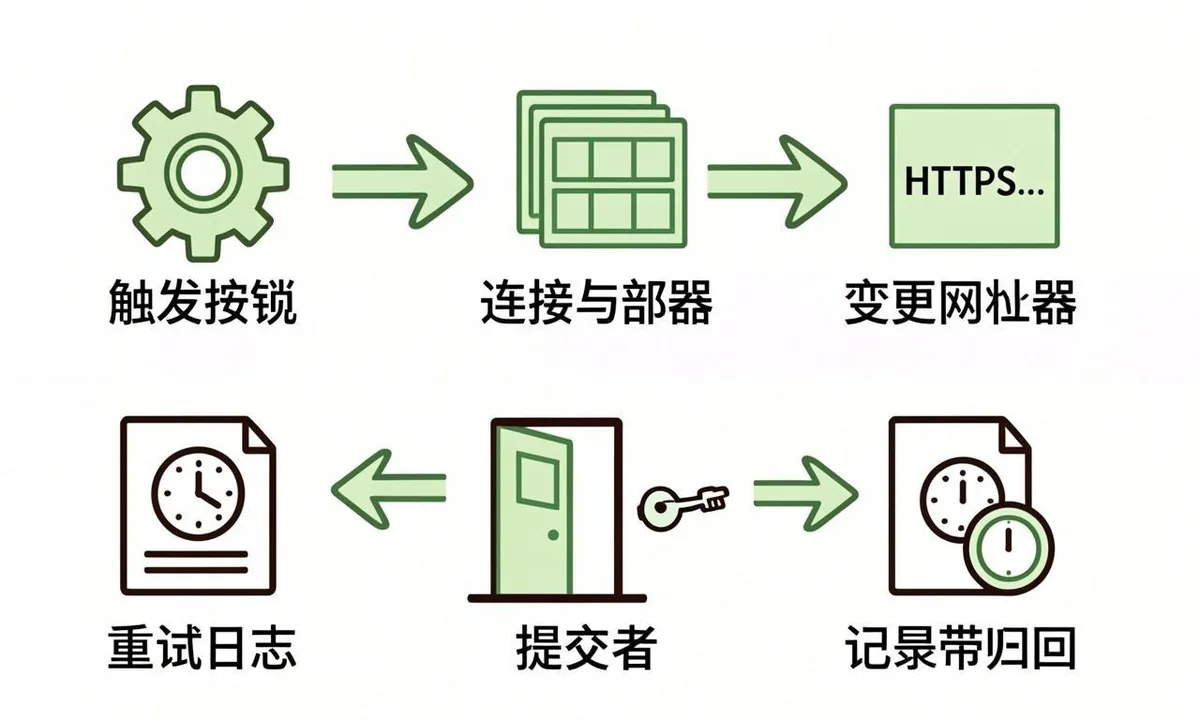 <!-- IMAGE-PROMPT workflow-02: 1600px max, DependsIt brand mint #22E3B0 on charcoal #121212, node-network line art, subject: Deploy validation to submission to log and retry workflow, flat vector, accessible, Clash Display headings General Sans labels feel, no em dash -->
Secrets, permissions and key safety in Actions
CI safety starts with secret hygiene. Store the IndexNow key, any API tokens and service account JSON in Actions secrets or environments with required reviewers for production. Never paste keys into YAML, logs or pull request comments. Grant the workflow minimal permissions, typically contents read plus whatever deploy target needs, and avoid passing secrets to jobs that run on fork pull requests. Masked values in logs still require care, so echo only counts, status codes and timings, never full payloads with keys. For related automation ideas, see automating IndexNow pings from your CMS or deploy pipeline.
Rotate keys on a schedule and document the rotation so future staff do not break submissions. For IndexNow, rotation means generating a new key string, updating the root text file and the Actions secret in the same change window, then verifying with a single test URL before resuming bulk batches. For service accounts used with Google endpoints, rotate JSON keys, restrict roles to least privilege and remove former members promptly. The complete setup guide for the Google Indexing API shows the service account and Search Console wiring that CI should mirror with locked down access.
In practice this means treating indexing as a post deploy step with the same care as cache purge or sitemap refresh. The job runs after the deploy succeeds, reads the changed URL list, validates status and canonicals, then submits in a small batch with timeouts and logging. If the deploy fails, the job skips submission so broken or partial builds never generate noise. Teams that follow this order see cleaner logs, fewer 422 responses, and steadier trust from engines that track signal quality over time.
Checklist for this step:
- Least privilege workflow permissions
- Secrets in Actions secrets, never in repo
- No secret access for fork PR builds
- Log counts and codes, never key values
- Documented rotation plan with test ping
| Item | What to do | Why it matters |
|---|---|---|
| IndexNow key | Secret plus root text file | Must match on every request |
| Service account | Least privilege JSON in secrets | Rotate and restrict |
| Permissions | Contents read by default | Expand only as needed |
| Logs | Masked and minimal | Auditable without leaks |
Keep this step small and repeatable so every deploy produces the same clean signal, and record what you changed so the next section can build on verified output rather than assumptions.
Logs, retries, backoff and failure handling
Treat every submission as a network call that can fail, and design retries accordingly. A deploy hook indexing step should distinguish retriable codes from fatal ones before any retry runs. Timeouts, 429 rate limits and occasional 5xx responses are normal at scale, while 400, 403 and repeated 422 point to config errors that retries will not fix. A sound runner distinguishes retriable from fatal codes, sleeps with exponential backoff and jitter, honors any Retry After hint, and stops after a small number of attempts with a clear error. Queue any unsent URLs for the next successful run rather than dropping them silently.
Structured logs make this work observable without leaking secrets. Record deploy SHA, timestamp, URL count, truncated host, status code and duration for each attempt. Store the full URL list as an artifact for a short retention window so failures can be replayed. Alert on repeated auth failures and sudden spikes in 422, since both signal mapping or key problems rather than transient limits. Over weeks, these logs reveal the right batch size and pacing for your host, which matters more than any generic quota advice copied from forums.
IndexNow fits this model because it is lightweight and key based. A single POST carries host, key, keyLocation and urlList, and engines answer with familiar status codes such as 200, 202, 400, 403, 422 and 429. There is no OAuth dance in the runner, only a stored key string and a public key text file at the site root. That simplicity keeps Actions minutes low and debugging straightforward. For background on the protocol, see the complete guide to IndexNow before wiring automation, then keep this article focused on the CI wiring itself.
Checklist for this step:
- Retry 429 and 5xx with backoff, never hammer
- Fail fast on 400, 403 and persistent 422
- Honor Retry After and add jitter
- Persist unsent URLs for next run
- Alert on auth failures and 422 spikes
| Item | What to do | Why it matters |
|---|---|---|
| 200 and 202 | Accepted, record and continue | Success path |
| 429 | Back off and retry with delay | Respects quotas |
| 400 and 422 | Fix payload and mapping | Retrying without fix wastes quota |
| 403 | Fix key and permissions | Auth must be corrected |
Keep this step small and repeatable so every deploy produces the same clean signal, and record what you changed so the next section can build on verified output rather than assumptions.
Measuring faster discovery after deploy automation
Measurement should tie deploys to engine behavior rather than vanity counts. Start by recording deploy time, submitted URLs and response codes in the workflow log. Then check Bing Webmaster Tools URL Submission and IndexNow insights plus Yandex Webmaster for crawl and index trends on those exact URLs. For Google, use Search Console URL Inspection and coverage reports on the same set, remembering that IndexNow does not reach Google. A simple join of deploy timestamp to first crawl and first index dates shows whether discovery moved from days to hours or minutes.
Run the comparison for at least three to four weeks across varied release sizes. This automated deploy indexing pattern earns trust when small typo fixes show quick recrawls and large refactors do not flood engines with unchanged URLs. Small typo fixes should show quick recrawls, new sections should show steady discovery without 429 growth, and large refactors should not flood engines with unchanged URLs. If pings are accepted but pages stay unindexed, shift focus to content depth, internal links, canonicals and speed rather than increasing ping volume. Teams that report separately for IndexNow engines and Google avoid confusion and can show stakeholders exactly where automation helped and where quality work is still needed.
Measurement closes the loop between deploy and discovery. Bing Webmaster Tools and Yandex Webmaster show submitted URLs, crawl activity and index trends that can be compared against deploy timestamps. Search Console covers Google separately, since Google does not consume IndexNow. By joining deploy logs with Webmaster data, teams can answer whether a given release was discovered in minutes, hours or days, and which URL types lag. That evidence guides batch size, priority rules and whether sitemap lastmod or internal linking needs work alongside pings.
Checklist for this step:
- Join deploy SHA to crawl and index dates
- Track Bing and Yandex separately from Google
- Compare before automation baseline to after
- Watch 429 and 422 trends as health signals
- Report wins and gaps by URL type
| Item | What to do | Why it matters |
|---|---|---|
| Bing Tools | Submission plus crawl stats | Shows IndexNow effect |
| Yandex | Webmaster crawl and index | Confirms second ecosystem |
| Inspection plus coverage | Separate path, no IndexNow | |
| Logs | Deploy time plus status | Joins cause to effect |
Keep this step small and repeatable so every deploy produces the same clean signal, and record what you changed so the next section can build on verified output rather than assumptions.
Keeping sitemaps, robots and canonicals healthy with CI
Automation amplifies whatever sitemaps and canonicals declare, so validate them in the same workflow that sends pings. Parse the fresh sitemap XML in CI, confirm 200 status for listed URLs, verify lastmod reflects real edits, check that canonical tags are self referencing for indexable pages, and confirm robots allows the submitted paths. Fail the build on broken sitemap XML, widespread 404 or mismatched canonicals before any submission runs. That gate prevents CI from telling engines to fetch pages that are not ready.
For larger sites, also validate sitemap index structure, size limits and compression, and confirm that paginated or segmented sitemaps stay consistent after each build. Keep robots simple and explicit, avoid accidental broad disallows introduced during refactors, and ensure internal links point to canonical forms rather than variants with tracking params. When these checks pass, the IndexNow batch that follows carries URLs engines can actually index. For broader context on dual coverage, the two API workflow covering Google and IndexNow together explains how sitemap health supports both ecosystems at once.
Reliability matters more than speed once automation runs daily. Engines accept timely hints but penalize noisy ones, so queueing, deduplication and backoff are not optional extras. A small file or cache that remembers recently submitted URLs prevents repeat pings for the same commit. A short sleep between batches and exponential backoff on 429 keeps the runner inside quotas. Structured logs with timestamps, status codes and request IDs make failures easy to trace without leaking secrets into plain text.
Checklist for this step:
- Validate sitemap XML and lastmod on every build
- Confirm 200, canonical and robots for submitted URLs
- Fail fast on sitemap or canonical breakage
- Keep sitemap index within size and count limits
- Link internally to canonical forms only
| Item | What to do | Why it matters |
|---|---|---|
| Sitemap | XML valid plus fresh lastmod | Inventory engines trust |
| Canonical | Self referencing on indexable | Avoids duplicate waste |
| Robots | Allows submitted paths | Blocked pings are noise |
| Links | Canonical internal hrefs | Guides crawl efficiently |
Keep this step small and repeatable so every deploy produces the same clean signal, and record what you changed so the next section can build on verified output rather than assumptions.
FAQ
Will auto submission get every deploy indexed instantly?
No. Automation shortens discovery time but does not guarantee indexing. A 200 or 202 response means the hint was accepted, after which each engine still decides whether to crawl and whether the page merits indexing. Thin pages, duplicates, slow templates, blocked resources or weak internal links can keep accepted URLs out of the index. Use automation to deliver timely hints for quality pages, then fix content and linking for URLs that stay unindexed after accepted pings. Track accepted versus crawled versus indexed separately so reports stay honest.
Does GitHub Actions submission reach Google?
Not through IndexNow. Google does not support IndexNow, so Actions pings are processed by Bing, Yandex, Naver, Seznam and other participating engines only. For Google, keep sitemaps accurate with correct lastmod, use URL Inspection for a small set of critical URLs, strengthen internal links and keep pages fast and accessible. Many teams run both paths from the same workflow: IndexNow for broad discovery plus sitemap and inspection steps for Google. Report the two ecosystems separately to avoid overstating coverage.
How many URLs should a deploy submit?
As few as accurately changed. Most deploys need tens of URLs, not thousands. Include new canonical pages and materially updated pages once, exclude unchanged pages, drafts, non canonical variants and static assets, and deduplicate against recent submissions. IndexNow technically allows up to 10,000 URLs per POST, but practical deploy use should stay far below that with small batches spaced minutes apart. Small precise batches earn faster recrawls and fewer 429 responses than full sitemap dumps on every push.
Where do I store the IndexNow key for Actions?
Store the key string in Actions secrets and host the matching key text file at the site root. The workflow reads the secret as an environment variable at runtime and never echoes it. The host, key and keyLocation fields in each request must agree, and the keyLocation URL must return the exact key string as plain text. Test with one URL and confirm 200 or 202 before enabling automatic batches. Rotate by updating the root file and the secret together, then retest with a single ping before resuming normal volume.
What should I log without leaking secrets?
Log deploy SHA, timestamp, submitted URL count, host, status code and duration. Store the full URL list as a short lived artifact for replay, but redact key values from all output. Mask secrets in workflow logs, restrict secret access to production environments, and avoid passing secrets to fork pull request builds. Alert on repeated 403, which signals key or permission problems, and on 422 spikes, which signal mapping errors. Clean logs make it possible to join deploys to crawl activity without exposing credentials.
Should preview branches submit URLs?
No. Limit real submissions to production deploys from the default branch. Preview and pull request builds should validate URL mapping, sitemap XML and key reachability without sending. This boundary keeps test hosts and draft URLs out of engine signals and protects the production host reputation for accuracy. Use workflow dispatch with a test URL for manual verification, then enable automatic submission only on the production job that runs after a successful deploy to the live domain.
Should I index on release tags or on every push?
Prefer production deploys: index on release tags and default branch pushes that reach the live domain, and keep preview builds in validate only mode. This boundary keeps test URLs out of engine signals while every real release still notifies participants within minutes.
How does CI CD indexing differ from CMS webhooks?
CI CD indexing reacts to code and content shipped through the repository, while CMS webhooks react to editor publishes inside the CMS. Teams that ship both ways often run the two side by side with shared deduplication so the same canonical is never submitted twice in one window.